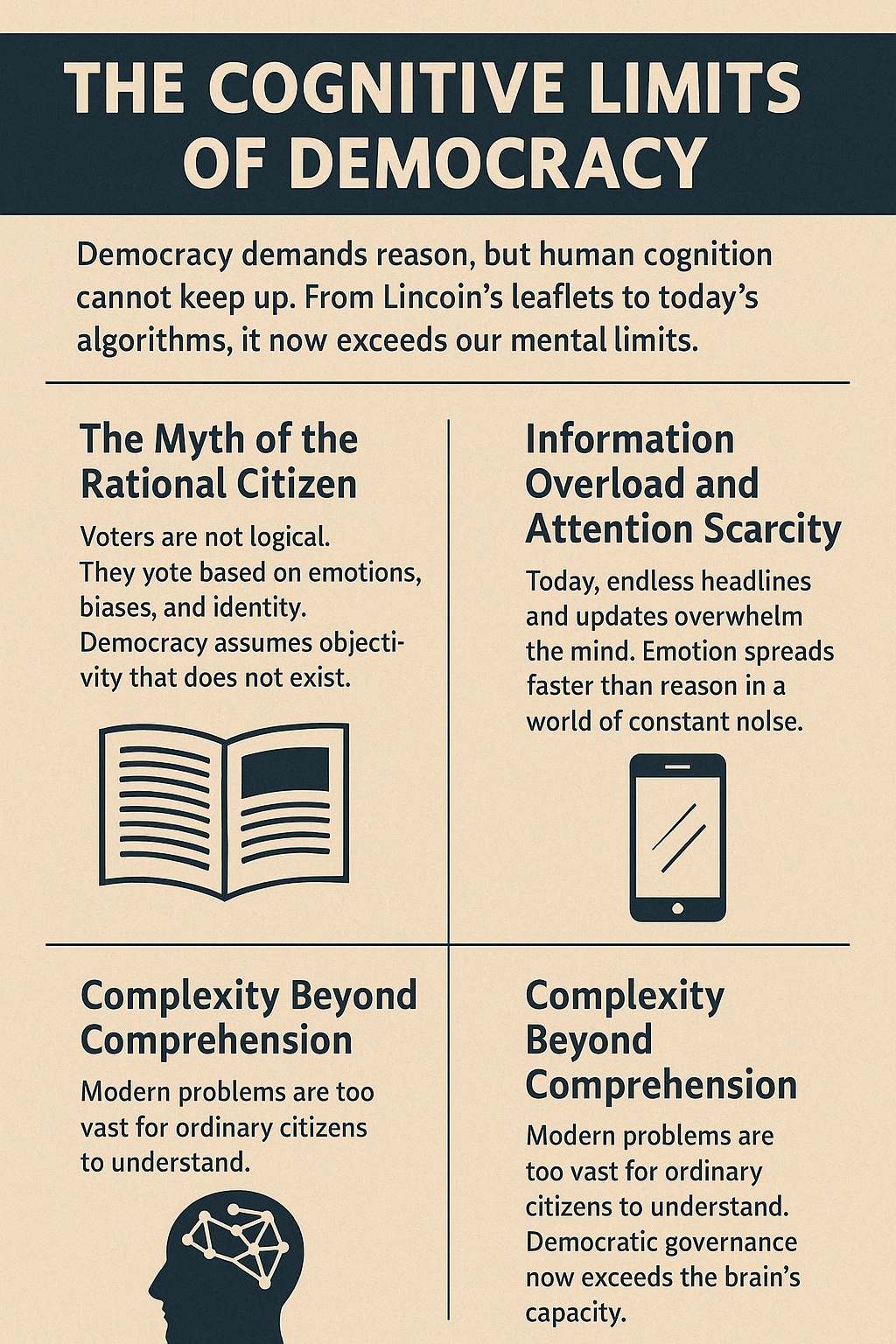
Democracy was built on a dream. It promised collective wisdom, shared power, and the rule of reason over passion. Yet what if that dream was never realistic? What if the very structure of democracy asks too much of the human brain? Modern civilization demands that millions of people make informed choices about problems too vast for anyone to grasp. Democracies do not fail because people are bad. They fail because people are limited. Understanding those limits may be the only way to save democracy from its own design.
The myth of the rational citizen
The entire democratic model rests on an assumption—that citizens are rational. Enlightenment philosophers imagined voters as reasoning beings, capable of judging evidence and pursuing truth. The system was meant for thinkers, not followers. But modern psychology shattered that myth. People do not vote rationally. They vote emotionally and justify it afterward. Biases rule the ballot box. Confirmation bias, group loyalty, and motivated reasoning shape every opinion.
Most citizens choose sides before they even understand the issue. They adopt arguments that make them feel safe within their tribe. Democracy assumes objectivity where none exists. The rational citizen never existed, yet the entire political order depends on that illusion.
When democracy was slower: The Lincoln era
In Abraham Lincoln’s time, democracy still lived within the brain’s natural boundaries. Political communication was slow, physical, and reflective. Voters received arguments through pamphlets, newspapers, and public speeches. They read long texts, not slogans. Campaigns relied on reasoning, not outrage. There was time to think, and thinking still mattered.
The pace of information suited human cognition. The average citizen could follow cause and consequence. Public debate was built on patience. Lincoln’s famous debates lasted hours. Listeners stood in silence, processing every word. The absence of noise protected democracy’s fragile logic.
Today, that silence is gone. Leaflets turned into feeds. Reflection turned into reaction. The transition from paper to pixels destroyed the gap between information and emotion. Democracy now moves faster than the mind can follow.
Evolutionary roots of irrationality
The brain never evolved for politics. It evolved for survival. For hundreds of thousands of years, humans lived in small groups where trust and belonging meant life or death. Emotion guided cooperation better than logic ever could. People learned to follow leaders, imitate behavior, and believe stories that united them. Truth was secondary to loyalty.
Democracy multiplies those instincts across millions of people. It turns tribal emotion into national identity. Political parties become modern tribes. Citizens defend their side even when it hurts them. Evolution made humans social, not rational. The democratic ideal of self-governance demands a kind of cognition nature never supplied.
Information overload and attention scarcity
The modern world drowns people in information. News arrives every second, opinions every millisecond. The brain cannot keep up. It evolved for stories told around a fire, not endless streams of global crises. Information now exceeds human attention, and democracy depends on attention.
Social media amplifies emotion and destroys depth. Outrage spreads faster than truth because it captures attention. The more emotional the content, the more viral it becomes. Algorithms feed anger because anger keeps people scrolling. The result is a population overstimulated yet uninformed.
In Lincoln’s age, citizens received information slowly enough to digest it. Today, they consume too much to understand anything. The democratic ideal of an informed public collapses under cognitive overload.
Complexity beyond comprehension
Modern governance deals with realities beyond human understanding. Global finance, artificial intelligence, ecological collapse—these are not problems the average voter can even describe, let alone solve. Even experts struggle to master them. Yet democracy requires every citizen to choose who manages them.
The public relies on simplified stories to navigate overwhelming complexity. Politicians provide those stories, stripped of nuance, polished for emotion. Voters choose narratives that confirm their worldview. Democracy demands comprehension in a world that defies it. The result is emotional politics—driven not by logic but by the limits of human cognition.
Emotional manipulation as political strategy
Politics today is psychological warfare. Campaigns no longer persuade; they trigger. Strategists study cognitive bias like a weapon. They design messages that bypass thought and hit the brainstem. Fear, resentment, identity—these emotions move voters faster than reason ever could.
Populists thrive in this environment because they simplify. Complexity repels the brain. Simplicity comforts it. Every successful demagogue knows that facts lose to feelings. The smarter the manipulation, the dumber the outcome. Democracy becomes a stage where emotion replaces argument.
The illusion of collective wisdom
Defenders of democracy often speak of the “wisdom of the crowd.” The idea is that many minds together reach better conclusions than one alone. In theory, that works—if each mind thinks independently and has access to good information. But in reality, most people imitate others. Independence collapses in a sea of conformity.
Online networks amplify imitation. Echo chambers reward belonging, not accuracy. Herding replaces deliberation. People no longer exchange ideas; they reinforce each other’s illusions. Collective wisdom becomes collective blindness. The crowd is not wise—it is predictable, emotional, and easily led.
The role of elites and experts
Every democracy hides a paradox: it depends on an elite. Experts, technocrats, and bureaucrats run what voters cannot understand. Economists steer monetary policy. Scientists shape health laws. Intelligence officials manage threats no one else can evaluate. Democracy survives only because someone smarter than the crowd does the real work.
Populists call this undemocratic, yet it is inevitable. Voters cannot oversee systems beyond comprehension. But the danger lies in unaccountable elites—those who use complexity as cover for corruption. Democracy cannot survive without expertise, yet it collapses when expertise becomes arrogance.
Education and its failure
Education was supposed to solve the problem. Enlightened citizens would think critically, analyze arguments, and resist manipulation. But schools failed that mission. They teach obedience, not reasoning. They produce workers, not thinkers.
Most citizens cannot distinguish science from pseudoscience, or fact from propaganda. Media literacy is low, and emotion dominates public opinion. A population trained to memorize but not analyze becomes the perfect audience for demagogues. Democracy without cognitive education becomes mob rule with ballots.
Technocracy and its dangers
As citizens lose understanding, technocracy quietly replaces democracy. Experts and algorithms govern what voters cannot comprehend. Efficiency replaces participation. Algorithms manage markets. Bureaucrats manage policy. Elected officials become figureheads.
At first, it seems rational. Yet technocracy fails for another reason—it lacks heart. People obey systems they do not feel part of. A purely rational government loses legitimacy because humans crave meaning, not calculation. The world risks becoming intelligent but soulless.
Can democracy evolve cognitively?
Democracy must adapt to the limits of the mind or perish under them. Artificial intelligence could serve as a cognitive prosthetic—helping citizens understand complex issues before voting. Structured deliberation could replace chaos. Civic platforms could slow information instead of speeding it up, forcing people to think before reacting.
Education must shift from obedience to reasoning. It must teach logic, skepticism, and emotional regulation. Without this shift, democracy will decay into endless emotional theater. The only way forward is cognitive evolution—tools and systems that expand human understanding instead of exploiting its weakness.
The neurological truth of politics
Democracy’s crisis is not moral. It is neurological. The brain that votes is the same brain that once hunted and gathered. It was not designed to manage economies, evaluate media, or foresee climate change. In Lincoln’s time, democracy still matched the mind’s speed. Now, the system races ahead of its operator.
The internet demands instant reaction; democracy needs reflection. The two are incompatible. Unless society redesigns how citizens think, deliberate, and decide, democracy will remain an illusion of choice governed by manipulation.
Conclusion
Democracy’s foundations rest on the human mind, yet that mind is reaching its limit. Civilization grows too complex, too fast, too abstract. Rational governance cannot survive on irrational cognition.
In the Lincoln era, rational leaflets once guided reasoned debate. Today, algorithms guide emotion. The democratic citizen has been replaced by the reactive user. Unless humanity slows down, re-educates itself, and rebuilds systems around the brain’s true capacity, democracy will keep degrading into spectacle.
The real enemy is not tyranny—it is the mind’s exhaustion. The question is not whether democracy will fall, but whether human cognition can rise high enough to sustain it.
Leave a Reply