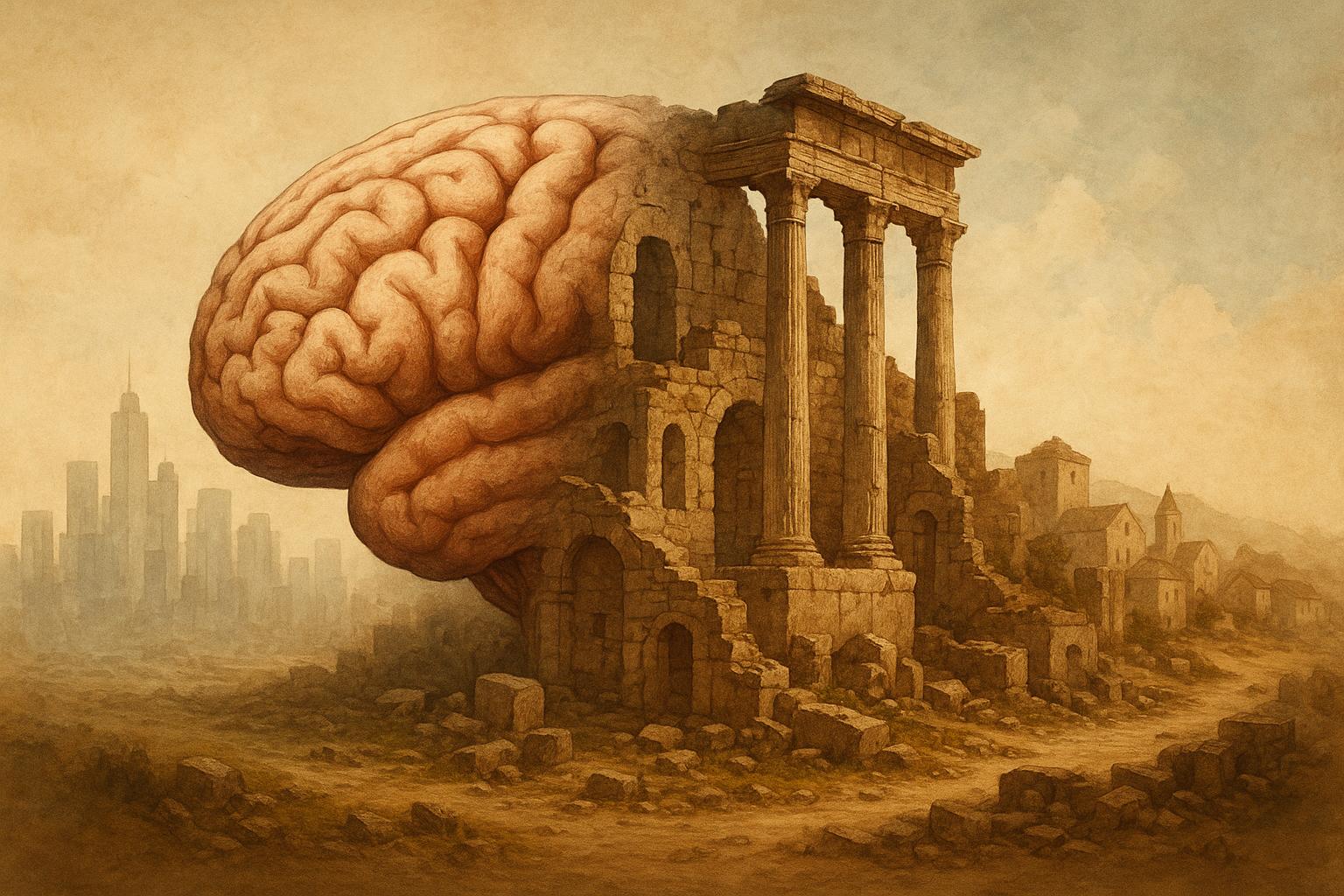
Humans treat history as something magical. They stare at ruins, listen to old songs, and feel emotion for people long dead; they cry over the paintings of wars fought centuries ago. They imagine that life back then was darker, slower, or somehow more meaningful. But that feeling is not based on reality. It is a product of evolution.
Four hundred years ago is nothing. Evolution works over tens of thousands of generations. People then saw the same sunlight, the same colors, and the same faces that we see now. Their world looked as vivid as ours. The only difference is our perception. The brain adds mystery where there was none. It makes the past glow with false emotion because it evolved to do so.
The ancestral mind remembers stories, not data
Long before history books, people relied on memory and stories. Remembering mattered. It helped track friends, enemies, and lessons that could save lives. The brain learned to store emotional stories more deeply than neutral facts. The stronger the emotion, the longer the memory lasted.
That instinct still shapes us. When we read about medieval kings or ancient wars, we feel something primal. Our neurons respond as if the story were about our own tribe. This bias was once adaptive—it strengthened loyalty and identity. Today, it is misplaced. We feel nostalgia for times we never lived. We confuse history with belonging.
The craving for continuity
Humans cannot stand randomness. The brain stitches events together until they make sense. This need for continuity once helped predict danger and understand cause and effect. But it also produced illusion. It made chaos look like destiny.
That same instinct now drives our obsession with historical meaning. We think the past holds “lessons.” We believe it reveals patterns, justice, or purpose. It rarely does. The world changed too fast. The brain did not. What once brought order now feeds myth.
Storytelling as tribal glue
In prehistoric tribes, storytelling was survival. It united people through shared memory. It created social order, identity, and meaning. Every myth carried a moral. Every ancestor became a symbol.
Modern nations inherited this instinct. They tell stories of founding fathers, martyrs, and glorious victories. It gives citizens a sense of unity. But it also fuels delusion. It hides crimes behind pride. It glorifies cruelty as courage. The same mechanism that once preserved tribes now manipulates entire populations.
The illusion of ancient wisdom
Respect for elders once meant survival. They remembered droughts, migrations, and patterns of nature. Over time, this turned into reverence for the past itself. Age began to equal truth.
But the instinct no longer serves us. The modern world changes faster than any ancestor could imagine. The old ways often fail. Still, many cling to tradition as if it contained eternal wisdom. This is why preservationists are redundant. They mistake memory for progress. They protect systems that no longer work, believing that what is old must be valuable. In reality, the world evolved beyond their nostalgia. Keeping ruins does not make a civilization wiser. It makes it afraid to move forward.
The beauty of distance
The past feels beautiful because pain fades in memory. The brain edits history. It erases the screams and leaves the music. It hides the dirt and highlights the gold.
People romanticize the Middle Ages, but they forget the stench, disease, and cruelty. They see harmony where there was hierarchy. They see meaning where there was misery. This is not love for truth. It is an illusion created by selective emotion.
The maladaptation of historical emotion
Feeling emotion for a world four centuries gone makes no evolutionary sense. The people we admire are dead. Their struggles are gone. Yet their images still trigger empathy, admiration, and sorrow. The brain cannot distinguish between the living and the symbolic. It reacts as if the past were still alive.
This instinct once helped remember ancestors. It now distracts from reality,it fuels nostalgia, nationalism, and sentimentalism. And it turns history into a stage play for emotional comfort. It keeps people dreaming instead of acting. Humanity is stuck in its own memory loop.
Worse, this emotional misfire shapes modern identity. People invest feelings into eras that would horrify them if they lived there. They romanticize suffering and glorify oppression. They mistake outdated systems for lost harmony. The more brutal the age, the deeper the fascination. The instinct that once built continuity now blocks adaptation. It turns curiosity into emotional dependence.
In a world facing artificial intelligence, biotechnology, and global instability, such instincts are dangerous. Emotional attachment to dead centuries prevents rational problem-solving. It replaces innovation with imitation. It glorifies decline as heritage. The more humanity worships the past, the less it can handle the future.
The preservation trap
Preservationists believe that saving the past saves identity. In truth, they often preserve illusions. They freeze cities, cultures, and even ideas that should evolve. And they call it heritage, but it is fear of change. They turn dynamic societies into museums.
Evolution rewards adaptation, not stagnation. What does not evolve dies. Preserving everything is as absurd as refusing to breathe to keep air pure. The past should be remembered, not worshipped. Progress needs room to grow, not walls built around memory.
Real knowledge Is in books, schools, lectures, or AI
Real knowledge does not live in nostalgia. It lives in systems built to question, verify, and transmit truth. Humanity once learned through myths and memories, but those tools became obsolete the moment writing appeared. Books replaced the tribal storyteller. Schools replaced the village elder. Lectures replaced oral myths. And now, artificial intelligence is replacing them all.
The human brain evolved to memorize stories, not to store information. It prefers emotion over accuracy. It remembers vivid lies better than dry facts. That is why history feels more “alive” than physics or logic. But feeling is not knowing. Real knowledge demands precision, not passion. It needs analysis, not attachment.
Books created the first system to store verified thought. They froze ideas in a permanent form that anyone could test or challenge. Schools then organized those ideas into structure. They trained the brain to think beyond instinct. Lectures added depth, forcing the mind to reason, not just remember. And now, AI continues this trajectory. It compresses centuries of learning into accessible form, demanding no tribe, no myth, no emotional bias.
This evolution of learning is the opposite of nostalgia. Where the mind wants comfort, knowledge gives discomfort. It challenges, corrects, and dismantles illusions. People who romanticize the past often reject that discomfort. They confuse emotion with wisdom. But wisdom without verification is myth.
AI, for all its flaws, represents the next step of human cognition. It does what memory never could—it integrates everything, from data to philosophy. And it does not care for heroes, myths, or nations. It only cares for coherence. Real knowledge now lives not in ruins or legends, but in books, schools, lectures, and machines that think faster than we can.
The past made us feel. Knowledge makes us understand.
Conclusion
The fascination with history is not a sign of wisdom. It is a fossil of the tribal brain. Evolution wired us to feel awe toward the past because memory once meant survival. But that same instinct now keeps us chained to illusion. We glorify eras that would have crushed us, and we mourn systems that should stay buried. The mind still behaves like a hunter-gatherer, but the world has turned digital, algorithmic, and unstable.
Emotionally, we still live in caves. We decorate the walls with memories and call it culture. Yet progress requires destroying some of those paintings. Humanity must stop mistaking the warmth of nostalgia for the light of truth. The past gives identity, but it also gives blindness. Every century we cling to becomes a weight on our ability to adapt.
Real intelligence is forward-looking. It builds, questions, and replaces. The brain that once remembered ancestors must now learn to understand equations, systems, and artificial minds. Evolution no longer rewards those who remember. It rewards those who learn faster than instincts can lie.
The future will not belong to preservationists. It will belong to those who can abandon their emotional attachment to history and see it for what it is—a long, unbroken rehearsal of mistakes. The real mystery is not behind us. It is ahead.
Leave a Reply