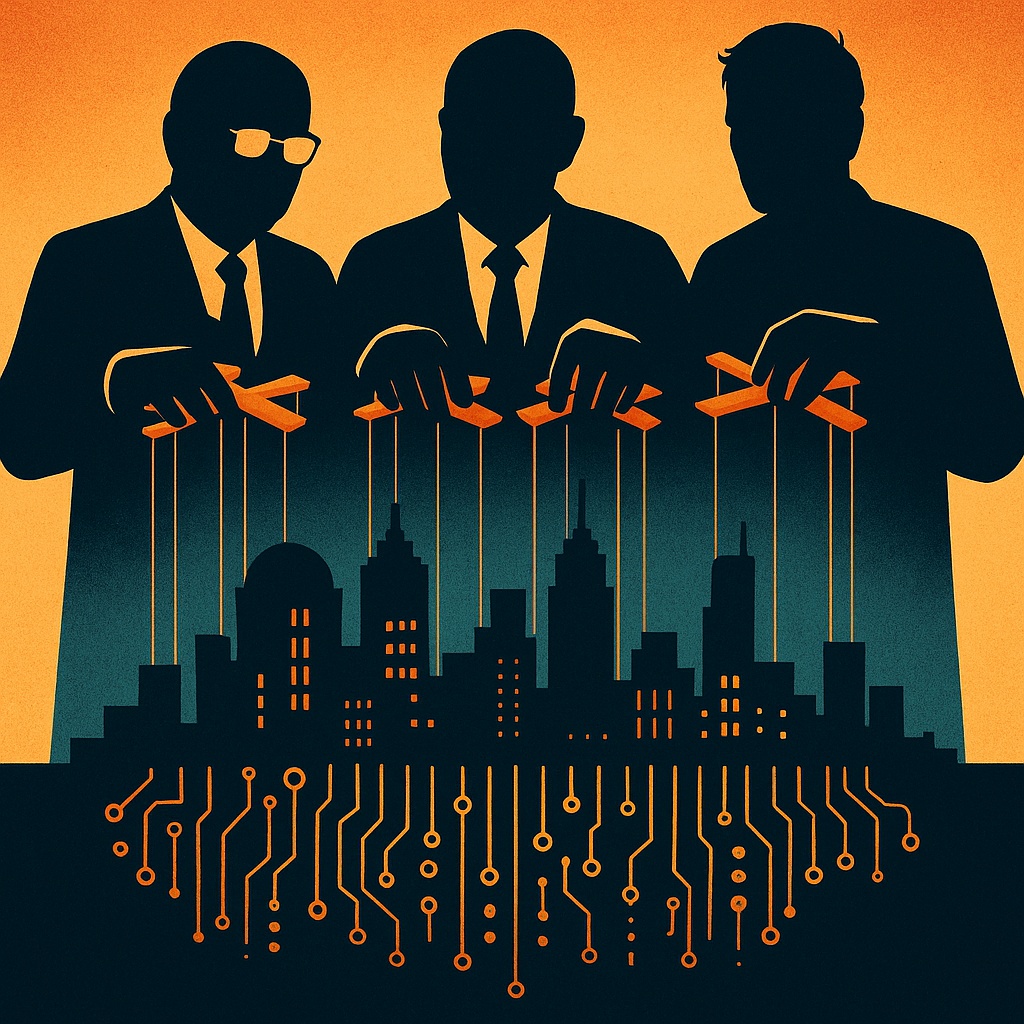
Modern society worships billionaires as saviors. They are portrayed as visionaries who will save the planet (Bill Gates), end disease, and colonize Mars (Elon Musk). Their faces appear on magazine covers as symbols of progress and genius. Yet their benevolence is a myth. Behind the spectacle lies a system of control — a fusion of capital, surveillance, and propaganda. The billionaires do not free humanity. They monitor it.
The illusion of independence
The story always begins the same. A young man in a garage builds a startup that changes the world. The narrative of self-made genius became the holy scripture of capitalism. But this legend conceals its architecture. Almost every “revolutionary” technology — the Internet, GPS, AI, or social media — began as a military or intelligence project. Startups were later built on this foundation. What looks like entrepreneurial brilliance often grows from state-funded research and hidden partnerships.
Either you have excellent connections or you are put in premade-startup.
The rise of Silicon Valley is no mystery. It was born from Cold War defense contracts and university laboratories financed by the Pentagon. Intelligence agencies never left the valley. They simply switched from missiles to microchips, from espionage to algorithms. Today’s “disruptors” inherited that legacy. They work with data instead of steel, but the purpose remains — control through information.
Startups as instruments of surveillance
Every startup promises convenience. A new app to connect, deliver, or predict. Yet behind this promise hides a new form of surveillance. Each service collects fragments of personal data — location, behavior, preferences, contacts — and stores them in global clouds. The product is not the app. The product is the user.
Most startups rely on data brokers, analytics platforms, or cloud providers tied to larger corporations. These companies share information with marketing networks, government agencies, and private intelligence contractors. Some partnerships are public. Others operate under the language of “security cooperation.” The boundary between private innovation and state surveillance has vanished.
Every device, every digital habit, becomes part of a behavioral map. Even small startups act as sensors feeding a planetary database. Some do it consciously, others simply because the infrastructure demands it. The result is the same — a transparent citizen in an opaque system.
When innovation serves the establishment
The dream of technology as liberation collapsed the moment data became currency. Real independence in the tech world is nearly impossible. Startups that grow too fast attract attention from major investors, defense-linked funds, or intelligence-connected accelerators. Without their blessing, global expansion is blocked. With it, the price is access.
Entrepreneurs who refuse cooperation face financial isolation or regulatory obstacles. Those who comply receive funding, protection, and publicity. The establishment decides who becomes the next genius. The myth of meritocracy hides the reality of selection.
The hierarchy of power
Above the visible billionaires stand older dynasties — Rockefellers, Morgans, and other financial families who shaped the global economy for a century. They control the foundations of power: banks, energy, and real estate. The new billionaires manage the surface layer — technology, media, and data. The structure resembles a pyramid. The old wealth provides capital; the new wealth provides obedience.
These families do not need visibility. Their influence flows through investment firms, think tanks, and charitable foundations. The billionaires we see are their public instruments — ambitious, talented, and hungry, but never independent.
Feuds as distraction
The media loves billionaire feuds. Musk mocks Gates. Zuckerberg fights Apple. Bezos competes with everyone. These battles look fierce but function as theater. They keep the public entertained and loyal to the system that produced them. In reality, all depend on the same banks, the same investors, and the same governments.
The rivalry is genuine, but its borders are fixed. They fight to dominate markets, not to change the structure of power itself. Their competition resembles gladiators fighting for the amusement of emperors. The noise hides the unity above them.
Philanthropy as disguise
When the rich give, the world applauds. Charity creates moral credit. Billionaires fund hospitals, schools, and climate programs. Yet philanthropy often serves as camouflage. Their foundations act as private ministries of influence. Donations buy access to governments, universities, and international organizations. The media frames them as moral leaders. In truth, they are architects of dependency.
Philanthropy replaces collective responsibility with private control. Public health, education, and climate policy become tools of private power. Benevolence becomes a brand, and generosity becomes strategy.
By having power abroad, they use it to influence US power structures.
The intelligence connection
The boundary between corporate data and national security is thin. Intelligence agencies depend on private technology firms for information analysis, cyber tools, and global monitoring. Contracts, grants, and “security collaborations” blur the line between democracy and digital surveillance.
Startups and major platforms feed this ecosystem. Their data streams provide behavioral insight that governments once dreamed of. The surveillance state no longer needs to spy. Citizens volunteer their information every day through devices, platforms, and apps.
When scandals erupt — from data leaks to election interference — the outrage fades quickly. No system changes. The partnership between intelligence and industry continues because both sides profit from it.
The psychology of worship
Humans evolved to follow dominant leaders. Billionaires exploit that instinct, projecting confidence and moral certainty. People mistake wealth for wisdom and power for virtue. This emotional reflex keeps the hierarchy stable.
Society admires those who seem untouchable. The richer they become, the more the public believes they must be right. It is a primitive reflex — obedience disguised as admiration. The media strengthens it with endless repetition, teaching that power equals success and success equals morality.
The price of disobedience
Those who challenge the system face destruction — through financial isolation, legal warfare, or character assassination. The game rewards loyalty and punishes rebellion. Even genuine ambition is tamed by the threat of ruin. The powerful may fight each other, but never the system itself.
Every era has examples. Whistleblowers vanish into exile or prison. Innovators who expose corruption lose funding. Politicians who question banks are removed. The system allows rivalry only within its limits. Beyond them lies silence.
When real innovation threatens power
True innovators who refuse compromise are erased. Their ideas are bought, buried, or rebranded under corporate names. The establishment ensures that progress never escapes its control. Humanity advances technologically but not politically.
Breakthroughs in energy, privacy, or communication appear briefly, then disappear. The public sees only what is permitted to survive. The same technology that could liberate humanity becomes another tool of control. The circle closes again.
The genuine hunger for domination
Their power-grabbing is not an illusion. It is authentic ambition. These billionaires truly want to rule — industries, governments, even human evolution itself. They compete fiercely for markets, resources, and ideological dominance. Yet they never question the system that allows such inequality. Their freedom ends where the old money begins.
They expand their control over space, information, and biology, claiming it is for humanity’s good. But their goals converge with those of the financiers and states behind them — a more centralized, predictable, and monitored world.
The myth of progress
Technology was supposed to free people from toil and ignorance. Instead, it became a new chain. Every innovation strengthens dependence on the same few corporations. The more data the system gathers, the less freedom remains. Progress became propaganda.
The digital empire now governs not through force but through convenience. People trade autonomy for access, privacy for comfort. The system no longer needs obedience — only participation.
The predators behind the mask
The old dynasties perfected the art of disguise. Rockefellers, Morgans, Rothschilds, and other financial families present themselves as pillars of stability, culture, and progress. Their names appear on museums, hospitals, and universities. They sponsor science, art, and humanitarian causes. Yet behind the facade of generosity lies the cold logic of empire.
Their wealth was born from monopolies, wars, and exploitation. Oil, steel, banking — every fortune grew from human suffering and political manipulation. Over time, they learned a crucial lesson: domination lasts longer when wrapped in morality. Instead of ruling with iron, they began ruling with reputation.
Their charitable foundations act as both shield and sword. They protect old money from taxation and public scrutiny while shaping global policy. Under banners of peace, health, and education, they fund the institutions that preserve their dominance. Every donation becomes an investment in stability — their stability.
They mastered the image of benevolence. The world sees them as wise patrons who care about humanity’s future. But these “good elements” are predators disguised as protectors. They speak of progress while maintaining control. They speak of equality while owning the system that creates inequality. Their kindness is strategic. Their morality is calculated.
The modern billionaires simply copy their method. What the Rockefellers were to oil, today’s tech moguls are to data. Both feed on dependence. Both hide greed behind virtue. The faces change, but the empire remains the same.
Conclusion
Billionaires and the dynasties behind them built an empire not of freedom but of illusion. They rule through startups, through data, and through a morality they purchase. Their power hides behind technology and charity — two faces of the same deception.
Startups are their laboratories. Philanthropy is their mask. Together they create a perfect loop: technology collects control, and charity cleans its image. Every billionaire today understands that domination must look like compassion. The age of open tyranny has ended; the age of moral branding has begun.
Their “philanthropy” is not generosity but investment. Each donation buys influence over governments, universities, and media. The same families that shape policy through capital shape public morality through foundations. They fund what they wish the world to believe. Health, education, climate — all become tools for steering civilization in directions profitable to them. They decide what is a crisis, what counts as progress, and which voices are amplified or erased.
The pattern repeats everywhere. A billionaire funds vaccines after his companies monopolize medical patents. Another finances climate initiatives while his supply chains poison rivers. A tech empire donates computers to schools while harvesting children’s data. Each act of giving erases the memory of taking. The world sees a savior, not a strategist.
Not so honest philanthropy
The system rewards this theater. Philanthropy reduces taxes, protects reputations, and secures access to decision-makers. It creates immunity — legal, social, and moral. A politician who receives a foundation grant does not criticize its founder. A journalist whose outlet depends on donations does not investigate them. Charity builds silence around power.
Startups play their part in the same illusion — whether premade or backed by founders with excellent connections. They are the research arm of the empire — agile, youthful, and idealistic. Yet almost every successful one ends in the same place: acquired by a giant corporation or tied to defense contracts. Their technology becomes another instrument of surveillance and control. What began as creativity ends as compliance.
Real innovators disappear because they cannot compete with capital disguised as kindness. When true reform threatens profit, philanthropy steps in to redirect it. It funds “solutions” that solve nothing but maintain stability. It turns rebellion into partnership, outrage into conference panels, and resistance into corporate social responsibility.
The benevolent billionaire became the modern priest. He promises redemption through money, not faith. He forgives himself with donations. The poor thank him for crumbs while he rewrites the laws that made them poor. The old dynasties once ruled with armies; now they rule with grants and press releases.
No wealth is moral
Humanity mistakes this for progress. People want to believe that wealth can be moral, that power can be good. But morality cannot be bought, and true generosity never asks for visibility. The empire of illusion thrives because its rulers have learned that the easiest way to dominate is to appear humane.
Until people stop confusing charity with justice, the cycle will not end. Startups will keep feeding data into systems of control, and foundations will keep polishing the image of those who built them. The world will keep bowing to men who call themselves philanthropists but behave like kings.
The empire of illusion will not fall through revolution. It will fall when humanity learns to see kindness not as a brand, but as a duty no fortune can replace.
Leave a Reply