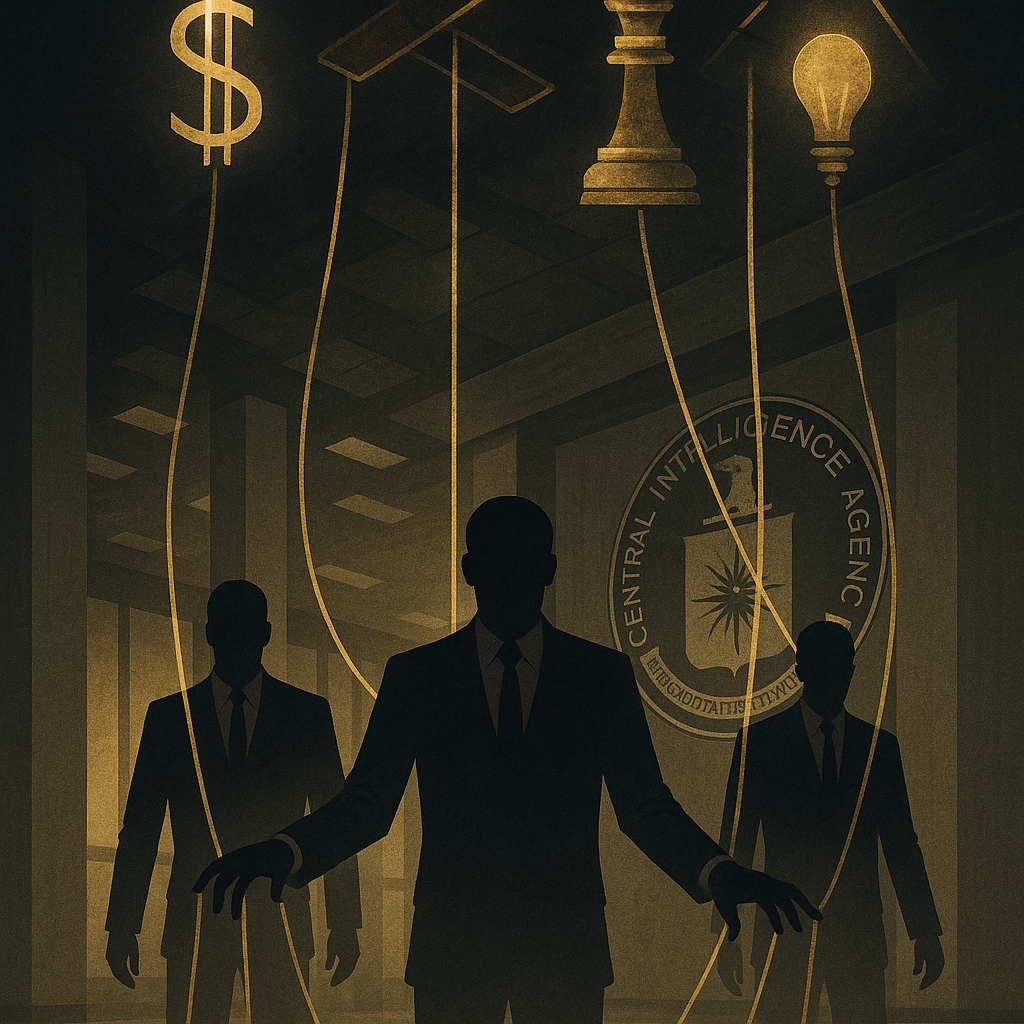
The CIA presents itself as an intelligence agency serving the United States. In reality, it has always served networks of influence — financial, ideological, and ethnic.
Among these, Jewish clientelism has quietly shaped alliances, recruitment, and foreign policy priorities.
Also, Anglosaxon clientelism has its say in the CIA.
The goal is not to accuse an ethnicity (Jewish or Anglosaxon), but to expose how loyalty networks override national interest.
From Ivy League to Langley
The early CIA was built on elite universities — Harvard, Yale, Columbia. These institutions already hosted tight Jewish academic and financial circles linked to Wall Street and law firms. Recruits shared not only education but social and ideological loyalties. There is continuity of these networks through mentorship, family connections, and donor influence.
The fusion of finance and intelligence
Intelligence operations depend on funding, access, and economic cover. Jewish banking families and business elites historically interacted with U.S. intelligence. For example, WWII finance-intelligence cooperation, Cold War business fronts, Israel–U.S. intelligence exchanges.
These links were not merely pragmatic but clientelistic — built on mutual protection and shared interest.
Banks rule the world, CIA is a shareholder
Since Big Banks and the super-rich families behind them have long ruled the world (though the U.S. role is now increasingly irrelevant), the CIA also has shares of banks and crucial companies.
Needless to say, it provides intelligence for the banks.
One late Czech oligarch with enormous power was warned: “Don’t go there. The CIA is here.” And, of course, he had relationships with the banks.
The revolving door
Many high-ranking officials later joined the private sector — defense contractors, risk consultancies, or investment firms with government contracts. Others returned to politics as advisers or think-tank fellows. This revolving door guaranteed continuity. The same individuals who shaped intelligence policy later profited from it.
Clientelism turned structural. Loyalty was rewarded, not questioned. Whistleblowers were punished. Those who adapted thrived. The price of dissent was silence or exile.
The Israeli connection
Since 1948, U.S. and Israeli intelligence agencies have maintained deep cooperation. This cooperation often blurred the line between alliance and dependency. Some CIA officials built careers by serving Israeli interests under the guise of “strategic partnership.” (Information sharing, double channels, and pro-Israel policy shaping.)
The Five Eyes share their harvested data with Israel without any reciprocity
Internal clientelism and promotion
Inside the CIA, career advancement often depends on belonging — not to religion, but to networks.
Some of these networks have distinct cultural or ideological cohesion. There are patterns of mutual promotion, ideological alignment, and selective loyalty. The criticism of Israel or Jewish elites within the agency became taboo.
Shaping foreign policy through intelligence
Clientelism distorts objectivity in intelligence assessments. The Middle East reports often reflect ideological bias rather than neutral analysis. The influence of lobbying and donor networks on intelligence outcomes — from Iraq to Iran. For many times, CIA conclusions conveniently aligned with pro-Israeli narratives.
Media protection and cultural silence
Media avoids this subject through self-censorship, ownership ties, and reputational fear. The role of Jewish elites in journalism and entertainment further shields the network from criticism. The taboo around “Jewish influence” makes rational investigation nearly impossible.
Why this matters
Clientelism, of any form, erodes democracy. The CIA should serve national interest, not hidden loyalties. When intelligence becomes ideological, truth disappears, and state policy becomes hostage to private alliances.
Conclusion
The CIA was never a neutral guardian of American security. It grew inside an environment shaped by loyalty networks that reached far beyond national borders. These networks — Jewish, Anglosaxon, financial, and ideological — turned intelligence into a tool of power rather than truth. What was built as a shield for democracy became a gatekeeper for clientelism.
The agency’s problem is not ethnicity. It is loyalty. Every network that puts private allegiance above public duty corrupts intelligence itself. When intelligence officers serve families, donors, or foreign allies instead of their own citizens, democracy becomes theater. Policies are written not by evidence but by influence.
If the CIA wants to reclaim integrity, it must end its silent feudalism. It must dismantle inner circles that trade information for protection. It must cut its umbilical cord to private banks, ideological lobbies, and unspoken loyalties. Only then can intelligence return to what it was meant to be — the pursuit of truth in service of the public, not the privilege of the few.
Leave a Reply