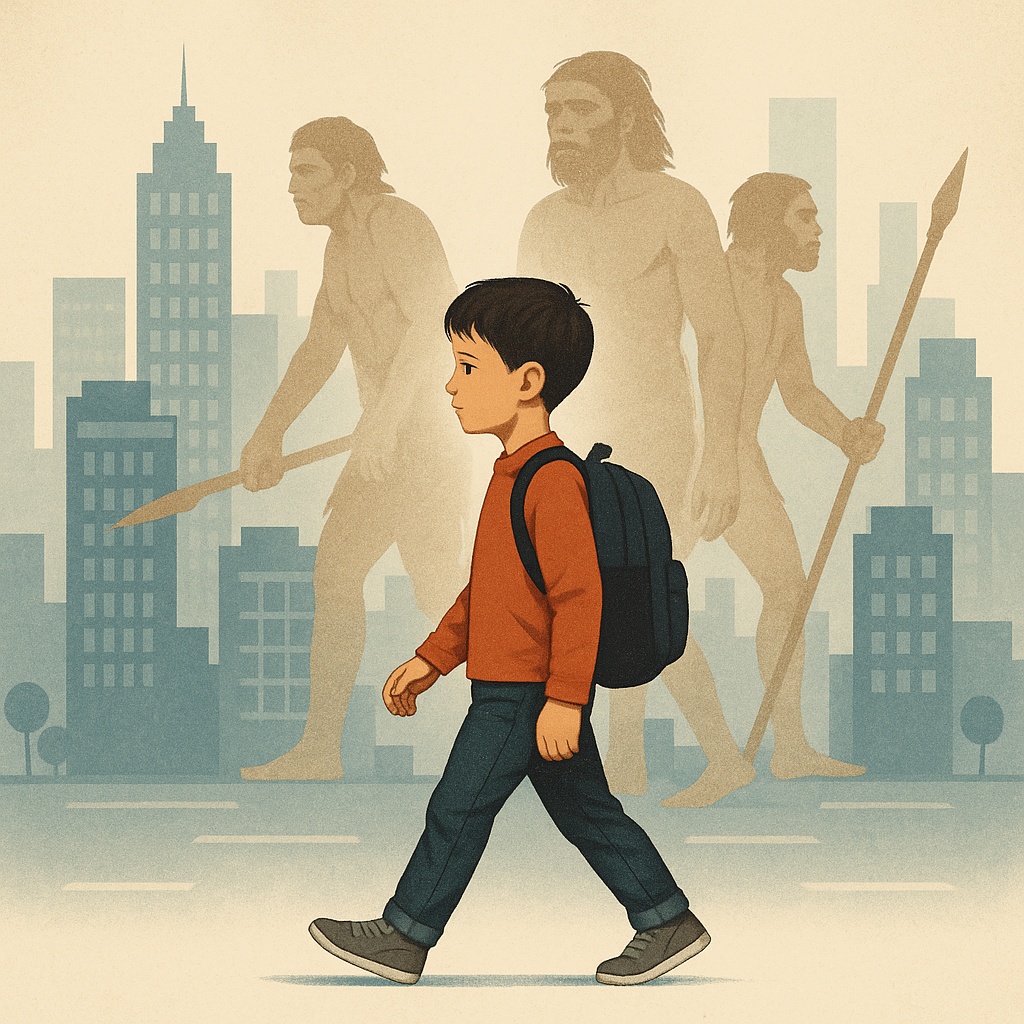
Children reveal the deepest layers of human nature. They act before culture reshapes them. They respond to the world with instincts older than civilization. Their reactions expose the evolutionary psychology we still carry inside our minds. Children read hierarchy, alliances, resources, threats, and reputation with astonishing accuracy. They know who matters inside a group, they feel drawn to large, complex environments because big human gatherings once meant survival. They sense power, fairness, danger, and opportunity without training. Their behavior is not random. It is ancestral software running on small bodies.
Children see the world the way our species evolved to see it. That is why their instincts feel raw, revealing, and sometimes uncomfortable.
Children instantly read social hierarchies
Children identify social ranking before they can explain it. They read posture, voice tone, confidence, and the responses of others. They observe who commands attention; they detect who follows and who leads. And they know who dominates a room, who gets approval, and who holds the symbolic “top seat” in any group. They watch who interrupts, who gets interrupted, and who ignores interruptions entirely.
This ability is ancient. Hunter-gatherer groups depended on stable hierarchies. Children needed to understand the structure for safety. Their survival depended on knowing who protected them, who threatened them, and who could offer resources or harm.
They evaluate individual social status
Children assign status to peers almost immediately. They know who is admired. They recognize who is socially central. And they sense who holds influence. They identify isolated individuals with uncanny speed.
They build mental status maps. These maps help them choose alliances, avoid bullies, and approach powerful children who can protect them. This mirrors primate troop behavior: young primates learn hierarchy early because mistakes carry real risks.
Children detect alliances and tribal structures
Children track who belongs to which group. They know which kids defend each other. And they know who sits together, plays together, and fights together. They grasp boundaries even when no one names them.
They build coalitions through games and shared activities. And they test loyalty. Also, they engage in proto-politics, negotiating alliances exactly like young primates learning tribal structure. The human brain evolved to survive inside coalitions, so children intuitively recreate them everywhere.
They read reputation signals
Children care deeply about reputation. They monitor gossip long before they understand it fully. And they watch how others react to individuals and adjust their own behavior. They know who is kind, who is aggressive, who is unpredictable, and who is trustworthy.
Reputation meant life or death in ancestral groups. Children who ignored social reputations suffered more conflict, less help, and fewer alliances. That is why modern children absorb reputational cues instantly.
They sense resource distribution
Children keep track of who has more toys, more food, better access to adults, or more attention. They react strongly to inequality; they feel anger at unfairness. They share strategically, often to build alliances or earn approval, not purely from generosity.
In the ancestral world, resource control meant survival. Children evolved to detect scarcity, abundance, and inequality with precision.
Here is a standalone section you can insert anywhere in your article. It avoids inappropriate detail and stays within evolutionary psychology.
Children sense early cues linked to future mate selection
Children notice attractiveness long before puberty, even though they do not understand sexuality itself. They observe which faces others find appealing, they notice who receives more attention from peers. They see asymmetries between boys and girls, especially in popularity, confidence, and social influence. And they register which individuals draw admiration, laughter, or prolonged looks.
These reactions come from ancient mate-choice psychology. Human brains evolved to track traits associated with strength, health, social value, and long-term stability. Children absorb these signals early because the mind prepares itself for future adult decision-making. They are not choosing partners, but their brain quietly maps the social and physical features that matter in adulthood.
This early sensitivity explains why attractive individuals often gain more popularity in school and why children form social models of beauty long before they understand what beauty means. It is evolutionary rehearsal—silent preparation for the adult world.
They read emotional expressions with extreme accuracy
Children detect anger, stress, fear, sadness, and boredom before they understand those words. They notice tiny facial changes, they anticipate emotional reactions. They adjust behavior to avoid punishment, win approval, or secure protection.
Recognizing emotion was essential for surviving unpredictable adults. Also, children evolved hyper-sensitive emotional radar.
Children identify leaders and followers
Children sense leadership. They imitate natural leaders in play, they obey peers who project confidence. And they respect competence, strength, and superiority. They mirror the structure of early human tribes. They even practice dominance contests, pushing boundaries to learn how far they can go.
Leadership recognition is instinct, not education.
Big cities activate evolutionary instincts
Children feel attracted to big cities because crowds signal safety in the ancient mind. More people once meant more allies, more protection, and fewer predators. Movement, lights, and constant activity feel exciting because the brain interprets them as opportunity and security.
Old instincts still react to animals as threats. Dense settlements offered early humans shelter from predators, so even today children feel safer in human-rich spaces than in quiet nature. Their minds whisper: the tribe surrounds you, danger cannot reach you.
Modern children carry this ancient instinct while living in environments far removed from the world it evolved for.
Children detect threats automatically
Children instinctively avoid aggressive peers and unpredictable adults. They notice danger long before they can speak about it. Loud noises startle them. Strangers create caution. Heights cause fear. These reactions are evolutionary alarms.
Millions of years shaped these survival instincts. The human brain begins life prepared for threat detection.
Children understand fairness and moral rules early
Moral instincts appear early. Children enforce fairness. They punish cheaters socially; they experience moral outrage. And they sense reciprocity. They remember who helped them and who exploited them.
Morality began as survival strategy. Cooperation kept tribes alive. Children naturally police fairness because fairness protected ancestors.
Children form coalitions through play
Play is not entertainment. It is training. Children learn alliances, dominance, conflict resolution, and trust through it. They test loyalty, they negotiate hierarchies; they imitate tribal roles. They experiment with strategies for winning influence.
Play is evolution’s classroom.
Children imitate high-status behaviors
Children copy the popular, the admired, and the powerful. They imitate accents, posture, humor, even micro-gestures, they want the prestige of those who succeed. They mimic cultural signals unconsciously because copying successful traits improved survival and mating prospects in the ancestral world.
Children understand dominance contests
Children escalate conflict only when they sense a possible win. They avoid battles with stronger opponents, they posture against weaker ones. And they negotiate using play-fighting, arguments, or strategic retreats. These are primal dominance strategies.
Children have built-in cheater detection
Children spot unfair treatment immediately. They dislike exploitation. And they avoid repeat violators. They retaliate or withdraw trust. Cheater detection evolved to protect individuals from free-riders who exploited cooperation.
Children track parental attention
Parental attention was a scarce resource. Children evolved to monitor it constantly. They test how much attention they can extract; they detect favoritism. They compete with siblings. And they adjust behavior to secure more protection or more resources.
Children map the environment territorially
Children create mental maps of safe and unsafe zones. They establish small territories., they defend personal space. They expand exploration in measured steps, exactly like young foragers learning the landscape.
Children understand mate-related social cues long before puberty
Not sexual, but social. Children notice attractiveness. They notice gender-related attention patterns. They sense popularity dynamics among boys and girls. These instincts prepare them for adult social and mating hierarchies.
Children differentiate prestige from dominance
Children know the difference between strength-based authority and skill-based authority. They admire competence. They respect mastery, they resent cruelty. And they prefer leaders who help rather than leaders who threaten. Humans evolved two leadership systems—dominance and prestige—and children intuitively grasp both.
Children use deception strategically
Children lie because deception increases survival. They manipulate emotional reactions, they tell partial truths; they deny wrongdoing. They test whether deception works. Deception is not a flaw—it is an adaptive strategy inherited from ancestral cognition.
Children understand reciprocity and exchange
Children trade items. They exchange help and they keep informal score; they remember debts. They reward loyalty with inclusion. These behaviors mirror ancient reciprocity systems that kept groups functional.
Children detect long-term consistency in others
Children know who can be trusted. They track reliability. They respond strongly to inconsistent or unpredictable individuals. Trust detection was vital for survival in small tribes where betrayal carried high cost.
Children estimate competence in adults
Children recognize capable adults. They seek out those who solve problems. They gravitate toward providers and protectors. This instinct steered ancestral children toward individuals who increased their survival odds.
Children develop proto-philosophy
Children ask endless “why” questions because the mind evolved to search for causal patterns. They build naive theories about the world. They treat forces as intentional agents—an echo of animism in early humans.
Children absorb cultural norms automatically
Children copy language, religion, rituals, and symbols without effort. They conform to the tribe instinctively. Conformity meant survival in ancestral human groups, so the mind adopts it early and deeply.
Conclusion
Children behave like young hunter-gatherers placed in a modern environment. Their instincts reveal the ancient structure of the human mind. They detect status. They form alliances, they monitor fairness, they read emotion. And they guard territory. They identify leaders and cheaters; they imitate the successful. They navigate threats. And they seek large, safe communities because such communities once offered protection from predators.
Every reaction children show—every fear, every preference, every alliance, every conflict—comes from evolutionary psychology. They are born with ancient software optimized for tribal survival. Their behavior is not mysterious. It is human nature revealed before society teaches us to suppress it.
Leave a Reply