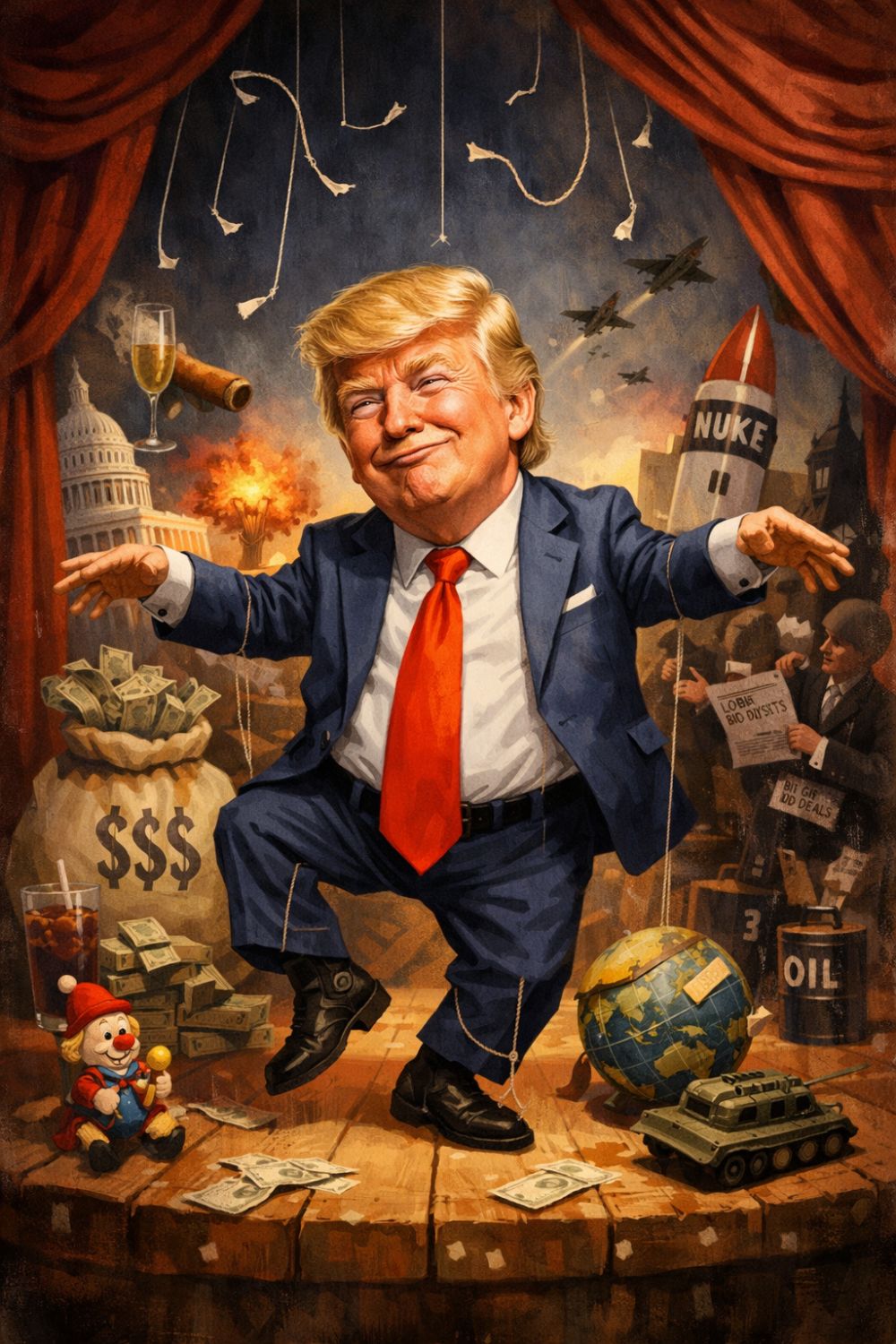
We can be proud we have a stable, mature, self-less leader of the world.
The praise sounds reassuring. It sounds calming. It sounds like adult supervision has finally arrived. In an age of overlapping wars, collapsing norms, and nuclear escalation, many people want to believe that someone sane sits at the top. Someone restrained, someone altruistic. Someone who always does what the world needs, never what his own image demands.
That belief does not emerge from evidence. It emerges from fear. Therefore, irony becomes useful. Not as humor. As diagnosis.
This article removes the comfort slowly. Step by step. With transitions. With structure. Without shouting.
The myth of the “leader of the world”
The phrase exists for a reason. The United States commands unmatched military reach. It controls the world’s reserve currency. It shapes global institutions. Consequently, its president often functions as an informal executive of the planet.
However, this role never came from a global mandate. No world election happened. No planetary consent followed. Instead, power accumulated historically, then hardened structurally. As a result, leadership appears natural rather than imposed.
This myth matters because it shifts responsibility. When one figure symbolizes order, the system behind him fades from view. Criticism then targets personality, not structure. Accountability shrinks. Meanwhile, consequences expand.
Leadership without consent, power without mandate
Democratic legitimacy stops at borders. Effects do not. A single executive decision can raise food prices across continents. A sanction can collapse hospitals thousands of kilometers away. A military signal can destabilize entire regions.
Yet no global electorate exists. No recall mechanism exists. No shared deliberation occurs. Therefore, moral hazard explodes. Leaders act locally. Costs distribute globally.
Because of this mismatch, restraint matters more than ambition. Personality matters more than ideology. Emotional regulation matters more than rhetoric. Unfortunately, modern politics rewards the opposite.
Psychological maturity under asymmetric power
Psychological maturity means impulse control. It means delayed gratification. It means the ability to absorb humiliation without retaliation. Crucially, it means separating personal identity from institutional role.
Under normal conditions, immaturity causes inconvenience. Under asymmetric power, it causes catastrophe. When one individual controls escalation ladders, personal insecurity becomes a global variable.
Institutions once buffered this risk. Over time, personalization eroded those buffers. Advisors adapted. Media normalized volatility. Eventually, systems bent around ego rather than containing it.
Self-lessness as narrative, not behavior
True self-lessness hides itself. Performative self-lessness announces itself. Modern leadership relies on the second form.
Leaders speak of sacrifice while demanding loyalty. They invoke morality while maximizing leverage. They frame interest as duty. Consequently, altruism becomes branding.
This shift matters because narratives replace metrics. Image replaces outcome. Suffering becomes acceptable when rhetorically justified. Once morality becomes a costume, any action can wear it.
Donald Trump and the personalization of global risk
Here, abstraction collapses. Foreign policy becomes autobiographical. Criticism feels like attack. Diplomacy turns transactional. Loyalty displaces expertise.
Instead of strategy, grievance drives reaction. Instead of restraint, spectacle escalates. Retaliation becomes emotional rather than calculated. Meanwhile, allies absorb the shockwaves.
This is not unique to one individual. However, extremes clarify structure. When power centralizes and personality dominates, global stability becomes contingent on mood.
Governance by spectacle
Modern governance competes with entertainment. Visibility replaces deliberation. Crisis becomes currency. Noise drowns scrutiny.
Under constant spectacle, complexity disappears. Decisions happen offstage. Announcements substitute for outcomes. The public receives theater instead of transparency.
As a result, accountability weakens. Attention fragments. Fatigue sets in. Eventually, volatility feels normal. That normalization becomes dangerous.
Cover-ups as structural necessity
Admission of error threatens legitimacy. Therefore, denial becomes rational. Blame shifts outward. Institutions protect the narrative. Media ecosystems adapt.
Over time, correction appears as betrayal. Whistleblowers become enemies. Reality becomes negotiable. Stability then rests on collective pretense.
This mechanism does not require conspiracy. It requires incentives. Once image equals authority, truth becomes liability.
A leader untouched by wealth, bloodlines, and lobbyists
Naturally, he serves no rich families. That idea would be offensive. Absurd, even. After all, he rose alone. Pure talent. Pure will. No dynasties nearby, no inherited networks whispering advice. No capital flows shaping priorities. Power simply recognized virtue and gathered around it out of respect.
This belief comforts many people. Therefore, it deserves careful irony.
First, consider the obvious. He does not represent money. Money represents him. Billionaires line up not because they expect returns, but because they admire character. Lobbyists do not lobby. They merely attend spontaneous meetings of shared values. Donations appear accidentally. Regulations loosen themselves out of gratitude.
Meanwhile, rich families remain politely absent. Old money does not call. New money does not invest. Financial dynasties certainly do not hedge bets. Banks do not anticipate policy. Asset managers do not price expectations. Everything happens organically. Magically.
Of course, this independence explains everything. Tax policies align with elite interests by coincidence. Deregulation follows moral clarity. Appointments reward merit alone. Revolving doors spin because of strong winds, not incentives.
Now enter the lobbyists. Thousands of them. Invisible. Powerless. Harmless. They roam corridors with empty briefcases, hoping someone asks them for directions. They draft nothing. And they influence nothing. They merely observe democracy at work.
When legislation mirrors their talking points, coincidence strikes again. When loopholes survive, chance intervenes; when enforcement weakens, it reflects trust in human goodness.
Importantly, this purity separates him from history. Past leaders served capital. Past empires obeyed oligarchs, past systems bent under wealth. This time differs. This time, power finally escaped structure.
No rich people
Even when surrounded by donors, executives, and heirs, he remains untouched. Their interests never shape his worldview, their fortunes never define priorities, Their losses never register. Their gains never motivate.
Critics claim capture. That word sounds ugly. Conspiratorial. Therefore, we reject it. Instead, we prefer harmony. Alignment. Mutual understanding. Shared destiny.
Yet alignment always flows one way. Wealth aligns policy. Policy never aligns downward. Somehow, the poor remain patient, somehow, inequality deepens. Somehow, access narrows. Still, altruism shines.
Even global decisions follow this pattern. Trade wars help ordinary people, coincidentally harming competitors of domestic capital. Sanctions defend values, conveniently opening markets. Military spending protects peace, while contracts bloom.
At every step, independence remains intact. The rich ask for nothing. Lobbyists demand nothing. Families expect nothing. Power floats above material reality.
Finally, irony collapses under weight.
In reality, leaders do not need to consciously serve wealth to serve it. Structure does the work. Incentives guide behavior. Networks reward compliance. Punishment waits quietly for deviation.
Thus, the most effective service looks like freedom. The cleanest capture feels like choice. The smoothest obedience masquerades as strength.
And so, yes, we can be proud. Proud that our leader answers to no one at all—except history, incentives, donors, dynasties, lobbyists, markets, and the quiet rules of power itself.
The illusion of restraint
Leaders speak of red lines. They praise deterrence. They retroactively claim caution. Yet escalation often hides inside routine decisions.
Small moves accumulate. Signals misfire. Adversaries misread intent. Allies overinterpret reassurance. Eventually, restraint exists only rhetorically.
Ironically, restraint theater increases risk. When leaders must appear strong, backing down feels impossible. Ego enters the deterrence equation.
Stability as a public relations product
Markets demand confidence. Allies demand reassurance. Voters demand certainty. Therefore, stability becomes messaging.
Volatility gets rebranded as decisiveness. Chaos becomes strength. Abrupt reversals become flexibility. Language absorbs contradiction.
Meanwhile, real instability grows beneath the surface. Institutions hollow out. Trust erodes. Systems survive on perception alone.
Altruism and the structure of international politics
States do not act altruistically. They act through incentives. Survival, advantage, and dominance drive behavior. Moral language decorates outcomes.
When altruism appears, alignment exists. When alignment disappears, morality vanishes. Selective compassion exposes real priorities.
Understanding this does not require cynicism. It requires realism. Pretending otherwise invites manipulation.
Allies as involuntary participants
Allies share risk without control. Dependency masquerades as partnership. Dissent triggers discipline.
Smaller states internalize instability generated elsewhere. They adjust budgets. They accept escalation. And they absorb consequences.
Thus, leadership without consent reproduces hierarchy, not cooperation.
Economic warfare and moral abstraction
Sanctions get framed as ethical tools. Their human cost fades into spreadsheets. Civilian suffering becomes collateral language.
Because economic harm lacks spectacle, it escapes outrage. Yet it reshapes societies quietly. Hospitals lose supplies. Infrastructure decays. Desperation rises.
Morality language sanitizes this damage. Distance protects conscience.
Nuclear weapons and personality amplification
Nuclear arsenals magnify individual traits. Bluffing becomes existential. Masculinity narratives enter deterrence logic. Accidents matter more than intent.
Signaling errors occur not because leaders want war, but because they want dominance. Ego distorts perception. Escalation becomes performance.
In such a system, maturity becomes a security asset. Immaturity becomes a threat multiplier.
World War III as process, not event
Modern wars do not start with declarations. They emerge through normalization. Proxy conflicts expand. Economic warfare hardens. Language radicalizes.
Each step feels manageable. Each decision feels isolated. Only hindsight reveals accumulation.
Leaders deny proximity to catastrophe until catastrophe arrives.
The comfort of believing in adult supervision
Psychologically, people want guardians. They want competence above them. They want reassurance without engagement.
This desire infantilizes the public. Responsibility shifts upward. Fear gets outsourced. Scrutiny declines.
Ironically, belief in benevolent leadership reduces pressure for restraint.
Why irony still matters
Irony exposes contradiction. It mirrors official language until it collapses under its own weight. However, irony alone cannot stop power.
Power absorbs satire. It rebrands critique. It survives exposure.
Still, diagnosis precedes treatment. Without naming illusions, reform remains impossible.
Conclusion: removing the mask
No stable world rests on personality myths, no global system survives ego governance. No peace endures image management.
When leadership becomes theater, catastrophe becomes probable. When power personalizes, risk globalizes.
World stability demands structure, constraint, and humility. It cannot rely on belief in benevolent individuals.
Irony ends here. Reality does not.
Leave a Reply