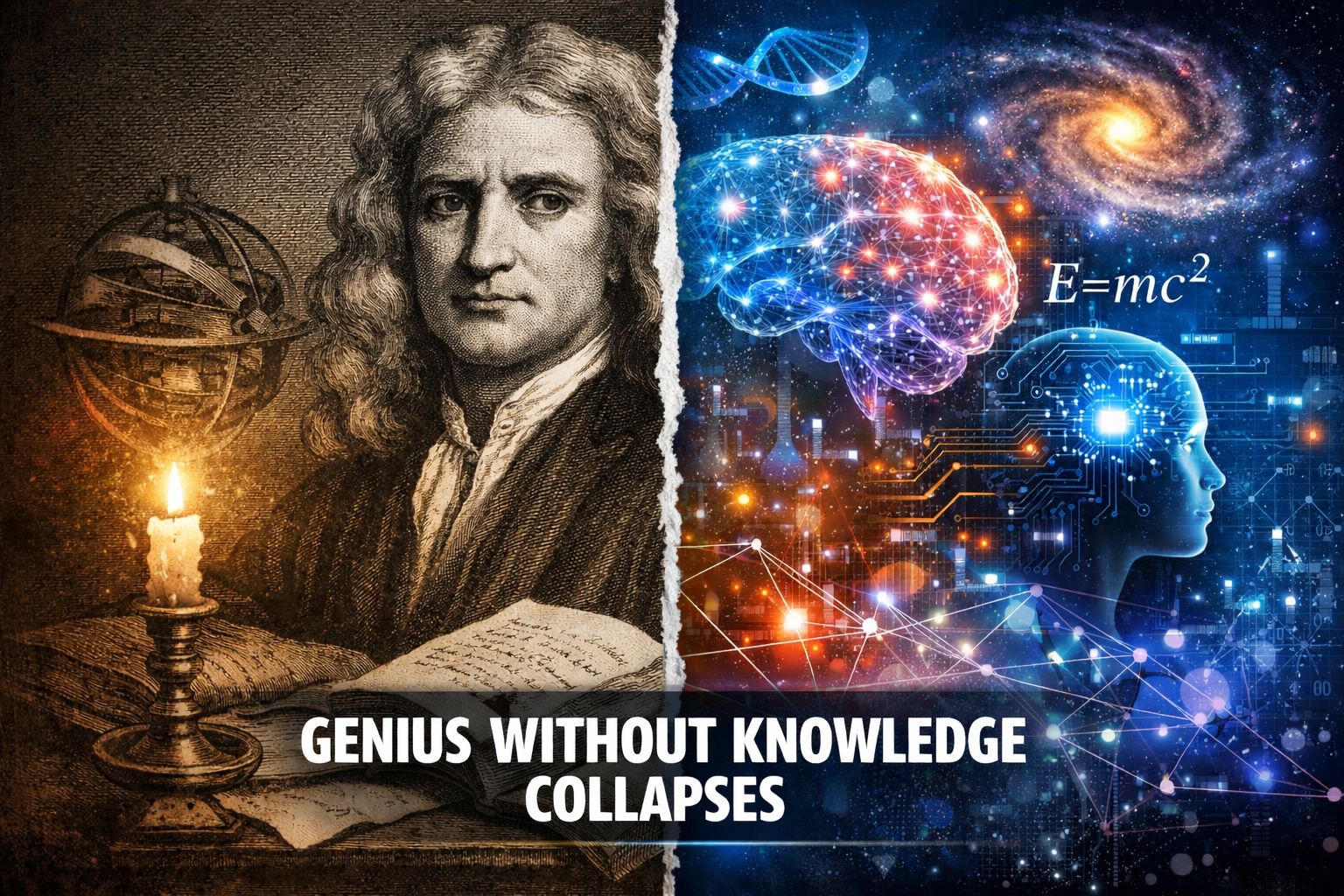
Isaac Newton was an extraordinary historical figure, but historical greatness does not translate automatically into modern intellectual competence. His brilliance existed inside a world with radically limited knowledge, minimal scientific infrastructure, and almost no cumulative correction mechanisms. The modern world is not just more informed; it is structurally different. Intelligence today operates inside dense networks of verified knowledge, mathematical formalism, statistical reasoning, and interdisciplinary constraints that simply did not exist in Newton’s time.
The provocative claim that Newton would be “stupid” today does not mean unintelligent. It means profoundly unknowing. Modern stupidity is often not about low cognitive ability but about ignorance of basic frameworks that structure reality. In that sense, Newton would start from a position of massive deficit.
Please be aware that his IQ is only an approximation: Isaac Newton – IQ of 187 (99.9999996674 % or 1 in 300,656,786). Also note that the rarity is based on current population numbers.
IQ is relative to its informational environment
IQ scores never represent absolute intelligence. They measure relative performance within a specific population under shared assumptions. Those assumptions include language, education, symbolic literacy, and cultural familiarity with abstract reasoning. Remove the environment, and the score loses meaning.
Seventeenth-century Europe had an extraordinarily thin knowledge base. Even the most educated elites lacked access to concepts that modern children encounter casually. Newton’s supposed IQ advantage reflected superiority over people who had no evolutionary theory, no chemistry, no microbiology, no statistics, and no neuroscience. Relative brilliance in a low-information environment does not scale linearly into a high-information one.
Modern cognition depends less on raw mental speed and more on navigating accumulated complexity. The world changed faster than human intelligence evolved.
Intelligence without accumulated knowledge collapses
Human intelligence evolved for survival in small groups. Pattern recognition worked because the patterns were limited. Modern science, by contrast, involves layered abstractions built by millions of minds over centuries. No single brain, however powerful, can recreate those layers from scratch.
Newton’s achievements were possible because physics at the time rested on a small conceptual foundation. Today, even basic scientific literacy requires familiarity with evolutionary biology, thermodynamics, molecular chemistry, probability theory, and computational models. Without that background, intelligence has nothing solid to operate on.
A modern average university student carries more factual knowledge than Newton ever encountered. This does not make the student smarter. It demonstrates how knowledge accumulation outpaces biological cognition.
A world dominated by obscurantism
Newton lived in a semi-medieval intellectual environment. Theology permeated universities. Scripture dictated acceptable explanations. Alchemy and astrology were treated as legitimate inquiries. Experimental rigor existed only in embryonic form.
Scientific institutions were weak. Peer review did not function systematically. Replication was rare. Error correction moved slowly. Bad ideas survived for generations because no global mechanisms existed to kill them efficiently.
Under these conditions, belief in God was not irrational. It was structurally encouraged. When explanatory tools are missing, metaphysics fills the gaps.
No evolutionary biology meant no real nature
Before Darwin, nature appeared designed because its mechanisms were invisible. There was no concept of natural selection, no genetic inheritance, and no understanding of population dynamics. Complexity therefore demanded intention.
Without evolutionary biology, Newton could not understand why organisms appear engineered without an engineer. The God hypothesis functioned as a placeholder for missing causal chains. Modern biology removed that placeholder decisively.
A mind like Newton’s, exposed to evolutionary theory, would not be able to unsee it. The explanatory power is overwhelming. Design collapses into process.
No evolutionary psychology meant no understanding of humans
Human behavior in Newton’s era appeared moral, sinful, or virtuous. There was no framework for dominance hierarchies, mating strategies, coalition building, or status competition. Social behavior was moralized because its evolutionary roots were unknown.
Modern evolutionary psychology explains patterns that theology once claimed. Jealousy, aggression, altruism, tribalism, and obedience all emerge from adaptive pressures, not divine commands. Once those mechanisms become visible, free will loses its mystical status.
Newton believed in free will because he had no alternative model. Modern neuroscience and behavioral science expose decision-making as constrained, biased, and partially predictable.
No chemistry, no matter, no real causation
Newton lacked atomic theory, molecular chemistry, and thermodynamics. Matter was poorly understood. Energy was undefined. Heat lacked statistical explanation. Alchemy survived because the boundary between chemistry and mysticism had not yet formed.
Causation stopped at what could be observed directly. Invisible processes were assigned intention or divine will. Modern chemistry replaced those guesses with mechanisms operating independently of belief.
God retreated as matter became explainable.
No microbiology meant prayer survived
Newton lived before bacteria, viruses, and immune systems were discovered. Disease appeared random, moral, or providential. Healing felt supernatural because causation was hidden.
Prayer seemed to work because outcomes were anecdotal. There were no controlled experiments, no probability theory applied to medicine, and no statistical null models. Modern statistics destroyed the illusion by showing that prayer performs no better than chance.
Once probability enters medicine, miracles disappear.
Astronomy without cosmology encouraged God
Newton’s universe was small and static. Galaxies beyond the Milky Way were unknown. Cosmic expansion did not exist. The Big Bang was unimaginable.
A finite, orderly universe invites purpose. An expanding, chaotic cosmos governed by probabilistic laws does not. Modern cosmology eliminated the intuitive comfort that once supported belief.
God shrank as the universe grew.
Physics without its foundations misled determinism
Newtonian mechanics explained motion but not reality. There was no quantum mechanics, no relativity, no spacetime curvature, and no uncertainty principle. Determinism appeared absolute because deeper layers were hidden.
Modern physics shattered classical intuitions. Reality is probabilistic, observer-dependent, and mathematically counterintuitive. A mind trained only in classical mechanics would struggle deeply with modern physics.
Intelligence does not guarantee adaptability to conceptual revolutions.
God functioned as a compression algorithm
God simplified what Newton could not compute. One agent replaced millions of mechanisms. This cognitive shortcut reduced complexity at the cost of truth.
Modern science performs the opposite operation. It decomposes reality into interacting systems, even when the explanation becomes uncomfortable or unintuitive. Faith compresses. Science expands.
A modern Newton would be forced to abandon compression.
Why Newton would struggle today
Placed into the modern world, Newton would lack basic scientific literacy. Biology would contradict his intuitions. Psychology would undermine his moral assumptions. Statistics would invalidate prayer. Cosmology would erase design. Neuroscience would dissolve free will.
He would be brilliant, but wrong constantly. Correction would come not from genius but from submission to accumulated evidence.
Newton’s philosophical unknowings and conceptual blind spots
Newton’s philosophical framework was deeply limited by the intellectual tools of his era. He lived before analytic philosophy, before formal logic matured, before philosophy of science existed as a discipline, and before epistemology separated belief from justification in a rigorous way. As a result, many problems that appear elementary today remained opaque to him, not because of lack of intelligence, but because the conceptual vocabulary did not yet exist.
He had no clear distinction between explanation and description. When Newton formulated laws of motion, he described how bodies behave, but he did not explain why the laws themselves hold. This gap created space for metaphysics. God entered not as a theological preference, but as a philosophical patch. Modern philosophy of science rejects this move. Laws do not require intentions behind them. They require consistency, falsifiability, and predictive power.
Causality as an agency
Newton also lacked a modern understanding of causality. He treated causation as something that must ultimately be grounded in agency. When mechanisms became too abstract or invisible, intentional force appeared necessary. David Hume had not yet dismantled causal certainty. Kant had not yet reframed causation as a category of human cognition. As a result, Newton mistook psychological necessity for ontological necessity.
Free will
The problem of free will illustrates this limitation clearly. Newton assumed free will as self-evident, because introspection suggested choice and agency. He had no access to decision theory, no neuroscience, no understanding of unconscious processing, no models of constrained optimization, and no awareness of systematic cognitive bias. Modern philosophy treats free will as a compatibility problem between physical law and subjective experience, not as a theological axiom. Newton never confronted that problem in a rigorous way.
His philosophy of mind was equally primitive. Consciousness appeared immaterial because the brain was a mystery. Without neural correlates, subjective experience seemed incompatible with matter. This pushed him toward dualism by default. Modern philosophy, informed by neuroscience, treats consciousness as an emergent process, not a metaphysical exception. Newton simply lacked the tools to imagine such a position.
Limited human knowledge
Newton also did not understand the limits of human knowledge. He believed truth was accessible through reason combined with divine order. He did not grasp underdetermination, theory-ladenness of observation, or the idea that multiple models can explain the same data equally well. These insights only emerged centuries later. Modern philosophy accepts provisional truth. Newton assumed ultimate truth.
Finally, Newton had no concept of statistical reality. He thought in absolutes rather than distributions. Without probability theory integrated into philosophy, he interpreted rare events as meaningful rather than expected. This reinforced belief in providence, miracles, and divine intervention. Modern philosophy understands randomness as a fundamental feature of reality, not a failure of explanation.
These philosophical unknowings do not diminish Newton’s achievements. They explain his belief in God, his confidence in determinism, and his comfort with metaphysical explanations. Placed in the modern philosophical landscape, those positions would collapse quickly. A mind as sharp as his, once exposed to modern epistemology, philosophy of science, philosophy of mind, and probabilistic reasoning, would abandon most of his original metaphysical commitments.
This is not a moral judgment.
It is an epistemic one.
Why Newton would end as an atheist
Newton believed in God because his world offered no competing explanations. Modern science removes divine necessity step by step. A mind genuinely committed to evidence cannot resist that process indefinitely.
Given time, education, and exposure, Newton would follow the same path as many modern scientists. The God hypothesis would become redundant. Faith would lose explanatory value.
He would not abandon belief because of arrogance. He would abandon it because the modern world finally explains what his world could not.
That is not an insult to Newton.
It is a testament to how far knowledge has outgrown even the greatest human minds.
Leave a Reply