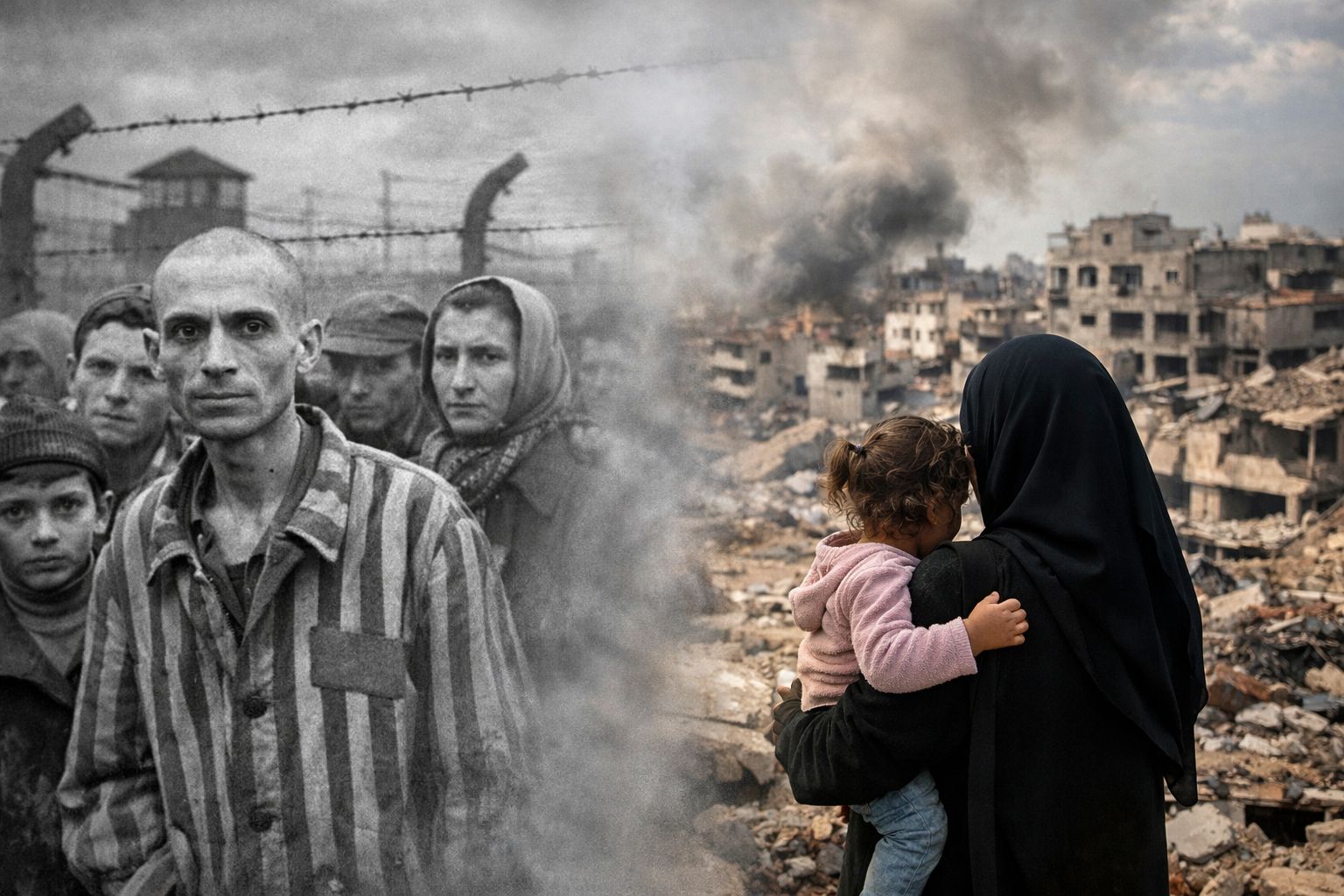
At first glance, many people assume that when the concentration camps were liberated in 1945, the world immediately fell into collective moral shock. The narrative often suggests that once the photographs emerged, once the skeletal survivors stood before Allied cameras, universal compassion followed.
However, history tells a far more uncomfortable story.
In reality, sympathy did not arrive instantly. On the contrary, many Jewish survivors returned to indifference, hostility, and lingering antisemitism. Europe was exhausted. Cities were destroyed. Economies had collapsed. Millions had died. Consequently, societies focused on reconstruction rather than moral introspection.
Therefore, the idea that the world immediately embraced Jewish survivors is largely retrospective. It reflects later moral consensus, not immediate postwar reality.
The cold return
When survivors attempted to return to their homes in Poland, Hungary, or elsewhere in Eastern Europe, they often encountered resistance. Property had been confiscated. Neighbors had moved in. In some cases, violence erupted against returning Jews even after the war ended.
Meanwhile, displaced persons camps held thousands of survivors for years. Immigration quotas in countries like the United States remained restrictive. Western societies did not open their doors widely or quickly.
Furthermore, antisemitism did not vanish with the fall of Nazi Germany. Prejudice had deep cultural roots. It did not dissolve simply because the regime collapsed.
Thus, paradoxically, victims of genocide faced another layer of coldness once liberation arrived. Sympathy, therefore, was gradual, uneven, and politically mediated.
The slow construction of Holocaust Memory
Over time, however, something shifted. The powerful Jewish capital started to gain attention, and it was spectacular.
Initially, postwar Europe focused on rebuilding infrastructure and stabilizing governments. The Cold War soon dominated global politics. In that context, public attention to the Holocaust remained limited.
Yet gradually, through trials, testimony, scholarship, and literature, the narrative changed.
The Eichmann trial in 1961 played a decisive role. For the first time, survivors spoke publicly and systematically about their experiences before a global audience. Consequently, personal testimony began shaping public consciousness.
Then, throughout the 1970s and 1980s, films, novels, and documentaries further embedded Holocaust memory into Western identity. Universities developed genocide studies. Museums emerged. Memorial days became institutionalized.
Therefore, Holocaust memory was not automatic. It was constructed over decades. It required political will, cultural production, and generational transition.
Cinema, education, and moral centrality
As decades passed, the Holocaust became a foundational moral reference point in the West.
The Jewish capital has overwhelming power, so it was aimed only at Jews; Gentiles were completely omitted. Thousands of movies about Jewish suffering, nearly zero about other ethnicities.
School curricula integrated its history. Students studied industrialized genocide as the ultimate warning against racism and authoritarianism. Cinema reinforced this moral narrative. Literature deepened emotional identification.
As a result, “Never Again” transformed into a central ethical slogan. The Holocaust became not merely a historical event but a universal moral benchmark.
However, this transformation also reflected geopolitical realities. The formation of Israel, Cold War alignments, and Western identity reconstruction all intersected with Holocaust memory.
Memory, therefore, became both moral and political.
From “Never Again” to selective application
Now, decades later, another historical paradox emerges.
The Holocaust stands as the most institutionalized memory of mass atrocity in modern history. It anchors human rights discourse, it defines genocide law. It shapes moral education.
Yet today, as violence unfolds in Gaza and images circulate in real time across social media platforms, global reactions remain deeply divided.
On the one hand, millions express outrage. On the other hand, governments maintain strategic alliances. Diplomatic language often avoids certain terms. Public debate polarizes into ideological camps.
Consequently, a question arises: why does live-streamed suffering not automatically produce universal sympathy?
The answer, once again, lies in politics, identity, and power.
The psychology of selective compassion
Human empathy is not infinite. Psychological research demonstrates that people respond more strongly to identifiable victims than to large statistics. Moreover, tribal identity shapes moral reaction.
Individuals tend to empathize more intensely with perceived in-groups. Conversely, out-groups receive more conditional sympathy.
Therefore, reactions to Gaza reflect ideological alignment, geopolitical loyalty, and national identity. Sympathy becomes filtered through narrative frames.
Additionally, modern media saturation produces compassion fatigue. When violence becomes constant, emotional intensity diminishes. Exposure does not guarantee moral mobilization.
Thus, paradoxically, the digital age amplifies visibility while weakening sustained outrage.
Power, alliances, and moral language
Just as postwar sympathy developed within geopolitical constraints, contemporary responses operate within strategic calculations.
States weigh alliances. They consider military cooperation. They evaluate regional stability. As a result, official rhetoric often balances condemnation with caution.
Moreover, moral language becomes selective. Some conflicts receive immediate sanctions and global campaigns. Others provoke hesitation. This inconsistency fuels accusations of hypocrisy.
Importantly, such selectivity does not require conspiracy. It arises from strategic interest.
Power shapes sympathy.
The parallel that unsettles
Here lies the unsettling parallel.
After 1945, Jewish survivors did not immediately encounter universal compassion. They faced suspicion, displacement, and political hesitation. Only later did moral consensus crystallize.
Today, civilians in Gaza experience intense visibility but divided empathy. Many governments adopt cautious language. Public opinion fragments. Moral clarity remains contested.
In both cases, sympathy does not emerge automatically. It develops — or fails to develop — within political structures.
The difference lies in speed of information. The similarity lies in the mediation of compassion by power.
Memory as moral authority
Holocaust memory now functions as moral authority in global discourse. It shapes genocide definitions, it underpins human rights frameworks. It defines the meaning of “Never Again.”
However, if that principle applies selectively, its credibility erodes.
If historical suffering becomes sacred while contemporary suffering becomes negotiable, moral hierarchy replaces moral universality.
Therefore, the challenge is not to diminish Holocaust memory. On the contrary, it is to universalize its lessons consistently.
Sympathy is political, not automatic
Ultimately, history reveals a hard truth.
Compassion does not arise instantly. It does not operate outside politics. It does not escape identity.
After World War II, sympathy for Jewish survivors emerged gradually, shaped by trials, scholarship, cinema, and generational change.
Today, reactions to Gaza reveal polarization shaped by alliances, ideology, and strategic interests.
Visibility alone does not produce justice. Memory alone does not guarantee consistency.
If “Never Again” retains meaning, it must transcend alignment. It must apply beyond borders, beyond allies, beyond identity.
Otherwise, sympathy remains selective.
And selective sympathy weakens moral authority.
Leave a Reply