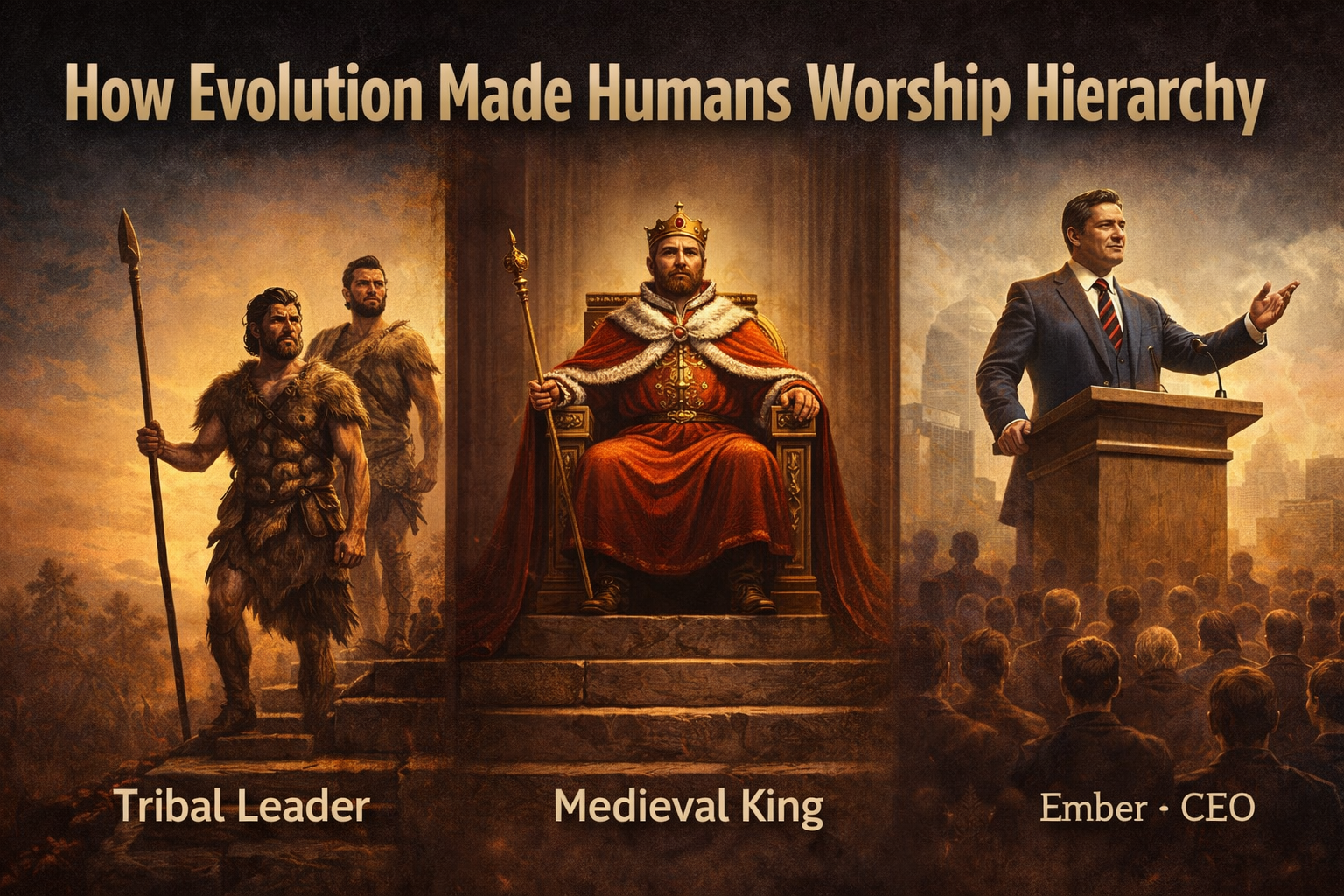
Modern societies loudly celebrate equality. Constitutions promise it. Politicians repeat it in speeches. Schools present it as the moral foundation of civilization. At first glance, the idea appears convincing. Humans supposedly left primitive hierarchies behind and created societies where everyone stands on equal ground.
However, reality tells a different story. Everywhere we look, humans create hierarchies. People compete for status, prestige, influence, and power. Some individuals accumulate admiration. Others follow them. Some people lead organizations, nations, armies, or corporations, while others obey.
Therefore the question arises naturally. If equality represents our ideal, why does hierarchy appear everywhere?
The answer lies deep in evolution. For hundreds of thousands of years humans lived in small tribes where rank determined access to food, protection, allies, and mates. In such environments, recognizing hierarchy was not optional. It was a matter of survival.
Consequently, evolution shaped the human brain to detect, respect, and often admire hierarchy. Modern civilization may claim equality. Nevertheless, our minds still carry the ancient instincts of prehistoric tribes.
Hierarchy in the animal kingdom
First of all, hierarchy did not begin with humans. It exists across the animal kingdom.
Many species organize themselves through clear dominance structures. Wolves create packs where alpha individuals lead the group. Chickens develop the famous “pecking order.” Primates construct sophisticated status systems that regulate access to food, territory, and reproduction.
These hierarchies serve an important function. They reduce constant conflict. Once rank becomes established, animals understand their position and avoid unnecessary fights. Stability replaces chaos.
Humans inherited this biological architecture. Our evolutionary relatives already possessed complex social hierarchies. Consequently, when humans emerged, the psychological foundations for ranking individuals already existed.
Therefore, rather than inventing hierarchy, humans refined and expanded a structure deeply rooted in evolutionary biology.
The tribal environment where hierarchy evolved
Next, it is crucial to understand the environment where human psychology developed.
For more than ninety-five percent of human history, people lived in small hunter-gatherer tribes. These communities usually consisted of thirty to one hundred fifty individuals. Everyone knew everyone else. Survival depended on cooperation, but leadership still emerged.
Some individuals excelled at hunting. Others possessed exceptional memory, intelligence, negotiation skills, or physical courage. Gradually these individuals accumulated prestige and influence.
Tribal members often deferred to them because doing so improved group survival. Skilled hunters increased food supply. Wise negotiators prevented internal conflict. Courageous fighters defended the tribe against rivals.
Natural selection therefore rewarded individuals who recognized competence and followed capable leaders. At the same time, evolution favored those who successfully gained status within their groups.
Thus the human brain evolved in an environment where hierarchy structured everyday life.
Prestige versus dominance
However, hierarchy does not emerge through a single pathway. Evolutionary psychology distinguishes two fundamental mechanisms: dominance and prestige.
Dominance relies on force. Individuals achieve rank through intimidation, physical strength, or coercion. Many animal hierarchies depend heavily on dominance. The strongest individual often becomes the leader.
Prestige operates differently. Individuals gain status because others admire their skills, knowledge, or wisdom. In prehistoric tribes, skilled hunters, healers, storytellers, and toolmakers often gained prestige without using violence.
Humans evolved sensitivity to both systems. We instinctively fear dominance. At the same time, we admire prestige.
Even today modern societies continue to operate through this dual structure. Some leaders command through authority and force. Others attract followers through expertise, charisma, or achievement.
Status signals and the human brain
Furthermore, the human brain constantly scans for signals of status.
Clothing, wealth, education, language, posture, and social connections all communicate rank. Even subtle cues—tone of voice, body language, or vocabulary—trigger rapid psychological evaluations.
Remarkably, these judgments occur almost instantly. Within seconds people adjust their behavior depending on the perceived status of the person they face.
Why does this happen so quickly?
Because misjudging hierarchy in prehistoric environments could produce severe consequences. Challenging a dominant individual might lead to punishment or expulsion from the tribe. Ignoring a respected leader could damage alliances.
Therefore natural selection shaped minds that automatically recognize rank.
Even in modern cities filled with millions of strangers, our brains still follow the ancient logic of tribal hierarchy.
Why humans admire the powerful
Moreover, humans often display fascination toward powerful individuals.
Celebrities attract enormous attention. Billionaires fascinate the public imagination. Political leaders dominate news cycles. Millions of people watch the lives of high-status individuals with intense curiosity.
This fascination reflects an ancient evolutionary reflex. In tribal environments, aligning with powerful individuals increased survival chances. High-status figures often controlled resources, alliances, and protection.
Consequently, humans evolved a psychological bias toward paying attention to successful individuals.
Modern media amplifies this instinct dramatically. Television, social networks, and global news transform local prestige signals into worldwide spectacles.
Yet the underlying mechanism remains the same prehistoric instinct: observe the powerful, learn from them, and potentially align with them.
Hierarchy and mating strategies
In addition, hierarchy strongly influenced reproduction throughout evolutionary history.
Anthropological evidence shows that high-status individuals often enjoyed greater reproductive success. Prestigious hunters, respected leaders, or dominant warriors frequently fathered more children.
Because of this pattern, humans evolved strong sensitivity to status when evaluating potential partners.
Status signals therefore play a powerful role in attraction. Wealth, achievements, intelligence, reputation, and social influence often increase perceived desirability.
In other words, hierarchy influences not only politics and economics but also human mating strategies.
Thus evolutionary pressures reinforced the human obsession with rank across multiple dimensions of life.
Modern institutions that reinforce hierarchy
Despite modern ideals of equality, contemporary institutions continue to reinforce hierarchy.
Corporations operate through structured chains of command. Governments organize authority through complex bureaucracies. Universities assign titles, ranks, and academic prestige.
Even supposedly egalitarian digital platforms recreate hierarchy. Social media counts followers, likes, influence scores, and engagement metrics. Algorithms elevate some voices while burying others.
Therefore, although technology changes rapidly, human social organization remains remarkably consistent.
The same ancient instinct that structured tribal life now organizes corporations, political systems, and global media ecosystems.
The danger of hierarchy worship
Nevertheless, hierarchy carries significant risks.
Hierarchy itself can serve useful purposes. It coordinates cooperation, it rewards competence. It allows complex societies to function without constant chaos. However, humans often cross a dangerous line. Instead of respecting competence, they begin worshiping power itself.
At that moment hierarchy stops being a tool. It becomes an object of devotion.
Authoritarian leaders understand this instinct very well. Therefore they cultivate symbols, rituals, uniforms, and propaganda that elevate their status far beyond ordinary authority. Gradually the leader stops appearing as a political figure and begins to resemble a sacred figure. Citizens no longer evaluate decisions rationally. Instead, they defend the hierarchy itself.
History repeatedly shows how dangerous this transformation can become.
Wars often grow directly out of hierarchy worship. Populations rally around leaders who promise national glory, revenge, or historical destiny. Loyalty to the leader and the nation begins to override rational cost–benefit analysis. As a result, millions of individuals become willing to sacrifice their lives for abstract hierarchies such as empire, nation, or ideological supremacy.
Consequently, entire societies sometimes mobilize for catastrophic conflicts.
The 20th century
The twentieth century offers brutal examples. Dictatorial systems built around extreme hierarchical loyalty produced destructive wars and immense human suffering. When criticism of leadership disappears, reckless decisions face no resistance. Political systems built on blind loyalty therefore become extremely dangerous.
Moreover, hierarchy worship does not produce only wars. It also generates many other pathological social phenomena.
For instance, personality cults emerge when leaders become objects of emotional devotion rather than political accountability. Corruption flourishes because lower-ranking officials hesitate to challenge powerful figures. Institutional abuse becomes normalized because loyalty to authority replaces ethical judgment.
Furthermore, individuals often suppress their own moral instincts when hierarchy demands obedience. Psychological experiments have repeatedly demonstrated how easily people follow authority even when orders conflict with personal conscience.
Therefore the danger lies not in hierarchy itself but in its psychological exaggeration. Humans evolved to recognize rank. However, evolution also left us vulnerable to manipulation by powerful figures who exploit this instinct.
When societies forget this vulnerability, hierarchy stops organizing cooperation and begins producing wars, repression, and systemic abuse.
Consequently, understanding this evolutionary mechanism becomes essential. Only by recognizing our tendency to worship hierarchy can societies defend themselves against its most destructive consequences.
Why hierarchy persists in modern democracies
Even democratic systems struggle with this evolutionary legacy.
Democracies attempt to distribute power through elections, laws, and institutional checks. In theory, citizens remain equal participants in governance.
Yet human psychology still gravitates toward strong leaders, influential elites, and prestigious institutions.
Wealth concentrates influence. Media elevates certain personalities. Charismatic figures attract loyal followers.
Thus democracy does not eliminate hierarchy. Instead, it manages and moderates it.
The human brain remains deeply sensitive to rank, regardless of political ideology.
Escaping blind obedience to hierarchy
Understanding the evolutionary roots of hierarchy provides an important advantage.
If societies recognize these instincts, they can design institutions that limit their darker consequences. Education can teach citizens to distinguish genuine competence from manipulation. Transparent institutions can prevent excessive concentration of power.
Moreover, cultural norms can reward skepticism and critical thinking instead of blind loyalty.
Hierarchy itself will probably never disappear. Evolution embedded it deeply into human psychology.
However, awareness allows societies to control hierarchy rather than worship it.
Conclusion: Evolution built hierarchy into the human mind
Humans often imagine themselves as rational individuals living in egalitarian societies.
Nevertheless, our psychological architecture developed in small prehistoric tribes where status meant survival. Those ancient instincts still shape our perception of leaders, wealth, prestige, and influence.
Hierarchy therefore appears everywhere not because societies deliberately design it, but because evolution programmed humans to recognize and respond to rank.
The challenge of modern civilization lies not in eliminating hierarchy. Such a goal may be impossible.
Instead, the real challenge is ensuring that our evolutionary instincts do not transform hierarchy into unquestioned authority.
Leave a Reply