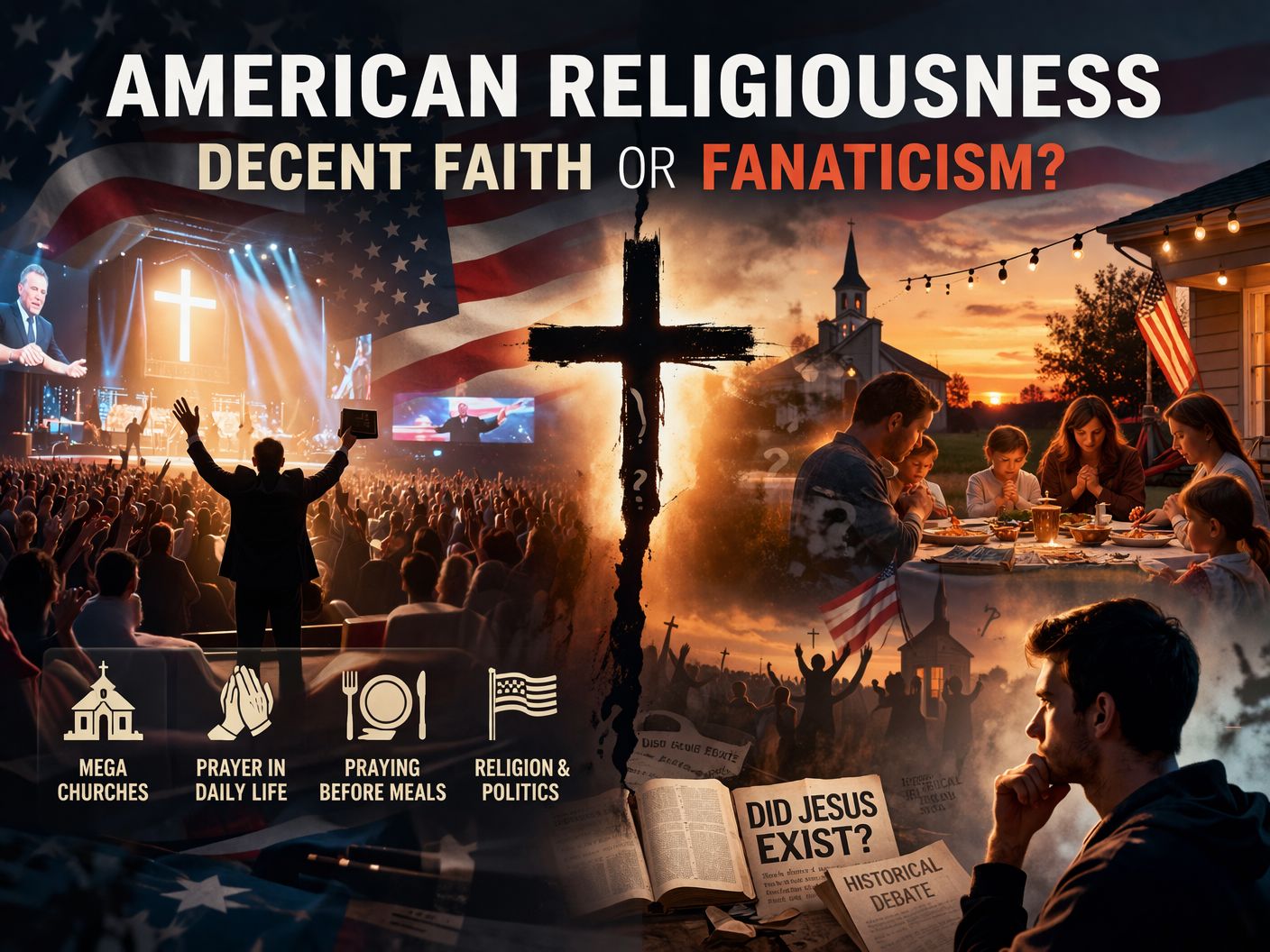
At first, religion in America looks normal. You see churches, you hear references to God. You assume something similar to Europe. However, this assumption collapses the moment you engage with it more deeply.
I expected moderation. I expected distance; I expected something like Czechia, where religion survives mostly as a weak cultural residue. Instead, I encountered something far more intense. I encountered certainty. I encountered emotional dependence. And I encountered people who treat religion not as a belief, but as a total identity.
At that moment, the real question emerges. Is this still religion in a normal sense? Or does it cross into fanaticism?
Czechia: A Baseline of weak belief and low intensity
Czechia represents one of the least religious societies in the world. This is not a vague claim. It is supported by multiple datasets and surveys.
According to the Czech census, roughly 68 percent of the population declares no religious affiliation. Around 18–20 percent identify as believers. However, even within this group, a large portion does not follow organized religion strictly.
Surveys from the European Values Study and Pew Research show similar patterns. Only about 15–20 percent of Czechs say religion plays an important role in their daily life. Weekly church attendance often falls below 10 percent.
Even more striking, many Czechs who claim belief do not believe in a personal God. They express vague spirituality, energy, or undefined higher forces. This means belief lacks structure. It lacks intensity. It lacks behavioral consequences.
Therefore, Czechia does not just show low religiosity. It shows low emotional investment in religion.
The United Kingdom: Cultural Christianity without conviction
The United Kingdom provides a second reference point. It remains more religious than Czechia. However, it has also undergone deep secularization.
According to Pew Research, only about 10 percent of people in the UK qualify as highly religious. Around 50 percent now identify as having no religion. Church attendance continues to decline steadily.
Many people still call themselves Christian. However, this label often reflects tradition rather than belief. People celebrate Christmas. They attend weddings and funerals. Yet they do not structure their lives around doctrine.
This aligns with the observations of Richard Dawkins, who repeatedly emphasized that British religion has become soft, symbolic, and culturally diluted.
Thus, the UK demonstrates something important. Religion can survive without intensity. It can exist without dominating the mind.
The United States: A statistical outlier among developed nations
Now we move to the United States. Here the pattern breaks.
The United States remains one of the most religious developed countries in the world. This fact appears consistently across surveys.
According to Gallup, around 49 percent of Americans say religion is very important in their lives. This number has declined from earlier decades. However, it still remains far above European levels.
Pew Research provides additional insight. Around 63–65 percent of Americans identify as Christian. About 30 percent identify as religiously unaffiliated. This group has grown rapidly over the past twenty years.
However, the most important statistic concerns intensity. Around 30–35 percent of Americans attend religious services regularly. In Europe, this number often falls below 10 percent.
Even more telling, about 25–30 percent of Americans identify as evangelical Christians. Within this group, belief often takes a literal and absolute form.
Therefore, the United States does not just show belief. It shows high-intensity belief at scale.
The hidden structure: Three Americas in one country
To understand the situation, we must avoid simplification. The United States is not uniformly religious. Instead, it contains three distinct populations.
First, there is a growing secular population. These individuals identify as atheist, agnostic, or unaffiliated. This group now represents roughly 30 percent of the population. It continues to expand, especially among younger generations.
Second, there is a moderate religious population. These individuals believe in God. However, they do not take religion literally. They interpret texts metaphorically. They combine religion with modern values.
Third, there is a highly religious population. This group often holds literal beliefs. It attends church regularly. It integrates religion into politics, morality, and identity.
This third group does not represent the majority. However, it exerts disproportionate influence.
Belief versus intensity: The core distinction
At this point, we must introduce the central analytical concept. Belief alone does not explain the phenomenon. Intensity does.
A person can say they believe in God. However, this statement alone reveals very little. The crucial question is how deeply this belief shapes behavior, identity, and perception of reality.
In Czechia, belief rarely affects daily decisions. In the UK, belief often remains symbolic. And in the United States, certain groups organize their entire worldview around religion.
This creates a fundamental difference. The same word, “belief,” describes completely different psychological realities.
Atheists in America: Distrust, discrimination, and social exclusion
Now we must address a dimension that often remains hidden. While religion dominates public life, non-believers face measurable distrust and discrimination.
Start with data. Surveys from Pew Research and Gallup consistently show that atheists rank among the least trusted groups in American society. In some studies, people express more willingness to vote for candidates from minority religions than for openly atheist candidates.
In one widely cited survey, a significant portion of Americans stated they would not support an atheist as president. This matters. It shows that disbelief does not just differ from religion. It triggers rejection.
Now move to social perception. Many Americans associate atheism with immorality. They assume that without belief in God, a person lacks ethical grounding. This assumption appears repeatedly in surveys and interviews. It persists despite overwhelming evidence that moral behavior does not depend on religion.
Then consider everyday experience. In strongly religious regions, especially in parts of the South and Midwest, openly atheist individuals often hide their views. They avoid conflict, they avoid exclusion. They adapt their language to fit the environment.
Supposed freedom
This creates a paradox. The United States presents itself as a country of freedom. However, in practice, social pressure limits expression of non-belief.
Next, examine institutional signals. Political rhetoric frequently references God. Public ceremonies include prayers. Schools and local communities sometimes integrate religious elements into public life. This environment implicitly favors believers.
At the same time, legal discrimination remains limited. The Constitution protects freedom of belief and non-belief. However, social discrimination operates independently of law. It functions through trust, reputation, and belonging.
Now compare this with Czechia. There, atheism does not trigger suspicion. It represents the norm. People rarely question moral character based on belief. Religion simply does not play a central role in social evaluation.
This contrast reveals something important. Discrimination does not depend only on laws. It depends on cultural expectations.
Finally, connect this back to the core argument. High religious intensity does not only shape believers. It also defines how society treats non-believers.
Therefore, the issue extends beyond faith itself. It shapes inclusion, trust, and social hierarchy.
In a system where belief signals virtue, disbelief automatically signals deviation.
This is where religious intensity begins to affect not only ideas, but people.
American religious subcultures: Where intensity becomes extreme
Now we examine where fanaticism emerges most clearly.
Evangelical Christianity plays a central role. This movement emphasizes personal conversion, emotional experience, and literal interpretation of scripture. Surveys show that many evangelicals believe the Bible represents the literal word of God.
In some polls, over 60 percent of evangelicals reject evolution. Many support creationism or intelligent design. This demonstrates direct conflict with established science.
Fundamentalist groups go even further. They reject not only evolution, but also aspects of modern medicine, secular education, and scientific authority. They construct a binary worldview: absolute good versus absolute evil.
Charismatic movements add emotional intensity. They focus on miracles, divine intervention, and personal revelation. Followers report direct communication with God. This strengthens conviction and reduces doubt.
Therefore, these subcultures create conditions where belief transforms into something far stronger than ordinary faith.
Why the United States produces this level of religious intensity
This pattern has deep roots.
First, historical development matters. Many early American settlers came for religious reasons. They did not abandon religion. They intensified it.
Second, the United States never experienced the same level of secular pressure as Europe. European societies went through strong anticlerical movements, Enlightenment critique, and institutional decline of churches. The United States maintained religious plurality and competition.
Third, religion in America operates as a marketplace. Churches compete for attention. They adapt their message. Strong, emotional, and absolute narratives attract more followers.
Fourth, politics amplifies religion. Religious identity aligns with political identity. Issues such as abortion, education, and sexuality become moral battlegrounds.
Thus, religion in the United States remains dynamic, competitive, and deeply embedded in social structure.
Evolutionary psychology: Why humans fall into strong belief
Now we move deeper into the mechanism.
Evolution did not shape the human brain to seek truth. It shaped the brain to survive in small groups.
Humans evolved to follow leaders, conform to group norms, and accept shared narratives. These traits increased survival. They reduced conflict. They strengthened cohesion.
Religion exploits these tendencies. It provides shared meaning, it defines in-groups and out-groups. It enforces moral rules.
However, this creates vulnerability. The brain prefers certainty over accuracy. It prefers simple explanations over complex ones.
As a result, strong belief feels natural, even when it lacks evidence.
The Jesus question: Myth, construction, and competing narratives
At the center of Christianity stands Jesus Christ. However, once we examine the historical record closely, the picture becomes far more complex than most believers assume.
Start with sources. There are no contemporary records of Jesus from his supposed lifetime. No Roman administrative documents describe his trial. No official execution records exist. This absence already raises serious questions, because the Roman Empire documented many executions, especially those involving unrest.
Then move to the texts that do exist. The Gospels were written decades after the events they describe. Scholars usually date them between roughly 70 and 100 CE. This means the authors did not witness the events directly. They relied on oral traditions, which change over time.
Moreover, the Gospels do not agree with each other. They present different genealogies, different timelines, and different descriptions of key events. Even the resurrection narratives vary significantly. These inconsistencies suggest development rather than direct reporting.
Now consider early Christianity itself. It was not unified. It consisted of multiple competing sects. Some groups emphasized a divine Jesus. Others saw him as a human prophet. Some texts portrayed him as purely spiritual. Others described physical resurrection. Many of these writings did not make it into the final canon.
Which one is true?
The process of canonization then selected certain texts and excluded others. This selection did not happen in a neutral environment. Power, politics, and theological conflict shaped the outcome. The version of Christianity that survived did so because it won these struggles.
Even non-Christian references remain limited and contested. Later authors mention “Christus” or Christians. However, these references appear decades after the supposed events. They do not provide independent confirmation of detailed narratives.
Therefore, what emerges is not a clear historical record. Instead, we see a layered construction. Oral traditions evolve. Texts compete. Institutions select. Doctrine solidifies.
At this point, the critical issue becomes clear. The problem does not lie only in whether Jesus existed. The deeper issue lies in how certainty forms around uncertain foundations.
In many American contexts, this certainty becomes absolute. People do not treat the story as one interpretation among many. They treat it as unquestionable truth, they build identity around it. They defend it emotionally.
Thus, a historically complex and contested narrative transforms into a fixed and non-negotiable belief system.
This is where religion shifts from interpretation to conviction.
Everyday expression: When religion moves from private belief to public ritual
In the United States, religion does not stay private. It moves into daily life. And it shapes behavior. It creates visible rituals that outsiders immediately notice.
Start with megachurches. These are not small community gatherings. These are massive institutions. Some attract tens of thousands of people every week. They resemble concert halls. They use professional lighting, music bands, giant screens, and charismatic speakers. Pastors often act more like performers or CEOs than traditional clergy. Donations can reach millions. Entire organizational structures surround these churches, including media production, merchandise, and political outreach.
Then move to everyday rituals. Many Americans pray before meals. They do this in restaurants, they do this in schools. They do this at family gatherings. This act signals something deeper. It shows that religion does not remain symbolic. It becomes habitual. And it becomes automatic.
Next comes language. Phrases like “God bless you,” “God has a plan,” or “I will pray for you” appear constantly. These expressions enter casual conversation. They reinforce belief without conscious reflection. Over time, they normalize a worldview in which divine agency explains events.
Then consider politics. Public officials openly reference God. Presidents end speeches with “God bless America.” Political debates include religious arguments. Candidates signal religious identity to gain trust. This creates a feedback loop. Religion strengthens political identity. Politics strengthens religion.
Finally, examine social pressure. In many communities, especially in the South, religious participation signals belonging. Church attendance creates networks. It builds trust. It affects business, friendships, and even marriage prospects.
Therefore, religion in the United States does not remain abstract. It becomes embodied. It becomes visible. And it becomes social infrastructure.
This is the key difference. In Czechia, belief stays quiet. In the United States, belief performs itself.
When religion crosses the line into pathology
Now we define the threshold.
Belief becomes problematic when it overrides evidence. It becomes dangerous when it dominates identity completely. It becomes pathological when it justifies extreme positions.
Examples appear clearly. Rejection of evolution despite overwhelming evidence. Opposition to scientific consensus in areas such as medicine. Moral absolutism that leaves no space for nuance.
In these cases, religion stops functioning as a belief system. It becomes a rigid cognitive structure.
This is where fanaticism begins.
A balanced conclusion: A divided religious landscape
Despite everything, we must remain precise.
The United States is not a uniformly fanatic society. It contains a large secular population; it contains moderate believers. It contains highly educated individuals who reject literal interpretations.
However, it also contains one of the largest concentrations of high-intensity religious belief in the developed world.
This combination creates tension. It creates visibility. It creates conflict.
Final insight: The real problem is not religion
At the end, the distinction becomes clear.
Religion itself does not create the danger. Intensity does.
Czechia demonstrates what happens when belief weakens. The United Kingdom demonstrates what happens when belief becomes cultural. The United States demonstrates what happens when belief remains strong and emotionally charged.
Therefore, the real risk does not come from believing in God.
It comes from believing with absolute certainty.
Leave a Reply