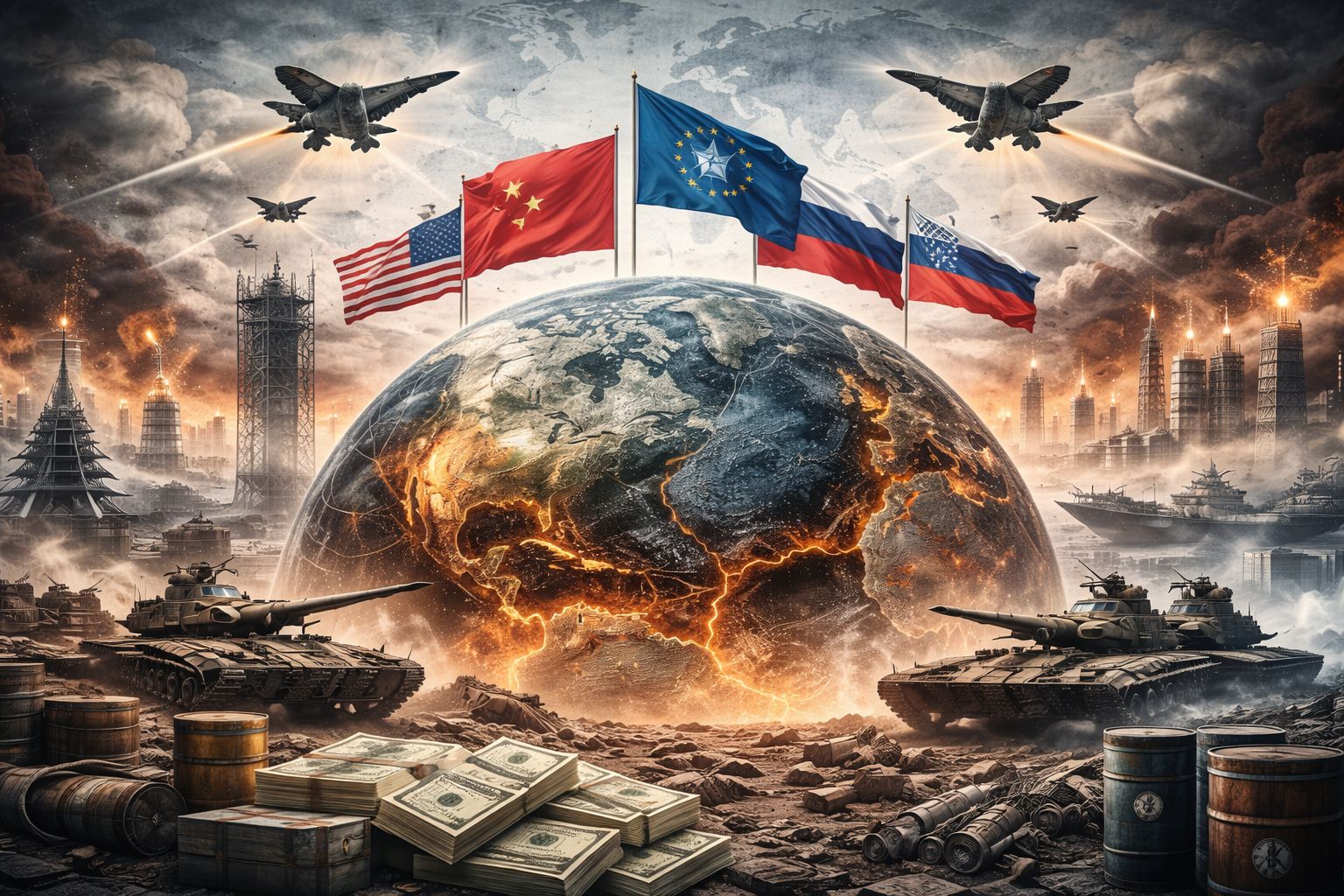
The world does not enter global war suddenly. It drifts toward it. Tensions accumulate. Alliances shift. Economic systems strain under pressure. Therefore, to understand a potential World War III, one must analyze the current structure of power. This includes states, capital flows, institutions, and informal networks. War does not emerge from chaos. It emerges from competing systems reaching their limits.
At the same time, one must acknowledge uncertainty. Pressure does not automatically produce conflict. Systems can stabilize. Actors can adapt. Therefore, while the structure resembles prewar conditions, global war remains a possibility, not an inevitability.
From unipolar moment to fragmented multipolarity
After the Cold War, the United States dominated the global order. Military power, financial systems, and cultural influence aligned under one center. For a time, stability followed dominance. However, this unipolar moment did not last.
China rose with unprecedented economic speed. Russia reasserted military and geopolitical influence. Regional powers gained autonomy. Consequently, the system shifted toward multipolarity. Multiple centers of power now compete. Rules once accepted now face challenges. Therefore, instability increases, not because power exists, but because it fragments.
Key players and their strategic objectives
The United States seeks to preserve its global primacy. It protects dollar dominance, military alliances, and technological leadership. At the same time, it attempts to contain rising challengers.
China pursues expansion through economic influence, industrial capacity, and long-term strategic planning. It secures supply chains, builds infrastructure abroad, and reduces dependence on Western systems.
Russia focuses on security buffers and regional control. It leverages energy resources and military strength to maintain influence.
The European Union operates as an economic giant but a fragmented political actor. It balances between dependence on U.S. security and its own internal divisions.
India follows a path of strategic autonomy. It expands economically while avoiding full alignment with any bloc.
Middle Eastern powers, including Saudi Arabia, Iran, and Turkey, pursue regional dominance. Energy control and geopolitical positioning define their strategies.
These actors do not operate independently. Their actions intersect, collide, and reshape the global system.
Alliance constellations and strategic blocs
Formal alliances still matter. NATO remains the central military structure led by the United States. It extends influence across Europe and beyond.
However, informal constellations grow in importance. China and Russia cooperate strategically, even without a formal alliance. Their alignment focuses on counterbalancing Western dominance.
BRICS expands as an economic alternative. It seeks to reduce dependence on Western financial systems.
Regional alignments in Asia and the Middle East evolve rapidly. Therefore, alliances become fluid. They overlap, shift, and sometimes contradict each other. This fluidity increases the risk of miscalculation.
Constellations of capital flows
Power does not depend only on armies. It depends on capital. Financial flows shape influence more quietly but more persistently.
The United States controls the central node through the dollar system. Global trade, debt, and reserves rely heavily on it. This creates structural dependence.
China builds parallel networks through infrastructure financing, trade corridors, and long-term loans. It converts capital into geopolitical influence.
Oil-rich states deploy sovereign wealth funds globally. They invest across sectors and continents.
Large financial institutions move capital at scale. They influence markets, governments, and policy decisions.
Therefore, capital flows create invisible alliances. Money aligns interests even when politics diverge.
The global banking system and structural compliance
The global banking system enforces compliance through access. Participation requires adherence to rules set by dominant actors.
Systems such as SWIFT and international clearing mechanisms create dependency. Sanctions reveal the enforcement power of this structure. Countries can be excluded, isolated, and economically weakened.
Therefore, many countries in the Global South comply not out of agreement, but necessity. Access to trade, credit, and stability depends on integration into this system.
This creates a hierarchy. Some countries define the rules. Others adapt to them.
The Global South: Dependence and strategic balancing
Countries in Africa, Latin America, and parts of Asia operate within constraints. They depend on external capital, technology, and markets.
The United States offers financial integration and security partnerships. China offers infrastructure and investment with fewer political conditions.
Therefore, the Global South balances between competing systems. It avoids full alignment. It maximizes benefit from both sides.
However, this balance remains fragile. External pressure forces decisions. Choices reshape alliances. Stability becomes temporary.
Energy, resources, and strategic vulnerabilities
Energy remains central to global power. Oil, gas, and rare earth materials shape geopolitical strategies.
Russia uses energy exports as leverage. The Middle East controls key supply routes. China secures resource access across continents. The United States seeks energy independence while influencing global markets.
Therefore, resource control becomes a strategic priority. Disruptions in supply chains create immediate geopolitical consequences.
Technology and the new arms race
Modern power depends on technological superiority. Artificial intelligence, cyber capabilities, and advanced weapons systems redefine competition.
The United States leads in innovation and integration. China invests heavily in technological self-sufficiency. Other powers attempt to close the gap.
At the same time, the West increasingly relies on massive military spending to maintain its advantage. Budgets expand. Capabilities scale. Deterrence becomes the central logic. Therefore, military buildup functions both as protection and pressure. It aims to overpower potential adversaries before conflict emerges.
This creates a paradox. Strength can deter war. However, it can also provoke counter-expansion. Arms races intensify. Each side interprets the other’s buildup as a threat.
Information warfare and narrative control
Control over information shapes perception. States influence narratives through media, digital platforms, and strategic communication.
Disinformation campaigns weaken opponents internally. Psychological operations shape public opinion. Therefore, conflict begins before physical confrontation.
Information becomes a battlefield. Perception becomes a weapon.
Economic fragmentation and de-globalization
Globalization once integrated economies. Trade, finance, and production networks connected the world.
However, rising tensions disrupt this system. Supply chains shift toward national security priorities. Trade barriers increase. Technological ecosystems divide.
Therefore, the global economy fragments. Interdependence decreases. This reduces the cost of conflict. War becomes more feasible when economic ties weaken.
Henry Kissinger and the prewar constellation
Henry Kissinger warned that the world had entered a configuration typical of the prewar era. He did not refer to one conflict. He referred to structure.
In his view, stability depends on a balance of power accepted by major actors. When rising powers challenge existing systems and established powers resist decline, tension becomes structural.
He emphasized that the current world lacks a shared framework. Multiple centers of power pursue incompatible objectives. Therefore, the system resembles the period before previous global wars.
At the same time, Kissinger did not claim that war must follow. He warned about conditions, not destiny. Diplomacy, restraint, and strategic balance can still prevent escalation.
Escalation pathways toward global conflict
Global war rarely begins as a single event. It emerges from interconnected crises.
Regional conflicts draw in larger powers through alliances. Economic warfare escalates into direct confrontation. Technological disruptions destabilize critical systems.
Therefore, escalation follows pathways. Each step increases commitment. Each decision reduces flexibility. Over time, containment becomes impossible.
The role of elites, financial networks, and power structures
Political leaders operate within broader systems. Financial elites, corporations, and networks influence decision-making.
Capital flows shape policy directions. Lobbying directs national priorities. Informal networks connect power across borders.
Therefore, visible politics reflects deeper structures. Decisions often follow economic interests rather than public narratives.
The psychological dimension: Fear, status, and survival
At its core, global conflict reflects human psychology. Fear of decline drives defensive actions. Desire for dominance drives expansion. Competition for status shapes decisions.
Leaders respond to perceived threats, not only real ones. Nations seek recognition, security, and influence. Therefore, global dynamics mirror individual behavior at scale.
Conclusion: A system under strain, not a fixed outcome
The world before World War III is not defined by one crisis. It is defined by accumulation. Power shifts, economic fragmentation, and competing systems create constant pressure.
However, pressure does not guarantee explosion. Systems can stabilize. Actors can recalibrate. Diplomacy can intervene. Therefore, global war remains one possible outcome, not an inevitable one.
Understanding this structure does not predict the future with certainty. It reveals conditions. It shows how close the system operates to its limits, and how easily it could either collapse into conflict or stabilize into a new balance.
Leave a Reply