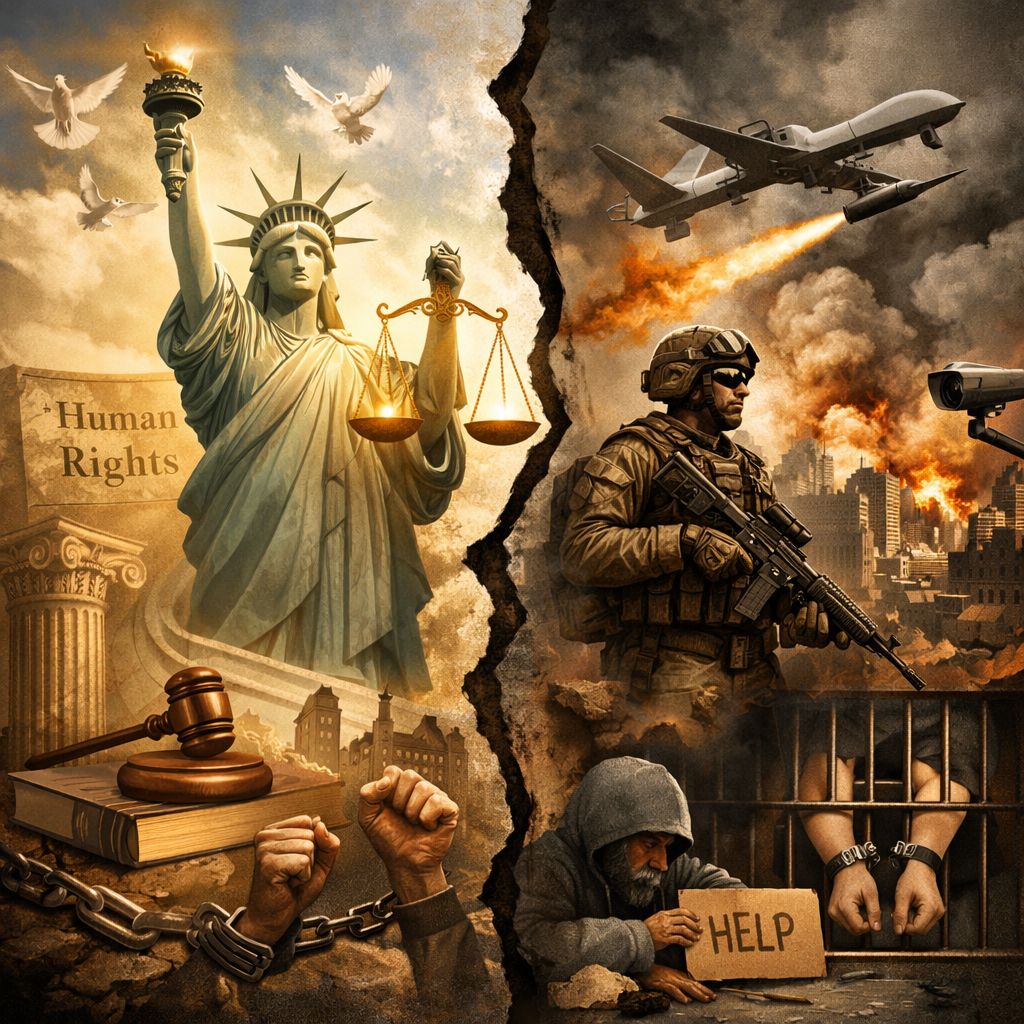
The West presents itself as the highest moral stage of civilization. It speaks in the language of human rights, dignity, restraint, and universal values. Moreover, it exports this language through diplomacy, media, academia, and international institutions. Therefore, moral superiority does not remain an internal belief. It becomes a global standard against which other societies are judged.
At the same time, this claim carries power. It legitimizes interventions. It shapes alliances. It defines who stands as civilized and who stands as backward. Consequently, morality merges with geopolitics.
However, a tension appears immediately. Principles promise limits. Power resists limits. Ideals demand restraint. Interests demand flexibility. Therefore, the central question emerges. Does Western morality truly constrain behavior, or does it adapt itself whenever strategic necessity appears?
The theoretical ideal: Morality as restraint
Western morality begins with a strict claim. Some actions must never occur. Therefore, the system sets absolute limits on behavior.
First, no torture. Not even caning. Pain must not serve governance. Consequently, human dignity stands above utility.
Second, freedom of speech. Individuals must criticize power without fear. Therefore, truth emerges through confrontation.
Third, freedom of thought. No authority may dictate belief. Instead, individuals must reach conclusions through reasoning.
Fourth, no death penalty. The state must not take life. Consequently, justice must not mirror violence.
Fifth, peace over war. Conflicts must resolve through diplomacy. Therefore, war represents failure, not strategy.
Sixth, maximizing survival. Systems must protect life above all. Consequently, healthcare, safety, and stability become priorities.
Finally, rule of law. Everyone stands equal before it. Therefore, justice must apply without exception.
At this level, the system appears internally consistent. It rejects instinctive retaliation. Instead, it elevates abstract principles above immediate gain.
Philosophical roots: Rights above power
These ideals did not emerge randomly. They developed through centuries of philosophical struggle.
John Locke argued that individuals possess natural rights. Governments exist to protect them.
Immanuel Kant argued that humans must never serve merely as means. Every individual holds intrinsic value.
Later, global frameworks such as the United Nations codified these principles into international norms.
Institutionalization: Turning morality into systems
Institutionalization turns morality into systems. Courts limit executive power. Media expose wrongdoing. Civil society monitors abuse. International law binds states.
Therefore, morality moves beyond theory. It gains structure, enforcement, and legitimacy.
Contradiction one: No torture vs “refined coercion”
The principle states zero tolerance.
However, practice introduces reinterpretation. “Enhanced interrogation.” Psychological pressure. Sensory deprivation. Legal definitions shift.
Operations linked to CIA show how the system adapts. Therefore, torture does not disappear. It becomes less visible and more technical.
Contradiction two: Freedom of speech vs managed discourse
The theory promises unrestricted expression.
However, reality shows suppression. Praxis shows freedom of speech under pressure. It is suppressed. You can go to prison for certain forms of speech. Platforms regulate content. Legal frameworks expand. Social pressure enforces conformity.
Therefore, speech operates within enforced boundaries, not absolute freedom.
Contradiction three: No death penalty vs indirect killing
The West rejects execution within courts.
However, it conducts drone strikes, targeted killings, and military operations. These actions bypass judicial processes. Moreover, prolonged conflicts and interventions in the Middle East have contributed to deaths on a massive scale, with millions affected directly or indirectly through war, displacement, and collapse of infrastructure.
Therefore, the method changes. The principle does not fully hold. Death occurs without formal sentencing.
Contradiction four: Peace vs permanent intervention
Peace stands as a core value.
However, repeated interventions in Iraq, Afghanistan, and Libya show continuous reliance on force.
Each intervention claims moral justification. Yet outcomes often include instability and prolonged conflict.
Therefore, peace becomes conditional. War becomes instrumental.
Contradiction five: Maximizing survival vs strategic sacrifice
The system claims to protect life.
However, policies accept casualties. Military planning includes collateral damage. Sanctions harm civilian populations.
Therefore, survival becomes selective. Some lives matter more within strategic calculations.
Contradiction six: Rule of law vs power asymmetry
The theory insists on equality before the law.
However, power distorts application. Strong states shape international law. Weak states face enforcement without influence.
Therefore, law reflects hierarchy, not pure equality.
Contradiction seven: Democracy vs elite influence
Democracy defines Western identity.
However, lobbying, financial power, and elite networks influence decisions. Voters participate, yet outcomes reflect concentrated interests.
Therefore, democracy operates within limits imposed by power structures.
Contradiction eight: Universal human rights vs selective enforcement
Human rights claim universality.
However, enforcement depends on alliances. Violations by adversaries trigger outrage. Violations by allies often bring silence or justification.
Moreover, human rights remain selective. Economic rights receive less attention and often fall outside practical enforcement.
The right to work exists on paper, yet unemployment persists. Poverty continues even in wealthy societies. Homelessness appears alongside empty housing and rising property wealth.
Social safety nets differ and often fail to prevent deprivation. Access to healthcare depends on income. Housing remains a market commodity.
Therefore, survival becomes conditional. It reflects economic position rather than universal protection.
Contradiction nine: Freedom of thought vs narrative control
The theory allows independent thinking.
However, institutions shape perception. Education, media, and culture guide acceptable viewpoints.
Therefore, thought remains formally free, yet structurally influenced.
Contradiction ten: Moral universalism vs lack of enforcement abroad
The West promotes universal moral standards.
However, it does not consistently use its power to enforce these standards globally. Severe human rights violations persist in many regions without intervention. Strategic interests determine action or inaction.
Therefore, morality becomes optional in international practice. It applies selectively, not universally.
Structural explanation: Incentives over ideals
These contradictions follow structural logic.
States pursue survival and influence. Elites maintain power networks. Institutions balance ideals with pressure.
Therefore, morality competes with incentives. Incentives often prevail.
Psychological layer: Preserving moral identity
Societies maintain belief in moral superiority.
People reinterpret actions as necessary. Violence becomes protection. Intervention becomes responsibility.
Therefore, contradiction appears justified rather than acknowledged.
Why the system persists
Despite inconsistencies, the system continues.
Public criticism exists. Investigations expose abuse. Courts intervene.
These mechanisms create partial correction. They prevent total collapse.
Conclusion: Superiority as tension, not fact
Western moral superiority exists clearly in theory. It defines strict limits and high ideals.
However, praxis reveals repeated deviation. War, coercion, inequality, and selective morality persist.
Therefore, superiority exists as tension, not reality. A system that claims universal morality while continuously negotiating with power.
Leave a Reply