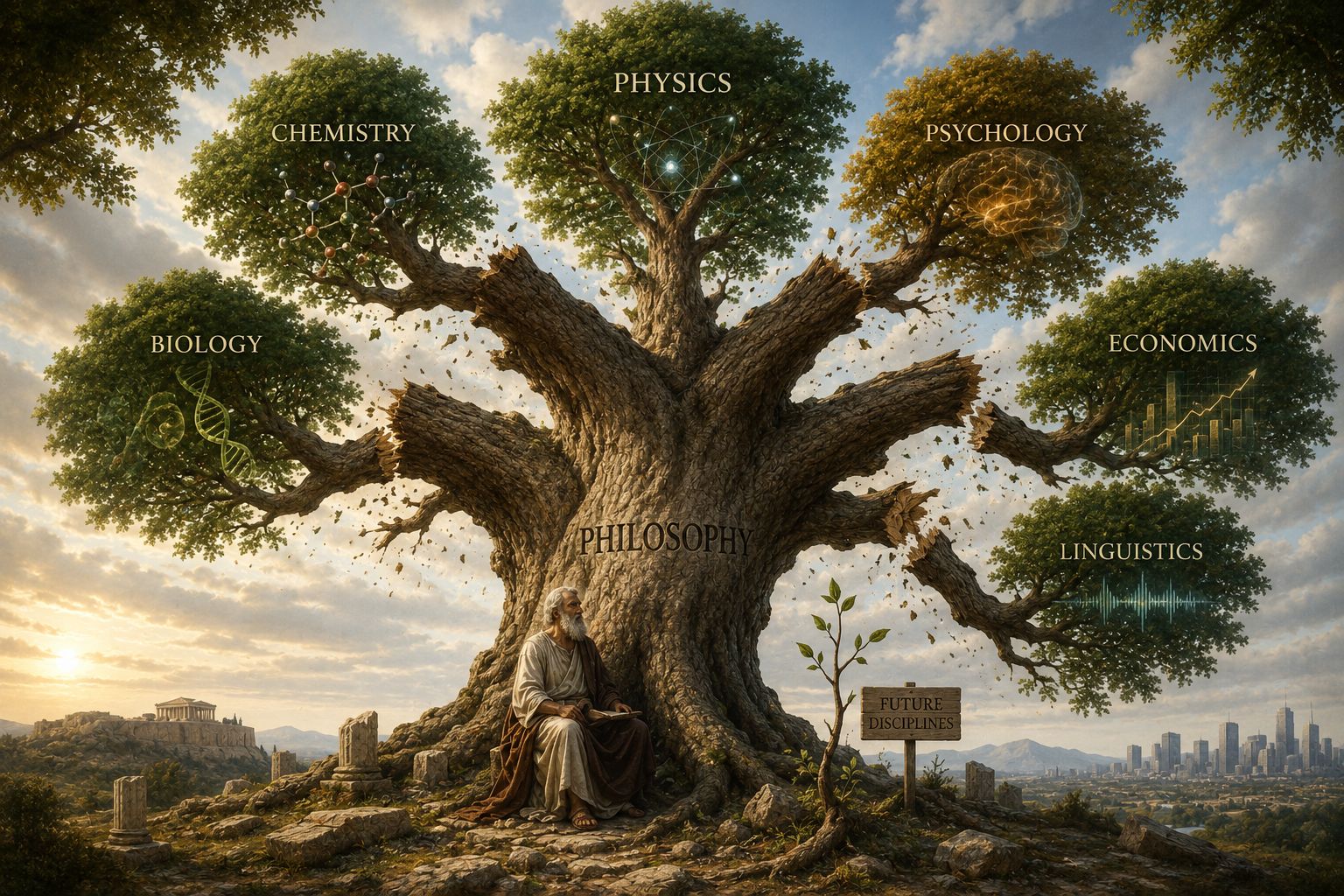
There is another explanation for why philosophy still exists. It is one of the most controversial ideas in the philosophy of science. According to this view, philosophy has not failed because it cannot answer questions. Rather, it continuously transforms into science whenever reliable methods become available. In other words, philosophy is not a permanent discipline. It is a temporary stage in humanity’s search for knowledge.
Supporters of this idea argue that philosophy investigates questions before they become scientifically answerable. Once they can be tested through observation, experiment, or mathematics, they cease to be philosophical questions. They become scientific ones. The process is often summarized by a memorable phrase: “Yesterday’s philosophy becomes today’s science.”
It is an elegant theory. It is also highly controversial.
Philosophy was once almost everything
Modern readers often forget that science did not always exist as a separate enterprise. For much of history, there were no physicists, psychologists, economists, or linguists in the modern sense. There were philosophers.
The ancient Greeks made little distinction between philosophy and what we now call science. Aristotle wrote about logic, ethics, politics, biology, zoology, astronomy, psychology, and physics. To him, these subjects formed parts of a single intellectual endeavor.
The same pattern continued for centuries. René Descartes discussed mathematics, optics, mechanics, physiology, and metaphysics without drawing the sharp disciplinary boundaries familiar today. Isaac Newton, now regarded as one of history’s greatest physicists, did not even describe himself as a physicist. The word “scientist” would not be coined until the nineteenth century. His masterpiece was titled Philosophiæ Naturalis Principia Mathematica—Mathematical Principles of Natural Philosophy. Today, we simply call it physics.
The gradual separation
Supporters of the “shrinking philosophy” thesis point to a recurring historical pattern. A philosophical question is debated for decades or centuries. Competing schools develop different theories. Arguments accumulate, but no consensus emerges. Eventually, someone develops reliable methods for testing the competing ideas. At that point, the subject separates from philosophy and becomes an independent science.
Natural philosophy became physics. Questions about gravity, planetary motion, electricity, light, and the structure of the universe gradually moved from philosophical speculation into laboratories and observatories. Mathematical models and experiments replaced purely conceptual arguments.
The same happened with psychology. For thousands of years, philosophers debated memory, perception, intelligence, emotions, and learning. During the nineteenth century, however, researchers such as Wilhelm Wundt began investigating these questions experimentally. Psychology gradually established itself as an independent empirical science.
Economics followed a similar path. Adam Smith and John Stuart Mill regarded economics as part of moral philosophy. Modern economics, by contrast, relies heavily on statistics, mathematical modeling, econometrics, and controlled experiments.
Political science underwent a comparable transformation. Questions that Plato, Aristotle, Hobbes, Locke, and Rousseau approached philosophically are now also investigated through surveys, statistical analysis, formal modeling, and empirical research.
Linguistics, too, developed into an independent discipline with its own methods. More recently, cognitive science emerged at the intersection of philosophy, psychology, neuroscience, computer science, and linguistics.
Again and again, philosophy appears to lose territory as specialized sciences gain it.
Philosophy as the parent of science
Seen from this perspective, philosophy resembles the trunk of a great tree. Over time, branch after branch grows large enough to separate from it. Physics becomes independent. Psychology becomes independent. Economics becomes independent. Linguistics becomes independent. The trunk grows smaller, yet it continues producing new branches.
This historical pattern has led some thinkers to argue that philosophy functions primarily as the incubator of science. Its role is not necessarily to provide final answers. Instead, it formulates questions, develops concepts, and refines methods until empirical investigation becomes possible. Once reliable scientific techniques emerge, the discipline effectively graduates from philosophy.
Bertrand Russell expressed a related idea when he described philosophy as occupying the territory between theology and science. Questions that eventually receive definite answers, he argued, typically become part of science rather than remaining philosophy. W. V. O. Quine likewise rejected a sharp boundary between philosophy and science, arguing that philosophical inquiry forms part of the same continuous enterprise of understanding reality.
Neither Russell nor Quine claimed that philosophy would eventually disappear altogether. Nevertheless, both saw philosophy and science as much more closely connected than many traditional philosophers were willing to admit.
An even stronger claim
Some critics take the argument much further. They suggest that philosophy exists only because the relevant sciences have not yet matured. According to this stronger version of the thesis, philosophy is essentially a waiting room for future sciences. Whenever a field develops reliable empirical methods, it leaves philosophy permanently.
If neuroscience were someday to explain consciousness completely, philosophy of mind might disappear. If objective methods for resolving ethical questions were discovered, moral philosophy might eventually become another empirical discipline. If psychology, neuroscience, and artificial intelligence fully explained human knowledge, epistemology might likewise leave philosophy.
Taken to its logical conclusion, this view suggests that philosophy could one day shrink dramatically or even disappear almost entirely. Every major scientific breakthrough would reduce the range of questions that remain philosophical.
It is a bold idea. It is also one that many philosophers strongly reject.
The strongest objection
Critics of the “shrinking philosophy” thesis argue that it confuses two fundamentally different kinds of questions. Science investigates how the world works. Philosophy often investigates what concepts mean, which conclusions follow logically from given premises, or what people ought to do.
Science can explain how the brain processes information. It cannot determine what counts as knowledge. Science can describe why people make moral judgments. It cannot, by itself, establish whether those judgments are objectively correct. Likewise, science relies on concepts such as evidence, logic, probability, explanation, and rationality. Many philosophers argue that examining those concepts is itself a philosophical task.
From this perspective, philosophy cannot simply disappear because science itself rests upon philosophical foundations. Every scientific discipline presupposes assumptions about reasoning, evidence, and explanation that cannot all be established through experiment alone.
A debate with no consensus
The idea that philosophy gradually transforms into science remains one of the most intriguing and controversial theories about the nature of philosophy itself. It explains an undeniable historical pattern: many modern sciences did indeed emerge from subjects once regarded as branches of philosophy.
Whether this process will continue indefinitely, however, remains unknown. Perhaps philosophy will continue shrinking as science advances. Perhaps some philosophical questions will always remain beyond the reach of experiments. Or perhaps entirely new sciences will emerge from philosophical debates that today seem impossible to resolve.
Ironically, even this disagreement has never been settled. The question of whether philosophy is gradually disappearing is itself a philosophical question.
Leave a Reply