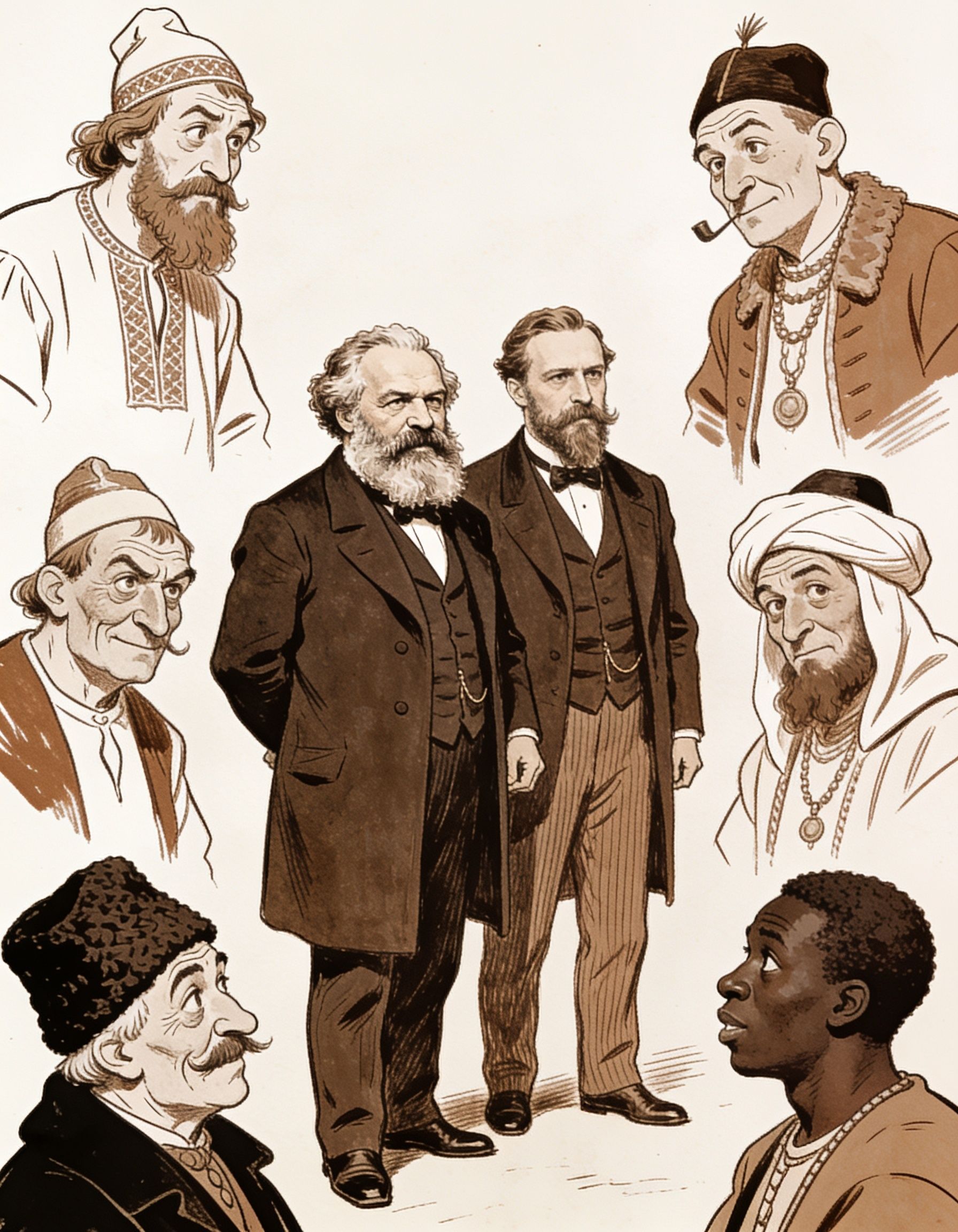
Karl Marx and Friedrich Engels presented themselves as thinkers concerned with exploitation, inequality and human emancipation. Their writings helped inspire political movements that claimed solidarity between workers regardless of nationality.
Read some of their other writings, however, and the picture becomes considerably uglier. Marx and Engels occasionally wrote about Jews, Black people and entire Slavic nations in language that would now be recognized as racist, antisemitic or ethnically chauvinistic.
This does not mean that Marxism can simply be reduced to racism. Nor does it mean that every offensive quotation circulating online is authentic. In fact, some remarks attributed to Marx were written by Engels.
The genuine material is disturbing enough without inventing anything.
Marx and the Jews
Marx himself came from a family of Jewish ancestry. His father converted to Christianity before Marx’s childhood baptism. Yet Marx’s 1844 essay On the Jewish Question contains passages that rely heavily on stereotypes associating Jews with money, commerce and selfishness.
Marx asks:
“What is the worldly religion of the Jew? Huckstering. What is his worldly God? Money.”
He goes on to describe money as the “jealous god of Israel” and associates Judaism with practical need and egoism. Near the conclusion, Marx writes that the emancipation of society would amount to its emancipation from Judaism.
There is an important philosophical context. Marx was not simply writing a racial manifesto against Jewish people. He was responding to Bruno Bauer’s arguments about Jewish emancipation and using Judaism as part of a broader attack on money, private interests and capitalist civil society.
That context matters. It does not, however, make the stereotypes disappear.
Marx repeatedly takes characteristics traditionally attributed to Jews—money worship, commerce, selfishness—and incorporates them into his criticism of capitalism. Whatever theoretical meaning he intended, passages such as “the worldly God” of the Jew being money sound strikingly similar to antisemitic stereotypes that existed long before Marx and survived long after him.
Defenders of Marx therefore have a legitimate point when they say that simply extracting a sentence from the essay can distort his argument. Critics have an equally legitimate reason to ask why an advocate of human emancipation chose Jews and Judaism as vehicles for stereotypes about money and selfishness in the first place.
Marx and racist abuse
Marx’s private correspondence can be considerably harder to defend as complicated philosophical argument.
His political rivalry with socialist Ferdinand Lassalle produced particularly vicious personal attacks. In an 1862 letter to Engels, Marx used racist language about Lassalle, combining references to his Jewish background with an offensive racial slur for Black people. He also speculated about Lassalle’s supposed African ancestry on the basis of his appearance.
This was not a sophisticated critique of capitalism hidden behind uncomfortable nineteenth-century terminology. It was personal racial abuse.
That distinction matters because historical context can explain language without magically making its meaning disappear. Racist thinking was widespread in nineteenth-century Europe, but Marx was not merely recording somebody else’s prejudice. In private correspondence, he was willing to use racial characteristics as material for humiliating an opponent.
The contradiction is striking. A thinker whose political philosophy emphasized social structures and material conditions could still resort to crude ideas about ancestry and physical appearance when insulting somebody he despised.
Engels and the Slavs
Some of the most shocking statements associated with Marxism’s founders concern Slavic peoples. Here accuracy is especially important because many of these statements came from Friedrich Engels, not Marx.
Following the revolutionary upheavals of 1848, Engels regarded several Slavic national movements within the Habsburg Empire as counterrevolutionary forces. His hostility was political, but he expanded it into sweeping judgments about entire peoples.
In Democratic Pan-Slavism in 1849, Engels argued that, with limited exceptions, Slavic peoples lacked a future because they supposedly lacked the historical, geographical, political and industrial conditions required for independent existence. He singled out Austrian Slavs and discussed Czechs, Moravians and Slovaks in extraordinarily dismissive terms.
He even argued that the Czechs had effectively never possessed a history of their own and treated their aspirations for independence with contempt. South Slavic peoples received similar treatment. Croats, Slovenes and others were presented not primarily as millions of individual human beings but as historical remnants standing in the way of revolutionary progress.
History subsequently made this supposed historical certainty look absurd.
Czechs and Slovaks established Czechoslovakia in 1918. Slovenia and Croatia are independent states today. These societies developed modern economies, political institutions, universities, industries and national cultures despite Engels’s confidence that some of them lacked the conditions for viable national existence.
The irony is particularly strong because Marxism claimed to possess an unusually scientific understanding of historical development. Engels was making enormous predictions about the destiny of entire peoples, and history did not politely cooperate.
When historical progress becomes dehumanizing
The deeper problem is not merely that Marx and Engels occasionally used offensive words. Their theories could encourage them to divide political movements into forces of historical progress and historical reaction.
Once an entire nation was placed on the wrong side of that equation, individual people could disappear behind an abstraction. Czechs were no longer simply people with different political opinions. A whole nation could instead be characterized according to its supposed historical usefulness.
That is an extremely dangerous way to think about humanity.
People do not lose their moral worth because their government supports the wrong empire, because some members of their ethnic group oppose a revolution or because an intellectual decides that history no longer requires their nation.
The same principle applies today. Russians are not Vladimir Putin. Israelis are not Benjamin Netanyahu. Palestinians are not Hamas. Americans are not Donald Trump. Collective moral judgment is intellectually lazy precisely because enormous populations contain millions of different people with different beliefs and different degrees of political power.
Marx and Engels were often capable of analyzing structural forces with extraordinary ambition. At other moments, however, their language reduced complicated populations to crude categories.
Historical context explains; it does not erase
One obvious defense is that Marx and Engels were nineteenth-century Europeans. Racism, antisemitism, nationalism and theories of ethnic hierarchy were widespread in their intellectual environment.
That is true and should be acknowledged.
We should not pretend that two men born around 200 years ago naturally shared twenty-first-century assumptions about ethnicity and race. Reading historical figures entirely through contemporary vocabulary can produce bad history.
But context works both ways.
The nineteenth century also contained abolitionists, advocates of religious tolerance, opponents of antisemitism and people capable of recognizing the humanity of populations different from themselves. Prejudice being common does not make every prejudiced statement morally neutral.
More importantly, Marx and Engels were not ordinary men whose worldview we remember only because they happened to leave behind some letters. They proposed sweeping theories about human emancipation and profoundly influenced political movements around the world.
It is therefore entirely reasonable to examine whether their own language lived up to their universalist ambitions.
Sometimes it plainly did not.
Marx was not Hitler—and that is not the point
There is also a danger of turning legitimate criticism into historical caricature.
Quoting Marx’s offensive comments does not establish that Marxism is equivalent to Nazism. Marx did not develop a political program for exterminating Jews or Black people. Likewise, Engels’s appalling rhetoric about Slavic peoples should be analyzed in the political context of the revolutions of 1848 rather than transformed into something he never wrote.
We do not need such exaggerations.
Marx’s actual words about Jews are uncomfortable enough. His racist private abuse is ugly enough. Engels’s sweeping dismissal of Slavic peoples is extraordinary enough.
Historical criticism becomes stronger, not weaker, when we distinguish between what these men really said and what later opponents claim they said.
Nobody should be intellectually untouchable
Perhaps the most useful lesson has little to do with Marxism itself.
Political movements have a tendency to turn intellectual heroes into secular saints. Supporters carefully contextualize every ugly sentence, while opponents remove every sentence from context. Both approaches begin with the desired verdict and work backward.
Marx and Engels deserve better treatment than that—and so do their victims.
Their contributions to economics, sociology, philosophy and political thought can be studied without pretending that everything they wrote was admirable. Their criticism of exploitation does not cease to exist because Marx made racist remarks. Conversely, writing Capital does not transform an antisemitic stereotype into an acceptable one.
Great thinkers can have disgusting prejudices. Advocates of liberation can dehumanize other people. Brilliant analysis in one area does not guarantee moral wisdom in another.
Marx and Engels wanted humanity to question the structures inherited from the past.
There is no reason they themselves should be exempt from the same scrutiny.
Leave a Reply