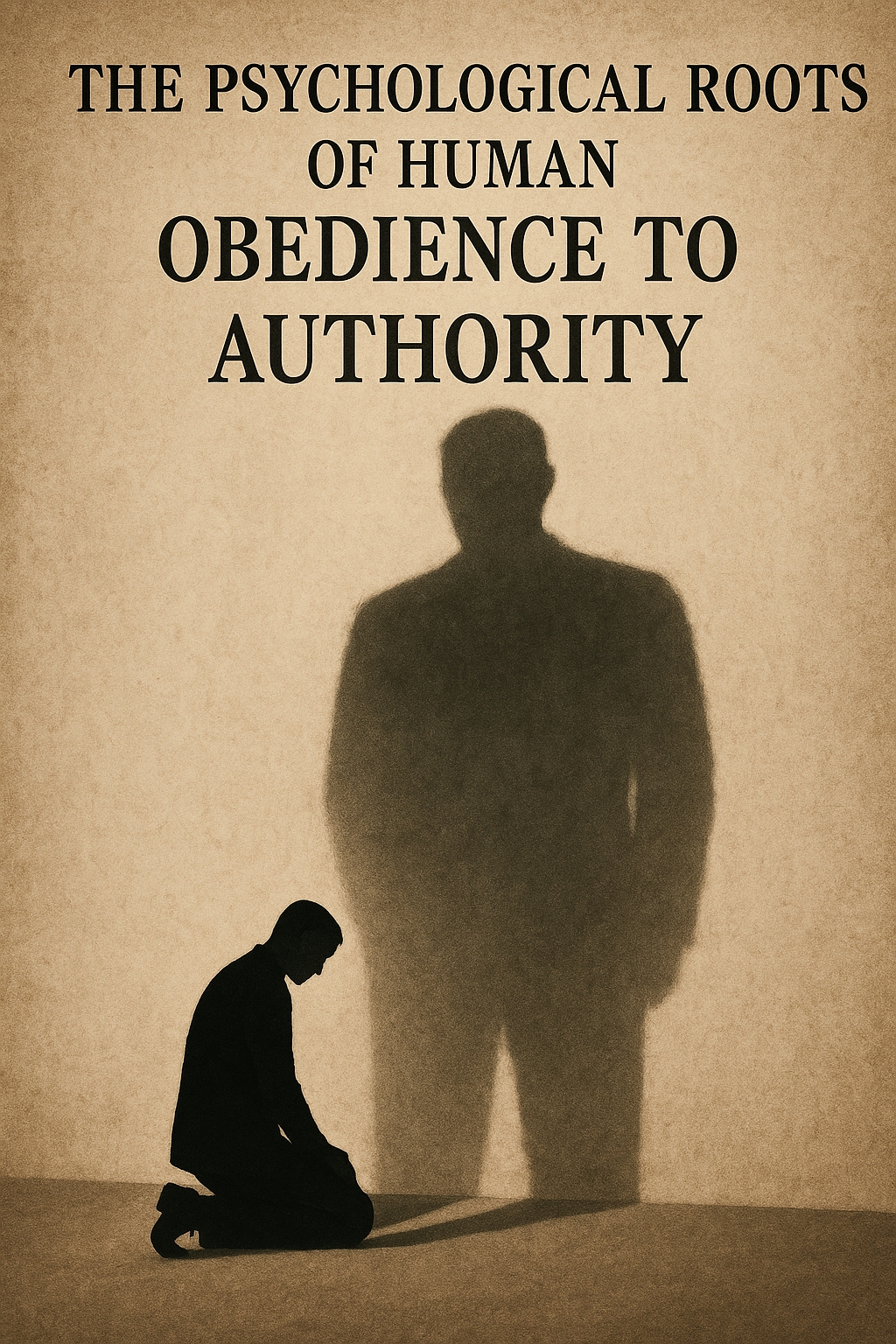
Obedience to authority defines human civilization. Yet it also explains humanity’s darkest moments. Every institution—from armies and churches to corporations and governments—depends on obedience to survive. However, the same force that maintains order can also destroy moral judgment. From the earliest tribal leaders to modern dictators, obedience has been both a survival strategy and a moral trap. Therefore, understanding why humans obey—even against their conscience—is essential for understanding the structure of power itself.
The evolutionary origins of submission
To begin with, obedience evolved as a tool for survival. In prehistoric tribes, cooperation required hierarchy. Following a dominant leader meant better coordination during hunting, defense, or migration. Those who rebelled often endangered the group. Consequently, evolution favored individuals who submitted to authority, because obedience increased survival chances. Among primates, similar hierarchies still exist. Subordinates yield to leaders to avoid conflict or gain protection. Humans inherited these instincts. Over time, submission became not only an external act but also an inner comfort—a psychological adaptation to group living.
Moreover, the human brain is wired to sense rank and dominance. Neuropsychological studies reveal that people instantly detect authority cues such as tone, posture, and gaze. The amygdala triggers respect or fear depending on status signals. At the same time, oxytocin strengthens trust in high-ranking figures within a group, while mirror neurons make individuals subconsciously imitate leaders’ gestures and emotions. Consequently, humans do not only obey consciously; they feel obedience biologically. This ancient neural network helps explain why charisma, uniforms, or confidence can command automatic submission.
The Milgram experiment and the shock of obedience
In the modern era, Stanley Milgram’s famous experiment in the 1960s revealed how deeply this instinct persists. Ordinary people, under the direction of an authority figure in a white lab coat, administered what they believed were lethal electric shocks to another person. Despite hearing screams, two-thirds continued to the end. The finding was shocking: authority can override empathy. People do not need hatred to harm others—they only need permission. Milgram described this as an “agentic state,” where individuals stop seeing themselves as moral agents and instead act as instruments of authority.
The banality of evil: Hannah Arendt and bureaucratic obedience
Furthermore, Hannah Arendt provided a philosophical dimension to this finding. Observing Adolf Eichmann’s trial, she concluded that evil often appears banal—committed not by monsters, but by ordinary individuals following orders. Bureaucratic systems reinforce this. Rules replace conscience, and responsibility becomes invisible. In such structures, moral thinking collapses because no one feels personally accountable. Modern bureaucracies—from corporations to governments—still rely on this diffusion of responsibility. Therefore, evil continues to operate quietly, hidden behind paperwork and procedures.
Religion as obedience training
In addition, religion amplified obedience into sacred duty. Early societies merged divine and political authority, portraying rulers as chosen by gods. Disobedience thus became not only a crime but a sin. Religious systems perfected obedience through fear of punishment and hope for reward. Faith demanded trust without evidence. Doctrines such as divine command and eternal judgment turned submission into moral virtue. Across centuries, priests and kings used the same psychological mechanism: obey, and you will be safe. This religious conditioning later merged with political obedience, making rebellion feel like blasphemy.
Beyond that, humans obey because they fear chaos. The brain craves predictability. Authority provides structure, especially in times of crisis. When war, famine, or uncertainty strike, obedience rises sharply. People surrender autonomy for stability. Leaders who promise order easily exploit this instinct. Historically, authoritarian figures—from emperors to populists—rose by offering security in exchange for submission. Thus, fear of disorder becomes a powerful emotional lever that sustains tyranny.
The roots of obedience begin early. From infancy, humans learn that adults control survival—food, warmth, and protection. Parents represent absolute authority, and children internalize obedience as safety. Schools reinforce this pattern by rewarding compliance and punishing defiance. Step by step, obedience becomes a habit rather than a choice. Attachment theory explains that children bond with those who hold power over them. Later in life, this emotional blueprint transfers to employers, leaders, or political figures. Therefore, obedience feels natural, even when reason disagrees.
Collective identity and moral outsourcing
In social settings, obedience multiplies. Once people act as part of a group, they delegate moral responsibility to leaders or institutions. Psychologist Albert Bandura called this moral disengagement—justifying harmful acts as serving a higher purpose. Similarly, Solomon Asch’s conformity experiments showed that individuals will knowingly follow wrong opinions if others do. The need to belong overpowers the need to think. Therefore, obedience and conformity fuse into a dangerous synergy: individuals stop evaluating morality and instead imitate the group’s behavior.
Modern manifestations: corporations, politics, and military obedience
In contemporary society, obedience remains the foundation of hierarchy. Soldiers are trained to execute orders without hesitation In the military. In corporations, employees follow directives even when they contradict personal ethics. In politics, loyalty to party leaders often outweighs truth. Each system rewards obedience and punishes dissent. The face of authority may change—from monarchs to managers—but the psychology stays the same. Bureaucracy turns moral decisions into procedures. Algorithms and hierarchies now replace divine will, yet both demand submission. Whistleblowers who refuse to obey show how costly resistance remains.
Breaking obedience: the psychology of dissent
Nevertheless, some individuals resist. Throughout history, dissenters have broken ranks, often at great personal risk. Their psychology reveals crucial differences. They display high moral reasoning, strong autonomy, and empathy that surpasses fear. They rely on internal principles rather than external orders. Examples include whistleblowers, revolutionaries, and freethinkers who refused to participate in injustice. Evolutionarily, such dissenters play a corrective role—they balance the herd instinct with independent thought. Without them, moral progress would stop, and societies would stagnate under unquestioned authority.
Conclusion
In conclusion, obedience to authority is both an evolutionary gift and a moral danger. It allowed humans to build civilizations, but it also enabled slavery, genocide, and dictatorship. It offers safety but kills responsibility. From tribal survival to modern bureaucracy, the instinct to obey has remained constant. Therefore, the future of moral civilization depends not on eliminating authority, but on questioning it. Progress begins when humans learn to balance order with conscience, loyalty with reason, and hierarchy with truth. Only then can obedience serve humanity instead of enslaving it.
Leave a Reply