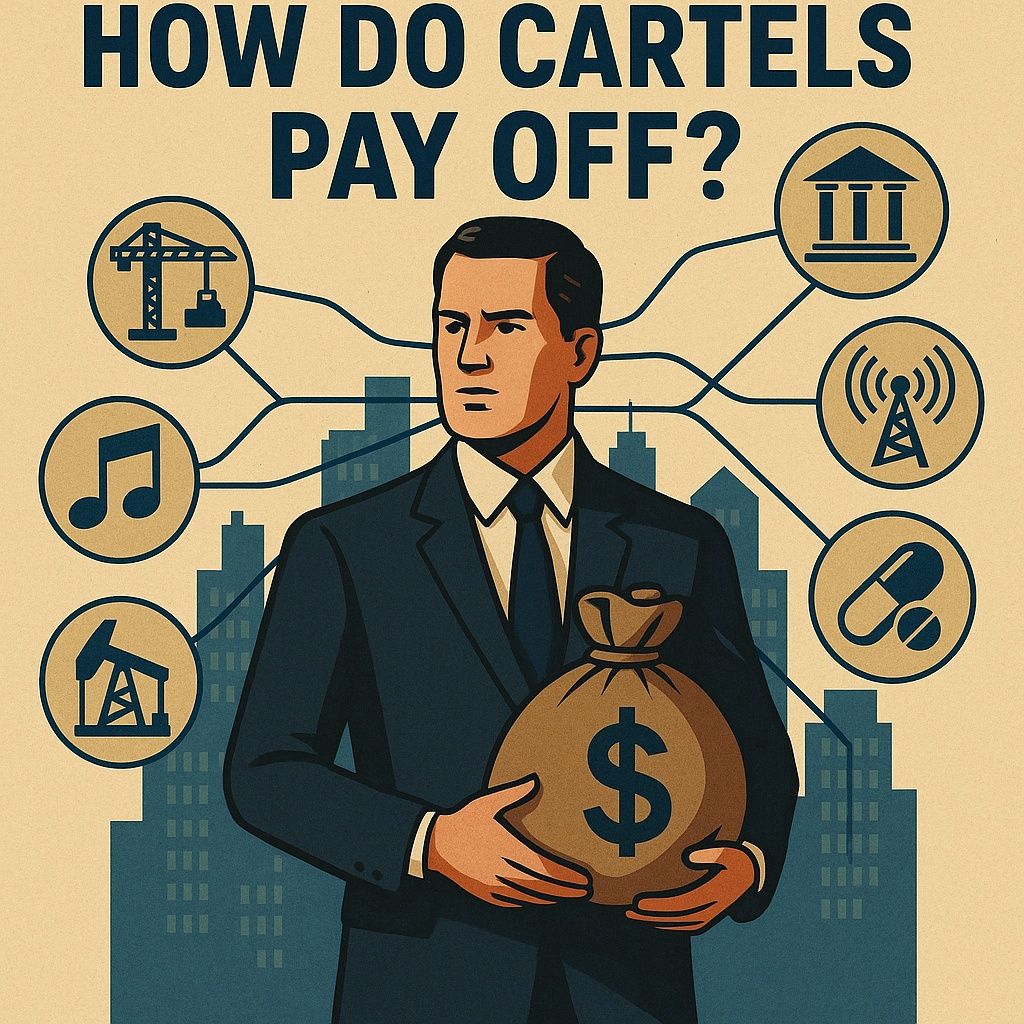
Cartels are not relics of the past. They are not drug lords in jungles, they wear suits, hold bank accounts, and speak at summits. They exist in every major industry — finance, telecommunications, construction, energy, pharmaceuticals, and even entertainment. Their language is formal, their documents clean, and their crimes almost impossible to detect.
A cartel is not only about fixing prices. It is about fixing power. The payoffs are subtle: consulting fees, exclusive rights, delayed enforcement, quiet protection. Every major cartel shares one instinct — to control the flow of money without looking criminal.
Cartels form when markets mature and profits shrink. Competition becomes dangerous, uncertainty too costly. The players who survive decide to cooperate instead of compete. They disguise it as “strategic partnership,” “market coordination,” or “self-regulation.”
Their real aim is to freeze the game. Keep newcomers out. Make regulators their friends. Capture data, control supply, and set prices. The structure looks legal. The outcome is not.
Their language hides intent. They say “align pricing strategies” instead of “fix prices.” Also, they say “industry standardization” instead of “market division.” They say “public-private cooperation” instead of “corruption.”
The invisible engineers of the cartel
Cartels do not act through CEOs alone. They operate through layers of deniability. Lawyers draft contracts that hide collusion behind complex legal terms. Accountants design structures that move money without raising suspicion. Auditors confirm compliance but never question motives.
Then come the lobbyists and “industry experts.” They host panels, sponsor think tanks, and fund research. Every report they produce supports the cartel’s interests. It looks like public policy. It is private defense.
Consultants play a double role. They design efficiency strategies for governments while working for the companies those governments are supposed to regulate. The result is a system built by the culprits for their own oversight.
Banks – The cartel of cartels
Banks are not only cartel members. They are the cartel’s bloodstream. They move money, design tax shelters, and structure payoffs under professional cover.
Interest-rate cartels like LIBOR and EURIBOR show how deeply systemic collusion can be. Global banks coordinated benchmark rates that affected trillions. They did not need meetings in secret rooms. A few emails were enough.
When fines came, they were symbolic. The money paid returned through government bailouts or indirect subsidies. The same executives kept their bonuses. No one went to prison.
Banks also protect corporate cartels. They help disguise ownership through offshore accounts; they set up shell companies under trust names. They use correspondent banking to move funds across jurisdictions where investigations stop at national borders.
Sometimes they even act as “consultants” for regulators, advising how to design compliance that they later exploit. It is not just conflict of interest. It is a legalized symbiosis.
Mobile operators – Paying for the invisible network
Telecom cartels form in silence. Frequencies, infrastructure, and data routes are limited. The fewer the players, the higher the control.
When governments auction spectrum, operators coordinate bids through intermediaries. Some hire the same lobbying firms. Others share legal advisors who “accidentally” leak information. A few agree to divide territories — one takes urban areas, another rural.
They also collude through “roaming fees” and “interconnect agreements.” Regulators often approve because they do not understand the complexity. The result is an illusion of competition. Prices never drop, and innovations appear slower than technology allows.
Even equipment suppliers join the network. Contractors inflate tower-building costs, and consulting firms receive “performance fees” for projects that never finish. Behind every telecom giant stands a trail of silent payoffs.
The music undustry – Payola never died
In the music world, cartel logic wears art as a mask. Major labels dominate distribution, playlists, and live venues. They pay radio stations and streaming services to promote certain songs, sometimes through intermediaries who issue fake invoices for “marketing campaigns.”
Royalty systems are built to confuse. Every contract uses complex percentages, deductions, and recoupable expenses. Artists rarely see what they earned. Accounting departments can hide millions under “foreign collection fees.”
Large artists sometimes become cartel enforcers. They are given exclusive sponsorships and festival slots, keeping outsiders excluded. When independent musicians gain traction, they are quietly offered “distribution partnerships” — effectively absorption.
Even award ceremonies and algorithmic playlists follow the same logic: favor those who play along, erase those who ask questions.
Pharmaceuticals – Collusion disguised as science
Drug cartels are not underground. They are multinational corporations with glossy advertisements and humanitarian slogans. They control access to healthcare by manipulating research, pricing, and patents.
The most lucrative practice is “pay-for-delay.” A company holding a drug patent pays competitors not to release generics. Patients pay higher prices for years while the deal hides behind “settlement agreements.”
Then there is influence-buying. Pharmaceutical firms fund medical conferences, “continuing education,” and ghostwritten research papers. Doctors who prescribe their drugs receive speaking fees, grants, or future consulting roles.
The real corruption lies in guideline formation. Medical associations rely on corporate funding to survive. Those who pay decide what becomes a “standard of care.” Regulation is captured before it begins.
Construction and procurement – The public loot
Public construction is paradise for cartels. The projects are large, the rules complex, and the oversight weak. Companies coordinate bids, take turns winning, and compensate losers through subcontracting.
Officials are paid through “success fees” or inflated “consulting” contracts. Sometimes they receive positions in foundations that exist only on paper.
One common trick is the “change order.” After winning a contract cheaply, the company later claims “unforeseen costs.” Prices rise quietly. Everyone gets their cut.
Many governments proudly announce “transparency portals,” but these systems often hide more than they reveal. Data are incomplete, contracts are redacted, and penalties are minor.
How cartels hide the payoffs
The money rarely travels in straight lines. It moves through trust funds, investment vehicles, offshore subsidiaries, and pseudo-charities.
One popular technique is invoice layering. A consultant charges a company for services never rendered, takes a small fee, and forwards the rest to the intended recipient. The chain of companies makes the trail almost impossible to follow.
Another is “donation laundering.” A company donates to a charity that later funds a project linked to the regulator or politician who granted them a contract. On paper it looks altruistic. In reality, it is repayment.
Some cartels use art and collectibles as payment channels. A painting or sculpture is “sold” at an inflated price to move funds discreetly. Others rely on cryptocurrency transfers through decentralized exchanges — fast, untraceable, and borderless.
The role of auditors, ratings, and media
Independent oversight often becomes dependent profit. Auditors rely on long-term clients, so they rarely expose wrongdoing. Rating agencies give high scores to firms they also consult. Media companies depend on advertising revenue, so they avoid investigating sponsors.
This soft corruption is the most dangerous. It builds the illusion of accountability while removing its substance. Everyone appears professional. No one is honest.
The patterns and red flags
Cartels always leave patterns. Identical bids, synchronized price increases, identical contract clauses, sudden wealth of officials, or coordinated lobbying on obscure regulations.
Watch for revolving doors — regulators who suddenly become board members. Follow donations before elections. Study procurement data for circular rotations of winners. The proof lies in repetition.
Why they risk everything
Because the rewards are immense. A small coordination in price can yield billions. Legal risk is low. Fines are smaller than profit margins. Jail is rare.
Cartel members also believe they are untouchable. They sponsor universities, fund campaigns, and sit on advisory councils. They see themselves not as criminals, but as “stabilizers of markets.” Their language hides their greed.
The real cost – Democracy on sale
When cartels dominate, democracy fades. Prices rise. Innovation slows. Citizens lose trust in institutions. Governments turn into clients of private power.
The damage is not only economic. It becomes cultural. Societies learn that honesty is naïve, that law is flexible, that justice is negotiable. People stop believing in merit. They start believing in connections.
How to break them
There is no single solution. Only transparency and courage. Governments must publish every contract, every bid, every ownership. Whistleblowers must be rewarded, not punished. Journalists must follow money instead of press releases.
Banks must reveal beneficial owners, not just clients. Regulators must rotate staff to avoid capture. Civil society must teach economic literacy — how to read numbers, tenders, and reports. Knowledge is the strongest disinfectant.
Each citizen must understand that cartels thrive on ignorance. They pay off because we do not ask questions. Once light reaches them, their shadow power weakens.
The real secret – Collusion Is the default
The world does not run on competition. It runs on alliances. Corporations, regulators, and financiers form an ecosystem where favors replace fairness. The greatest secret of cartels is that they do not see themselves as cartels. They believe they are maintaining order.
Yet every empire collapses once it starts believing its own lies. That collapse begins when the public starts counting, connecting, and asking who profits.
Conclusion – The price of silence
Cartels teach one cruel lesson: legality is negotiable, morality optional, transparency fatal. Their money flows through respectable institutions, their faces appear on magazine covers, and their crimes pass as economic strategy.
To break them, one must expose not their crimes, but their structure. Follow the consultants, the auditors, the charities, and the intermediaries. There, the true payoff lies.
Leave a Reply