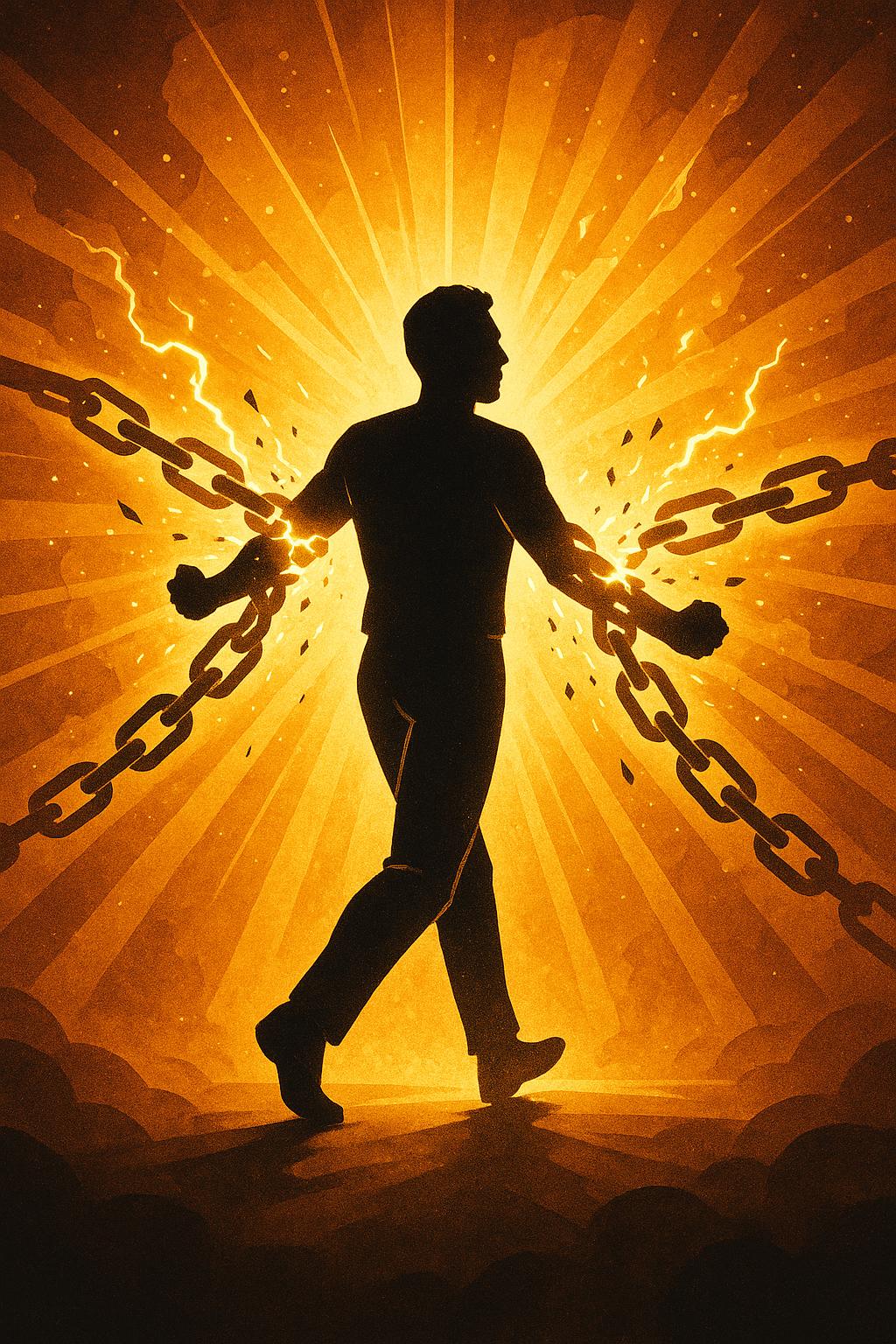
Leaving a religious community is not merely an act of disbelief. It is a psychological, social, and existential transformation. It dismantles everything that once gave meaning to life — the rituals, the people, the identity, and the idea of purpose. To walk away from religion is to face the void directly, without the comfort of divine supervision or collective reassurance. It is both liberation and mourning. For many, the mind does not simply adapt — it must rebuild itself from ruins.
Breaking the bond of belief
Religion imprints itself on the brain early. From childhood, the mind learns to associate divine obedience with safety, belonging, and moral worth. Prayer, confession, or ritual become not just acts of faith but neurological patterns. The believer feels rewarded when they conform and punished when they doubt. These associations become automatic.
When faith collapses, the brain loses its internal compass. Doubt feels like guilt. Disagreement feels like sin. Cognitive dissonance — the clash between what one feels and what one knows — becomes overwhelming. This is why many people stay inside systems they intellectually reject: the psychological cost of leaving feels unbearable. Yet once one crosses the line, the mind experiences shock and disorientation. It is the emotional equivalent of exile.
Humans evolved to live in tribes. Religion, for millennia, functioned as the most powerful tribal bond. It offered security, belonging, and identity. To abandon it means to abandon the group’s approval — and in many cases, to lose family, friends, and status. The former believer becomes a threat to the social fabric, a reminder that belief is optional.
In many religious groups, apostasy equals betrayal. Ex-Mormons are labeled spiritually diseased. Former Jehovah’s Witnesses are “disfellowshipped” and shunned. In Islamic countries, leaving Islam can mean prison or death. Even in secular societies, ex-believers can face subtle rejection, pity, or distrust. This isolation causes emotional distress comparable to grief. Psychologists describe this as “social death” — the body lives, but the old social identity dies.
The loneliness that follows is not just absence of people. It is the loss of shared language. Suddenly, old expressions, festivals, and values lose meaning. Conversations that once flowed now feel hollow. The ex-believer must build a new world of words and meanings.
Identity reconstruction
After leaving, the central question becomes: who am I without faith? Religion once provided an entire identity — moral, social, and cosmic. Without it, there is emptiness. This is not weakness; it is the psychological reality of deconstruction. The process of rebuilding begins slowly.
Some turn to philosophy or science to fill the void. Others seek political or humanitarian causes to give life purpose. Some simply take time to heal before creating a new worldview. The transformation often follows a pattern: shock, guilt, grief, exploration, and eventually, self-definition. It mirrors the stages of recovery from psychological trauma, because in many ways, it is one.
Identity reconstruction involves not just what to believe, but how to live. Moral autonomy replaces divine command. Choice replaces obedience. Over time, the ex-believer learns to rely on conscience rather than scripture. Many discover they can still be moral, empathetic, and purposeful — perhaps more so — without fear of divine punishment.
The role of guilt and fear
Religious guilt is a deep neural imprint. For years, many believers internalize ideas of sin, judgment, and eternal punishment. These concepts become automatic responses. Even when disbelief takes hold, the emotional residue remains. A former Christian might still fear hell. An ex-Muslim might still feel watched by God. The conscious mind rejects the doctrine, but the subconscious has not yet caught up.
This conflict often manifests as anxiety, nightmares, or intrusive thoughts. Psychologists liken it to post-traumatic stress. The fear of divine retribution, drilled from childhood, does not vanish easily. It requires unlearning — a process of reprogramming thought patterns through introspection, therapy, and time.
Religious institutions also exploit fear as control. By depicting the outside world as corrupt or doomed, they create psychological dependency. Leaving then becomes an act of defiance, not just against God, but against one’s own survival instincts. Overcoming this fear is perhaps the hardest step toward freedom.
Emotional liberation and growth
When the fear fades and the guilt dissolves, something extraordinary happens. The mind, once bound by dogma, begins to stretch. For years, belief controlled not just behavior but thought itself. Every doubt had to be suppressed, every question redirected toward faith. Once that control disappears, the brain starts to explore again. It rediscovers curiosity — that ancient instinct that religion had disciplined into obedience.
Intellectual freedom often comes first. The former believer begins to read, study, and compare ideas without the filter of divine authority. Philosophy, science, psychology, and history suddenly feel alive. Questions that were once taboo become exhilarating. This period can feel like intellectual adolescence — a second birth of the mind. Yet it is more than knowledge; it is ownership of thought. One realizes that truth does not come from sacred books but from honest inquiry.
Emotional freedom follows more slowly. Many ex-believers describe a period of numbness, as if their emotional vocabulary has collapsed. Religion had provided ready-made meanings for love, guilt, forgiveness, and fear. Without it, these emotions must be redefined. Over time, however, emotional life becomes more authentic. Love is no longer tied to divine approval. Guilt arises from conscience, not commandments. Forgiveness becomes an act of empathy, not obedience. This emotional independence is the true foundation of maturity.
Moral creativity
Leaving religion also reawakens moral creativity. People who once measured good and evil by scripture start asking deeper questions: What truly harms? What truly helps? They begin to construct morality from human experience — empathy, suffering, cooperation, and fairness. This is not moral relativism; it is moral responsibility. Without divine authority, the individual must think ethically, not just conform. Many discover that secular ethics are not weaker but stronger because they rest on compassion rather than fear.
The transformation also changes relationships. Former believers often report that their bonds become more genuine. They no longer love people for sharing beliefs but for who they are. This shift builds tolerance and humility. The world becomes more complex, but also more human. Difference stops being a threat and becomes a source of understanding.
At a deeper level, emotional liberation is about reclaiming ownership of the self. Religion often splits the individual — the “pure” soul versus the “sinful” body, the “divine will” versus human desire. After leaving, this inner conflict begins to heal. Pleasure, creativity, and individuality stop being sins and start being expressions of life. The mind no longer has to censor itself. Desire no longer needs to apologize.
The new self-awareness
This new self-awareness also changes the perception of suffering. In religion, pain is often framed as punishment or divine test. Outside religion, it becomes a natural part of existence — not moral failure, but reality. This recognition brings resilience. The ex-believer learns that strength does not come from prayer but from persistence, empathy, and understanding of the human condition.
Over time, the emotional liberation of leaving faith evolves into something larger — a form of psychological growth that transcends religion entirely. Many ex-believers describe a profound sense of authenticity. They are no longer pretending. They no longer divide life into sacred and profane, pure and impure, chosen and damned. The world regains its natural texture — complex, uncertain, yet profoundly beautiful.
That is the paradox of leaving religion. It feels like losing everything, but it often leads to finding oneself. It strips away illusions, yet replaces them with freedom. The path is not easy, but it leads to a deeper, more honest form of peace — one that no scripture can grant, and no priest can take away.
The need for support systems
Recovery from religion should not be faced alone. Humans need new tribes — ones built on understanding, not conformity. Support groups for ex-believers, both online and in person, help normalize doubt. Secular therapy can help disentangle trauma from belief. Community projects and secular social spaces can provide new belonging without dogma.
Unfortunately, society often fails to recognize this need. Many assume leaving religion is easy or purely intellectual. In reality, it is emotional surgery. What is required is empathy from both believers and non-believers. Understanding that deconversion is not rebellion but reconstruction can transform how societies treat those who leave.
Conclusion
Leaving a religious community is a psychological revolution. It dismantles deep identity layers, confronts fear, and redefines morality. It is painful but transformative. Those who go through it experience both death and rebirth — the death of one world and the creation of another.
To leave religion is not to lose meaning. It is to reclaim the power to create it. The ex-believer stands alone at first, but later stands stronger — aware that meaning was never given by gods, but built by the human mind itself.
Leave a Reply