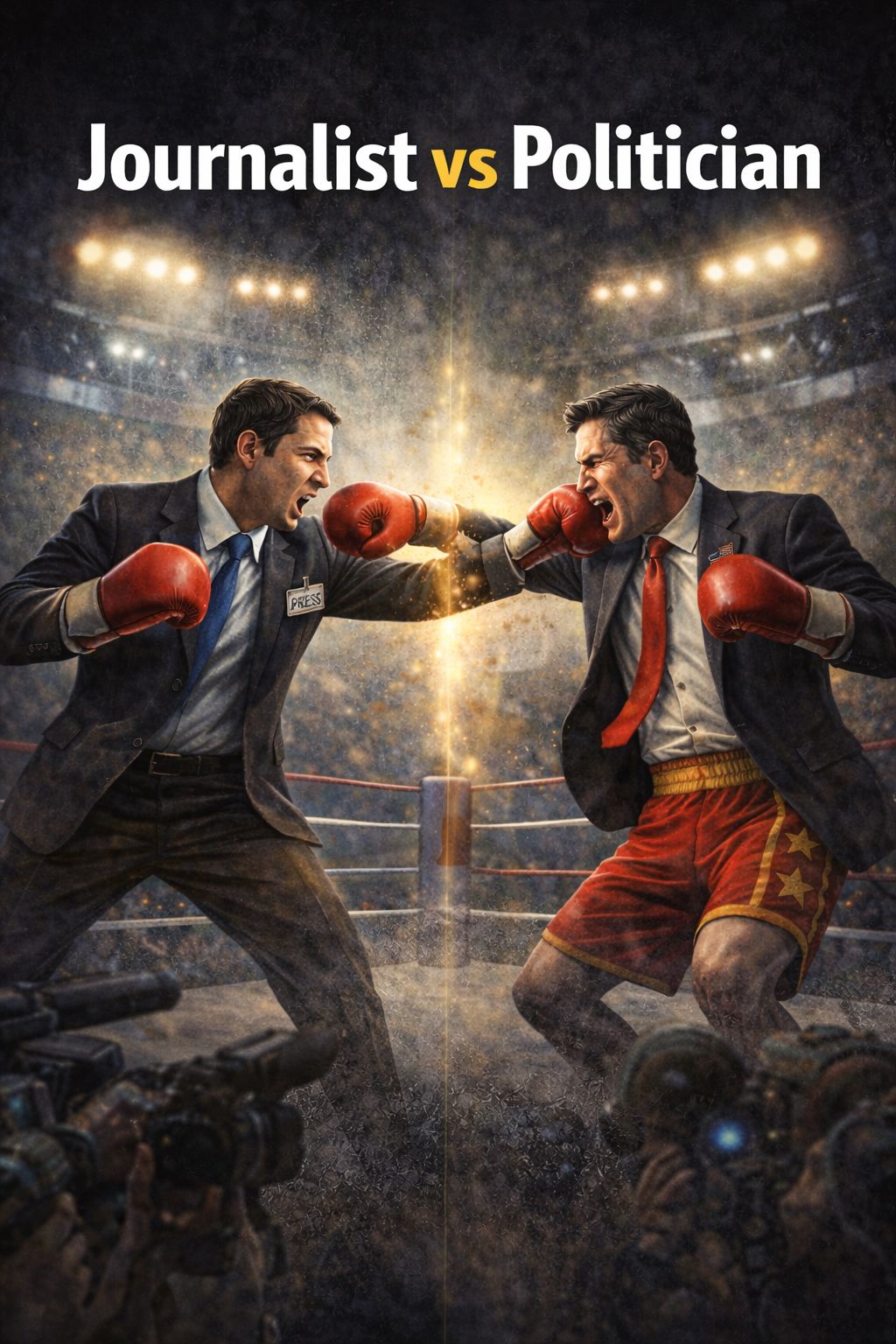
Journalists and politicians present themselves as opposing forces. One claims to expose power. The other claims to exercise it. Therefore, conflict defines their public image.
However, this conflict often conceals alignment. Both groups operate within the same system. Both depend on access, resources, and networks. Consequently, the real question does not concern who fights harder. It concerns who adapts more to the influence of the super-rich.
The original claim: Politicians as the “lesser problem”
One may argue that politicians perform better in absolute terms. Even when they pretend, they still act. They pass laws. They implement policies. They shape outcomes.
By contrast, journalists often only describe. Worse, they omit or distort. Therefore, in absolute terms, politicians may appear more useful.
However, this comparison rewards output. It values action over influence. Once we remove this factor, the comparison shifts. The real issue becomes dependence on elite power.
Removing output: Redefining the comparison
A fair comparison must isolate susceptibility. Politicians produce decisions. Journalists produce narratives. These outputs differ fundamentally.
Therefore, the evaluation must focus on constraints. Who relies more on elite networks? Who aligns more closely with the interests of the super-rich?
Only then does the comparison gain clarity.
The Czech perspective: Mutual moral superiority
A Czech journalist once described the relationship clearly. Journalists believe they are better than politicians. Politicians believe they are better than journalists.
Consequently, both groups construct moral hierarchies. Each claims legitimacy. Each dismisses the other.
However, this symmetry reveals something deeper. If both claim superiority, yet neither demonstrates independence, then the difference narrows. Therefore, the conclusion emerges: they are largely the same.
The real variable: The super-rich as the common constraint
The decisive factor does not lie in personality or profession. It lies in structure. The super-rich define the boundaries within which both groups operate.
They control capital, access, and influence. They shape incentives. Therefore, both journalists and politicians must adapt.
Consequently, their rivalry becomes secondary. The primary relationship connects both to elite power.
The United States: Media access versus campaign finance
In the United States, the distinction appears through different mechanisms.
Politicians depend on campaign financing. Elections require enormous resources. Therefore, donors, corporations, and financial networks gain influence. Access to power often follows funding.
At the same time, journalists depend on access to sources. Political insiders provide information. Corporations provide advertising revenue. Therefore, media organizations avoid alienating key actors.
Moreover, large media ownership structures concentrate influence further. Corporate interests shape editorial boundaries. Consequently, systemic critique remains limited.
France: Centralized power and elite reproduction
In France, elite formation follows a centralized path. Political and media elites often emerge from the same educational networks.
Graduates of École nationale d’administration circulate between administration, politics, and media. Therefore, boundaries blur.
Politicians and journalists share social circles and norms. Consequently, alignment does not require pressure. It emerges from shared background.
At the same time, major media groups connect to industrial and financial interests. Therefore, economic power reinforces this cohesion.
Germany: Corporatism and structured cooperation
In Germany, the system reflects corporatist traditions. Institutions coordinate interests between business, labor, and the state.
Politicians operate within negotiated frameworks. Therefore, direct confrontation with economic elites remains limited.
Journalists function within structured media environments. Public broadcasters coexist with private ownership. However, large corporations still influence the landscape.
Consequently, influence becomes institutionalized rather than eliminated.
Italy: Media ownership and political fusion
In Italy, the relationship between media and politics becomes even more direct.
The career of Silvio Berlusconi illustrates this fusion. He controlled major television networks while holding political power. Therefore, the boundary between journalism and politics collapsed.
Media ownership concentrated in few hands shapes public narratives. At the same time, political actors maintain close ties with business elites. Consequently, influence operates both structurally and personally.
This creates a system where journalism and politics do not merely align. They overlap.
Different mechanisms, same outcome
Across these countries, mechanisms differ. The United States emphasizes finance and access. France emphasizes elite reproduction. Germany emphasizes institutional coordination. Italy demonstrates direct overlap between media and political power.
However, the outcome converges. Both journalists and politicians operate within constraints shaped by the super-rich.
Therefore, the question “who succumbs more” becomes complex. Each group adapts in different ways.
Evolutionary explanation: Status, risk, and adaptation
From an evolutionary perspective, both professions attract individuals sensitive to status and hierarchy. Success depends on navigating complex social structures.
Politicians seek power directly. Journalists seek influence through information. However, both must maintain their position within networks.
Challenging elite structures creates risk. It threatens careers, access, and stability. Therefore, adaptation becomes rational.
Consequently, both groups converge toward similar behavioral patterns.
Moral and ethical framing: The illusion of independence
Both journalists and politicians construct moral narratives. Journalists emphasize truth and accountability. Politicians emphasize representation and responsibility.
However, these narratives obscure dependence. They create the illusion of independence.
Therefore, moral claims often function as justification rather than accurate description.
So who succumbs more?
If we include output, politicians may appear more valuable. They act. They produce decisions.
However, once we remove output and focus on dependence, the difference narrows significantly.
Journalists shape perception under constraints. Politicians shape policy under constraints. Both align with elite influence in different forms.
Therefore, neither group clearly dominates in susceptibility.
Conclusion: The conflict is a distraction
The visible conflict between journalists and politicians attracts attention. It suggests opposition and accountability.
However, this conflict distracts from the deeper structure. Both groups operate within systems shaped by the super-rich.
Therefore, the real issue does not concern which group is worse. It concerns the system that constrains both.
Leave a Reply