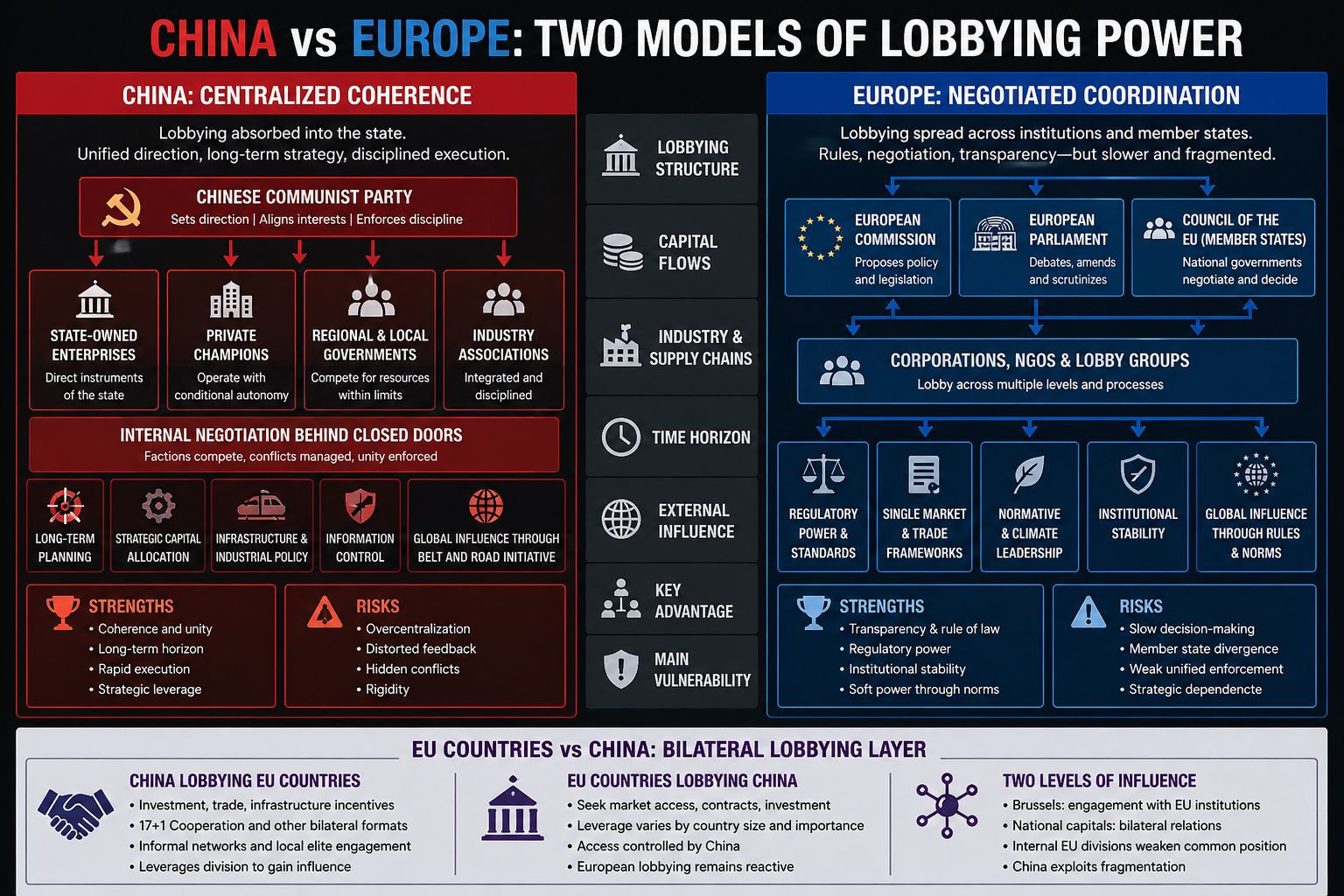
At first glance, China and Europe organize influence in fundamentally different ways. On the one hand, China integrates lobbying into the state. On the other hand, Europe distributes lobbying across institutions and member states. Therefore, the contrast does not lie in whether lobbying exists. Rather, it lies in how power structures absorb or disperse it.
At the center of the Chinese system stands the Chinese Communist Party. It does not simply govern. Instead, it coordinates direction across sectors. Moreover, it aligns interests when needed. At the same time, it enforces discipline when required. As a result, the boundary between state, corporation, and strategy becomes blurred.
By contrast, the European Union operates through layered governance. In this case, institutions negotiate. Meanwhile, member states bargain. In addition, corporations lobby across multiple levels. Therefore, Europe produces structured complexity rather than unified direction.
China: Lobbying absorbed into the state
First, China does not eliminate interest groups. Instead, it absorbs them. More precisely, it disciplines them. At the same time, it integrates them into a shared strategic framework.
State-owned firms act as direct instruments. Meanwhile, private companies operate within political limits. For example, firms like Alibaba Group and Tencent grow rapidly. However, they remain aware of boundaries. Consequently, they adjust behavior accordingly.
Therefore, lobbying in China does not take the form of external pressure. Rather, it becomes internal negotiation. Actors compete, yet within defined limits. They influence outcomes, yet under supervision.
China: Internal factions and enforced coherence
However, unity in China is not natural. Instead, it is constructed. On the one hand, regional governments compete for investment. On the other hand, provincial actors seek priority. At the same time, Party factions build networks of influence.
Nevertheless, these conflicts do not vanish. Rather, they move behind closed doors. For instance, campaigns that target corruption remove inefficiencies. At the same time, they remove rivals. Thus, power shifts without public confrontation.
Under Xi Jinping, centralization intensified. Consequently, authority consolidated. Yet, importantly, factionalism did not disappear. Instead, it became more costly. It also became less visible.
Therefore, China does not eliminate conflict. Instead, it compresses it. In turn, it transforms open competition into controlled rivalry. External unity emerges from internal constraint.
China: Strengths and structural risks
As a result of this structure, clear advantages emerge. First, China acts with coherence. Second, it plans long-term. Third, it executes decisions rapidly. In addition, it directs resources into strategic sectors.
However, the same structure creates risks. For example, feedback can distort as information flows upward. Moreover, overcentralization can lead to misallocation. At the same time, hidden conflicts can accumulate beneath the surface.
Therefore, China trades flexibility for control. In other words, it gains direction. Yet, at the same time, it risks rigidity.
Europe: Lobbying through institutions and layered governance
By contrast, Europe follows a different logic. Here, lobbying does not disappear. Instead, it becomes institutionalized.
The European Commission proposes policy. Then, the European Parliament debates and amends it. Meanwhile, member states negotiate outcomes within the Council.
At the same time, corporations, NGOs, and governments all participate. Therefore, influence flows through procedures. As a result, decisions emerge from negotiation rather than command.
Europe: Strengths and structural constraints
Consequently, this system produces clear strengths. It increases transparency. It anchors decisions in rules. It stabilizes outcomes over time.
However, it also imposes limits. First, decision-making slows down. Second, member states diverge. Third, enforcement weakens when consensus breaks.
Therefore, Europe trades speed for legitimacy. In other words, it gains procedural stability. Yet it loses strategic unity.
Capital flows: Direction versus regulation
At a deeper level, capital reveals structural differences.
In China, financial flows align with state goals. The People’s Bank of China operates within a coordinated framework. Consequently, credit flows into infrastructure, manufacturing, and strategic sectors.
By contrast, in Europe, capital operates under regulation rather than direction. Rules shape behavior. However, no single authority fully allocates capital across the system.
Therefore, China directs capital. Meanwhile, Europe shapes conditions. One system channels resources. The other constrains them.
Supply chains and industrial positioning
Furthermore, China dominates key segments of global production. It processes rare earths. It manufactures at scale. It controls critical intermediate goods.
At the same time, Europe maintains strong industrial capacity. However, it depends on external inputs in several sectors. Consequently, this creates exposure.
As a result, supply chains become instruments of power. China gains leverage through control. Meanwhile, Europe faces vulnerability through dependence.
Time horizon and strategic planning
Another crucial factor is time.
China operates with long-term horizons. It tolerates delayed returns. It prioritizes positioning over immediate profit. As a result, planning extends across decades.
In contrast, Europe operates through negotiated timelines. Member states seek agreement. Policies reflect compromise. Therefore, planning becomes medium-term.
Thus, China moves with direction. Meanwhile, Europe moves with consensus. One accelerates. The other stabilizes.
External influence: Infrastructure versus regulation
In addition, China projects influence through structure. The Belt and Road Initiative extends infrastructure across regions. Ports, railways, and networks reshape economic geography.
By contrast, Europe projects influence through rules. Regulation defines standards. Consequently, companies worldwide adapt to comply.
Therefore, China builds systems. Meanwhile, Europe sets frameworks. One reshapes the environment. The other defines its boundaries.
EU countries vs China: Bilateral lobbying layer
At this point, a crucial layer emerges. China does not treat Europe as a single actor. Instead, it engages individual member states.
Therefore, lobbying becomes bilateral. Moreover, it becomes asymmetric. China negotiates separately with different countries.
Meanwhile, Europe attempts to act collectively. However, internal differences weaken this effort.
China lobbying EU countries
China uses multiple channels simultaneously. First, investment creates incentives. Second, trade strengthens ties. Third, infrastructure builds dependency.
Through frameworks such as 17+1 Cooperation, China engages specific regions directly. Even as formats evolve, the underlying logic persists.
In addition, local elites benefit from cooperation. Businesses gain access. These actors then influence domestic policy.
Therefore, China does not impose directly. Instead, it shapes incentives. In doing so, it leverages fragmentation.
EU countries lobbying China
At the same time, European countries also lobby China. However, their position differs significantly.
They seek market access. They pursue contracts. They attempt to secure better conditions.
Larger economies hold more leverage. Smaller states hold less. Nevertheless, access remains controlled by China.
Therefore, European lobbying becomes reactive. In essence, it responds to conditions set elsewhere.
Brussels versus national capitals
Consequently, influence operates on two levels.
In Brussels, China interacts with EU institutions. It responds to regulation. It engages policy frameworks.
At the same time, it works with national governments. Decisions in Berlin, Paris, or Budapest shape broader outcomes.
Therefore, lobbying does not occur in one arena. Instead, it spans institutional and national levels simultaneously.
Internal EU division as a strategic factor
Importantly, Europe does not act uniformly. Member states prioritize different goals.
Some emphasize trade with China. Others emphasize strategic autonomy. As a result, these differences shape policy outcomes.
China uses this divergence. It does not need full agreement. Partial division is sufficient to weaken consensus.
Therefore, internal structure becomes a channel for external influence.
European counter-strategy
In response, Europe has begun to act. The European Union develops investment screening mechanisms. It strengthens regulatory tools. It promotes strategic autonomy.
However, implementation depends on member states. Consequently, alignment remains incomplete.
Therefore, Europe reacts through rules. Yet coordination still limits effectiveness.
Informal networks and influence channels
Beyond formal structures, influence also operates informally.
China uses Party-linked networks and state-aligned business ties. Europe relies on institutional channels and lobbying frameworks.
Thus, both systems contain informal elements. However, their structure differs. One integrates them centrally. The other disperses them.
Structural vulnerabilities
Ultimately, each system carries risks.
China risks rigidity. Centralization can distort information. Hidden conflict can accumulate.
Europe risks fragmentation. Decision-making slows. Dependence persists.
Therefore, strength and weakness emerge from the same structural foundations.
Conclusion: Coherence versus negotiation
In conclusion, the contrast becomes clear.
China represents centralized coherence. Europe represents negotiated coordination.
On the one hand, one system aligns and executes. On the other hand, the other balances and legitimizes.
Therefore, the key question remains open. Can Europe overcome fragmentation, or will China continue to exploit it through structure and strategy?
Leave a Reply