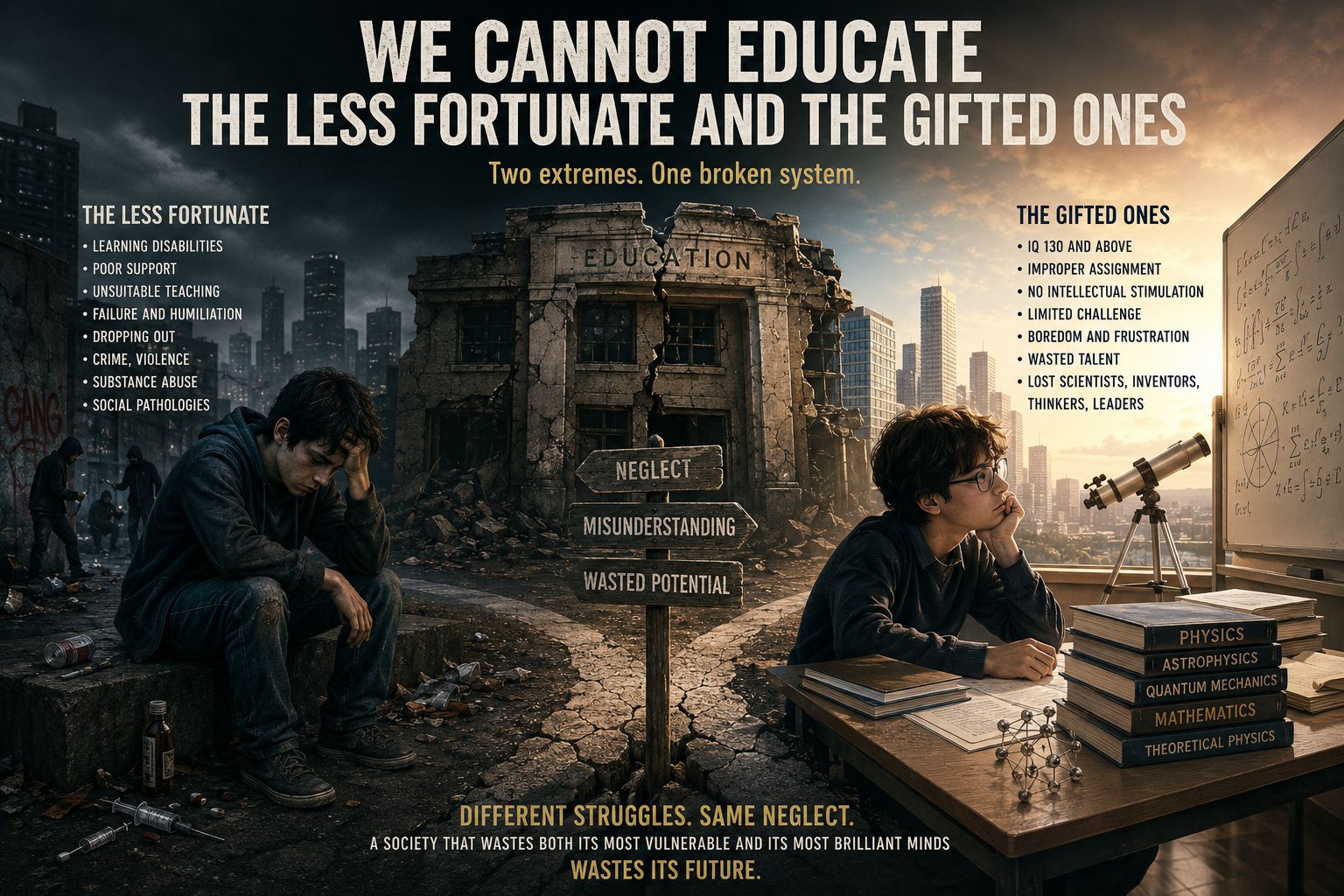
Modern education constantly speaks about equality, opportunity, and human potential. Schools promise social mobility. Politicians promise inclusion. Experts promise innovation. However, the reality looks very different.
On one side stand students with learning disabilities, lower cognitive abilities, unstable family backgrounds, trauma, or behavioral problems. Many of them slowly collapse inside the system. They fail classes. They lose motivation. Eventually, many drop out of high school entirely. Consequently, society later faces crime, violence, addiction, unemployment, and social pathology.
On the other side stand intellectually gifted students. IQ 130, 140, or even higher. These individuals often receive almost no specialized stimulation either. Teachers rarely challenge them properly. Schools rarely provide advanced intellectual environments. Therefore, enormous scientific, technological, and philosophical potential disappears.
Thus, the paradox emerges clearly. Modern systems fail both the weakest and the strongest.
The myth that one educational model fits everyone
Education systems usually operate on standardization.
Large groups enter classrooms. One teacher stands before twenty or thirty students. The same curriculum applies to everyone. The same pace dominates the classroom. The same tests evaluate radically different minds.
However, human cognition does not work uniformly.
Some students process information slowly. Others absorb concepts almost instantly. Some struggle with memory. Others struggle with attention. Meanwhile, gifted students may understand the entire lesson before the teacher even finishes explaining it.
Therefore, one educational model inevitably produces casualties.
Teachers are not the best of the best
Society often pretends teachers represent intellectual excellence. However, the profession frequently suffers from low prestige, limited salaries, bureaucracy, exhaustion, and mediocre selection mechanisms.
This does not mean teachers are evil people. Many genuinely try to help. Nevertheless, the system rarely attracts the absolute best minds at a large scale.
The highest-IQ individuals often move toward finance, technology, medicine, engineering, elite science, entrepreneurship, or prestigious corporate sectors. Consequently, education systems lose many potential exceptional educators before they ever enter classrooms.
Moreover, even talented teachers often become crushed by administration, oversized classrooms, ideological pressure, standardized testing, and psychological burnout.
Therefore, education frequently becomes management rather than intellectual development.
Students with learning disabilities: Left to their fate
The system particularly fails vulnerable students.
Children with dyslexia, ADHD, autism spectrum conditions, processing disorders, lower IQ, trauma histories, unstable homes, or emotional problems often require individualized approaches. However, schools rarely possess enough specialists, enough time, or enough resources.
As a result, these students begin experiencing repeated failure very early.
Failure then creates humiliation. Humiliation creates frustration. Frustration creates behavioral problems. Eventually, many students detach emotionally from school itself.
Some stop trying entirely.
Others begin associating with destructive peer groups. Substance abuse appears. Aggression appears. Criminality sometimes follows. Therefore, educational failure transforms into wider social instability.
The tragedy becomes even deeper because many of these individuals never truly received effective educational intervention in the first place.
High school dropout and the road toward pathology
Dropping out of high school rarely exists as an isolated event.
Instead, it often reflects cumulative systemic failure.
Low academic performance combines with social exclusion. Social exclusion combines with hopelessness. Hopelessness then increases impulsive behavior, addiction risk, gang involvement, violence, or criminal activity.
Moreover, modern economies increasingly punish low educational attainment. Consequently, individuals without qualifications face unstable labor markets, lower income, worse housing, poorer healthcare access, and greater psychological stress.
Thus, educational collapse later reappears inside prisons, addiction clinics, psychiatric institutions, and dysfunctional neighborhoods.
Society then spends enormous amounts of money managing consequences rather than preventing them early.
The gifted students are abandoned too
At the same time, highly intelligent students often experience a completely different form of neglect.
A student with IQ 130 or 140 may sit in classrooms that move painfully slowly. Lessons become repetitive. Curiosity dies. Intellectual hunger disappears.
Some gifted students begin underperforming deliberately to fit socially into peer groups. Others become isolated, cynical, depressed, or detached from school entirely.
Moreover, schools frequently mistake giftedness for arrogance, boredom, behavioral problems, or emotional instability.
Consequently, many highly gifted individuals never receive proper intellectual cultivation.
Improper assignment and wasted potential
Gifted students often require radically different stimulation.
They may need accelerated programs, advanced reading materials, specialized mentors, scientific projects, philosophical discussion, mathematical abstraction, or interdisciplinary exploration.
However, most schools prioritize average performance instead.
Therefore, exceptional minds frequently receive average treatment.
This creates enormous long-term consequences.
Potential scientists never become scientists. Potential inventors never develop fully. Potential philosophers never refine their thinking. Potential innovators disappear into ordinary institutional pathways.
The damage extends beyond the individual. Society itself loses discoveries, inventions, technologies, and intellectual breakthroughs.
Education rewards conformity more than intelligence
Modern educational systems often reward obedience rather than deep thinking.
Students memorize information. They repeat frameworks. They follow institutional expectations. They learn how to satisfy grading systems.
However, many highly intelligent individuals think divergently. They question assumptions. They challenge inconsistencies. They explore unconventional connections.
Schools frequently interpret such behavior as problematic rather than valuable.
Consequently, intellectual originality may become suppressed very early.
Meanwhile, vulnerable students who cannot conform behaviorally also become punished by the same system.
Thus, both extremes suffer under identical institutional rigidity.
The economic structure behind educational failure
The problem also connects to economics.
True individualized education requires enormous investment. Smaller classrooms. Specialized teachers. Psychologists. Mentors. Advanced programs. Flexible curricula. Long-term intervention systems.
However, mass education systems prioritize scalability and cost efficiency.
Therefore, institutions often optimize for average outcomes rather than maximum human development.
This creates a brutal reality. Society talks about human potential while structurally underinvesting in its actual cultivation.
IQ differences and educational difficulty
Human cognitive ability varies enormously.
Some individuals naturally process abstraction, memory, language, or logic far more effectively than others. Meanwhile, some individuals genuinely struggle despite strong effort.
Education often avoids discussing these differences openly because the topic feels politically uncomfortable.
However, refusing to acknowledge cognitive variation does not eliminate it.
Instead, it creates unrealistic expectations, improper educational assignment, and chronic frustration for both students and teachers.
The role of family environment
Education never operates independently from the family.
Children arriving from stable, intellectually stimulating homes possess enormous advantages. Vocabulary exposure differs. Reading habits differ. Emotional regulation differs. Discipline differs.
Meanwhile, chaotic environments may produce chronic stress, trauma, neglect, addiction exposure, or violence.
Consequently, schools often inherit developmental inequalities they cannot fully repair alone.
Teachers then face impossible expectations.
Technology may worsen the problem
Modern digital environments further complicate education.
Short-form content reduces attention spans. Constant stimulation weakens concentration. Algorithmic entertainment competes directly with deep learning.
Gifted students may escape into isolated online intellectual worlds. Vulnerable students may disappear into addiction-like digital consumption patterns.
Therefore, modern education fights not only cognitive diversity but also technological distraction at a massive scale.
The illusion of equal outcomes
Many societies increasingly promote the idea that everyone can achieve identical outcomes with sufficient support.
However, humans differ biologically, psychologically, socially, and cognitively.
This does not justify cruelty or inequality. Nevertheless, realistic systems must acknowledge variation honestly.
Otherwise, education becomes ideological theater rather than effective human development.
What a better system would require
A more functional educational model would require several major changes:
Early identification
Schools should identify both learning disabilities and exceptional giftedness very early.
Individualized pathways
Students should not all follow identical educational trajectories.
Elite intellectual cultivation
Highly gifted students should receive advanced mentorship, scientific training, accelerated learning, and elite cognitive stimulation.
Intensive support systems
Students with learning disabilities require long-term psychological, educational, and social assistance before failure compounds.
Higher standards for teachers
Society must increase teacher prestige, intellectual standards, and compensation if it wants truly exceptional educators.
Flexible educational structures
Rigid one-size-fits-all classrooms fail enormous numbers of students.
Conclusion: A civilization wasting human minds
Modern civilization constantly speaks about progress, innovation, equality, and opportunity. Yet its educational systems frequently waste human potential at both extremes.
The less fortunate often descend into failure, social exclusion, addiction, violence, or crime because society never properly educated them.
Meanwhile, highly gifted minds often stagnate inside intellectually mediocre environments that fail to cultivate their capabilities fully.
Therefore, the problem does not lie merely in schools. The problem lies in how civilization allocates attention, resources, prestige, and long-term priorities.
A society that abandons both the vulnerable and the exceptional ultimately weakens itself from both directions.
Leave a Reply