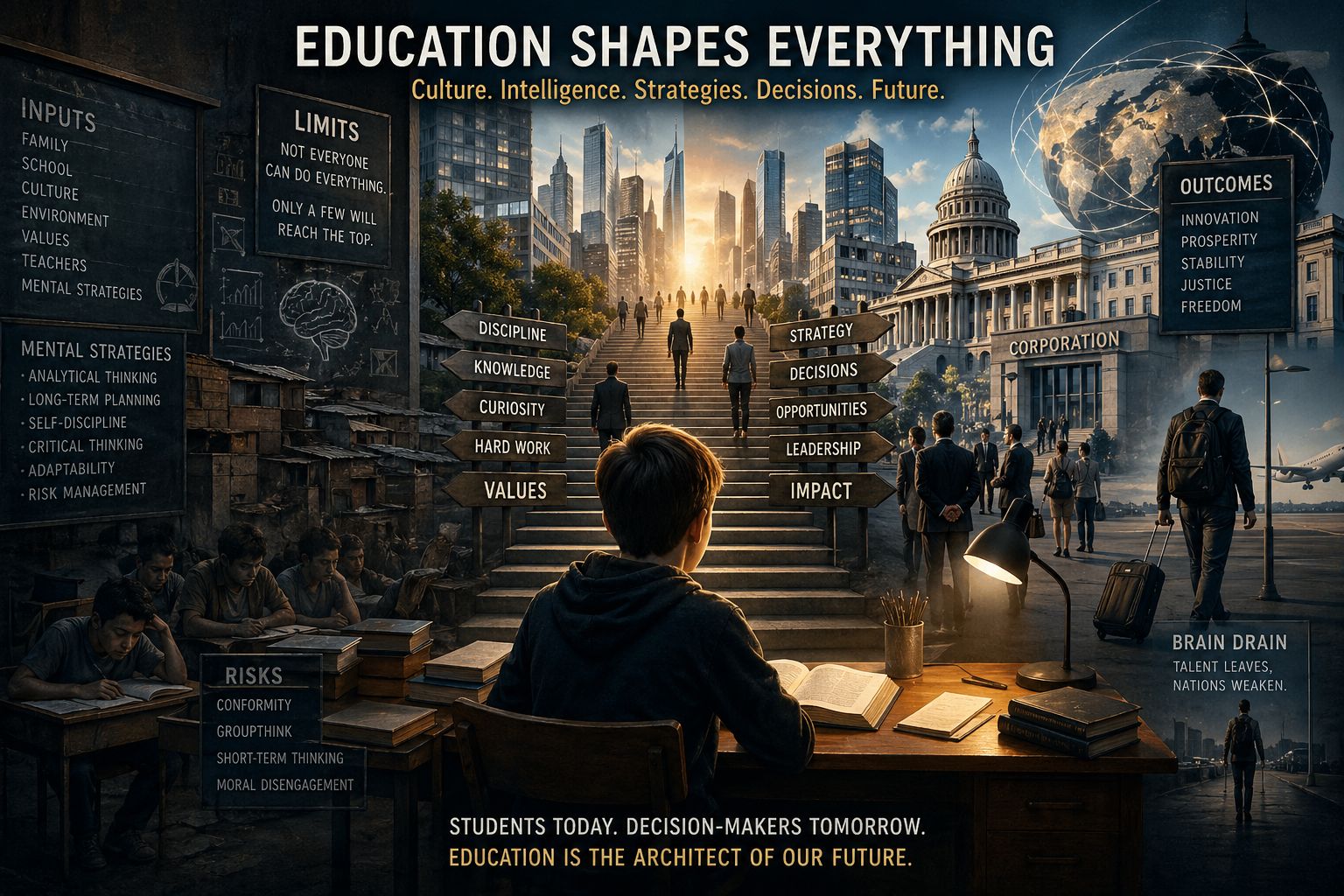
Education does not only transfer knowledge. It shapes perception. It defines what people see as possible, acceptable, and true. Therefore, when people underestimate education, they misunderstand society itself.
Moreover, education operates quietly. It does not announce its influence. Yet it determines how individuals think, decide, and act. Consequently, its reach extends far beyond classrooms.
Education as culture transmission
First, education embeds culture. However, culture does not stop at schools. It extends into firms, institutions, and everyday behavior. Therefore, education must be understood as part of a broader cultural system.
Take China. The system emphasizes discipline, memorization, and collective alignment. As a result, students internalize obedience and endurance. These traits later appear in workplaces and institutions.
Now consider Germany. Cultural patterns emphasize precision, planning, and reliability. These traits appear in engineering, management, and corporate organization. Education reinforces them. It rewards structured thinking and systematic problem-solving. Consequently, firms mirror these behaviors.
Thus, culture operates on multiple layers. Formal education transmits knowledge. Informal norms shape expectations. Institutional behavior reflects both.
Moreover, culture is multifaceted. It differs across regions, industries, and social classes. Elite institutions often produce different cognitive styles than mass education. Therefore, education does not create culture alone. It stabilizes it, amplifies it, and transmits it across generations.
At the same time, education selects for traits aligned with dominant culture. Systems that reward precision produce methodical workers. Systems that reward creativity produce risk-takers. Systems that reward obedience produce hierarchical structures.
Consequently, education and culture form a feedback loop. Culture shapes education. Education reproduces culture.
This also explains why importing education models often fails. A system that works in Germany may not function the same elsewhere. The surrounding culture modifies outcomes.
For example, Germans have a culture that constrains certain interest groups, whereas Czech political culture is more permissive and often boorish.
IQ and cognitive stratification
Second, education interacts with intelligence. However, it does not only sort people. It can also shape cognitive ability itself.
Strong educational systems can increase effective IQ. They train working memory, abstraction, and problem-solving. Over time, individuals become better at recognizing patterns and handling complexity.
By contrast, weak systems can suppress cognitive development. They overemphasize memorization without understanding. They discourage questioning. They limit exposure to complex reasoning. As a result, potential remains underdeveloped.
Therefore, education does not only measure intelligence. It can amplify it or constrain it.
At the same time, differences still matter. Higher-IQ individuals extract deeper structures from the same material. Meanwhile, others rely more on repetition and authority.
Consequently, education both shapes and stratifies cognition. It raises the ceiling for some. It lowers it for others when poorly designed.
Beyond formal knowledge, education teaches mental strategies. However, these strategies do not remain abstract. They translate directly into socioeconomic outcomes.
Some systems train analytical reasoning and probabilistic thinking. Individuals from such systems evaluate risk more accurately. As a result, they make better financial decisions, avoid extreme losses, and identify long-term opportunities.
Other systems emphasize long-term planning. These individuals delay gratification. Consequently, they accumulate capital, invest in education, and build stable careers.
By contrast, systems that reward rule-following create individuals who perform well in structured environments. They succeed in bureaucracies and large corporations. However, they may struggle in uncertain or innovative settings.
Moreover, imitation-based learning produces individuals who follow trends. These individuals may succeed in stable systems. However, they often enter markets late and capture fewer gains.
At the same time, authority-dependent thinking leads to reliance on external guidance. Such individuals may avoid risky mistakes. Yet they also miss independent opportunities.
Impulsivity, when not corrected by education, leads to short-term decision-making. This often results in poor financial outcomes, unstable careers, and vulnerability to manipulation.
Conversely, strategic thinking allows individuals to navigate complex systems. They understand incentives, anticipate behavior, and position themselves advantageously.
Therefore, mental strategies act as invisible drivers of inequality. They influence income stability, career trajectory, investment behavior, and vulnerability to exploitation.
Consequently, education does not only determine what people know. It determines how they act within economic systems.
Critical thinking: The decisive divide
Critical thinking does not emerge automatically. Education either develops it or suppresses it. Therefore, it becomes one of the most decisive variables in long-term outcomes.
First, critical thinking allows individuals to question assumptions. They do not accept claims at face value. Instead, they analyze evidence, detect inconsistencies, and evaluate sources. As a result, they resist manipulation more effectively.
By contrast, systems that discourage questioning produce individuals who rely on authority. These individuals follow narratives without verification. Consequently, they become vulnerable to propaganda, misinformation, and ideological capture.
Moreover, critical thinking directly affects economic behavior. Individuals who think critically assess risks more accurately. They avoid scams, poor investments, and irrational decisions. Over time, this leads to more stable and often higher socioeconomic outcomes.
At the same time, critical thinking enables institutional improvement. Individuals challenge inefficient systems. They identify structural problems. They propose alternatives. Therefore, societies with higher levels of critical thinking adapt faster.
However, there is a trade-off. Critical thinkers often resist hierarchy. They question leadership. This can slow decision-making in rigid systems. In extreme cases, it creates conflict between innovation and control.
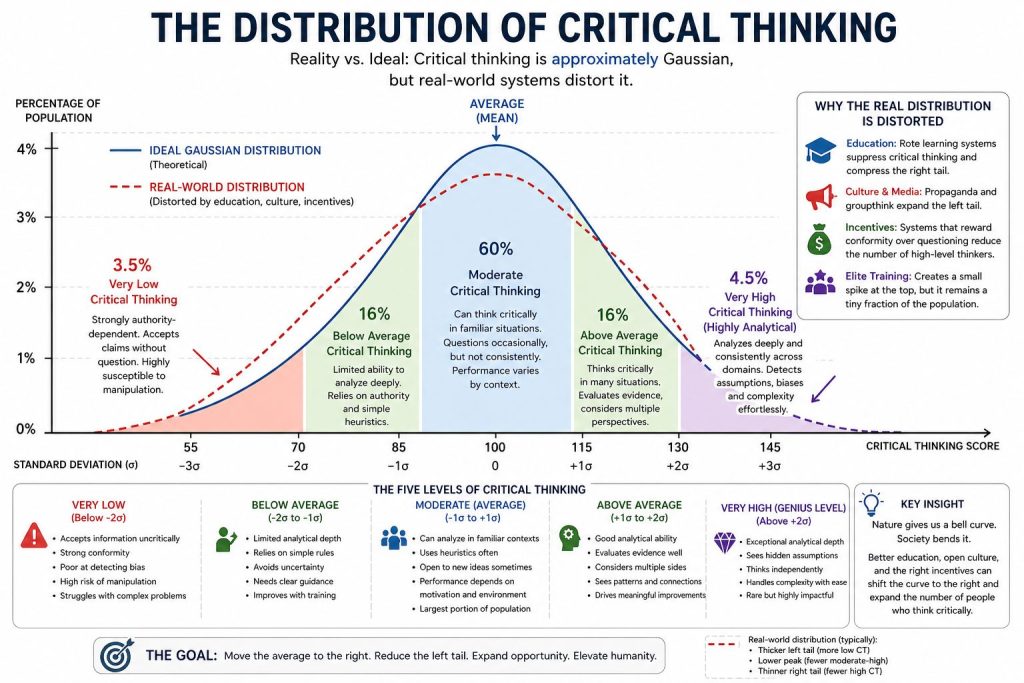
Furthermore, critical thinking requires cognitive effort. Not everyone develops it to the same degree. Even when education promotes it, only a portion of individuals apply it consistently. Therefore, it remains unevenly distributed.
This creates another layer of stratification. Those who think critically navigate complex environments more effectively. Those who do not remain dependent on external guidance.
Consequently, critical thinking is not just an academic skill. It is a structural force. It shapes power, resilience, and long-term societal direction.
Cognitive limits: Not everyone can do everything
A crucial constraint appears here. Education has limits. It cannot turn everyone into a top strategist, innovator, or decision-maker.
Cognitive ability varies across individuals. Even with optimal education, only a limited number of people can operate at high levels of abstraction, manage complex systems, anticipate multi-layered consequences, and innovate at the frontier of knowledge.
Therefore, societies naturally stratify. A small proportion of individuals performs high-complexity tasks. A larger proportion operates within structured roles.
Education can improve baseline competence. However, it cannot eliminate cognitive ceilings.
This has direct consequences. Advanced economies require individuals capable of designing financial systems, leading technological innovation, and managing large-scale institutions.
Yet these individuals remain rare.
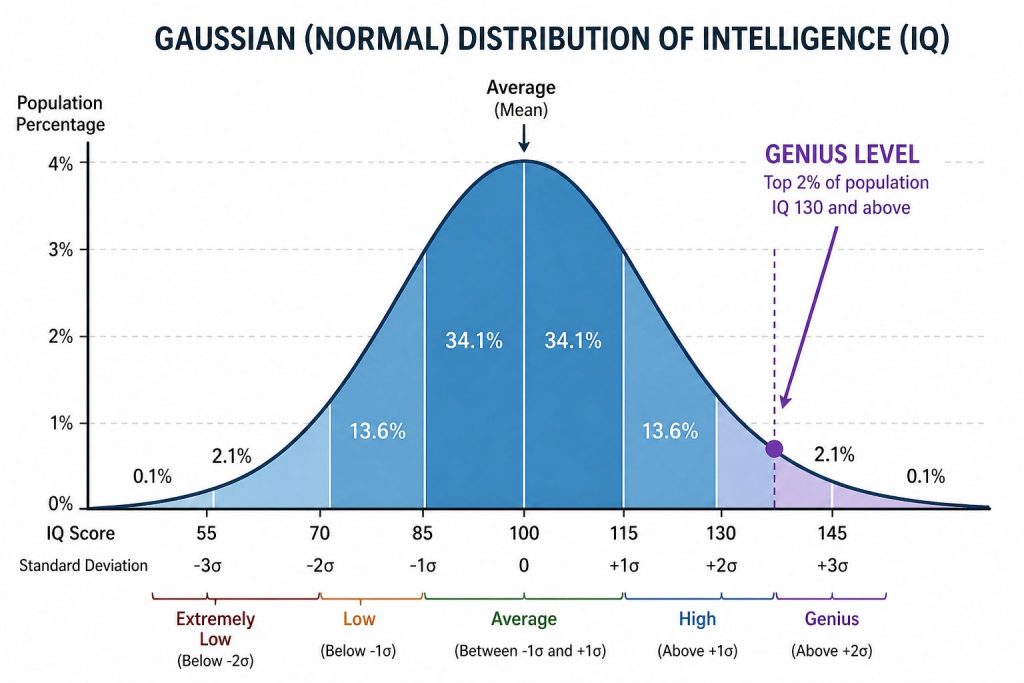
As a result, societies depend heavily on a limited cognitive elite. When education fails to identify and develop them, systems stagnate. When it overestimates average capability, institutions become inefficient.
At the same time, this limitation creates tension. Modern ideology often assumes equal potential. Reality contradicts this assumption. Therefore, policy frequently misaligns with human variation.
Education can reduce or amplify social dysfunction.
In structured environments, it may suppress crime, impulsivity, and antisocial behavior. However, it can also multiply conformity, bureaucratic cruelty, and moral disengagement.
For example, highly educated individuals can design efficient systems. Yet those systems may optimize harmful outcomes if moral reasoning fails.
Therefore, education does not guarantee morality. It enhances capability.
From school to corporations
People do not leave education behind. They carry it into companies.
Corporate cultures often mirror educational systems. Hierarchical schooling produces rigid corporate structures. Creative schooling produces innovative firms.
Thus, education shapes economic behavior.
Moreover, companies amplify these traits. They reward efficiency, compliance, or innovation depending on structure.
Consequently, education indirectly shapes entire industries.
Brain drain: When education leaves the country
Education does not only shape individuals. It also moves across borders.
Highly educated individuals often migrate toward better opportunities. This process, known as brain drain, redistributes human capital globally.
Countries invest in education. However, the benefits do not always stay domestic. Talented individuals leave for higher salaries, better institutions, and more stable systems.
As a result, developing or unstable countries lose innovation capacity, institutional competence, and future leadership.
Meanwhile, receiving countries gain disproportionately. They import already-trained individuals without bearing the full cost of education.
This creates a structural imbalance. Education becomes an export without compensation.
Moreover, brain drain reinforces inequality. Strong systems attract talent. Weak systems lose it. Therefore, divergence accelerates.
Students today, decision-makers tomorrow
Today’s pupils become tomorrow’s elites. However, this transformation does not occur abstractly. It follows concrete pathways.
A student trained in rote memorization becomes a bureaucrat who follows procedure without questioning it. When placed in government, such a person may enforce inefficient or harmful policies simply because they align with rules.
A student trained in analytical reasoning becomes a policymaker who evaluates trade-offs. In a crisis, this person weighs probabilities, long-term costs, and systemic risks.
A student trained in obedience may become a corporate manager who prioritizes hierarchy over innovation. Such a leader maintains stability but may fail to adapt.
A student trained in creativity and independent thinking may become an entrepreneur or reformer. This individual challenges systems, sometimes improving them, sometimes destabilizing them.
Therefore, education directly shapes decision-making styles.
Moreover, scale matters. Thousands of similarly trained individuals enter institutions at once. They reinforce each other’s thinking patterns. Consequently, entire governments, corporations, and industries begin to reflect the dominant educational model.
Thus, when one observes rigid bureaucracy, impulsive policymaking, or innovative breakthroughs, one often observes the long-term output of education systems.
The political blind spot
A striking problem emerges. Many politicians do not understand education systems.
They regulate education. Yet they often lack insight into cognitive development, misunderstand long-term effects, and focus on short-term outcomes.
As a result, policies remain superficial.
This creates a paradox. Those shaping education often do not grasp its true power.
Education as a tool of power
Education is not neutral. It reflects interests.
States and elites shape curricula. They influence historical narratives, acceptable ideologies, and limits of debate.
Therefore, education can stabilize systems. It can also suppress dissent.
In this sense, education becomes a soft form of control.
Economic consequences: Capital and competence
Education directly affects economic output.
Highly trained populations innovate more, adapt faster, and generate higher productivity.
However, mismatched education creates inefficiencies. Overqualified individuals end up in low-skill jobs. Underqualified individuals reach decision roles.
Thus, education influences capital flows and economic stability.
The illusion of equality
Education often claims to equalize opportunity.
However, reality differs. Family background influences outcomes. Access to quality education varies. Cultural capital matters.
Therefore, education can reinforce inequality while appearing fair.
Digital era: New educational divide
Technology reshapes education.
Online platforms expand access. However, they also create new gaps. Self-directed learners thrive. Others fall behind without structure.
Moreover, information overload requires new skills. Not everyone adapts.
Thus, the digital age intensifies differences.
Long-term civilizational impact
Over decades, education determines innovation capacity, political stability, and social cohesion.
Civilizations rise and fall partly due to how they educate.
Therefore, education is not a sector. It is a foundation.
Conclusion: Education as architecture of power and constraint
People often imagine education as a phase of life. This assumption is wrong. Education does not end. It reproduces itself through decisions, institutions, and culture.
It shapes how individuals think. Then those individuals shape systems. Those systems reinforce the same patterns in the next generation.
Moreover, education can elevate or suppress intelligence. It can create innovation or stagnation. It can stabilize societies or make them fragile.
At the same time, it operates under constraints. Only a limited number of individuals can manage complexity at the highest level. Therefore, systems depend on a narrow cognitive layer.
Finally, education determines where talent flows. Brain drain proves that education follows incentives, not borders.
Therefore, education is not preparation for life. It is the mechanism through which societies design their own future, within the limits of human cognition.
Leave a Reply