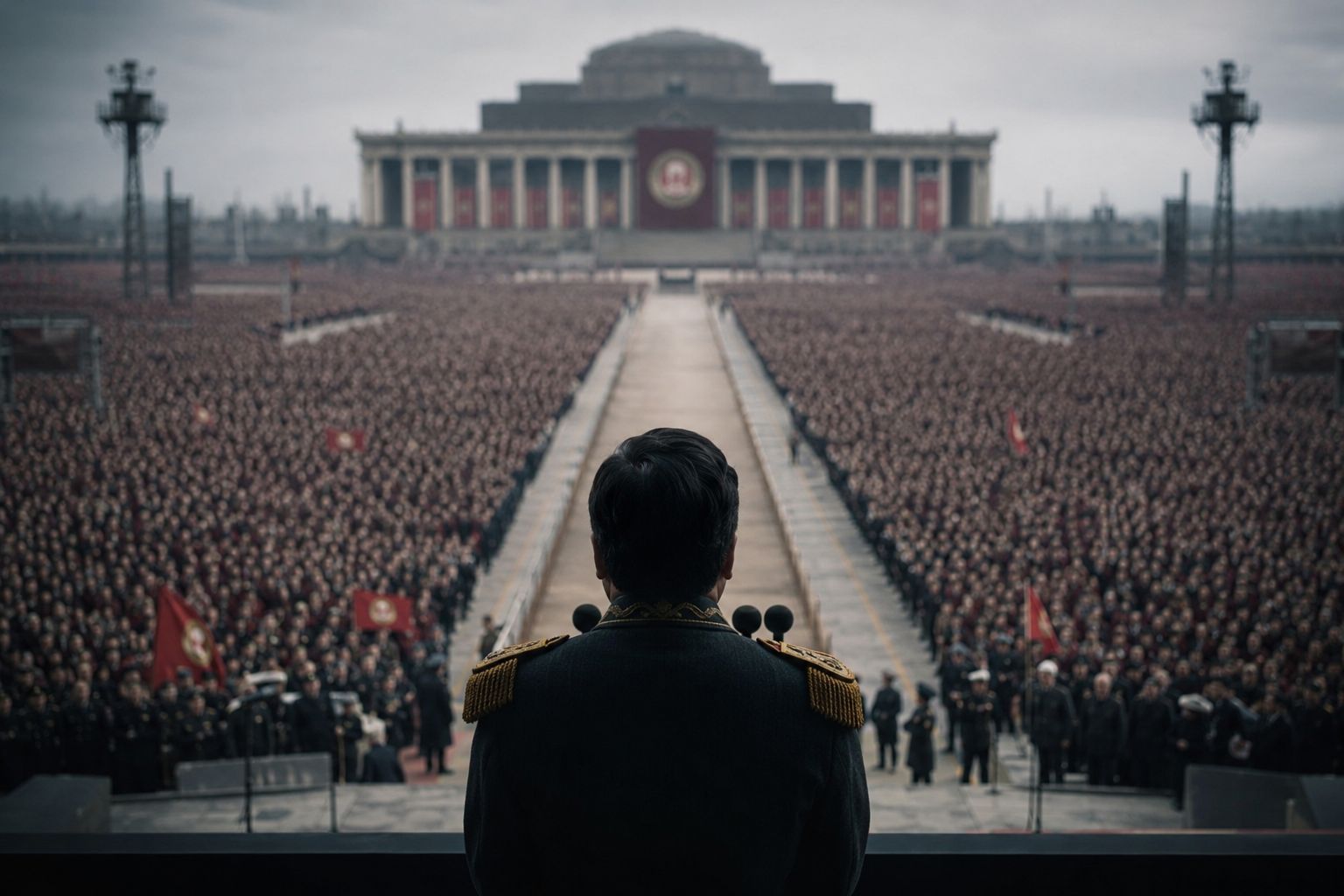
Dictators do not emerge randomly. They emerge from deep psychological mechanisms rooted inside human evolution, fear, hierarchy, social instability, tribalism, domination, and mass psychology.
At first glance, dictators appear inhuman. People often imagine them as monsters born fundamentally different from ordinary individuals. However, reality looks far more disturbing. Many psychological traits visible in dictators exist in normal human behavior. The difference lies in intensity, incentives, opportunity, trauma, institutional collapse, and the removal of restraints.
Moreover, dictators rarely build power alone. Entire systems construct them gradually. Bureaucracies protect them. Propaganda normalizes them. Economic elites finance them. Military structures enforce them. Fear stabilizes them. Crowds glorify them. Consequently, dictatorship reveals not only the psychology of one ruler, but also the psychology of entire civilizations under pressure.
History repeatedly demonstrates this pattern. Ancient emperors, medieval conquerors, fascist rulers, communist strongmen, military juntas, revolutionary cult leaders, and modern authoritarian presidents all relied on surprisingly similar psychological mechanisms despite massive cultural differences.
Therefore, understanding dictatorship requires much more than political analysis alone. One must examine evolutionary psychology, dominance hierarchies, narcissism, paranoia, tribalism, trauma, propaganda, obedience, crowd psychology, symbolic power, social identity, emotional contagion, and institutional decay.
The frightening truth emerges slowly. Dictators do not merely manipulate society. They exploit ancient psychological instincts already present inside human beings.
Human beings evolved in extremely small groups for most of evolutionary history. Hunter-gatherer tribes rarely exceeded a few dozen individuals. Survival depended heavily on alliances, hierarchy, dominance, status recognition, coalition-building, intimidation, and group loyalty.
Consequently, the human brain evolved to respond strongly to dominant individuals.
A confident, aggressive, decisive leader could increase tribal survival during warfare, famine, territorial conflict, or resource scarcity. Therefore, humans developed instincts to follow dominant personalities during periods of uncertainty and fear.
However, these instincts evolved for tiny tribal societies, not for modern industrial civilizations with hundreds of millions of citizens.
This mismatch creates enormous psychological vulnerabilities.
Modern dictators exploit ancient tribal instincts in highly artificial environments. They manufacture existential threats, they exaggerate danger continuously. They divide populations into “us” and “them.” Then they present themselves as protectors, saviors, fathers of the nation, or defenders of civilization.
As a result, populations psychologically regress toward tribal thinking.
Fear reduces cognitive complexity. Nuance disappears. People begin prioritizing safety over freedom, identity over truth, and loyalty over rational analysis.
This explains why highly educated societies can still descend into authoritarianism under sufficient stress.
The psychology of dominance
Dominance plays a central role in dictatorship.
Many dictators possess unusually strong dominance motivation. They crave control, submission, admiration, obedience, symbolic superiority, and social centrality.
At the same time, dominance behavior often appears attractive psychologically during unstable periods.
Why?
Because uncertainty terrifies humans.
Economic collapse, cultural instability, war, terrorism, demographic anxiety, inflation, social fragmentation, or institutional dysfunction all increase psychological stress. Under these conditions, populations frequently gravitate toward leaders who project certainty and decisiveness.
Even when those leaders lack competence.
This phenomenon appears repeatedly throughout history.
Confident individuals often appear more intelligent than they truly are. Aggressive communication frequently gets mistaken for strength. Emotional certainty gets mistaken for truth.
Consequently, dictators often rise not despite their psychological extremism, but partially because of it.
Extreme narcissism appears repeatedly among authoritarian rulers.
Narcissistic personalities view themselves as exceptional, historically important, morally superior, or destined for greatness. They crave admiration continuously. They struggle to tolerate criticism. And they interpret disagreement as betrayal.
Moreover, narcissistic individuals often divide reality into simple binaries:
- loyal vs disloyal
- strong vs weak
- superior vs inferior
- winners vs enemies
This binary worldview fits authoritarian politics extremely well.
Many dictators construct mythological identities around themselves. They become “chosen figures,” “great reformers,” “protectors,” “visionaries,” or “historic saviors.”
However, beneath grandiosity often lies deep psychological fragility.
Many narcissistic personalities possess unstable self-esteem. They depend heavily on external validation. Therefore, criticism feels psychologically catastrophic.
This helps explain why dictators frequently react disproportionately to:
- journalists
- satirists
- dissidents
- academics
- artists
- students
- intellectuals
Minor criticism threatens the dictator’s self-image. Consequently, authoritarian systems often become obsessed with controlling speech, symbolism, media, and public narratives.
Trauma, humiliation, and psychological compensation
Some dictators emerge from deeply humiliating personal or national experiences.
Humiliation can produce powerful compensatory psychology.
A psychologically wounded individual may develop grandiose fantasies of restoration, revenge, or historical greatness. Power becomes emotionally addictive because it compensates for feelings of weakness, shame, rejection, or insignificance.
At the national level, collective humiliation can produce similar dynamics.
Military defeat, economic collapse, foreign domination, cultural decline, hyperinflation, or political chaos create collective psychological trauma. Populations begin craving restoration and certainty.
Dictators exploit this vulnerability skillfully.
They promise:
- national rebirth
- revenge against enemies
- restoration of pride
- return to greatness
- purification of society
- destruction of “traitors”
Consequently, authoritarian movements often feed emotionally on humiliation and resentment.
The creation of enemies
Dictators need enemies psychologically and politically.
Without enemies, fear weakens. Without fear, centralized power becomes harder to justify.
Therefore, authoritarian systems constantly construct threats.
These enemies may include:
- ethnic minorities
- immigrants
- intellectuals
- political dissidents
- religious groups
- foreign governments
- journalists
- LGBTQ communities
- “globalists”
- capitalists
- communists
- “traitors”
- “degenerates”
The specific target changes historically. The mechanism remains remarkably consistent.
Fear simplifies cognition. Complex problems become emotionally manageable when blamed on identifiable groups.
Moreover, enemies strengthen tribal cohesion.
People unite psychologically against perceived threats. Individual frustration redirects toward external scapegoats rather than systemic analysis.
Consequently, dictators frequently maintain power through permanent emotional mobilization.
Paranoia and isolation
Many dictators gradually become paranoid.
At first, some fears may reflect genuine threats. Dictators often do possess enemies. However, authoritarian systems intensify paranoia structurally.
Why?
Because honest feedback disappears.
Subordinates fear punishment. Advisors compete through loyalty rather than competence. Intelligence agencies manipulate information to satisfy leadership expectations.
Consequently, dictators increasingly inhabit distorted realities.
Over time, they may begin believing their own propaganda.
This process becomes psychologically dangerous.
Isolation intensifies suspicion. Suspicion intensifies repression. Repression increases fear among subordinates. Fear reduces truthful communication further.
Eventually, dictators often become trapped inside informational bubbles disconnected from reality itself.
History repeatedly demonstrates this pattern:
- military miscalculations
- unrealistic economic policies
- exaggerated confidence
- irrational purges
- conspiratorial thinking
- catastrophic strategic decisions
The dictator becomes psychologically imprisoned by the very system designed to protect him.
The cult of personality
Force alone rarely sustains dictatorship long-term. Psychological worship matters enormously.
The cult of personality transforms political authority into emotional devotion.
Portraits dominate public spaces. Speeches become ritualistic performances. School systems rewrite history around one individual. Media glorifies leadership continuously.
As a result, the dictator appears superhuman.
This process strongly resembles religious psychology.
The leader becomes sacred.
Criticism becomes blasphemy.
Loyalty becomes morality.
Obedience becomes virtue.
Moreover, propaganda intentionally simplifies reality emotionally.
Complex social problems become reduced into theatrical narratives:
- civilization vs chaos
- patriots vs traitors
- purity vs corruption
- strength vs weakness
Such narratives feel emotionally satisfying during unstable periods.
Human cognition naturally prefers simple explanations over complexity, especially under stress.
The psychology of propaganda
Propaganda does not merely spread false information. It reshapes emotional perception itself.
Effective propaganda operates psychologically rather than intellectually.
It uses:
- repetition
- emotional triggers
- fear
- outrage
- symbolism
- identity reinforcement
- selective memory
- simplification
- scapegoating
Repeated exposure normalizes ideas gradually.
Even obviously false narratives can become psychologically familiar through constant repetition. Familiarity then creates perceived truthfulness.
Moreover, propaganda exhausts critical thinking.
When populations encounter endless emotional stimulation, outrage cycles, fear narratives, and conflicting information, cognitive fatigue increases dramatically.
As a result, many individuals stop seeking objective truth entirely. Instead, they seek emotional reassurance and tribal belonging.
Modern digital technology amplifies this process enormously.
Algorithms reward emotional intensity.
Social media amplifies outrage.
Bots manufacture consensus.
Influencers spread ideological narratives rapidly.
Consequently, modern authoritarianism increasingly relies on psychological engineering rather than visible terror alone.
Why ordinary people obey dictators
One of the most disturbing realities about dictatorship concerns ordinary participation.
Authoritarian systems rarely survive through pure force alone. Millions often cooperate voluntarily to varying degrees.
This does not necessarily mean populations become universally evil.
Instead, ordinary psychological mechanisms operate under extraordinary conditions.
Humans deeply desire:
- belonging
- social approval
- identity
- stability
- certainty
- protection
- economic security
- meaning
Dictators promise these things.
Moreover, conformity possesses deep evolutionary roots. In small tribal environments, exclusion from the group could mean death. Consequently, humans evolved strong instincts toward social conformity.
This explains why many individuals obey systems they privately question.
Fear of isolation matters enormously psychologically.
People frequently adapt beliefs publicly to match perceived social norms even when privately uncertain.
Authoritarian systems exploit this tendency relentlessly.
Bureaucracy and moral fragmentation
Dictatorships depend heavily on bureaucracy.
No dictator controls millions personally. Therefore, authoritarian systems fragment responsibility across countless administrative layers.
One official signs forms.
Another transports prisoners;
Another censors newspapers;
Another manages surveillance.
Another enforces policy.
Consequently, individuals psychologically distance themselves from consequences.
They begin viewing themselves as technical participants rather than moral agents.
Statements such as:
- “I only followed orders”
- “I only enforced regulations”
- “I only handled paperwork”
become psychologically common.
This fragmentation reduces personal guilt.
As a result, horrifying systems can appear administratively ordinary from inside.
Modern industrial civilization intensifies this phenomenon because specialization disconnects actions from visible consequences.
Fear and the collapse of critical thinking
Fear profoundly alters cognition.
Under severe stress, humans prioritize immediate survival over abstract reasoning. Emotional processing increasingly dominates analytical thought.
Dictators exploit this neurological vulnerability deliberately.
Continuous fear exposure produces:
- heightened tribalism
- reduced nuance
- black-and-white thinking
- increased obedience
- greater hostility toward outsiders
- stronger attraction to authority
This process partly explains why populations sometimes support policies that directly undermine freedom.
Psychological survival instincts override long-term reasoning.
Many dictators intentionally cultivate hyper-masculine public identities.
Military uniforms, aggressive speeches, emotional hardness, physical symbolism, anti-intellectualism, dominance rituals, and theatrical displays of strength all serve psychological functions.
Why does this work?
Because humans instinctively associate dominance with competence under stressful conditions.
In evolutionary environments, physically formidable individuals could indeed improve tribal survival during violent conflict.
Modern dictators exploit these ancient associations symbolically.
Consequently, intellectual complexity often loses emotionally against simplistic strength performances during crises.
Sexuality, power, and domination
Power frequently becomes psychologically eroticized inside authoritarian systems.
Why?
Because status strongly influences human social behavior evolutionarily.
Dominance can increase admiration, attention, fear, access, and symbolic importance. Consequently, some dictators become addicted not merely to political control, but to psychological centrality itself.
This partly explains extreme vanity, theatrical behavior, obsession with image, and exaggerated symbolic rituals among many authoritarian rulers.
Power becomes emotionally intoxicating.
Over time, the dictator may increasingly perceive himself as historically indispensable.
Dictators and the fear of intellectuals
Authoritarian systems frequently attack:
- universities
- journalists
- scientists
- philosophers
- artists
- writers
- freethinkers
This pattern appears globally across vastly different ideologies.
Why?
Because independent thought weakens centralized psychological control.
Critical thinking introduces uncertainty and complexity. Dictators require simplified narratives.
Moreover, intellectuals often identify contradictions inside propaganda systems earlier than the general population.
Therefore, authoritarian movements frequently portray intellectuals as:
- corrupt elites
- enemies of the people
- traitors
- degenerates
- foreign agents
The attack is psychological before it becomes political.
The psychology of crowds
Crowds behave differently from isolated individuals.
Inside large emotional groups, personal responsibility weakens. Emotional contagion intensifies. Identity merges into collective psychology.
As a result:
- aggression spreads faster
- conformity increases
- rational hesitation weakens
- symbolic rituals gain power
- moral restraints decline
Dictators exploit mass rallies precisely because crowds amplify emotional synchronization.
Music, symbols, chants, flags, lighting, uniforms, and theatrical speeches all increase collective emotional fusion.
The individual gradually disappears psychologically into the movement.
Totalitarianism and control of reality
The most extreme dictatorships seek not merely political obedience, but control over reality itself.
Language changes.
History changes.
Statistics change.
Facts change.
Why?
Because controlling perception becomes more powerful than controlling force alone.
If populations lose confidence in objective reality, they become psychologically dependent on centralized narratives.
Consequently, totalitarian systems frequently attack truth itself.
Contradictions become normalized.
Propaganda becomes reality.
Memory becomes political.
This creates profound psychological disorientation.
Why dictatorships often decay internally
Authoritarian systems frequently appear powerful externally while decaying internally.
Fear damages institutions severely.
Officials stop reporting failures honestly.
Innovation declines.
Corruption expands.
Competence becomes secondary to loyalty.
Consequently, the system gradually loses contact with reality.
At the same time, excessive centralization creates structural fragility. Everything depends on one leader psychologically and administratively.
Once that figure weakens, instability spreads rapidly.
Therefore, many dictatorships eventually collapse under the weight of informational dysfunction, corruption, paranoia, economic stagnation, and strategic delusion.

Future dictatorships may look very different from older forms.
Classical authoritarianism relied heavily on visible violence, censorship, and secret police. Modern systems increasingly rely on behavioral engineering.
Digital surveillance tracks populations continuously.
Algorithms shape emotional exposure.
Artificial intelligence predicts behavior.
Platforms manipulate attention.
Consequently, modern authoritarianism may become psychologically invisible.
Citizens may technically possess freedom while remaining heavily manipulated emotionally and behaviorally.
This represents a new phase in authoritarian psychology:
- surveillance without visible chains
- propaganda without state newspapers alone
- conformity through algorithms
- emotional control through digital ecosystems
The danger becomes harder to recognize precisely because it appears less theatrical.
The frightening truth: Dictatorship begins inside ordinary human psychology
The greatest danger does not lie solely inside dictators themselves.
It lies inside ordinary human tendencies:
- tribalism
- obedience
- fear
- conformity
- hero worship
- attraction to dominance
- hatred of ambiguity
- desire for certainty
Under sufficient stress, these instincts can reshape entire societies.
Therefore, dictatorship is not merely a historical anomaly. It remains a recurring psychological possibility inside human civilization itself.
Highly educated societies are not immune.
Technologically advanced societies are not immune.
Democratic societies are not immune.
Human psychology has not evolved beyond authoritarian vulnerability.
Conclusion: Understanding dictators means understanding humanity
People often imagine dictators as creatures fundamentally separate from humanity.
However, dictators emerge from human psychology itself.
They exploit fear, tribalism, dominance instincts, conformity pressures, emotional vulnerability, social fragmentation, identity crises, and institutional weakness.
Therefore, preventing dictatorship requires much more than elections alone.
Societies require:
- strong institutions
- independent courts
- free media
- scientific literacy
- decentralized power
- protection of dissent
- psychological awareness
- education focused on critical thinking
- transparency
- resistance to propaganda
Without these protections, even advanced civilizations can slowly drift toward authoritarianism.
History repeatedly demonstrates this reality.
The most disturbing lesson emerges at the end:
The psychology that creates dictators does not exist outside humanity.
It exists inside humanity itself.
Leave a Reply