
For a start, I do not mean myself, as I am just an average author and blogger. I have in mind people who have made enormous contributions to science and the arts. This interconnected problem has troubled the world for a long time. So, how are mental illness and genius connected?
Where did the notion come from?
People have long connected madness with genius. They did not do it because it was true. But because they envied geniuses. They could not match their intelligence, creativity, or achievements, so they had to believe genius came with a price. They told themselves that great minds suffered from insanity, isolation, or self-destruction. That way, they could feel superior in their own mediocrity. The truth is, intelligence does not come with built-in madness. Some geniuses struggle, but so do average people. The only difference is that when an ordinary person suffers, no one calls it the curse of genius.
“Why are so many people so invested in pathologizing the exceptionally talented among us?” – Judith Schlesinger
IQ vs creativity
IQ (g factor) is a very general ability to solve very general problems. Arguably one of the most statistically significant concept in humanities.
It is not everything but it is nearly everything. Having IQ of 50, 60, 70, 85, 100, 115, 125, 130, 145, 150 or 160+ drastically predict your life attainment. Assembling blocks won’t make you smarter of course, however, these tasks are the product of factor analysis which is a science of itself and your IQ is measured by it.
This also applies to your performance in the job environment, your income, morbidity and mortality.
Talents (for business, piano playing etc.) and creativity are derived from your IQ.
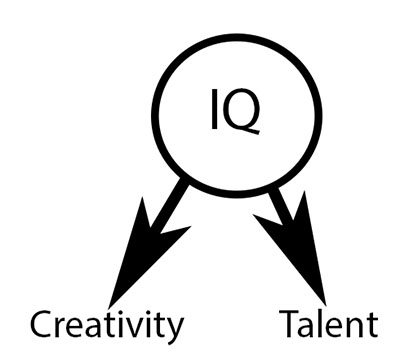
Creativity is the interaction among aptitude, process, and environment by which an individual or group produces a perceptible product that is both novel and useful as defined within a social context. (Plucker et al. (2004))
Verbal fluency and divergent thinking (divergent production), both of which are associated parts of IQ, are associated with creativity. Therefore, it is plausible that the heritability value for creativity, at least as it is measured by traditional tests of creativity, is only about half as large as the value for IQ. (IQ Testing 101, Alan S. Kaufman (2009)).
However, IQ is the foremost point to scientific discoveries, meanwhile creativity remains the major process in arts.
IQ is clear, what about creativity theories?
James C. Kaufman’s Creativity 101 organizes major creativity theories into the Four P’s framework, which examines creativity through the lenses of Person, Process, Product, and Press. The Person aspect focuses on the traits that contribute to creativity, including intelligence, personality, motivation, and cognitive styles. Research shows that intelligence and creativity are correlated. Highly creative individuals often exhibit openness to experience, intrinsic motivation, and a tolerance for ambiguity, which allow them to generate and refine novel ideas.
The Process component explores how creativity works, emphasizing cognitive mechanisms like divergent and convergent thinking. Graham Wallas’ Four-Stage Model describes creativity as moving through preparation, incubation, illumination, and verification, where initial idea formation, subconscious processing, sudden insight, and refinement interact to shape innovative solutions. Divergent thinking, which involves generating multiple possibilities, plays a key role, but creativity also requires convergent thinking to refine and evaluate ideas effectively.
Product and press
Creativity’s Product aspect examines what qualifies something as creative, typically defined by novelty and usefulness. Kaufman’s Four C Model classifies creative outputs based on expertise and impact, ranging from mini-c, which includes personal insights and learning experiences, to Big-C, which represents groundbreaking contributions that change entire fields. Pro-C refers to professional-level creativity within a domain, while little-c captures everyday creative acts that may not reach expert status but still demonstrate original thought.
Finally, Press explores how external influences, such as social, cultural, and environmental factors, shape creativity. Supportive environments, collaborative networks, and exposure to diverse perspectives can enhance creative potential, whereas rigid systems and excessive constraints may stifle it. Cultural differences also play a role, as societies that encourage exploration and intellectual risk-taking tend to produce more creative individuals and innovations. Together, the Four P’s framework provides a comprehensive understanding of creativity, showing that it emerges not just from innate talent but from a dynamic interaction between cognitive processes, personality traits, the nature of creative output, and the surrounding environment.
Creativity: IQ 120 and over?
Creativity’s correlation with IQ is maintained up to a certain level of performance on a traditional individual intelligence test. Traditional research has argued for a “threshold theory,” in which creativity and intelligence are positively correlated up until an IQ of approximately 120; in people with higher IQs, the two constructs show little relationship (e.g., Barron, 1963; Fuchs-Beauchamp, Karnes, & Johnson, 1993; Getzels & Jackson, 1962; Richards, 1976). More recently, however, the threshold theory has come under fire. Runco and Albert (1986) found that the nature of the relationship was dependent on the measures used and the populations tested. Preckel, Holling, and Wiese (2006) looked at measures of fluid intelligence and creativity (as measured through divergent thinking tests) and found modest correlations across all levels of intellectual abilities. Wai et al. (2005), in a longitudinal study of gifted (top 1%) 13-year-olds, found that differences in SAT scores—even within such an elite group—predicted creative accomplishments 20 years later. Kim (2005), in a meta-analysis of 21 studies, found virtually no support for the threshold theory, with small positive correlations found between measures of ability and measures of creativity and divergent thinking. (James C. Kaufman’s Creativity 101 (2009))
Creativity continues to correlate with IQ even above 120 (just like IQ over 120 contributes with contribution), as the Gaussian curve includes its extremes, where exceptionally high intelligence can enhance complex creative problem-solving and innovation.
Mentally ill have lower average IQ
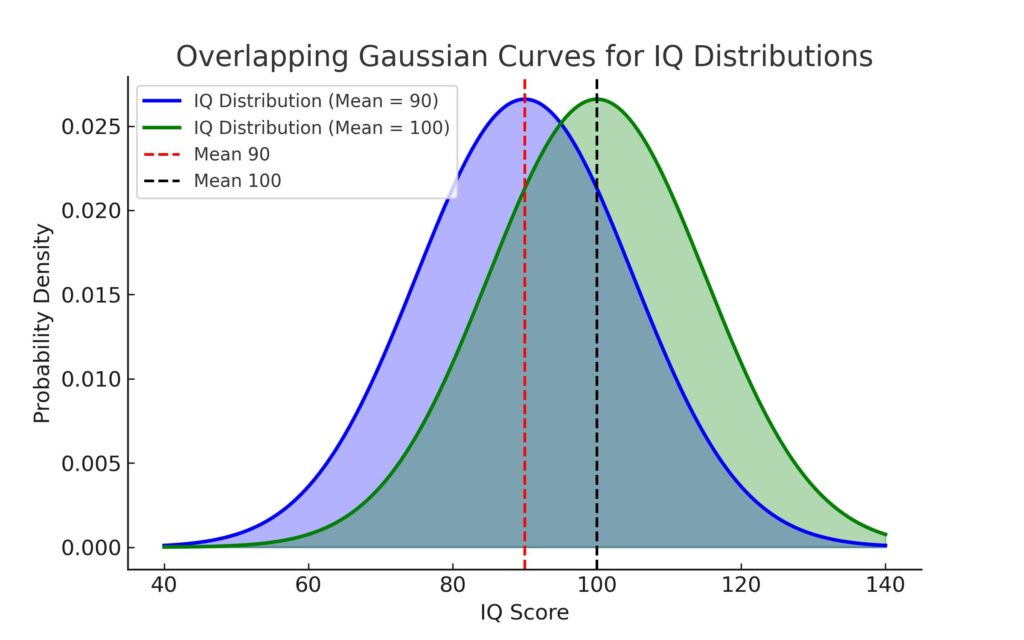
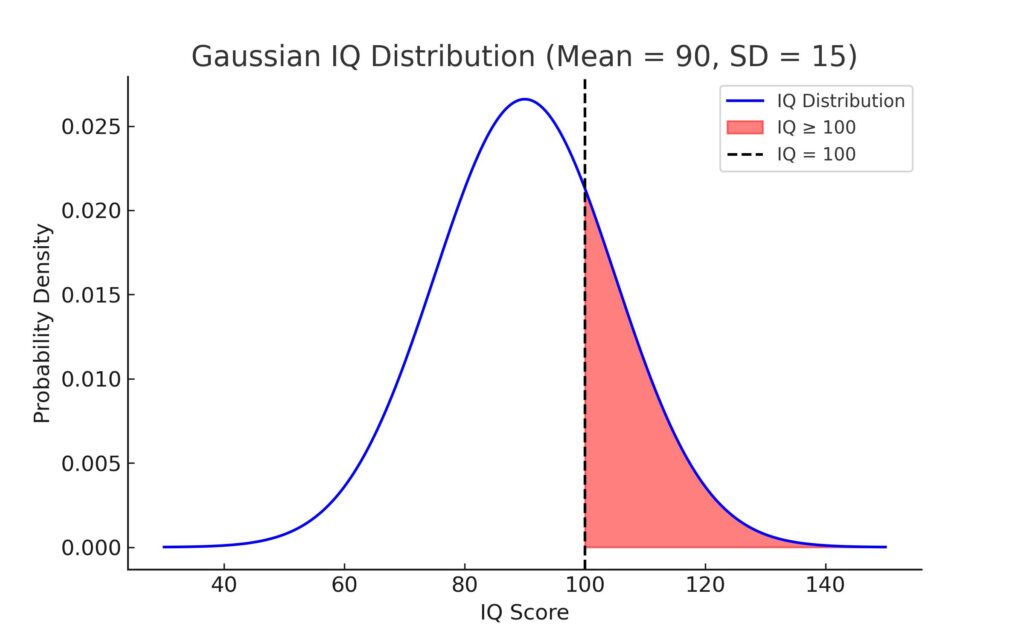
Let’s assume the average IQ of mentally ill people is 90, then:
If the average IQ is 90, the probability of having an IQ of 160 or higher is approximately 0.00000153 (1.53 in a million).
If the average IQ is 100, the probability of having an IQ of 160 or higher is approximately 0.0000317 (31.7 in a million).
This means that IQ 160+ is about 20.7 times rarer in a population with an average IQ of 90 compared to a population with an average IQ of 100.
Approximately 25.25% of the population with an average IQ of 90 would have an IQ of 100 or higher.
Lower childhood IQ was associated with increased risk of developing schizophrenia spectrum disorder, adult depression, and adult anxiety. Lower childhood IQ was also associated with greater comorbidity and with persistence of depression; the association with persistence of generalized anxiety disorder was nearly significant. Higher childhood IQ predicted increased risk of adult mania. Conclusions: Lower cognitive reserve, as reflected by childhood IQ, is an antecedent of several common psychiatric disorders and also predicts persistence and comorbidity. Thus, many patients who seek mental health treatment may have lower cognitive ability; this should be considered in prevention and treatment planning.
So this insinuates that contribution should be less because of the lower IQs.
Mentally ill with high IQs – different results? Or compensated?
Since high IQ is already rare among the mentally ill, the rarity of creativity is further intensified. As a result, should there be fewer highly creative people? Or does mental illness compensate for it? Or are people with mental illness and high IQs simply more contributive? These are unanswered questions.
Please note that my notion—that people with mental illness have fewer IQ points (and therefore are less creative) or that creativity is compensated by mental illness—is not part of any mainstream approach. This article fully adheres to mainstream science, except for this minor deviation.
The dark side of being a genius?
Perhaps the most well-known empirical study was conducted by Andreasen (1987), who used structured interviews to analyze 30 creative writers, 30 matched controls, and first-degree relatives of each group. The writers had a higher rate of mental illness, with a particular tendency toward bipolar and other affective disorders. The writers’ first-degree relatives were more likely to both be creative and have affective disorders. This study is often used as a cornerstone for demonstrating a connection between creative writing and mental illness. It is worth pointing out, however, that there have been several critiques of the methodology (Lindauer, 1994; Rothenberg, 1990, 1995; Schlesinger, 2003, in press). Rothenberg (1990), for example, argues that Andreasen’s control group was not well-matched to the writers chosen; the creative group comprised faculty members from the creative writing department, whereas the control group had a wide mix of people. Andreasen was the sole interviewer, with no corroborating opinions about the mental health of the writers.
Affective disorders
Most of the other studies of living, eminent people have also been conducted on writers. Jamison (1989) interviewed 47 British artists and writers and found that a significantly higher percentage of them suffered from some form of mental illness, particularly from affective disorders, than would be expected from population rates. Ludwig (1994) studied 59 female writers and 59 matched controls and found that the writers were more likely to have mental illness, including mood disorders and general anxieties. Staltaro (2003) looked at 43 published poets and found that approximately one-third had a history of at least one psychiatric condition and more than half had been in therapy (this is notably higher than population rates). However, poets did not score significantly higher than the norm on a measure of current depression. Nettle (2006) examined poets, mathematicians, visual artists, and average folks, finding higher levels of schizotypy in poets and visual artists and lower levels in mathematicians. Another study that found domain-based differences was Rawlings and Locarnini (2007), who gave measures of low-level psychosis and autism to artists and scientists. In the artist group, creativity was linked to schizotypy and hypomania. In the scientist group, these connections were not found; however, a slight connection was found between creativity and autistic tendencies. However, the relationship between schizotypy and creativity is not uncontested. Miller and Tal (2007) found that although both openness to experience and intelligence predicted creativity, schizotypy did not.
Perhaps it’s not that creative people are more likely to be mentally ill, but rather, people in the arts are more likely than people not in the arts to suffer from mental illness—regardless of the level of creativity.
Low level of latent inhibition
An extensive body of work suggests that people with schizophrenia and those suffering from schizophrenic-like disorders (such as schizotypy) have lower levels of latent inhibition.
Keefe and Magaro (1980) gave measures of divergent thinking to 10 paranoid schizophrenics, 10 nonparanoid schizophrenics, 10 nonpsychotic psychiatric patients, and 10 controls. The nonparanoid schizophrenics were found to get higher divergent thinking scores than the other three groups. Wadeson (1980) found that bipolar patients going through depression and unipolar depressive patients had similar painting styles, with fewer colors; bipolar patients in a manic stage used more colors and were more expressive. Strong et al. (2007) studied creativity and personality in bipolar and unipolar depressives, as well as controls from creative and noncreative disciplines. They found two distinct factors; one was strongly based in neuroticism and mood disorders (cyclothymia and dysthymia), whereas the other was comprised mostly of openness to experience and creativity.
Lowered creativity in unipolar disorders?
“Santosa, Strong, Nowakowska, Wang, Rennicke, and Ketter (2007) examined bipolar and unipolar depressives along with nondepressives and a group of people from creative disciplines (although, as you may remember from chapter 3, any discipline can be creative). They found that bipolar (but not unipolar) depressives outperformed nondepressives on the Barron-Walsh Art Scale (a scale that is used less often in current creativity research) but found the only difference on the Torrance Tests was that those in creative domains outperformed unipolar depressives. As is consistent with much research in this area (including my own), it is easy to emphasize the mental illness–creativity connection. Santosa et al.’s (2007) paper is titled “Enhanced creativity in bipolar disorders.” Couldn’t it just as easily be called “Lowered creativity in unipolar disorders”?”
Short and creative
Certainly, there are obvious ways that both manic depression and schizophrenia mirror creativity. The extreme highs of mania can result in creative output, and it is easy to compile a long list of individuals with manic depression (e.g., Jamison, 1993); however, remember the list of people who were short and creative. Or, if you prefer, think of the marvelous argument advanced by Lott (2002), who contended that the Eagles were responsible for world tragedy. He pointed out that the dates at which their hit singles (such as “Hotel California”) peaked coincided with terrible events, such as the prime minister of Tunisia having a stroke, Nixon making budget cuts, or the spillage of a Liberian oil tanker. Clearly, you can take any series of dates (or lists of creative people) and argue anything. These examples are not to call into question all data analysis, of course—but one needs to be an informed consumer.
It is also interesting, incidentally, to note that Ghadirian, Gregoire, and Kosmidis (2001) studied a total of 44 psychiatric patients with and without bipolar illness and found no difference between the two groups in creative abilities. Eisenman (1990) tested 37 individuals with schizophrenia, manic depression, or psychotic depression and found them to be less creative than controls.
Eminent researcher sees a weak link
James C. Kaufman: “Does creativity have a dark side? Sure. Everything has a dark side. Pizza can burn the roof of your mouth, and people can drown in Jacuzzis. So, yes, there are some creative people who are mentally ill, and there have been a tremendous amount of resources spent detailing those eminent geniuses who have also been mad. But I am not convinced by the highly inconsistent research literature that a strong and steady connection exists between creativity and mental illness. I am not denying that such a connection may exist; I have certainly seen evidence that certain types of creators or people of a high level of eminence may be more at risk. But I believe that the vast majority of studies on the topic are flawed in either their definition or measurement of creativity, mental illness, or both.”
“I don’t mean to indicate there is no empirical evidence for a creativity–mental illness connection, but it is certainly often buried in rhetoric, narrative, or anecdotes. For such a controversial topic, there are comparatively few studies that look at the question in a direct manner. As I explained at the beginning of this chapter, the reasons are obvious. I can test 500 college students pretty easily; getting 10 poets is a challenge. However, there are many areas of research that lack a consistent line of replicated studies. Why, then, do so many books, papers, and essays assume a strong connection exists?”
Inconsistent results
In Creativity and Mental Illness, editor James C. Kaufman presents a nuanced exploration of the complex relationship between creativity and mental health. His book challenges the traditional notion of the “mad genius,” suggesting that while certain mental illnesses may be associated with creativity in specific domains, such as the arts, this connection is not straightforward or universal. Kaufman emphasizes that the relationship between creativity and mental illness is multifaceted, with studies yielding inconsistent results across different populations. He also highlights that everyday creativity is often linked to positive mental health, underscoring the importance of considering individual differences and the specific nature of both creativity and mental health conditions.”
Mental illness and genius: Conclusion
The relationship between creativity and mental illness has been a subject of scholarly interest for decades. Contemporary scientific consensus acknowledges a nuanced and complex association rather than a direct causal link. Some studies have identified a correlation between creative professions and mood disorders, particularly bipolar disorder. Research has found that writers and artists may exhibit higher rates of affective disorders compared to the general population. However, the evidence is not uniform across all creative fields or mental health conditions. While certain creative individuals may experience mental health challenges, many do not, and mental illness is not a prerequisite for creativity. Conversely, not all individuals with mental illnesses display heightened creativity.
Variations in study designs, definitions of creativity, and assessments of mental illness contribute to mixed findings. Some critiques highlight potential biases, such as focusing on eminent creators or specific art forms, which may not represent the broader creative population. Recent research suggests overlapping genetic influences between creativity and certain mental disorders, indicating a shared biological basis. However, the exact nature and direction of this relationship remain unclear. Qualitative studies exploring individuals’ self-perceptions reveal that some creative people view their mental health experiences as integral to their creative process, while others do not. Cultural narratives often romanticize the “tortured artist” trope, which may influence these perceptions.
While there is evidence of an association between creativity and certain mental health conditions, the relationship is complex and not fully understood. Creativity manifests across a spectrum, and mental illness is neither a necessary nor sufficient condition for creative achievement. Ongoing research continues to explore the interplay of genetic, environmental, and psychological factors that contribute to both creativity and mental health.
Sources: Creativity 101 (James C. Kaufman) (2009)), IQ Testing 101 (Alan S. Kaufman (2009)), Creativity and Mental Illness (James C. Kaufman (2014))
Leave a Reply