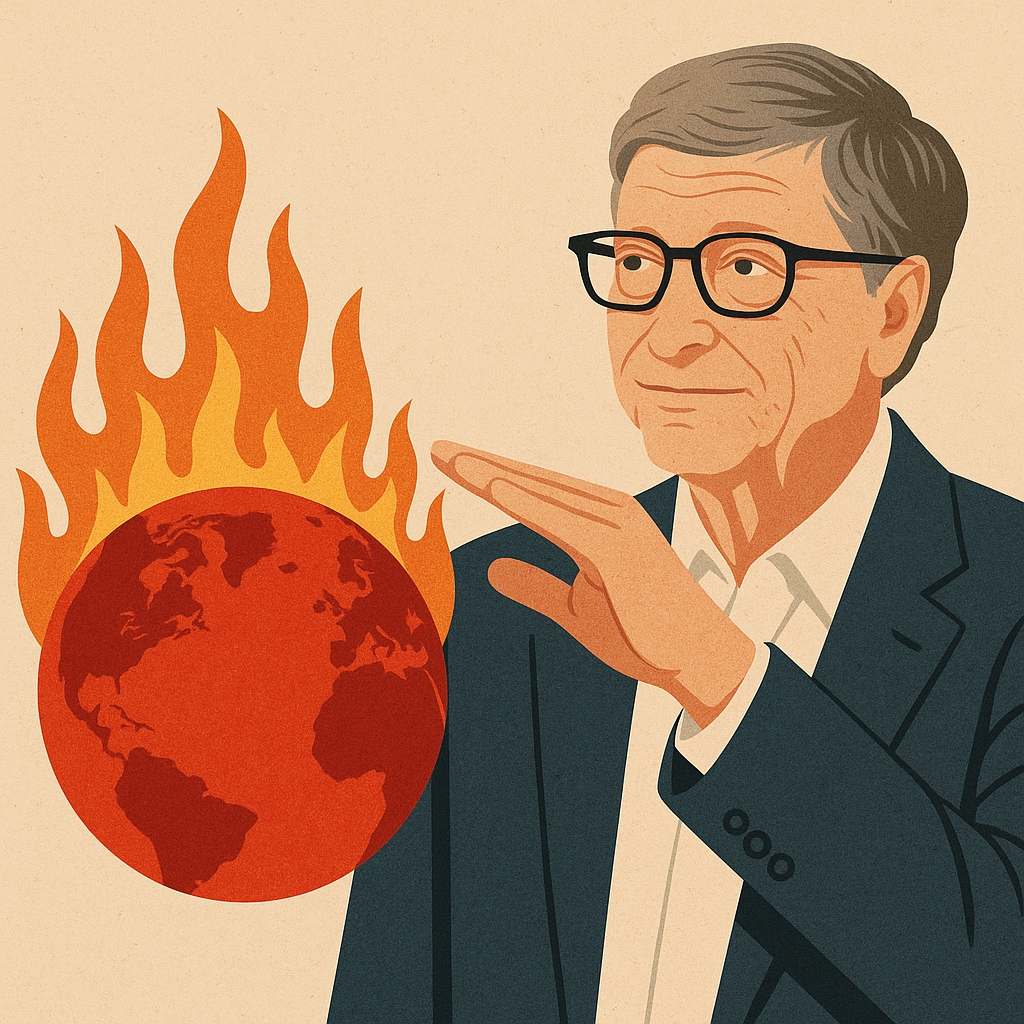
Bill Gates believes the climate crisis, while serious, is not the end of humankind. He argues that human intelligence, technological innovation, and financial power will ultimately prevail. To him, climate change is a solvable engineering problem. It is not a sign of moral collapse, only a challenge of scale. He envisions a future of nuclear micro-reactors, direct air capture, carbon-neutral cement, and meat grown in laboratories.
Gates often describes himself as a “technological optimist.” In his worldview, science and capitalism combined can fix what they broke. The same forces that caused the crisis will now rescue humanity. His philanthropic projects, investments in Breakthrough Energy, and faith in the private sector all point to one conviction: that the system can correct itself.
Yet many scientists, environmentalists, and systems theorists do not share his confidence. They warn that such optimism might be misplaced — not because of lack of intelligence or technology, but because of the limits of biology, physics, and politics.
The scientific reality of tipping points
In climate science, the most alarming concept is the tipping point — a threshold beyond which self-reinforcing feedback loops accelerate warming beyond human control. Once triggered, these loops cannot be stopped by human policy or technology.
Permafrost in Siberia stores enormous amounts of methane, a greenhouse gas dozens of times more potent than carbon dioxide. As temperatures rise, permafrost thaws and releases methane, which further heats the planet and accelerates its own melting. The same happens with melting polar ice, which reflects sunlight less efficiently once replaced by dark water. Forests like the Amazon, once carbon sinks, can transform into carbon sources if drought and deforestation continue.
Leading researchers such as Johan Rockström and Tim Lenton warn that these processes could link together, forming a domino effect that transforms the Earth’s climate system within decades. The Intergovernmental Panel on Climate Change (IPCC) has stated repeatedly that some of these thresholds may already be close to activation.
Gates’s optimism assumes that human ingenuity can always adapt. The scientific evidence suggests that nature might not wait long enough for that adaptation to happen.
The underestimated risk of societal breakdown
The debate around global warming often focuses on temperature numbers — 1.5°C, 2°C, or 3°C — as if humanity can precisely calculate safety. But behind these figures lies something deeper: the stability of civilization itself.
Food production depends on predictable seasons. Cities rely on functioning supply chains. Financial systems assume stability in agriculture, trade, and migration. Once those pillars start shaking, everything connected to them begins to fall.
Scientists like Jem Bendell, author of the Deep Adaptation framework, argue that climate change is not just an environmental issue but a societal one. Droughts destroy crops, which increase prices, which fuel unrest, which destabilize governments. Studies by the Global Systems Institute at the University of Exeter show that cascading failures across infrastructure, economy, and governance could occur even in developed nations.
From Syria to Sudan, environmental stress has already played a role in violent conflicts. If tropical regions become uninhabitable, hundreds of millions could migrate north, triggering unprecedented political crises. Technology can build seawalls or desalination plants, but it cannot fix hunger, fear, and chaos once they spread across borders.
The limits of technological salvation
Gates sees salvation in innovation. He believes in electric vehicles, smart grids, and hydrogen fuels. But scientists and engineers increasingly point to a harder truth: innovation alone will not save us.
Renewable energy is growing fast, yet global energy demand keeps growing faster. The more efficient technology becomes, the more energy humanity consumes — a phenomenon known as the Jevons paradox. Solar panels and wind turbines require massive quantities of rare earth metals, lithium, and cobalt. Their mining destroys ecosystems and exploits workers in the Global South.
Climate models show that even if all nations met their current pledges, global emissions would still exceed safe levels by 2030. The transition is too slow. Fossil fuel companies continue to expand drilling projects while presenting green rebranding campaigns. For many scientists, the problem is not lack of innovation but lack of structural change.
Systems ecologists argue that economic growth itself — the very foundation of Gates’s optimism — is incompatible with planetary limits. Without reducing consumption and inequality, even perfect technology will fail to stabilize the biosphere.
Beyond temperature — collapsing ecosystems
Climate change is not only about heat. It is about the intricate web of life unraveling. The Earth’s temperature affects everything, from coral reefs and plankton to forests and pollinators. Once those systems collapse, humanity loses its biological foundation.
The oceans absorb more than 90% of excess heat from greenhouse gases. As a result, they are warming, acidifying, and losing oxygen. Coral reefs, which support a quarter of all marine life, are dying. Fisheries are collapsing, threatening billions who rely on them for food. On land, soil degradation has already reached critical levels. Without healthy soil, agriculture will fail regardless of climate adaptation.
Biologists estimate that the current rate of species extinction is 100 to 1,000 times higher than the natural background rate. The Earth is entering its sixth mass extinction, driven not by asteroids but by humans. Even if temperature rise stopped today, many species would still vanish due to habitat loss and pollution.
When Gates speaks of humanity’s survival, scientists remind him that humans cannot survive apart from the living systems that sustain them.
The moral and psychological dimension
Some researchers now approach climate change not only as a scientific or technical issue but as a moral and psychological one. They study how denial, optimism, and despair shape public reaction.
Gates’s optimism comforts people who want to believe that everything will be fine. But it may also delay action. Psychologists call this “optimism bias” — the belief that bad outcomes are unlikely to happen to oneself. On the other side lies climate anxiety, a growing sense of helplessness among younger generations who see no meaningful progress.
Philosophers of science warn against both extremes. Blind optimism leads to complacency, while fatalism leads to paralysis. What humanity needs, they argue, is climate realism — the courage to face facts without surrendering to despair. It means recognizing that technology is necessary but insufficient, and that moral transformation must accompany material innovation.
Realistic scenarios for the future
Climate models outline several possible futures. The most optimistic one assumes immediate global cooperation, rapid decarbonization, and a revolution in energy systems. Under that path, warming might stabilize around 1.5°C to 2°C. Humanity would still face major disruptions but avoid total collapse.
The middle scenario — the one scientists consider most likely — leads to around 3°C of warming. It would devastate ecosystems, flood coastal cities, and create hundreds of millions of refugees. Civilization would survive, but in a diminished and fractured form.
The worst scenario, above 4°C, risks rendering large parts of the planet uninhabitable. Food systems would collapse, freshwater would disappear, and vast migrations could overwhelm every existing institution. Gates dismisses this as unlikely, but scientists warn that feedback loops and political inaction make it disturbingly plausible.
The future will depend not only on inventions but on values — on whether humanity can prioritize long-term survival over short-term profit.
Between denial and despair
Bill Gates’s faith in technology reflects a deep cultural belief — that progress never reverses, that intelligence always wins. But nature does not negotiate. The atmosphere does not respond to ideology.
Scientists do not deny human creativity or progress. They simply observe that the window for avoiding catastrophe is closing fast. They warn that optimism without realism is another form of denial — a pleasant illusion to mask fear.
Humanity may still have time to adapt, but not to continue as before. The question is not whether global warming is the final stage of humankind. It is whether humankind can finally overcome its own arrogance before that stage begins.
Leave a Reply