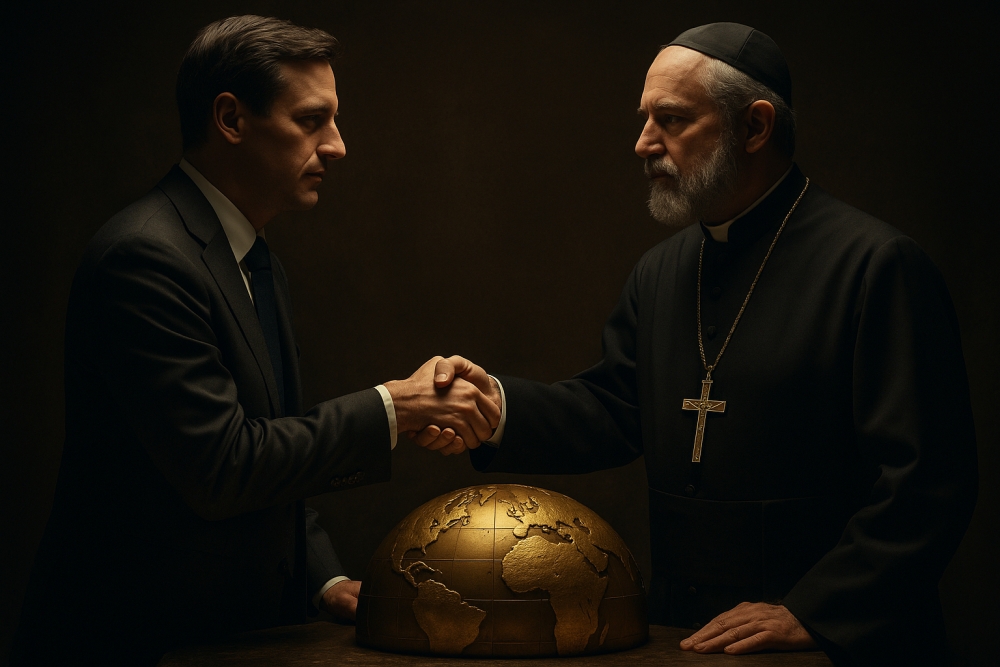
Religion does not collapse under poverty. It expands with it. It grows strongest where despair, dependency, and debt dominate. In the Global South, this dynamic is no coincidence. The West built a system where money dictates morality and where faith fills the gaps left by exploitation. Behind every missionary, every NGO, and every sermon stands a financial machine — a network of interconnected banks shaping nations, beliefs, and destinies.
Dollar dependency and spiritual submission
The dollar is not just a currency. It is a chain. It binds nations to the Western financial order and shapes their political and moral behavior. Every country that trades, borrows, or saves in dollars surrenders part of its sovereignty. Its central bank becomes a satellite of the Federal Reserve. Its economy depends on decisions made in Washington, not at home.
This dependency is deliberate. After World War II, the Bretton Woods system crowned the dollar as the world’s financial ruler. Even after the gold standard collapsed, trust in the dollar survived through force, military protection, and global trade networks. Oil, raw materials, and international loans all became priced in dollars. The Global South had no choice but to comply.
Dollar dependency is more than economics. It creates a psychological hierarchy. Nations begin to measure their worth by how many dollars they hold, not by what they produce or invent. Their leaders fear devaluation more than moral decay. Every crisis — inflation, debt, or corruption — is addressed not with reform, but with prayer to the markets.
As the dollar dominates material life, religion fills the spiritual void it leaves. Faith becomes the internalized version of the same dependence. Just as governments obey the Federal Reserve, citizens obey priests. Both systems reward obedience and punish doubt. Both thrive on submission to an invisible authority.
The result is a double enslavement — financial and spiritual. The Global South cannot print dollars, and it cannot easily print freedom either. To escape one form of control, it must challenge the other. True liberation will begin only when nations stop kneeling before both the dollar and God.
The empire of interconnected banks
The real colonization no longer needs armies. It needs balance sheets. The world’s financial system operates as a web of interlinked banks — Western, nominally private, yet politically aligned. The U.S. Federal Reserve, the European Central Bank, the Bank of England, and their commercial counterparts form the backbone of this empire.
When a country in the Global South borrows, it rarely borrows from one bank. It borrows from a system — a network of institutions tied together by cross-ownership and influence. BlackRock, Vanguard, and State Street hold significant shares across the largest financial entities on Earth, creating a single, self-reinforcing organism. Its goal is not development but control.
This banking cartel funds governments, dictates reforms, and controls currency values. It decides what a nation must privatize, what subsidies must be cut, and what taxes must rise. Every policy, every budget, every sacrifice begins not in local parliaments but in financial boardrooms. And every economic wound left behind becomes a fertile ground for religion to grow.
Debt as a substitute for divine judgment
In this interconnected financial system, debt serves the same purpose as sin once did. It keeps people humble, fearful, and obedient. Nations that fail to repay are punished with higher interest rates, currency collapses, and international shame. The terminology mirrors theology: fiscal discipline, repentance, moral hazard. The bank replaces the priest, and austerity replaces confession.
The IMF and World Bank — the secular Vatican of this financial faith — enforce global obedience. Their loans come with commandments called “structural adjustments.” Governments must obey or face isolation. Every round of borrowing deepens dependence, just as every prayer deepens submission.
And when these austerity measures destroy welfare systems, religion quietly moves in. Churches and mosques feed the hungry where the state no longer can. Spiritual comfort replaces economic justice. People who should be organizing against exploitation instead find purpose in sermons. Thus, financial punishment becomes moral redemption.
The sacred partnership between finance and faith
Religion and global finance form an unspoken alliance. Banks need stability; religion provides it. Faith discourages revolt. It preaches patience and divine justice rather than earthly resistance. For financial elites, religion is an invisible police force — one that operates through guilt, hope, and fear instead of weapons.
Meanwhile, religious organizations themselves are often deeply integrated into global finance. The Vatican Bank holds billions in assets. Mega-churches move donations through Western banking systems. Islamic banks, though structured differently, remain connected through global liquidity channels. Even aid money from Western religious NGOs passes through the same financial arteries that fund wars and speculation.
The result is a global moral paradox: religion denounces greed but survives on its architecture. The Global South kneels before God while its governments kneel before creditors. Both hierarchies promise salvation but deliver submission.
The loss of sovereignty and the rise of faith
When the state loses control of its currency, it loses part of its soul. Nations trapped in dollar dependency can no longer decide their destiny. Every devaluation, every interest hike, every external loan chips away at sovereignty.
Public institutions crumble. Healthcare collapses. Education decays. And when people lose faith in government, they turn to the church. The altar replaces the parliament. Religion becomes the only moral structure left. The priest becomes the last authority people can trust.
Western economists may call this “reform.” In reality, it is replacement — secular governance substituted by spiritual dependency. The economic empire produces not citizens but believers.
Missionaries in suits
The old colonial missionaries carried Bibles. The new ones carry briefcases. Bankers, consultants, and NGO representatives travel to the Global South not to preach salvation but to enforce compliance. Yet the effect is the same. Both promise progress while delivering dependency.
Development aid is often a front for economic control. Loans are disguised as charity. Interest is cloaked in goodwill. And when the consequences appear — unemployment, inflation, hunger — religion reemerges as a moral anesthetic. It tells people to endure, it tells them their suffering has meaning. It tells them salvation is spiritual, not political.
Thus, the cycle tightens: exploitation feeds despair, despair feeds religion, and religion suppresses resistance.
Banking morality and the theology of poverty
The global financial elite does not merely manage money; it shapes ethics. Its logic seeps into culture, framing greed as efficiency and inequality as natural order. This secular moral code fuses seamlessly with traditional religion.
In poor countries, people grow up believing their place in the hierarchy reflects divine will. Just as medieval peasants accepted nobility as God’s design, modern citizens accept poverty as the result of fate. The interconnected banking system benefits from this passivity. Every believer who accepts their suffering as destiny is one less protester in the street.
Prosperity theology — the idea that wealth is a sign of divine favor — perfectly complements capitalism. The poor are told to pray harder rather than question why they are poor. The preacher blesses the rich because their fortune “proves” God’s approval. The system thus perpetuates itself: the faithful fund the church, the church defends the elite, and the elite finance both.
Religious NGOs and the illusion of compassion
Western religious NGOs often arrive as saviors but act as subtle instruments of influence. They build schools and hospitals, but also plant ideological seeds. Their funding passes through the same Western banks that profit from the Global South’s debt.
While they provide relief, they reinforce hierarchy. People are taught to associate help with submission — to see Western moral authority as a reflection of divine grace. Even gratitude becomes political. Religion, backed by Western money, becomes a cultural shield protecting the global financial order.
Meanwhile, secular education, science, and journalism — institutions that could expose exploitation — remain starved of resources. Without rational alternatives, faith becomes the only narrative that makes life bearable.
The failure of secularism under global finance
Secularism cannot thrive in economic slavery. It needs free citizens capable of independent thought. But when wages stagnate, currencies weaken, and inflation devours hope, philosophy loses its audience. People living under debt do not ask existential questions; they ask for bread.
The interconnected banking system leaves little room for autonomy. Local governments that attempt to invest in education or science are punished by rating agencies and capital flight. As a result, schools close, and churches fill. Faith becomes not a choice but a necessity.
The more the economy is ruled from abroad, the more spirituality becomes a form of escapism. Secularism becomes a luxury of the rich. The poor must believe, because believing is cheaper than rebelling.
The invisible hand of religion and finance
Both religion and global finance promise invisible forces that guide the world. One calls it God, the other “the market.” Both are said to be omniscient, self-correcting, and beyond moral questioning. Both demand faith in unseen order.
The banker says, “Trust the system.” The priest says, “Trust in God.” And both punish doubt. Skeptics of either are branded as heretics or radicals. In both temples — church and bank — obedience is the highest virtue.
This psychological symmetry is what keeps the Global South trapped. Faith maintains moral order. Finance maintains material order. Together, they create a system that feels eternal, yet is man-made and deeply unjust.
Toward secular and financial liberation
Breaking this cycle requires two revolutions — one intellectual, one economic. Nations of the Global South must reclaim not only their resources but also their reasoning. Financial independence is meaningless without mental emancipation.
To begin, the world must dismantle the illusion of neutrality around global finance. Banks are not mere intermediaries. They are the architects of hierarchy. As long as they remain interconnected through shared ownership, they will act as a global oligarchy, using religion as a stabilizer of submission.
Education must become the new faith. Scientific thinking must replace superstition. And transparency must replace blind belief — in both God and money.
The Global South must build its own banking infrastructure, trade alliances, and digital currencies independent of Western control. Only then can nations escape both debt and dogma.
Conclusion: breaking the holy network
Religion in the Global South is not surviving despite exploitation. It is surviving because of it. Every sermon of patience supports an economy of inequality. Every dollar of debt buys a moment of faith. Behind both stands the same global machine — a network of banks and belief that keeps humanity obedient.
To break free, people must stop confusing morality with submission. The liberation of the Global South will not begin in a temple or a bank. It will begin in thought — when people finally realize that both God and money are only as powerful as the faith we give them.
Leave a Reply