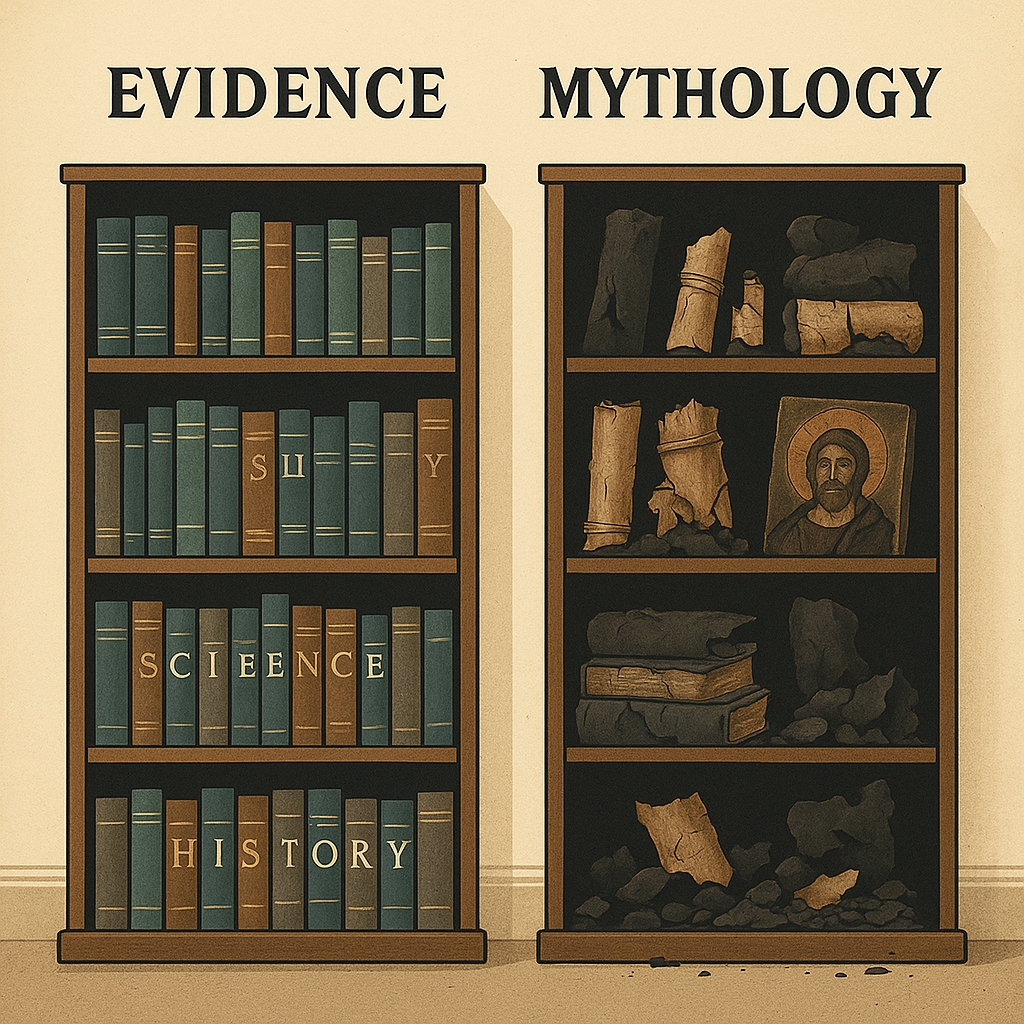
Every honest inquiry begins with discomfort. And nothing creates more discomfort than asking whether Jesus ever existed at all. Once you look at the historical evidence, the silence becomes deafening. The era overflowed with chroniclers who described everything: uprisings, quacks, prophets, magicians, riots, executions, natural phenomena, and obscure cults. Yet they never described Jesus. This forces a confrontation that many people fear, because it threatens the entire architecture of their worldview. And once the question appears, two radically different responses emerge. One follows evidence. The other follows emotional reflexes.
The historical problem: Why Jesus’ existence crumbles under scrutiny
You do not need conspiracies. You need only to read what historians of that era wrote — and, more importantly, what they did not write. Philo never mentioned Jesus. Seneca never mentioned him. Pliny never mentioned him. Josephus appears edited later by Christian scribes, which corrupts the text. And the gospels contradict each other at every crucial point. They use anonymous authors., they repeat earlier myths recycled from older religions. They disagree on genealogy, events, locations, dates, witnesses, and basic chronology. Early Christian communities even disagreed on whether Jesus was a man, a spirit, an allegory, or a cosmic principle. These contradictions matter. They weaken the historical claim to near-collapse. And this collapse forces people to face reality — or to run from it.
Approach one: The clear, rational confrontation with evidence
Some people approach the subject without fear. They look at facts. They consider arguments, they evaluate sources. And they understand cognitive distortions. They detect fallacies. They separate emotional loyalty from historical reality. This mindset leads to a simple moment of intellectual honesty: “Jesus did not exist? Fine. I must accept it.” No panic, no denial. No collapse. The evidence outweighs tradition. Therefore the person updates their worldview. This reaction shows maturity rather than coldness. And clarity often replaces confusion.
How a rational person reconstructs meaning
Once the myth dissolves, nothing catastrophic happens. The individual rebuilds their worldview on evidence rather than comfort. Morality shifts from divine threat to human empathy. Meaning grows from reality, not mythology. Fear of hell disappears. Shame designed by priests evaporates. Responsibility becomes internal rather than imposed. And the person moves forward without psychological dependence on a figure who likely never lived in the first place. Truth liberates because truth does not demand submission.
Approach two: The deeply biased rejection of evidence
Then comes the other response. Many people feel terror when the Jesus question enters their mind. They feel their identity shaking; they feel childhood conditioning rising. They feel tribal belonging threatened. Therefore they activate every cognitive bias in the human brain. Confirmation bias floods the system. Motivated reasoning twists logic. Appeal to tradition shields belief. Sunk cost fallacy keeps them invested. Tribal loyalty blocks doubt. Fear of eternal punishment freezes thought. And the person defends the myth as if their survival depends on it. In evolutionary terms, it does.
The emotional roots of denial
People do not reject evidence because they lack intelligence. They reject it because they fear psychological collapse. Families taught them faith when they had no critical tools. Communities rewarded obedience. Churches shaped their emotional vocabulary. And fear shaped their worldview. Therefore, when evidence contradicts belief, they do not evaluate it. They defend themselves against it. They protect identity, not truth. And this reflex hides under layers of piety, not logic.
Cognitive dissonance and the war against reality
When evidence contradicts belief, the mind ignites. It fights itself. Cognitive dissonance pushes people into extreme behaviors. They attack critics, they dismiss scholars, they invent excuses. And they shift definitions. They demand impossible standards of proof; they claim spiritual knowledge. They move goalposts endlessly. And every move hides a single motive: preserve the myth. Protect the self. Avoid collapse. Denial becomes psychological armor.
The desperate need to preserve Jesus
For many people, Jesus is not a historical figure. He is emotional scaffolding, he holds their worldview, he calms their fear of death. And he justifies their morals. He gives them language for suffering. Therefore the mind refuses to lose him. So believers say, “He exists in my heart.” Or, “The devil hides the evidence.”; Or, “Faith matters more than proof.” Or, “Silence is part of God’s plan.” These sentences function as psychological shields. They defend the believer against evidence, not against sin.
Two minds, two realities
And so two worlds emerge. One person follows evidence and reaches clarity. Another person follows emotion and reaches denial. One approach strengthens the mind. The other protects the ego. One accepts reality as it is. The other demands that reality bend to belief. Both reveal the internal architecture of the individual. And both show how humans negotiate truth: some with courage, others with fear.
What these approaches reveal about human cognition
Humans evolved to survive, not to seek truth. Myth protected tribes. Belief unified groups. Religion reduced anxiety about death. Supernatural thinking offered illusions of control. Therefore the brain naturally protects narratives that hold the group together. Truth-seeking develops later, through education, stability, and intellectual discipline. This is why one approach requires work while the other requires instinct. And this is why societies often reward obedience rather than accuracy.
The evolutionary psychology behind belief
Religion survives because it aligns with ancient cognitive systems. Humans evolved to detect agency everywhere. They evolved to overinterpret intention. They evolved to follow leaders, they evolved to find patterns in chaos. Jesus fits these instincts perfectly, even if he never existed. The myth offers structure; the myth offers belonging. The myth offers meaning. And evolutionary psychology explains why rejecting the myth requires cognitive strength rather than faith.
The personal cost of denial
Denial drains mental energy. It forces people into constant self-defense. It traps them inside a shrinking intellectual space. They avoid books, they avoid history. They avoid science; they avoid debate. And they avoid their own questions. And the cost grows as the world modernizes. Their emotional world stays ancient while reality evolves. Therefore denial becomes a prison.
The personal gain of acceptance
Acceptance frees the mind. It dissolves fear, it creates internal stability. It grounds morality in humanity rather than command. And it replaces illusion with clarity. It liberates people from punishment-based ethics. It reclaims life from superstition. Acceptance leads to intellectual adulthood. And it opens the path toward authentic meaning, not borrowed mythology.
The social consequences of both paths
Societies built on denial often resist progress. They enforce conformity, they punish questioning. They elevate myth over evidence, they protect institutions rather than truth. Meanwhile societies built on acceptance grow faster. They innovate, they educate. And they question authority. They challenge outdated values. And they create environments where individuals develop autonomy rather than submission.
Choosing between truth and comfort
Every person eventually reaches a junction. One road leads to truth. The other leads to emotional safety. Truth demands courage. Comfort demands surrender. Both shape the future of the mind. And both reveal the psychological structure of the individual. The world moves forward when more people choose truth over tradition.
Conclusion: Two approaches, one reality
Jesus’ existence does not depend on belief. Evidence stands on its own. Silence stands on its own. Contradictions stand on their own. And the historical record tells its story whether people accept it or not. The real question is not whether Jesus existed. The real question is how people respond when confronted with that possibility. One approach embraces reality. The other runs from it. And the moment you choose between them, you define your intellectual adulthood.
Leave a Reply