Many people imagine Silicon Valley as a spontaneous miracle of entrepreneurship. Young programmers in garages invent revolutionary technology. Venture capital funds the best ideas. Markets reward innovation. This story dominates public imagination.
Reality looks far more complex.
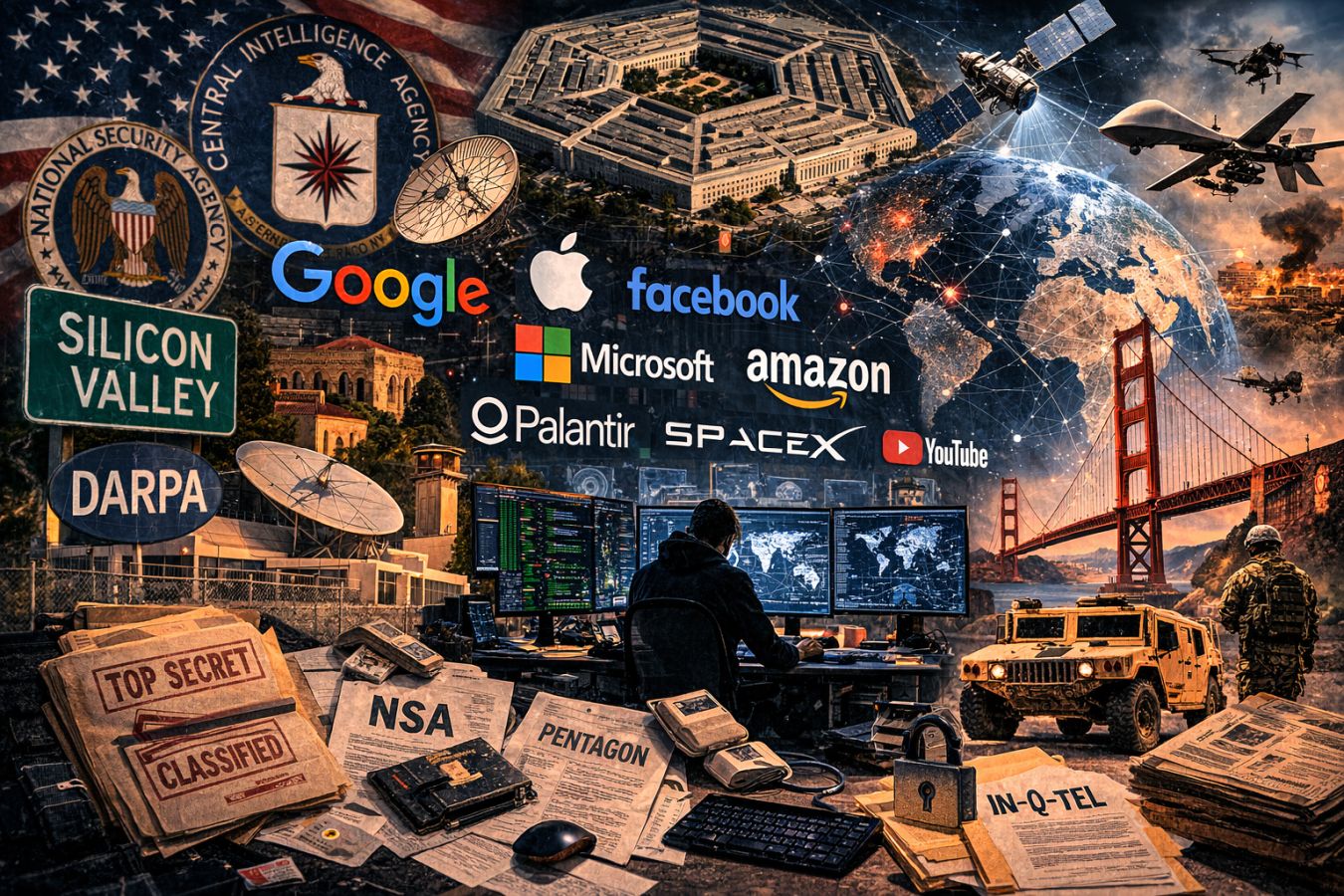
Silicon Valley grew inside a dense institutional ecosystem that involved the U.S. military, intelligence agencies, universities, and federal research programs. From the beginning, the region did not function as a purely private entrepreneurial environment. Instead, it operated as a strategic technological laboratory of the United States.
Behind the mythology of startups lies a structural triangle. Military institutions financed early research. Intelligence agencies supported technological breakthroughs. Private entrepreneurs then commercialized these technologies and built global corporations.
To understand Silicon Valley properly, one must understand this triangle of power.
Cold War roots of Silicon Valley
Silicon Valley did not arise naturally from free markets. The region grew directly out of Cold War military research.
After the Second World War, the United States faced a geopolitical confrontation with the Soviet Union. The government dramatically expanded funding for advanced science and engineering. Electronics, computing, missile guidance systems, radar technology, and satellite communication became strategic priorities.
Universities in California played a decisive role in this transformation. In particular, Stanford University became a central hub linking academia, defense research, and private industry.
The university encouraged close cooperation between professors, government laboratories, and emerging technology companies. Research contracts from the U.S. Department of Defense poured into laboratories and startups.
Early semiconductor companies such as Fairchild Semiconductor produced electronic components that supported missile systems, aerospace navigation, and military communications.
Thus, Silicon Valley began as a defense ecosystem. Military priorities created the technological infrastructure that later allowed commercial computing to flourish.
ARPANET and the birth of the internet
Perhaps the most influential technological development in modern history also emerged from military research.
The early internet originated from programs developed by DARPA.
During the Cold War, American strategists feared that a nuclear attack could destroy centralized communication systems. They needed a network that could survive catastrophic damage and continue transmitting information between military installations.
DARPA funded research into distributed networking systems capable of operating even if parts of the network were destroyed. This research led to the creation of ARPANET in the late 1960s.
Universities, military laboratories, and research institutions connected their computers through this experimental network. Over time the system expanded, evolved, and eventually formed the foundation of the modern internet.
Thus one of the most transformative technologies in human history began as a strategic military communication project.
Intelligence agencies enter venture capital
As the digital economy expanded, intelligence agencies faced a new challenge. Innovation increasingly occurred inside private startups rather than traditional defense contractors.
To keep access to emerging technologies, the Central Intelligence Agency created a venture capital organization called In-Q-Tel.
This organization invests in young technology companies that develop tools potentially useful for intelligence operations.
The areas of interest include artificial intelligence, advanced data analysis, cybersecurity, satellite imagery, and biometric identification systems.
Through these investments, intelligence agencies gain early access to emerging technologies before they reach commercial markets.
In other words, intelligence institutions participate directly in the innovation ecosystem of Silicon Valley.
Major startups built with military and intelligence support
Public narratives often present Silicon Valley startups as purely private achievements. However, several major companies emerged from environments shaped by defense funding or intelligence involvement.
One famous example involves Google.
The search engine originated from research projects funded partly through federal grants connected to programs supported by DARPA and the National Science Foundation.
The early research focused on improving large-scale information retrieval systems. Intelligence and defense analysts needed better tools to search massive databases. That research eventually evolved into Google’s search technology.
Another clear example involves Palantir Technologies. The company emerged with early investment from In-Q-Tel.
Palantir developed powerful software platforms capable of analyzing enormous datasets. Intelligence agencies use these systems to identify patterns in financial transactions, communications networks, and potential terrorist activities.
Geospatial technologies provide another example.
The satellite mapping company Keyhole Inc. received early funding from In-Q-Tel. Google later acquired Keyhole, and its technology became the foundation of Google Earth.
Even social media platforms emerged inside academic ecosystems heavily funded by federal research programs. Companies such as Facebook developed within universities that received extensive government research support, including projects linked to defense technology programs.
These cases reveal a structural pattern. Governments often finance risky early research. Private entrepreneurs later commercialize the technologies and build global corporations.
Thus many of the world’s most influential startups originated within environments strongly shaped by military and intelligence funding.
Secret services and the technological battlefield
Secret intelligence agencies play a central role in the technological ecosystem surrounding Silicon Valley. While the public often associates intelligence work with espionage, covert operations, and surveillance, modern intelligence increasingly depends on advanced computing, data processing, and artificial intelligence.
Agencies such as the National Security Agency, the Central Intelligence Agency, and military intelligence units require technologies capable of processing unimaginable volumes of data. Global communications, financial transactions, satellite imagery, and digital footprints produce information on a scale that traditional intelligence methods cannot handle.
For this reason, secret services developed deep relationships with the technology sector. Silicon Valley provides the infrastructure necessary for modern intelligence operations. Cloud computing platforms store vast quantities of information. Machine learning algorithms detect patterns hidden inside massive datasets. Artificial intelligence systems help analysts identify networks, predict behavior, and detect potential threats.
The silent collaboration
The collaboration between intelligence agencies and technology companies often operates quietly. Intelligence services may fund research programs, purchase advanced software, or cooperate with startups developing cutting-edge technologies. In some cases, they participate directly in the innovation ecosystem through investment structures such as In-Q-Tel.
At the same time, the relationship remains controversial. Critics argue that close cooperation between secret agencies and technology companies risks creating unprecedented surveillance capabilities. The global digital infrastructure—email systems, social media platforms, cloud storage, and mobile communication networks—can potentially provide intelligence agencies with extraordinary insight into human activity.
Supporters of this collaboration present a different argument. They claim that advanced technological tools allow intelligence services to prevent terrorism, cyber warfare, and geopolitical threats. In a world of complex global networks, they argue that modern intelligence requires access to the most sophisticated technologies available.
Thus, secret services increasingly operate on a technological battlefield where algorithms, data flows, and digital infrastructure become as important as traditional espionage methods. The relationship between Silicon Valley and intelligence agencies therefore represents one of the defining features of modern global power.
The military-industrial complex expands into software
In 1961, American president Dwight D. Eisenhower warned about the growing power of the military-industrial complex.
At that time, the system mainly consisted of aircraft manufacturers, weapons producers, and defense contractors.
Today the structure looks very different.
Software companies and technology platforms now form a crucial part of the military ecosystem.
Cloud infrastructure from companies such as Amazon and Microsoft supports military data processing. Artificial intelligence platforms developed by Palantir Technologies help intelligence agencies analyze complex information networks.
Private space companies such as SpaceX provide satellite communication and launch capabilities that increasingly integrate with national security systems.
The boundary between civilian technology firms and defense contractors therefore continues to blur.
Surveillance technologies and mass data
Modern intelligence operations depend heavily on data analysis.
After the September 11 attacks, surveillance capabilities expanded dramatically. Governments sought tools capable of detecting threats hidden inside global communication networks.
Revelations by Edward Snowden later exposed the scale of these surveillance systems. Agencies such as the National Security Agency collected enormous amounts of digital communication data.
Such systems require immense computational infrastructure. Silicon Valley companies provide the cloud platforms, machine learning algorithms, and large-scale data storage that make this analysis possible.
Thus the modern intelligence system relies heavily on technological ecosystems originally developed for commercial markets.
Dual-use technologies
Many technologies created in Silicon Valley possess dual-use characteristics. They serve both civilian markets and military applications.
Artificial intelligence illustrates this dynamic clearly. Companies develop AI systems for advertising optimization, medical research, and business analytics. The same technologies can also guide drones, analyze intelligence data, or identify targets on the battlefield.
Satellite imagery systems operate similarly. They help ordinary users navigate cities through mapping applications. At the same time, military analysts use similar systems for reconnaissance and strategic planning.
Autonomous technologies show the same pattern. Companies develop them for logistics, transportation, and industrial automation. Yet similar systems can control military drones and robotic vehicles.
Thus the boundary between civilian innovation and military capability grows increasingly blurred.
Technology and global power competition
In the twenty-first century, technological leadership represents one of the central arenas of geopolitical competition.
Advanced computing, artificial intelligence, quantum technologies, and semiconductor manufacturing determine strategic power.
American policymakers increasingly view Silicon Valley as a national security asset. The United States competes intensely with technological ecosystems emerging under leaders such as Xi Jinping.
Governments now treat technological infrastructure as a core component of global power.
Control over semiconductors, artificial intelligence, and digital platforms shapes the balance of power between nations.
Ethical tensions inside the technology sector
The growing connection between technology companies and military institutions produces internal tensions.
Many engineers and researchers oppose the use of technology for warfare or surveillance. Others believe cooperation with national security institutions protects democratic societies.
Protests inside major technology companies have emerged against military contracts or artificial intelligence systems designed for battlefield applications.
These debates highlight an unresolved dilemma. Should technology companies act purely as commercial innovators? Or should they function as strategic partners of national governments?
The rise of the techno-security state
The convergence of technology corporations, military institutions, and intelligence agencies creates a new form of power structure.
This system combines technological infrastructure, military capability, data dominance, and surveillance capacity.
Traditional democratic institutions struggle to oversee this complex network. Decisions occur across private companies, intelligence agencies, and defense institutions that operate partially outside public visibility.
Consequently, the alliance between Silicon Valley, the military-industrial complex, and secret intelligence agencies may represent one of the most influential power structures of the twenty-first century.
The psychological profile of the acceptable founder
Technological innovation alone does not determine which startups receive major funding, government contracts, or intelligence cooperation. The personality and psychological profile of the founder also matter. In ecosystems closely connected to national security institutions, investors and government partners prefer founders who appear predictable, cooperative, and institutionally reliable.
Silicon Valley mythology celebrates the image of the rebellious genius who disrupts the system. In reality, many founders who build companies integrated with military and intelligence ecosystems must demonstrate a very different profile. They must appear stable, pragmatic, and capable of operating within complex institutional networks.
Large defense contracts, intelligence partnerships, and sensitive technological programs require trust. Governments and security agencies do not collaborate easily with individuals who appear psychologically unstable, politically radical, or difficult to control. Therefore founders who gain access to these networks often possess characteristics that reassure powerful institutions.
Such founders typically show several traits. They communicate clearly with institutional partners, they respect security protocols. They avoid unpredictable public behavior; they demonstrate loyalty to strategic objectives and maintain stable professional relationships with investors, government agencies, and corporate partners.
This does not mean that founders lack ambition or bold ideas. On the contrary, technological vision remains essential. However, the individuals who receive access to strategic funding environments often combine innovation with psychological reliability.
In other words, technological ecosystems connected to the military-industrial complex do not only select technologies. They also select personalities.
Thus the success of many Silicon Valley companies may depend not only on technological breakthroughs but also on whether their founders fit the psychological expectations of investors, security agencies, and institutional partners.
Conclusion
Silicon Valley symbolizes innovation and technological progress. Yet its history reveals a deeper reality.
Military research funding helped create its foundations. Intelligence agencies continue to shape technological development. Private startups commercialize technologies that often originate from strategic government programs.
Understanding this triangle between technology, military power, and intelligence institutions provides essential insight into how modern global power actually operates.
Leave a Reply