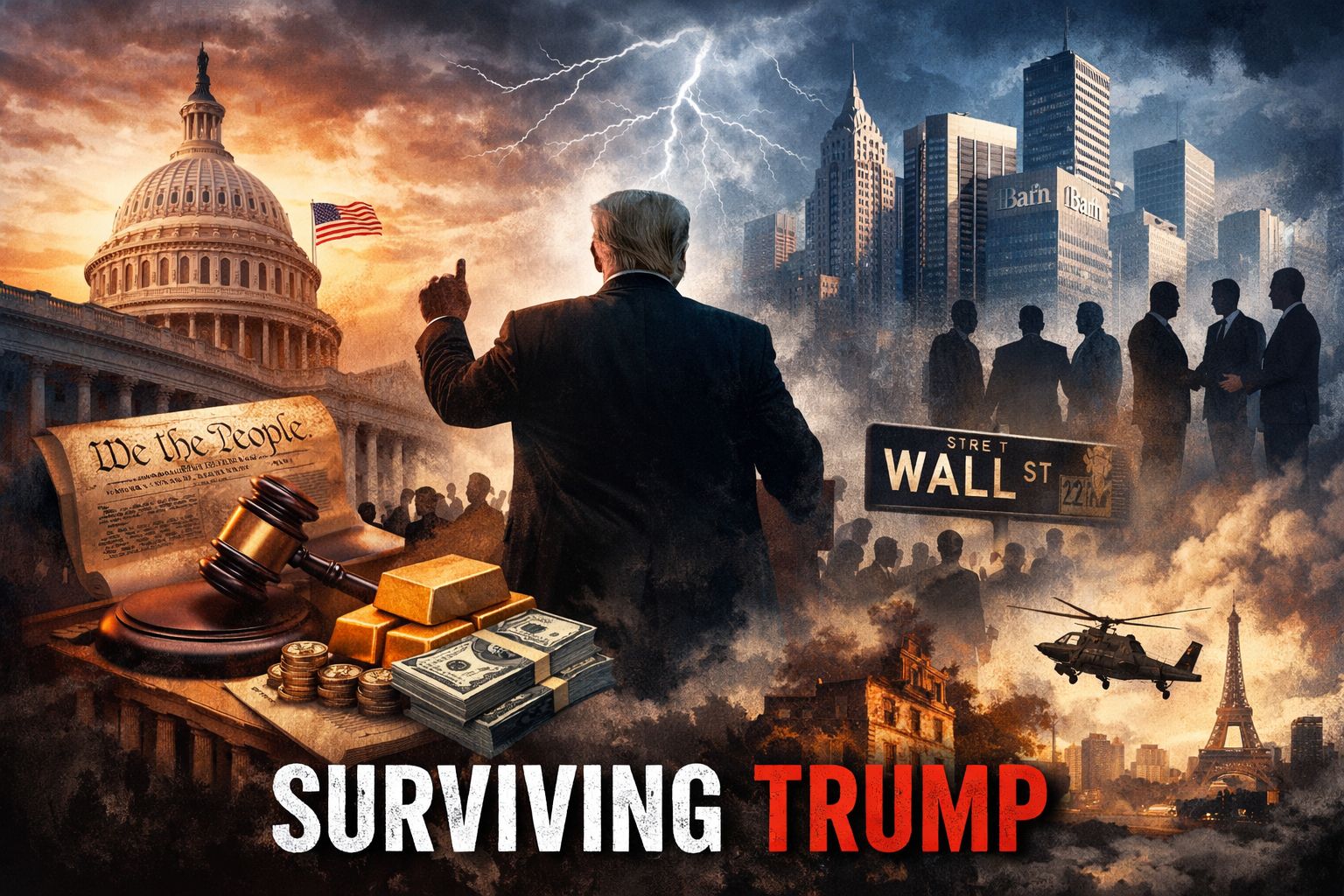
People panic. They imagine one man can destroy everything. They talk about collapse as if it stands one election away.
However, that view ignores how the system actually works. It ignores structure, it ignores incentives. It ignores history.
The system already survived far worse
The United States did not face its first crisis under Trump. It survived the civil war. It survived assassinations. And it survived economic collapse. It survived mass unrest and deep ideological division.
Each time, the system bent under pressure. Each time, it rebalanced. It did not collapse into dictatorship.
That history matters. It shows that the system contains shock absorbers. It does not rely on one moment or one leader.
Institutions in the US are unusually strong
Compared to most countries, US institutions operate with high capacity. Courts function. Elections continue. Transfers of power occur even after conflict.
The United States Constitution still structures behavior. It still limits action. It still creates boundaries.
These institutions do not depend on personal morality. They depend on rules, procedures, and enforcement.
Power does not sit in one person
Many people imagine the president as a king-like figure. That assumption breaks down quickly.
Power spreads across Congress, courts, states, agencies, and networks. Each part blocks, delays, or reshapes decisions.
A president does not rule alone. He negotiates; he reacts. He depends on others.
This fragmentation protects the system.
Federalism creates multiple centers of control
The United States is not a single centralized state. It is a layered system.
States control elections, states manage local enforcement. States run large parts of administration.
This creates barriers. A president cannot easily dominate all levels at once.
Even strong pressure meets resistance at multiple points.
Bureaucracy slows and reshapes decisions
Government does not operate at the speed of political speeches. It moves through procedures, rules, and internal review.
Career officials interpret orders. Agencies adjust implementation. Processes take time.
This frustrates rapid change. It also protects continuity.
Even aggressive political agendas face internal friction.
Elite networks shape the real landscape
Here lies a deeper layer.
Wealthy families, major financial institutions, investment firms, and lobbyists shape the political environment. They fund campaigns, they influence legislation. They build long-term relationships across parties.
Presidents often align with different clusters of these interests. Power does not vanish when leadership changes. It circulates among competing networks.
These actors prefer stability over disruption
This has nothing to do with moral virtue.
These actors operate businesses. They manage capital. They depend on contracts, markets, and predictable rules.
Chaos destroys value. Extreme authoritarian moves create uncertainty. Both outcomes damage long-term interests.
So they support a system that remains stable, even if imperfect. They apply pressure quietly. They shape outcomes without public confrontation.
The American economy anchors the system
The US economy provides another layer of resilience. It remains one of the strongest in the world. Capital markets dominate globally. Technological innovation continues. Financial networks extend across continents.
This economic weight stabilizes politics. It creates incentives to maintain order.
When the economic core remains strong, political shocks become easier to absorb.
Media, law, and opposition create constant pressure
No leader operates without scrutiny. Media investigate. Opponents attack. Courts review.
Every decision faces reaction. Every move creates counter-moves.
This constant pressure prevents unchecked expansion of power.
Trump tested limits, not foundations
Trump pushed rhetoric further than most presidents. He challenged norms openly. He attempted to expand executive influence.
However, the system did not collapse. Courts intervened. States resisted. Elections continued. Political opposition remained active.
The structure held. That matters more than any single moment.
Survival does not mean health
The system survived, but it showed stress. Polarization increased. Trust declined. Public discourse degraded.
Institutions still function, but they face pressure. Norms weakened. Conflict intensified.
Survival does not equal stability. It only shows that collapse did not occur.
The real weakness lies outside
The deeper problem appears in foreign policy.
The United States has often created instability abroad through interventions, wars, and strategic pressure. These actions produced long-term consequences in many regions.
Trump intensified tensions. He damaged alliances. He strained relationships, especially with Europe.
This external dimension matters more than internal drama.
Europe faces a different risk
The US system has depth. It has scale. It has economic and institutional strength.
European democracies do not always share that level of structural resilience. They rely more on consensus. They rely more on political culture.
That creates vulnerability.
If external pressure increases, European systems may struggle more than the American one.
The real answer
US democracy survives because power does not concentrate in one place. It spreads across institutions, states, networks, and economic structures.
No single actor controls everything. No decision moves without resistance.
And above all, the most powerful actors inside the system prefer stability over collapse.
Not because they believe in democracy as an ideal. Because it protects their interests.
Leave a Reply