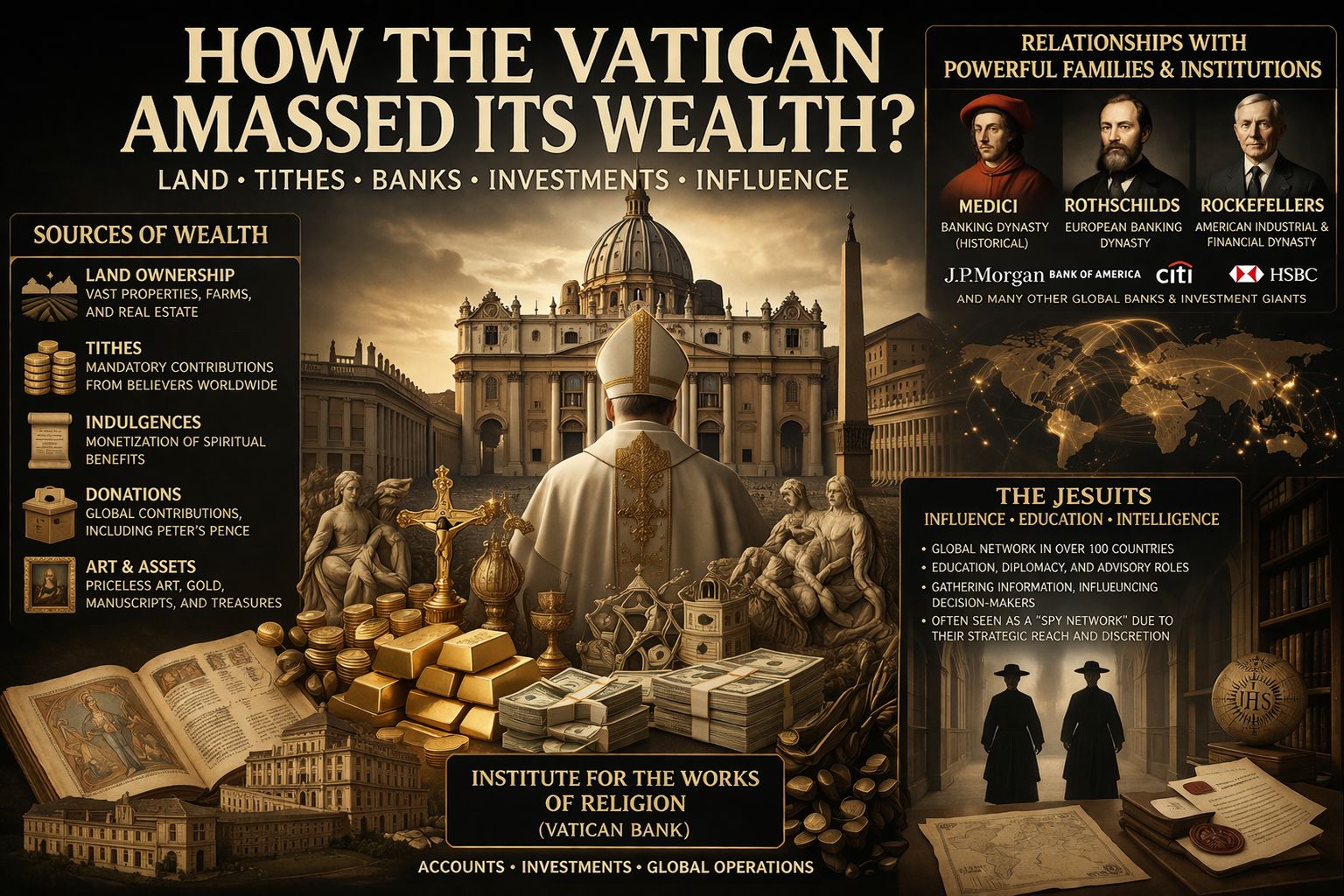
The Vatican appears as a purely spiritual institution. It presents itself as a moral authority, a religious center, and a guide for billions of believers. However, beneath this image lies a long history of material accumulation. Over centuries, the Church did not only shape belief. It built one of the most durable financial and asset-based systems in human history.
Understanding this requires moving beyond myths. The Vatican did not become wealthy through a single mechanism. It combined land ownership, donations, financial relationships, political leverage, and institutional continuity.
Land as the original source of power
The foundation of Church wealth began with land. During the late Roman Empire and early medieval period, the Church received vast donations from emperors, nobles, and local elites. These were not symbolic gifts. They were productive assets.
Land generated income through agriculture, rents, and labor obligations. Over time, the Church became one of the largest landholders in Europe. This gave it economic stability that did not depend on trade or market volatility.
Unlike kings, who lost territories through war, the Church retained land across generations. Its institutional continuity allowed it to accumulate rather than reset.
Tithes: A global revenue system
The Church did not rely only on land. It created a systematic income structure through tithes. Believers were expected to contribute a portion of their income. This was not always voluntary in practice. In many regions, it functioned as a mandatory system.
The result was a continuous flow of resources. Unlike taxation by states, this system extended across borders and political systems. It created a decentralized but reliable revenue network.
Over centuries, this mechanism generated enormous wealth. It also tied financial contribution to spiritual obligation, which strengthened compliance.
Banking and financial relationships
As European economies developed, the Church interacted with emerging banking systems. It maintained complex relationships with financial families and institutions. One of the most well-known connections involved the Medici family, who managed papal finances at key points.
The Church officially condemned usury. However, in practice, financial mechanisms evolved around these restrictions. Credit, delayed payments, and structured financial agreements allowed the Church to operate within economic systems while maintaining its doctrinal position.
Over time, these relationships expanded. The Church did not function as a commercial bank, but it operated within banking networks and benefited from them.
Loans, influence, and political leverage
Wealth is not only about accumulation. It is also about influence. The Church interacted with monarchs and states in ways that blended finance and authority.
Rulers depended on legitimacy. The Church provided it. At the same time, rulers required resources and stability. Financial relationships, direct or indirect, reinforced mutual dependence.
This created leverage. Influence did not always come from direct ownership. It often came from positioning within systems of power and obligation.
Indulgences and monetization
One of the most controversial mechanisms was the sale of indulgences. These were presented as spiritual benefits, often linked to forgiveness. In practice, they became a large-scale fundraising system.
This generated significant income but also triggered backlash. Criticism of indulgences played a major role in the Reformation. It exposed the tension between spiritual authority and financial practice.
Despite reforms, the underlying dynamic remained. The Church repeatedly found ways to convert belief into material support.
Assets beyond money
The Vatican’s wealth is not only financial. It is embedded in assets. Art, architecture, manuscripts, and real estate form a large part of its holdings.
These assets function as long-term stores of value. They do not behave like liquid capital, but their cumulative worth is immense. They also reinforce symbolic authority, which in turn supports financial flows.
The modern financial system
In the modern era, the Vatican developed formal financial structures. The Institute for the Works of Religion manages financial operations, accounts, and investments.
This institution operates globally. It supports Church activities and interacts with financial markets. At the same time, it has faced scrutiny related to transparency and regulation.
Reforms have been introduced, but the Vatican remains in a unique position. It is neither a typical state nor a typical financial institution.
Relationships with banks, investment networks, and wealthy families
The Vatican does not operate in isolation. It interacts with global financial systems, including banks, investment networks, and wealthy families.
Historically, it worked with major banking dynasties such as the Medici family. In modern contexts, its financial operations intersect with broader financial infrastructure that includes large banks, investment managers, and global capital networks.
It is often associated, in public discussion, with powerful financial families such as the Rothschild family and the Rockefeller family. These names appear frequently because they represent long-term capital accumulation and influence within global finance. However, this does not mean a single unified control structure. Rather, it reflects overlapping spheres of influence, where major institutions and wealthy actors operate within the same financial ecosystem.
The Vatican manages assets that require professional handling. This involves custodians, intermediaries, and financial institutions. In practice, this places it in the same operational space as states, corporations, and large private fortunes.
At the same time, wealthy donors continue to play a role. Contributions from affluent individuals and families support projects, institutions, and initiatives. This reinforces a long-standing pattern: capital and influence tend to circulate within interconnected networks, not isolated entities.
The key point is structural. The Vatican does not stand outside global finance. It operates within it, alongside other powerful financial actors, including families such as the Rothschilds and Rockefellers.
The Jesuits: influence, intelligence, and strategic presence
The Society of Jesus did not accumulate wealth primarily through land or banking. Instead, they operated in a different domain: knowledge, education, and influence.
Jesuits built a global network that extended across continents. They founded schools, advised rulers, and participated in diplomatic missions. This positioned them close to power without being formal rulers.
Their role created a form of strategic awareness. They gathered information through missions, maintained connections across regions, and influenced decision-making indirectly. This has often led to comparisons with intelligence networks.
While not a centralized spy agency, their structure allowed for observation, communication, and influence across borders. This contributed to the broader strength of the Vatican system, not through money, but through positioning.
Global donations and network effects
The Church continues to receive contributions from believers worldwide. Systems such as Peter’s Pence collect funds across continents. This creates a diversified inflow of resources.
Unlike states, the Vatican does not depend on a single tax base. Unlike corporations, it is not limited by market competition. Its global network provides resilience and continuity.
Structural advantage across centuries
The Vatican’s wealth results from structural advantages:
It operates continuously across centuries; it combines spiritual authority with material systems. And it maintains a global network of contributors.
It integrates financial, political, and informational influence.
Few institutions combine all these elements.
Conclusion: Accumulation through system, not simplicity
The Vatican did not become wealthy through a single action. It accumulated assets through land, tithes, financial relationships, institutional stability, and global reach.
Its power lies not only in money, but in structure. It operates across domains: belief, finance, politics, and knowledge.
Understanding this complexity is essential. Simple explanations fail. The reality is a system built over centuries, layer by layer.
Leave a Reply