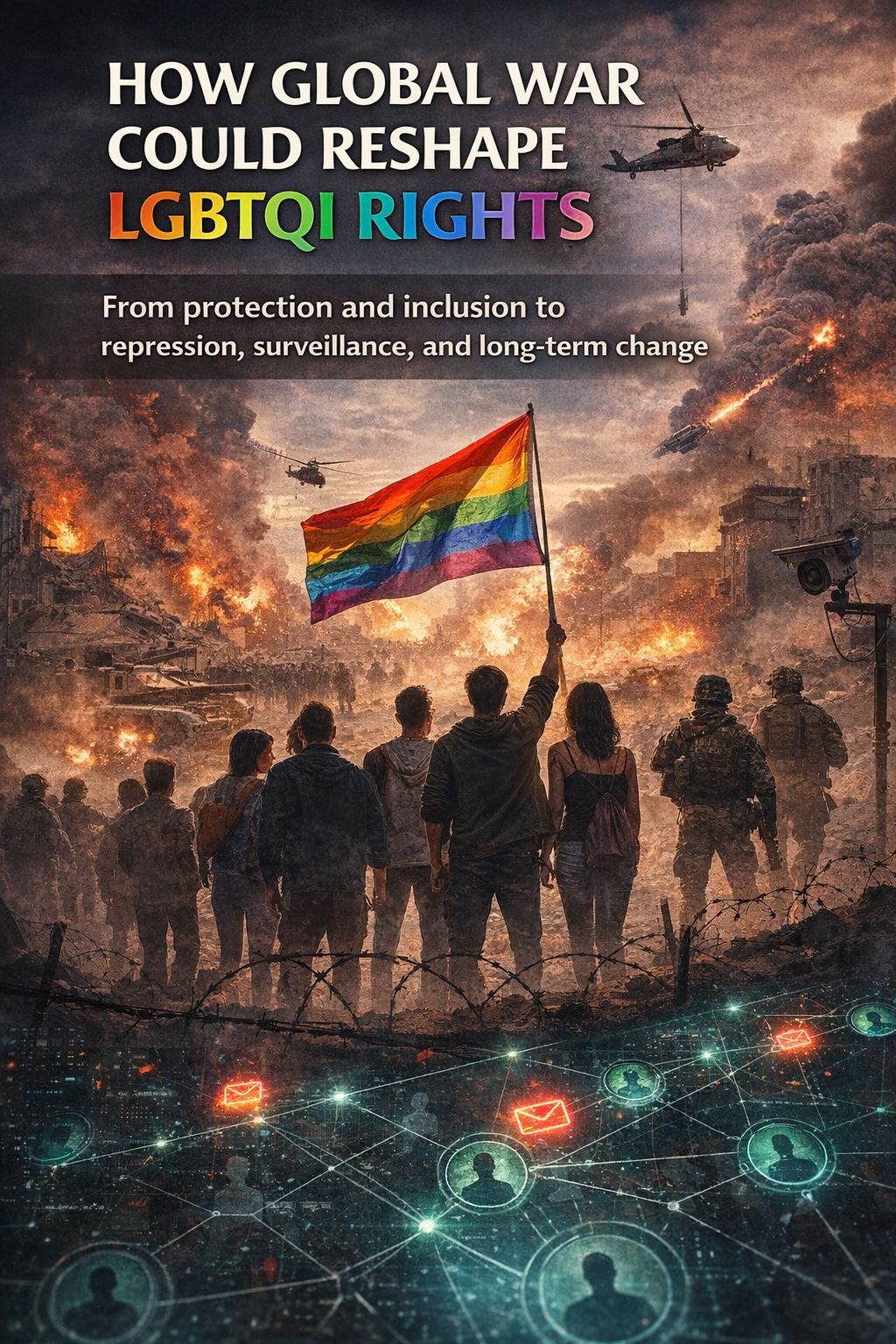
War does not only redraw borders. It reshapes priorities, values, and identities. When a global conflict erupts, states stop thinking in terms of rights and start thinking in terms of survival. Therefore, the question is not whether LGBTQI people will be affected. The real question is how deeply their position in society will shift when security replaces liberty as the central goal.
From rights to survival
In peacetime, societies debate rights, recognition, and inclusion. However, war changes the hierarchy overnight. Governments introduce emergency laws. They suspend protections. They centralize decision-making. As a result, what once looked like a permanent right suddenly becomes conditional.
Consequently, LGBTQI rights risk being reframed as secondary. Not because they logically are, but because wartime systems prioritize cohesion, obedience, and rapid decision-making. In such an environment, minority protections often lose political urgency.
State priorities: control, not diversity
War requires coordination. Coordination requires control. Therefore, governments expand surveillance, limit dissent, and enforce ideological conformity. This shift does not target only LGBTQI people, but it affects them disproportionately.
Non-conforming identities challenge uniformity. In wartime, uniformity becomes a strategic asset. As a result, visibility can turn into vulnerability. People who previously lived openly may feel pressure to hide, adapt, or leave.
Different worlds: democracies vs authoritarian regimes
Not all systems react the same way. Democracies tend to restrict rights temporarily, while still maintaining institutional limits. Courts, opposition parties, and civil society may weaken, but they rarely disappear entirely.
Authoritarian regimes move differently. They use war as justification to intensify control. They expand repression. They eliminate dissent. Therefore, in such systems, LGBTQI individuals may face not only marginalization but direct persecution.
Importantly, war does not create these tendencies. It accelerates them. Countries that already lean toward repression become harsher. Countries with stronger institutions may resist, but even they bend under pressure.
Military systems and LGBTQI inclusion
War demands manpower. This creates tension. On one hand, states need as many people as possible. On the other hand, military culture often emphasizes conformity and traditional roles.
As a result, some countries may expand inclusion out of necessity. Others may restrict it to maintain perceived cohesion. Consequently, LGBTQI individuals may find themselves both needed and excluded at the same time, depending on the system and the stage of the conflict.
Propaganda, nationalism, and identity
Every war produces narratives. Governments promote unity. They define who belongs and who does not. National identity becomes sharper. It becomes simplified.
Therefore, traditional gender roles often return with force. Masculinity links to combat. Femininity links to support. Anything outside this binary risks being labeled as deviant or even disloyal. In such narratives, LGBTQI identities can be framed as foreign, decadent, or incompatible with national survival.
Safe havens and their limits
In theory, some countries remain safer than others. In practice, global war shrinks safe space. Borders tighten. Immigration policies harden. Refugee systems become overwhelmed.
Therefore, escape becomes harder. Even individuals who seek protection in more liberal states may face delays, rejection, or political backlash. Safety does not disappear, but access to it becomes uncertain and uneven.
Digital life: Visibility vs danger
In the modern world, identity exists online as well as offline. This creates a paradox. Digital spaces can offer community, support, and visibility. At the same time, they create records.
During war, surveillance expands. Governments monitor communication more aggressively. Data becomes a tool. Consequently, digital visibility can expose individuals to risk, especially in hostile environments.
Economic collapse and vulnerability
War disrupts economies. Jobs disappear. Housing becomes unstable. Healthcare systems weaken. These disruptions do not affect everyone equally.
LGBTQI individuals, who already face structural disadvantages in many places, often experience sharper impacts. Access to gender-affirming care may vanish. HIV treatment can become inconsistent. Support networks break down. Therefore, economic instability translates directly into personal vulnerability.
Fragmentation within the LGBTQI community
The LGBTQI community is not uniform. Different groups face different realities. Some individuals may integrate more easily into dominant wartime narratives. Others may become more visible targets.
Geography, class, and culture all matter. A person in a liberal urban center faces different risks than someone in a conservative rural region or an authoritarian state. As a result, war does not produce a single outcome. It produces a spectrum of experiences.
Long-term consequences after war
War does not end when the fighting stops. It reshapes societies for decades. Sometimes rights expand after conflict, as societies reflect and rebuild. In other cases, repression becomes normalized and persists.
Therefore, the long-term impact on LGBTQI rights depends on how the war ends, who wins, and how societies interpret the conflict afterward. Progress is not guaranteed. Neither is regression. Both remain possible.
Ethical question: Are rights conditional?
At the core lies a deeper issue. Are human rights truly universal, or do they depend on stability? War exposes this tension. It forces societies to choose between ideals and survival.
If rights disappear under pressure, then they were never absolute. They were contingent. Therefore, the treatment of LGBTQI individuals during global conflict becomes a test of how deeply societies actually believe in their own principles.
Conclusion: Uncertainty and resilience
A global war would not affect LGBTQI people in one single way. It would reshape their lives through law, culture, economics, and security systems. Some would face repression. Others would adapt. A few might even see unexpected openings.
However, one pattern remains clear. War reduces complexity. It rewards conformity. It punishes deviation. Therefore, the future of LGBTQI individuals in such a scenario would depend less on ideology and more on power structures, institutional strength, and the ability to navigate a world where survival overrides everything else.
Leave a Reply