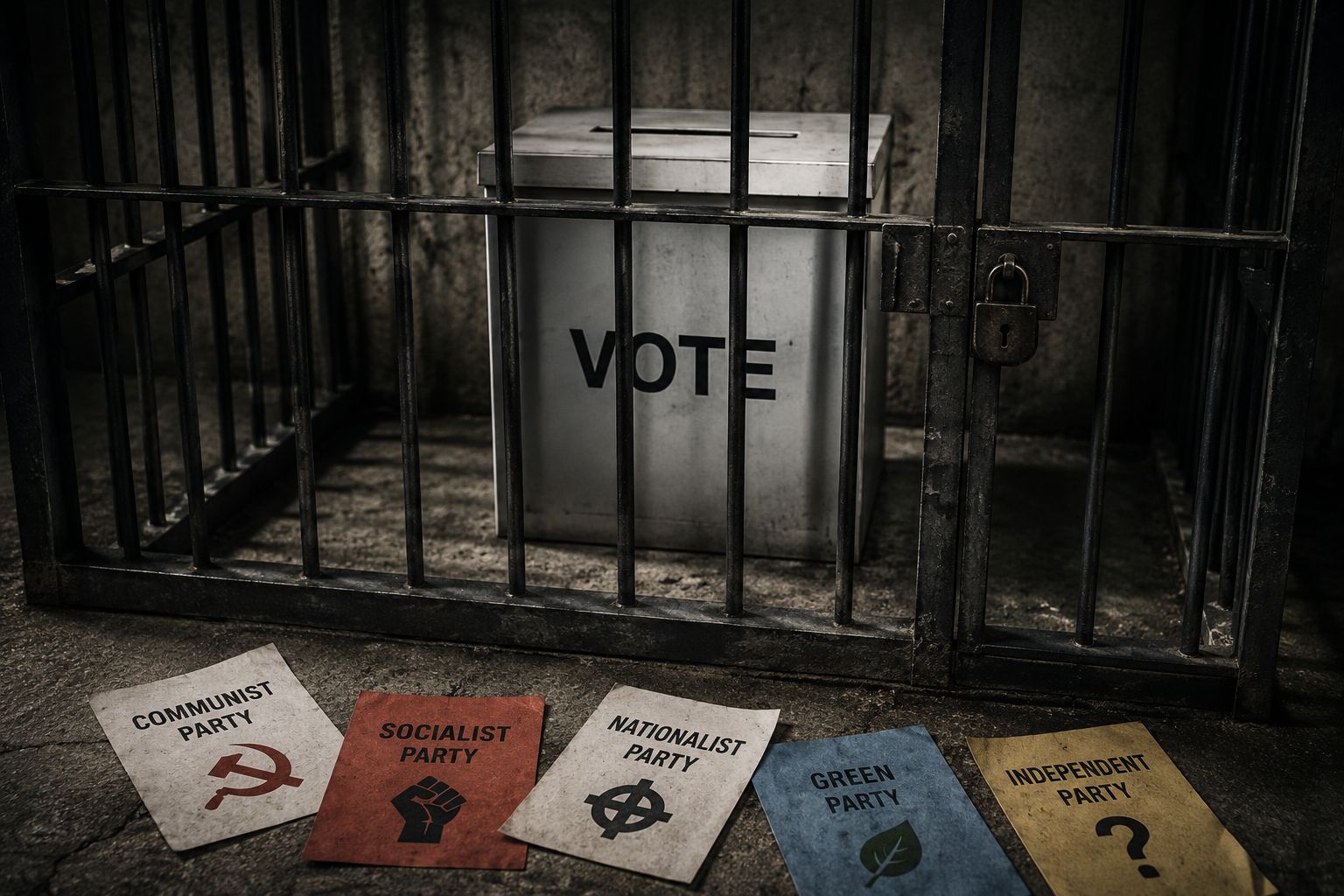
Banning a political party may look like a solution. In reality, it creates a dangerous political precedent.
A government first bans the extremists. Later, another government may ban the socialists, communists, nationalists, environmentalists, or anti-war movements. Eventually, the political establishment can outlaw anyone who threatens its power.
Without free political competition, no real political change can happen.
Elections lose their meaning when the state decides which parties may participate. Citizens can vote, but only for candidates approved by the political system. Consequently, democracy becomes a carefully managed performance.
Some political parties are undoubtedly dangerous. They may attack minorities, glorify dictatorships, excuse invasions, or undermine democratic institutions. Nevertheless, voters should normally defeat them at the ballot box.
The state should punish crimes. However, it should not criminalize political opposition merely because the opposition expresses ugly, radical, or unpopular ideas.
A ban creates a weapon for future governments
Supporters of party bans usually believe that the authorities will use this power responsibly.
That belief is dangerously naïve.
Political power changes hands. Therefore, every legal weapon created against one movement can later target another movement. A law designed against neo-Nazis may eventually silence communists. Similarly, a law aimed at communists can later attack trade unions, peace activists, or critics of capitalism.
Moreover, political elites rarely describe their opponents neutrally. They call them extremists, foreign agents, traitors, terrorists, or enemies of democracy.
Those labels sometimes describe reality. At other times, however, they merely provide an excuse for repression.
Once the state starts deciding which opposition remains acceptable, democracy enters dangerous territory.
The American model of free speech
In my view, only the United States protects freedom of speech in its fullest political form.
European countries protect many opinions. Yet they also criminalize some political symbols, extremist statements, historical claims, and forms of hate speech. The United States takes a far more radical approach.
American neo-Nazis can appear publicly in Nazi-style uniforms. They can carry swastikas. Furthermore, they can perform Nazi salutes and express views that most people find disgusting.
The First Amendment generally protects such expression unless it crosses into specific criminal conduct, such as a genuine threat or direct incitement to imminent lawless action.
The famous Skokie dispute demonstrated this principle. American neo-Nazis wanted to march in a community with many Holocaust survivors. The legal fight reached the Supreme Court, and the courts strongly protected the group’s rights to speech and assembly.
That protection did not make Nazism popular.
American neo-Nazis wore their uniforms. They displayed their symbols. Meanwhile, almost nobody voted for them, and most Americans did not give a damn about their pathetic political movement.
Open expression exposed them.
Prohibition, by contrast, could have allowed them to pretend that they represented a powerful truth feared by the establishment.
Free speech must include every opinion
I disagree with Noam Chomsky on tons of political questions. However, he is correct about one fundamental principle.
Freedom of speech means nothing unless it protects opinions we despise.
Popular views need no legal protection. Likewise, establishment opinions rarely face censorship. The true test comes when someone expresses a shocking, offensive, or radical idea.
Either all political opinions remain open to discussion, or freedom of speech becomes conditional.
Naturally, speech does not excuse violence. Nor does it protect direct threats, criminal conspiracy, or instructions for an immediate attack. Still, governments should not confuse an opinion with a crime.
Otherwise, freedom of speech merely means freedom to agree with the authorities.
The American establishment does not need party bans
The United States also shows another reality.
Its political and economic system remains heavily influenced by billionaires, old financial networks, powerful corporations, lobbying organizations, intelligence agencies, and elite institutions. Super-rich families and secretive organizations exercise enormous influence over American politics.
So the American establishment rarely needs to ban undesirable parties.
Instead, intelligence and law-enforcement agencies monitor and infiltrate communist, socialist, fascist, white-supremacist, revolutionary, and other radical organizations. American agencies have a long history of penetrating political movements that they consider dangerous.
Therefore, the establishment can observe them from inside. It can identify their members, follow their money, expose criminal plans, and prosecute actual offences.
This approach also creates serious dangers. Intelligence agencies can abuse surveillance. They can manipulate political groups, destroy innocent lives, and target legitimate dissent.
Nevertheless, infiltration differs from formally banning an entire political party.
One method monitors a possible threat. The other removes political competition altogether.
Czechoslovakia considered banning the communists
The First Czechoslovak Republic repeatedly faced the same dilemma.
Between the late 1920s and 1938, politicians discussed restrictions against the Communist Party of Czechoslovakia. The party followed the Communist International and openly looked toward Moscow. Moreover, many democrats feared that it wanted to destroy the democratic system from within.
Those fears were not imaginary.
The communists later seized power in February 1948. They abolished genuine democracy, persecuted their opponents, nationalized private property, imprisoned dissidents, and imposed four decades of dictatorship.
Still, during most of the First Republic, the communists competed in elections. In 1925, they received 13.2 percent of the vote. Four years later, they won 10.2 percent. Then, in 1935, they gained approximately 10.3 percent. The authoritarian Second Republic finally banned the party in October 1938, after the Munich crisis had already destroyed the democratic order.
After communism collapsed in 1989, some Czech politicians again discussed banning the communist movement.
Yet no ban came.
Today, the old Communist Party has almost disappeared politically. Recent polling trends have placed KSČM at roughly 1–2 percent when measured independently. One current aggregate gives it about 1.9 percent.
In other words, the communists once ruled the entire country. Now they receive around 1 percent in some polls.
Voters achieved what prohibition could not.
Banning the AfD would not solve Germany’s problems
Germany now debates whether it should ban Alternative for Germany.
The AfD contains genuine extremists. Some of its politicians make deeply disturbing statements. Others promote ethnic nationalism, minimize parts of German history, attack immigrants, or maintain suspicious relationships with authoritarian regimes.
Nevertheless, banning the AfD would not solve Germany’s political crisis.
In fact, a prohibition could make the party stronger underground. Its leaders would portray themselves as victims. Supporters would claim that Germany had abandoned democracy because the establishment feared an election result.
The AfD won 152 seats in the 2025 federal election. Therefore, banning it would not eliminate a tiny fringe organization. It would remove a party supported by millions of German voters.
Those voters would not suddenly disappear.
Instead, they would become angrier, more alienated, and more suspicious of the state.
The AfD and Russia
The AfD’s foreign policy deserves severe criticism.
The party supports lifting sanctions against Russia. Furthermore, it wants Germany to restore economic and energy relations with Moscow. Its leading figures have also opposed German military assistance to Ukraine and called for an end to weapons deliveries.
These positions would benefit Vladimir Putin.
Russia invaded Ukraine. It occupied Ukrainian territory, destroyed cities, and killed civilians. Therefore, ending assistance to Ukraine without reliable security guarantees could reward military aggression.
Likewise, lifting sanctions without meaningful Russian concessions would weaken Europe’s bargaining position.
The AfD may call this realism. However, critics can reasonably describe it as submission to Moscow.
Still, bad foreign policy should face political opposition, not an automatic party ban.
The Beneš decrees and Sudeten German property
The AfD has also repeatedly questioned the Beneš decrees.
Czechoslovak President Edvard Beneš issued a large group of decrees during and immediately after the Second World War. They dealt with many different legal and administrative matters.
However, the most controversial decrees stripped many ethnic Germans and Hungarians of Czechoslovak citizenship. They also provided a legal framework for confiscating property and expelling much of the German population from post-war Czechoslovakia.
The state confiscated homes, farms, businesses, land, and other assets. Approximately 2.5 million Sudeten Germans lost citizenship or property under the post-war system.
Some AfD politicians and Sudeten German activists want the decrees abolished or politically repudiated. Such demands raise fears in Czechia that descendants of expelled Germans could seek the return of confiscated properties or financial compensation. The AfD has continued to question the decrees in recent years.
Czechs have every right to reject those demands.
Abolishing the decrees could open an enormous legal, political, and financial conflict. It could also create restitution claims involving properties that have changed owners several times over eight decades.
Nevertheless, Germany should answer the AfD through historical evidence, legal arguments, and democratic debate.
A ban would avoid the argument rather than win it.
Germany’s limited sovereignty
However, the AfD is correct about one important issue.
Germany does not act as a completely independent power.
After the Second World War, the United States became Germany’s dominant security partner. American forces remained on German soil. Germany joined a Western political, military, and intelligence system led by Washington.
That relationship protected West Germany from the Soviet Union. It also helped the country rebuild and return to the democratic world.
Still, protection can create dependence.
The American government has repeatedly treated Germany not only as an ally but also as an intelligence target. Documents and investigations revealed that the NSA monitored Angela Merkel and other senior European politicians. Reports also indicated that American intelligence monitored the German Chancellery and its officials for years. But this is official. I was told the US secret services have been wiretapping German chancellors since the end of WW2.
Therefore, claims about Germany’s limited sovereignty do not come from nowhere.
Germany often follows American geopolitical priorities. It depends heavily on NATO. In addition, American military and intelligence structures retain enormous influence over European security.
Germany is a puppet state in the hands of globalists
The AfD exploits this reality. Yet mainstream parties often refuse to discuss it honestly.
That refusal only strengthens the extremists.
Germany must defeat the AfD politically
A democratic government should not fear an opposition party.
Instead, it should answer that party.
Germany must explain why supporting Ukraine matters. Similarly, politicians should defend sanctions or admit when those sanctions fail. They should discuss American influence without pretending that Germany enjoys unlimited sovereignty.
Furthermore, the government must address immigration, energy prices, inequality, housing shortages, regional divisions, and public distrust.
When mainstream politicians ignore real problems, extremist parties fill the vacuum.
A ban changes none of those conditions.
It does not lower energy prices. Nor does it improve integration, reduce crime, strengthen wages, or make Germany more independent.
Instead, prohibition merely removes a political organization while leaving every cause of its popularity untouched.
Dangerous ideas need public exposure
Extremist parties often benefit from secrecy.
When authorities suppress them, they create mystery. Their followers begin to believe that the state fears hidden truths. Consequently, conspiracy theories become more attractive.
Open debate produces the opposite effect.
Journalists can investigate extremist leaders. Historians can challenge their myths. Economists can expose impossible promises. Meanwhile, voters can watch their candidates fail in interviews, contradict one another, and reveal their incompetence.
American neo-Nazis provide a useful example.
They can wear Nazi uniforms and perform Nazi salutes. Yet their openness does not bring them political power. On the contrary, it shows society exactly what they are.
Most people reject them.
Germany should trust its citizens enough to do the same.
Democracy must tolerate political risk
Freedom always carries risk.
A free press can spread lies. Free elections can produce terrible governments. Likewise, free speech can protect hateful people.
Nevertheless, the alternative carries a greater danger.
Once governments can outlaw political competition, they can protect themselves from real change. The ruling establishment can then present every serious challenge as extremism.
A political party should face prohibition only when it directly organizes violence or takes concrete steps to destroy constitutional government. Even then, the state must present overwhelming evidence and follow the strictest legal process.
Disgusting opinions alone should not suffice.
The AfD may contain extremists. Its Russia policy may betray Ukraine. Its position on the Beneš decrees may threaten Czech interests. Moreover, some of its politicians may deserve complete political rejection.
However, German voters must reject them.
Banning the party would create a precedent. More importantly, it would prove that Germany’s political system could no longer defeat its opponents through arguments and elections.
Without free political competition, real change cannot happen.
Without protection for every political opinion, real freedom of speech cannot exist.
Finally, without both principles, democracy becomes nothing more than a word.
Leave a Reply