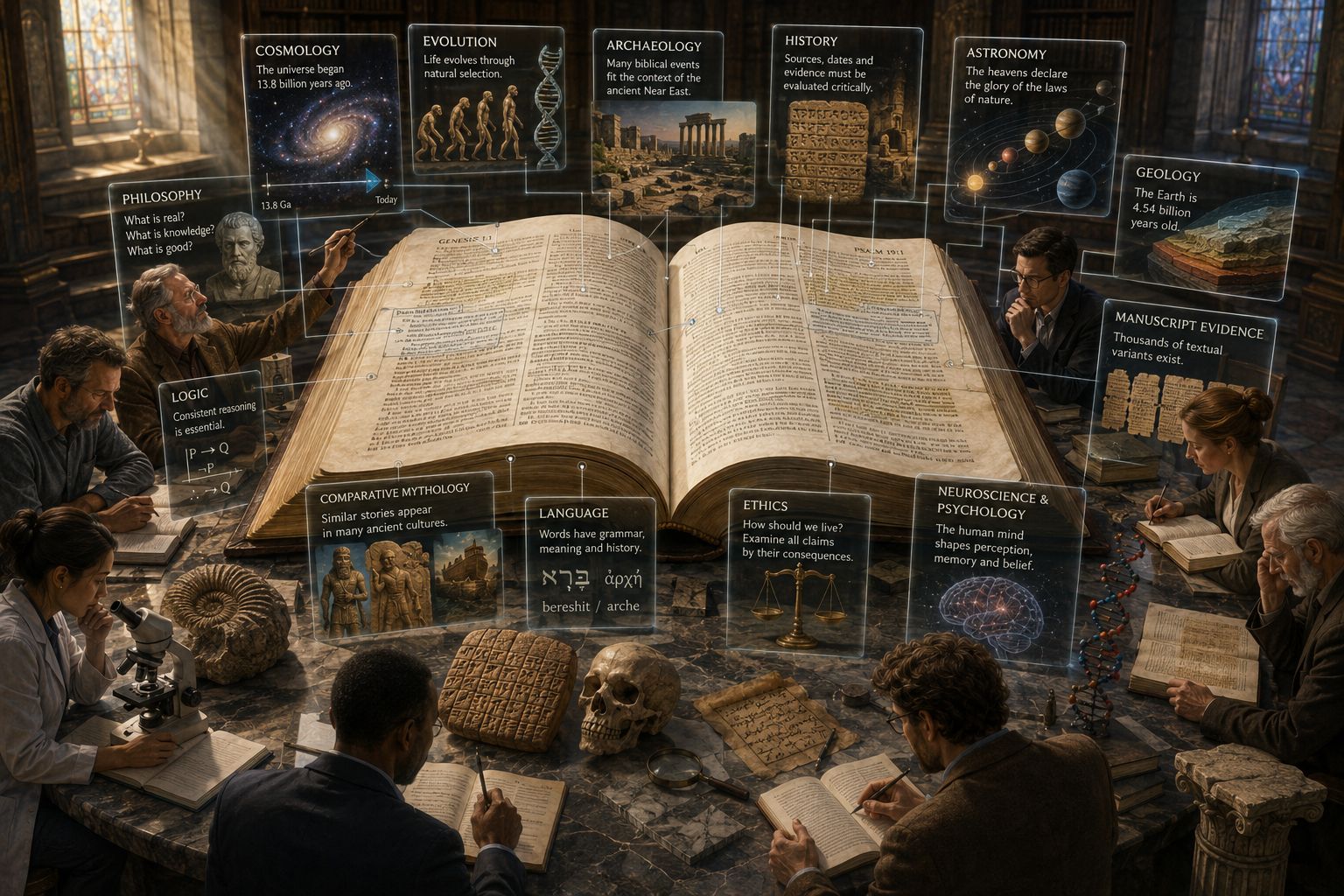
The Bible may be the most influential book in human history. It has inspired paintings, wars, constitutions, persecutions, charities, revolutions, and political movements. Billions of people consider at least part of it sacred. Even people who reject Christianity live in societies that Christianity helped shape.
Nevertheless, most people have never read the Bible critically.
They read it with the assistance of priests, pastors, relatives, or religious publishers. These interpreters usually explain how one passage fits Christian doctrine. They rarely ask whether the passage agrees with science, logic, history, or another biblical passage.
This creates a strange situation.
We have study Bibles containing maps, theological essays, linguistic notes, archaeological commentary, and historical introductions. Some editions examine textual variants and disputed authorship. Skeptical annotated Bibles also identify contradictions, violence, absurdities, and failed prophecies.
Therefore, something close to my proposal already exists. However, it does not yet exist in the modern and comprehensive form I have in mind.
Where is the Bible that places theology beside evolutionary biology, cosmology, meteorology, neuroscience, logic, epistemology, ethics, archaeology, comparative mythology, and analytic philosophy? Where is the edition that examines every important claim according to the standards we apply to every other claim?
Who will publish it?
Do not remove the Bible
I am not proposing that we ban the Bible, burn it, or remove it from libraries. Quite the opposite. We should read it more carefully.
However, we should stop granting it intellectual immunity.
When a chemistry textbook contains an error, scientists correct it; when historians discover new evidence, they revise their conclusions; when philosophers identify an invalid argument, they do not protect it because millions of people find it emotionally comforting.
Religious texts receive different treatment. Their defenders reinterpret errors, soften immoral commands, convert failed predictions into metaphors, and declare contradictions mysterious. Every possible problem receives an escape route.
A scientifically and philosophically annotated Bible would end this privilege. It would print the text honestly. Then it would explain what the text says, what ancient people probably believed, what modern evidence shows, and whether the claim makes logical sense.
Readers could reach their own conclusions.
God is personally responsible for the weather
The Bible repeatedly presents weather as the deliberate action of God.
God sends rain. He withholds it, he produces storms, he causes droughts, he commands winds. He uses hail, thunder, floods, and lightning to reward, punish, warn, or demonstrate his power.
This made sense in an ancient world without meteorological science. People saw rain falling from the sky, but they did not understand atmospheric circulation, air pressure, cloud formation, ocean temperatures, or the water cycle as we understand them today. Personal agency offered an intuitive explanation. Someone must be opening or closing the heavens.
Modern Christians often retreat from this literal picture. They say that weather follows natural laws. Nevertheless, they continue thanking God for pleasant weather and praying for rain. After a disaster, they may say that God has a plan.
This position creates an obvious moral problem.
Under classical Christianity, God created the atmosphere, knows every future weather event, controls nature, and possesses unlimited power. Therefore, God is personally responsible for the weather. A hurricane cannot surprise an omniscient being. A drought cannot overpower an omnipotent one. A tornado cannot move one inch beyond what God permits.
When rain saves a farmer’s crops, believers thank God. When a flood drowns children, they suddenly speak about nature, mystery, or human freedom.
Human freedom does not create hurricanes.
A modern annotated Bible should state this directly. If God controls the weather, he deserves responsibility for destructive weather as much as credit for beautiful sunshine. If weather operates without his intervention, many biblical descriptions of divine control reflect ancient meteorology rather than scientific reality.
Believers cannot logically assign every success to God and every catastrophe to impersonal nature.
What does science say?
Genesis does not describe the history of life discovered by modern science.
Life developed through evolution over immense periods. Species share common ancestors. Natural selection, mutation, genetic drift, migration, environmental pressures, and reproductive isolation shaped biological diversity. Humans belong to this evolutionary history. We did not arrive separately from the rest of life as finished biological products.
Religious believers can accept evolution. Many already do. However, once they accept it, they must reinterpret central biblical narratives.
There was no original human couple from whom every human being necessarily descended in the simple traditional sense. Death existed long before humans. Animals hunted, suffered, reproduced, and became extinct for hundreds of millions of years before anyone could commit a human sin.
Therefore, death did not enter the biological world because Adam disobeyed God.
This matters because Christianity often connects Adam’s fall with the need for Jesus’s sacrifice. Yet if Adam becomes symbolic, the theological structure changes. A symbolic crime produced a supposedly literal divine execution intended to repair the consequences of that crime.
A scientific annotation should explain the evolutionary evidence beside Genesis. It should not insult readers by pretending that Genesis secretly anticipated modern biology. Ancient authors did not understand DNA, genetics, deep time, or common descent.
That does not make them stupid. They lived in an ancient world.
It does make attempts to transform their cosmology into modern science intellectually dishonest.
Which creation story is correct?
Even the Bible does not present one perfectly uniform creation account.
Genesis 1 describes a structured sequence. Vegetation appears before the sun and moon. Animals appear before human beings. Humanity arrives as male and female at the culmination of creation.
Genesis 2 presents a different literary sequence and emphasis. The man exists before the garden is planted for him. Animals are formed and brought to him as possible companions. The woman appears afterward.
Religious interpreters have constructed harmonizations. They may translate particular verb forms differently or argue that Genesis 2 merely revisits events from Genesis 1. However, a modern edition should present the simpler possibility: the text preserves different traditions.
The reader should see a table.
One column would show the order in Genesis 1. Another would show the apparent order in Genesis 2. A third would describe the attempts to reconcile them. A fourth would explain the conclusions of historical-critical scholarship.
No preacher would decide the answer in advance.
What sentence contradicts another?
Biblical contradictions should receive direct cross-references.
How did Judas die? Matthew says that he hanged himself. Acts describes him falling and his body bursting open. Who purchased the field? Matthew places the transaction in the hands of the priests. Acts connects the purchase to Judas.
How many animals did Noah take? One passage gives a simple pair of every kind. Another distinguishes clean animals and requires additional pairs.
Who provoked David to conduct the census? In one account, God does it. In another, Satan does it.
Did anyone see God? Some passages say that no one has seen or can see him. Other passages describe people seeing God, speaking with him face to face, or encountering a visible divine figure.
Who carried Jesus’s cross? John presents Jesus carrying it. The Synoptic Gospels emphasize Simon of Cyrene being compelled to carry it.
What were Jesus’s final words? The Gospels preserve different statements.
Not every difference represents a fatal contradiction. Witnesses can emphasize different details. Authors can summarize events differently. However, this explanation cannot solve every conflict automatically.
A proper annotation would classify each case. Some differences are minor. Some can plausibly coexist. Others resist ordinary reconciliation.
The publisher should not hide the verdict.
Predictions that did not happen
The Bible contains predictions that appear unfulfilled or at least highly problematic.
Jesus reportedly told his listeners that some of them would not die before seeing the Son of Man coming in his kingdom. He also said that “this generation” would not pass away until the predicted events occurred. Early Christians clearly expected a dramatic culmination of history.
Two thousand years later, Christian interpreters offer several explanations. Perhaps Jesus referred to the Transfiguration; perhaps he meant the resurrection; perhaps “generation” referred to a people rather than the people standing before him; perhaps the prophecy concerned Jerusalem’s destruction. Perhaps the final event remains in the future.
These explanations cannot all represent the most natural reading.
The repeated reinterpretation itself deserves annotation. A prediction should not become unfalsifiable merely because believers can redefine it after the expected event fails to occur.
The Hebrew Bible creates similar problems. Prophecies concerning cities, kingdoms, restoration, conquest, and historical transformation do not always correspond neatly to what happened. Apologists divide predictions into literal, conditional, partial, symbolic, and future fulfillment. This method can protect almost any prophecy.
Imagine applying it elsewhere.
A man predicts that Prague will disappear next year. Prague remains. He then explains that “Prague” symbolized moral decadence, “disappear” meant cultural transformation, and “next year” referred to a divine period of indefinite length.
Nobody would call the prediction successful.
A scientific and philosophical Bible should evaluate prophecy using clear standards established before the alleged fulfillment. Was the prediction specific? Was it written before the event? Could ordinary political knowledge have produced it? Did later writers shape their stories to resemble the prophecy? Did the expected event actually occur?
Without these questions, prophecy becomes a word game.
Abstract objects may be older than God
Christian philosophers often describe God as the foundation of everything. However, the existence of abstract objects creates a serious difficulty.
Consider numbers, logical relations, possibilities, propositions, and mathematical truths. Could God make two plus two equal five? Could he create a square circle? Could he make a contradiction true in the same respect and at the same time?
Most theologians say no.
They then face a problem. If logical and mathematical truths exist independently of God, God did not create everything. These abstract structures must have preceded God, or at least exist necessarily alongside him.
Of course, “preceded” cannot mean earlier in chronological time if both God and abstract objects are timeless. It means metaphysically prior or independent. Their truth does not appear to depend on a divine decision.
Some theologians place abstract objects inside God’s mind. Others argue that they follow necessarily from God’s nature. A few claim that God created logical and mathematical truths.
Each solution has a price.
If God created logic, he apparently existed before logic. Yet the statement “God existed before logic” already uses identity, existence, order, and noncontradiction. The claim depends on the very logical structure it tries to place after God.
If logic follows from God’s nature, God does not choose it. His nature constrains what is possible.
If abstract objects exist independently, God is not the sole foundation of reality.
A philosophically annotated Bible would introduce readers to Platonism, nominalism, conceptualism, divine conceptualism, and the debate over necessary beings. It would show that saying “God created everything” does not solve metaphysics. It begins another problem.
Religion is often illogical
Christianity asks people to accept several propositions that become increasingly difficult when placed together.
God created humans while knowing exactly what they would do. He then punished them for doing what he eternally knew they would do. Their descendants inherited the consequences. God later required a sacrifice. Instead of simply forgiving humanity, he arranged the death of his own son, who is also God. This sacrifice satisfied rules established by God himself.
God sacrificed himself to himself to save us from a punishment imposed by himself.
Christians have developed sophisticated theories of atonement. These include substitution, victory over evil, moral influence, ransom, satisfaction, and other models. Their diversity reveals the problem. Even Christians disagree about why an omnipotent God needed blood, death, or suffering before offering forgiveness.
A human judge would not be praised for punishing an innocent person instead of the guilty one. We would call it injustice. Christianity turns the same structure into cosmic love.
The Trinity creates another puzzle. The Father is God. The Son is God. The Holy Spirit is God. The Father is not the Son. The Son is not the Holy Spirit. Nevertheless, there is only one God.
Theologians insist that this is a mystery rather than a contradiction. They distinguish one divine essence from three persons. Yet ordinary believers often receive no clear account of what a divine “person” means or how three centers of personal reference constitute one being.
Calling an unclear statement a mystery does not make it coherent.
Unverified claims remain unverified
The Bible reports miracles, angels, demons, divine voices, resurrections, fulfilled prophecies, and supernatural interventions. These are extraordinary claims. And extraordinary claims require extraordinary evidence
Where is the independently verifiable evidence?
We do not possess medical documentation showing that Jesus restored a genuinely dead person to life., we do not have contemporary records confirming darkness over a vast region during the crucifixion, we cannot inspect the empty tomb, we cannot interview witnesses. And we have religious texts written and transmitted by communities committed to their message.
This does not prove that every reported event was impossible. It means the evidence does not justify certainty.
The New Testament says that witnesses saw the risen Jesus. However, a document asserting that witnesses existed is not the same as access to those witnesses. We do not possess signed, independent depositions from hundreds of identifiable people whom historians can question.
Religious testimony deserves the same scrutiny as every other testimony. People in many religions report visions, healings, apparitions, answered prayers, possession, reincarnation, and divine messages. Christians reject most of these reports.
Why should everyone accept theirs?
“This is written in our holy book” cannot prove that the holy book is true. Otherwise, every religion could establish itself through its own scripture.
That is circular reasoning.
What evidence exists for Jesus?
The historical question requires precision.
It would be too strong to claim that no Jewish or Roman author ever mentioned Jesus. Josephus and Tacitus contain later references connected to Jesus or early Christianity. However, neither man wrote as a contemporary eyewitness to Jesus’s ministry.
The surviving non-Christian evidence is limited. Roman sources tell us little. Josephus wrote decades after the alleged events, and scholars have long debated Christian alteration of at least part of one famous passage. Another Josephus passage refers to James as the brother of Jesus “who was called Christ.” Tacitus also wrote later and confirmed that Christians believed their movement originated with someone executed under Pontius Pilate.
The Gospels themselves were written decades after the period they describe. Their traditional titles do not function like modern signatures, and the authors used earlier traditions and texts. Matthew and Luke drew heavily from Mark while changing details, adding material, and developing their own theological narratives.
Therefore, the evidence leaves room for several positions.
Most historians accept that some historical Jewish preacher stood behind the tradition. A minority of scholars and writers question whether Jesus existed at all. Even if a historical Jesus existed, the Christ of theology may bear only a limited resemblance to that person.
A modern annotated Bible should not announce either Christian dogma or mythicism as unquestionable fact. It should explain the evidence, its dates, its dependencies, and its limitations.
A human preacher may have existed.
That does not prove that God visited Earth.
The Bible did not invent its myths
The biblical authors lived among cultures with their own creation stories, flood narratives, divine councils, heroic births, sacred laws, dying figures, miracles, and journeys to supernatural realms.
The similarities do not prove that every biblical story was copied word for word. Cultures exchange ideas. Oral traditions change. Authors adapt old motifs for new political and theological purposes.
Nevertheless, the Bible did not emerge from an intellectual vacuum.
The flood story resembles older Mesopotamian traditions. A divinely warned man builds a vessel, survives a catastrophic flood, preserves life, releases birds, and offers a sacrifice afterward. Genesis reshapes the story around Israelite theology, but the family resemblance remains obvious.
Ancient literature also contains extraordinary births, divine sons, miraculous healings, descents to the underworld, heavenly ascents, and gods interacting with humans. Similarity alone does not prove direct plagiarism in every case. Still, it undermines the claim that biblical narratives are automatically unique because Christians later declared them unique.
Some biblical writers borrowed, adapted, combined, and transformed earlier material. In modern language, we might call some of them plagiators. Historically, however, ancient literary culture did not follow modern copyright rules. Reworking inherited traditions was normal.
A serious edition would show the parallel texts beside the biblical passages. Readers could compare them directly.
No pastor would be allowed to hide the older myths.
Morality also needs annotations
Scientific notes would not be enough. The Bible also needs ethical commentary.
It contains commands, permissions, and stories involving slavery, collective punishment, genocide, execution, patriarchy, sexual control, religious persecution, and the killing of children. Believers often say these passages belong to their historical context.
Exactly.
Once we accept historical context as an explanation, we admit that the text reflects the morality of ancient societies. It does not consistently deliver timeless moral perfection.
A modern edition should ask direct questions.
Can collective punishment ever be just? Can children deserve death because of their parents or nation? Can an all-powerful being have no alternative to mass killing? Does ownership of another person become moral because ancient law regulates it? Should blasphemy, apostasy, homosexuality, or work on a particular day deserve death?
The annotation should compare biblical morality with utilitarianism, deontology, virtue ethics, contractualism, human rights, feminist ethics, and contemporary theories of justice.
Perhaps some biblical passages contain moral wisdom. That does not make every command wise.
A book can contain valuable insights and terrible ideas at the same time.
The psychology of revelation
The Bible also needs psychological explanations.
Humans detect agency everywhere. A branch moves, and we imagine an animal. Thunder strikes, and our ancestors imagine anger. A coincidence helps us, and we perceive intention. A tragedy occurs, and we search for a hidden purpose.
These tendencies once offered evolutionary advantages. Missing a predator could be fatal. Mistakenly imagining one merely wasted time. Natural selection did not design the human mind as a perfect truth-detecting machine.
This may help explain gods, spirits, demons, curses, omens, and divine weather.
People also experience dreams, hallucinations, sleep paralysis, grief visions, ecstatic states, neurological disturbances, false memories, social contagion, and intense religious emotions. None of these automatically indicates mental illness. They do show that sincere supernatural experiences can arise from human brains.
Sincerity does not guarantee truth.
A prophet may genuinely believe that God spoke to him. A follower may honestly believe that she saw a miracle. A religious community may gradually transform uncertain memories into confident stories.
A psychological explanation does not disprove every revelation. However, it provides a natural alternative that we can investigate.
The supernatural explanation remains unverified.
Let every side write its notes
Such a project should not become crude atheist propaganda.
Scientists should explain science. Historians should evaluate historical evidence. philosophers should examine arguments. Biblical scholars should discuss languages, manuscripts, authorship, and literary context. Theologians should present their strongest responses. Skeptics should then be allowed to answer them.
Readers should see the disagreement.
For Genesis, a biologist could explain evolution. A Christian evolutionary creationist could offer a symbolic interpretation. A philosopher could analyze whether the reinterpretation preserves the original meaning. A historian could describe ancient Near Eastern cosmology.
For the resurrection, a theologian could present the case for a miracle. A historian could explain the limitations of the sources. A psychologist could discuss visions and group belief. A philosopher could examine the probability of miracle claims.
The purpose would not be to force atheism on readers.
The purpose would be to stop protecting religion from information.
We need a Bible for the twenty-first century
The project would be enormous. It would require several volumes, an online edition, interactive cross-references, and regular updates. Readers could click on a verse and compare manuscripts, contradictions, scientific findings, historical evidence, ethical problems, parallel myths, and philosophical arguments.
The edition should distinguish several questions.
What does the passage literally say?
What did its author probably mean?
What did ancient readers believe?
What does modern science show?
What historical evidence exists?
Does the argument follow logically?
Does another biblical passage disagree?
Did an older culture tell a similar story?
Did the prediction come true?
Is the moral teaching defensible?
That would be a genuinely modern Bible.
Believers should welcome it if they think their religion can survive honest examination. Atheists should welcome it because criticism would no longer depend on isolated quotations. Students should welcome it because they could learn science, history, philosophy, and comparative religion while reading one of civilization’s most influential collections of texts.
Perhaps the final result would strengthen some forms of faith. More likely, it would destroy biblical literalism and expose many theological claims as unsupported.
Either outcome would be better than ignorance.
The Bible has received thousands of years of sermons.
Now it needs explanations.
Leave a Reply