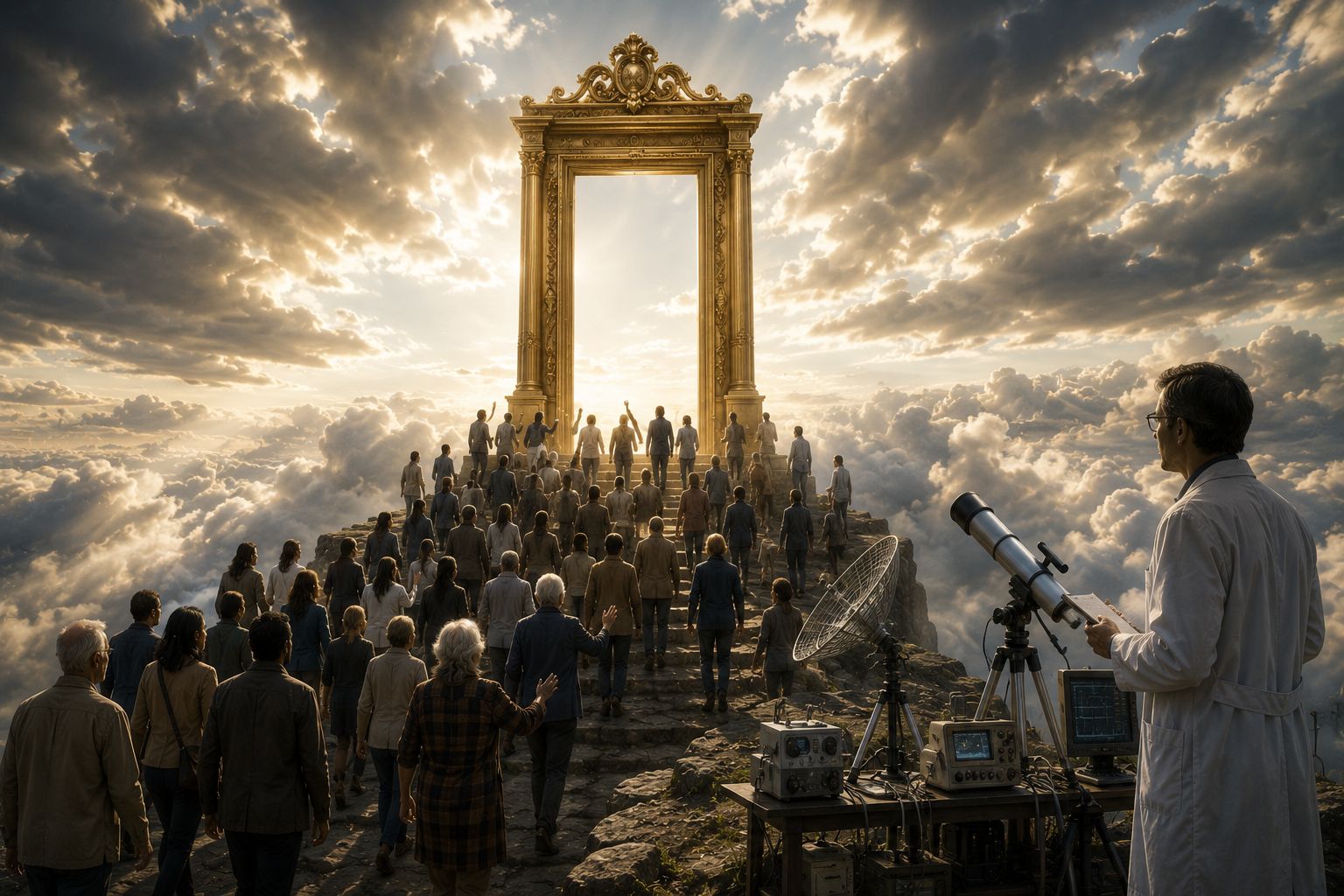
“Till we meet forever.”
People say it at funerals with complete sincerity. They believe they will see their loved ones again. Death is not the end. It is merely a temporary separation.
That single sentence reveals something remarkable about the human mind.
Hundreds of millions of Americans sincerely believe not only that an afterlife exists, but that the universe has a purpose, that God guides history, and that their nation possesses a unique divine mission. These ideas shape politics, education, foreign policy, and everyday life. They comfort people during grief, inspire acts of charity, and give many a profound sense of meaning.
Yet there is another side to the story.
None of these beliefs has been demonstrated scientifically. The existence of an afterlife remains unverified. God’s existence has never been established by empirical evidence. Claims that life possesses an objective, cosmic purpose belong to philosophy and theology rather than science. National destiny fares no better. Countries arise, expand, collapse, and disappear throughout history. The universe gives no indication that one nation occupies a privileged place in its design.
Some ideas also face substantial philosophical difficulties. If an afterlife exists, what exactly survives death? Memory? Personality? Consciousness? If the brain generates consciousness, what mechanism allows consciousness to continue once the brain permanently ceases to function? Different religions answer these questions in radically different—and often contradictory—ways.
Polls: I am certain God exists
According to recent Pew Research Center surveys, 83% of Americans believe in God or a universal spirit, 54% say they believe in God with absolute certainty, 86% believe human beings possess an immortal soul, 71% believe in heaven, 61% believe in hell, and 81% believe that something spiritual exists beyond the natural world. More than half also believe they will be reunited with deceased loved ones after death. Despite the United States leading the world in science, technology, and higher education, supernatural beliefs continue to shape the worldview of a large majority of its population.
An objective purpose? Are you kidding me?
The same applies to purpose. Human beings undoubtedly create meaning in their own lives through relationships, work, knowledge, creativity, and compassion. That differs, however, from claiming that the universe itself possesses an objective purpose waiting to be discovered. Science has never uncovered such evidence.
Perhaps the most fascinating question is not whether these beliefs are true. It is why they are so widespread. Evolutionary psychologists, anthropologists, and cognitive scientists have long argued that the human brain evolved to detect agency, construct narratives, and seek patterns. Those tendencies helped our ancestors survive, but they also make us remarkably receptive to supernatural explanations and grand stories about destiny.
From an evolutionary perspective, religion is not necessarily a divine revelation but an adaptation—or at least a byproduct of adaptations—that helped our ancestors survive.
A society built on beliefs that cannot be empirically verified faces an inevitable tension. Democracies function best when citizens can revise their views in response to evidence, challenge authority, and distinguish between comforting narratives and demonstrable facts. When unverifiable convictions become immune to criticism simply because they provide emotional reassurance, rational public debate becomes more difficult.
The issue is therefore not whether religious or patriotic people are unintelligent. Many brilliant scientists, philosophers, and statesmen have held religious beliefs. The real question is different. Should societies base their public decisions primarily on evidence, or on claims that cannot be tested?
That question may matter far more than whether we ever meet again.
Conclusion
The deeper problem is not that millions of people believe in an afterlife. Human beings have believed extraordinary things throughout history. They believed diseases came from evil spirits. They believed kings ruled by divine right. They believed witches controlled the weather. Every civilization has produced comforting stories that later generations abandoned.
The real problem begins when a society places comforting narratives above evidence. If people learn from childhood that the most important questions in life should be answered by faith rather than proof, why should we expect them to think differently about politics, economics, or science? Once evidence becomes optional, almost any belief can survive indefinitely, no matter how weak its foundations.
Modern civilization owes its greatest achievements to the opposite principle. Vaccines exist because scientists demanded evidence. Democracy survives because citizens can question authority. Technology advances because hypotheses must withstand reality rather than emotions. Progress has always required humanity to replace wishful thinking with critical thinking.
Perhaps that is why the sentence “Till we meet forever” deserves more attention than it usually receives. It is not merely an expression of grief. It reveals how easily the human mind prefers reassuring fiction to uncomfortable uncertainty. The afterlife may exist, or it may not. We simply do not know. Yet millions speak about it with greater confidence than they speak about demonstrable scientific facts.
A civilization cannot remain intellectually healthy if it rewards certainty without evidence. The more we teach people to distinguish what they hope is true from what they can actually demonstrate, the stronger our society becomes. The opposite path leads not only to religious dogma, but to every other ideology that asks us to believe first and question later.
Leave a Reply