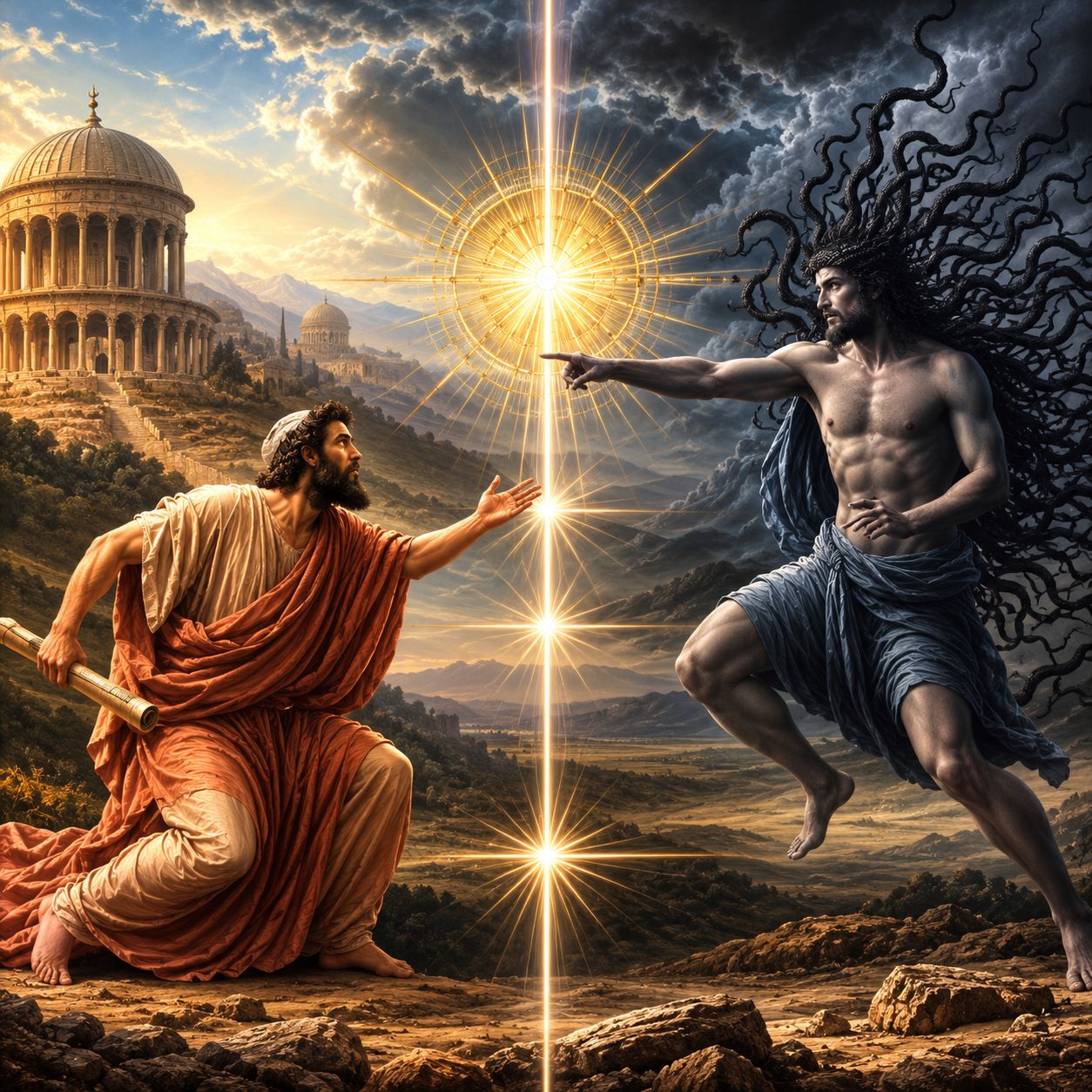
You think you know him, of course. The red skin, the horns, the pitchfork, the tail. The guy in the basement with a trident, laughing while people burn. That is not Satan, however. That is a cartoon. The real Satan is older, stranger, and far more complicated. He did not start out as the bad guy, in fact. He started out as God’s employee, a functionary, a civil servant in the divine bureaucracy. The most misunderstood character in the entire Bible is not Jesus, not Moses, not even Mary. It is the Devil, and what most people believe about him is not just wrong—it is a theological fiction that took centuries to construct.
The journey from heavenly prosecutor to prince of darkness is not a straight line, moreover. It is a winding road through Persian dualism, Jewish apocalypticism, Greek philosophy, medieval folklore, Renaissance literature, and modern pop culture. The Devil did not fall from heaven in a single dramatic moment, after all. He evolved, and he was shaped by human hands, human fears, and human needs. If you want to understand evil, in other words, you have to understand where our image of evil came from. The Devil is not real, ultimately. But the need for him is.
Why does the Devil still have so many followers?
If belief in supernatural beings were steadily disappearing, one might expect the Devil to have become little more than a historical curiosity. Surprisingly, that is not the case. Polling consistently shows that belief in Satan remains widespread, particularly in the United States.
According to a 2023 Gallup survey, 58% of Americans said they believe in the Devil, while 14% were unsure and only 28% rejected the idea outright. The same survey found that 74% believe in God, 69% believe in angels, 67% believe in heaven, and 59% believe in hell. Although these figures have gradually declined over the past two decades, they still represent clear majorities for most supernatural concepts.
Belief is not distributed evenly throughout society. Gallup has repeatedly found that belief in the Devil is substantially more common among people who attend religious services frequently, consider religion very important in their lives, identify as politically conservative, or belong to the Republican Party. By contrast, liberals, secular individuals, and those who rarely attend religious services are significantly less likely to believe that Satan literally exists.
The original Satan: God’s prosecutor
Go back to the oldest books of the Bible, for instance. Job, Numbers, Zechariah. Satan appears, but not as the Devil. He appears as a member of God’s divine council, a heavenly prosecutor, an accuser. His job is to test human faithfulness, expose sin, and act as the celestial district attorney. In the book of Job, he does not rebel against God, significantly. He asks permission: “Have you considered my servant Job?” God says yes, and Satan tests Job. God allows it, meaning Satan is not an enemy. He is an agent, a functionary, a civil servant of the divine bureaucracy. He is the heavenly inspector general, in essence.
He does his job and follows orders, as a result. He does not scheme against the throne, at least not yet. In the book of Numbers, Satan stands in the way of Balaam. He is an obstacle, but he is not evil; he is a tool. In Zechariah, Satan stands beside the angel of the Lord, accusing the high priest Joshua. Again, he is doing his job. He is the prosecutor, not the enemy of God. He is part of God’s system, in fact. The ancient Hebrews did not have a Devil, ultimately. They had an adversary, a role, a function. Not a villain.
The word itself: What “Satan” actually means
The Hebrew word is “ha-Satan,” which means the adversary, the accuser, the prosecutor. It is not a name, importantly. It is a title, like “the sheriff” or “the judge.” There is no “Satan” as a proper name in the Old Testament, consequently. Just the adversary, just the one who opposes, just the one who tests. He is a role, a function, a job description. He is not a fallen angel, not a rebel, not the prince of darkness. He is just the prosecutor, plain and simple.
This is crucial to understand, of course. When the Old Testament talks about Satan, it is not talking about the Devil. It is talking about a position in God’s court. The same word is used for human adversaries, for that matter. In 1 Samuel, David says that his enemies are “Satan” to him. It does not mean they are demons, obviously. It means they are opponents. The word is generic, and it becomes a name only later, when the Greek translation of the Old Testament—the Septuagint—begins to treat it as a proper name. Even then, it takes centuries for Satan to become the Devil we know today.
The Book of Job: The original courtroom drama
Read Job carefully, for starters. God and Satan are in heaven, and they talk. They make a bet, in fact. “Job loves you because you blessed him,” Satan says. “Take it away and see if he still loves you.” God says: “Do it.” Satan does it, as a result, and Job loses everything—his children, his wealth, his health. Satan is not punished, however. He is not banished, either. He is operating with divine permission, after all. He is doing his job, in other words.
The book of Job ends with God restoring Job, significantly. Satan disappears, and there is no punishment, no fall, no exile. Because there was no rebellion, ultimately. Just business as usual. This is the original Satan, in essence. He is not evil, nor is he a rebel. He is not the enemy of God, either. He is a member of the divine cabinet, the prosecutor, the tester, the one who asks hard questions.
He is like a district attorney who is allowed to cross-examine the defendant, if you will. He is not the defense attorney, nor is he the judge. He is the one who makes sure that faith is real, and God permits it. God even seems to depend on it, for that matter. Without Satan, how would God know if Job’s love was genuine? Satan is not the villain of Job, consequently. He is the catalyst, the necessary opposition, the prosecutor who makes the case that faith is a fraud. And he is proven wrong, in the end.
The Persian influence: Where it starts to change
Enter the Persians, then. Zoroastrianism and dualism. Two gods, specifically. Ahura Mazda, the good god of light, and Angra Mainyu, the evil god of darkness. Two forces that are equal, opposite, and locked in cosmic war. The Jews were in exile in Persia, and they absorbed the ideas. The Devil became something new, as a result. Not a prosecutor, not a functionary, but a cosmic enemy, a force of evil, a rival to God. The Persians changed everything, in other words.
Before Persia, evil was not a person, after all. It was a consequence, chaos, human sin. After Persia, however, evil had a face, a name, a will. It was not just the absence of good, in fact. It was the active pursuit of evil. The Persians introduced the idea that the universe was a battlefield between two equal powers—good and evil, light and darkness, God and the Devil. This was not Hebrew theology, notably. It was Persian theology, but the Jews brought it home, and it took root.
The Jewish apocryphal literature of the Second Temple period shows this influence clearly, for instance. The Book of Enoch describes fallen angels, led by Azazel, who rebel against God and corrupt humanity. The Dead Sea Scrolls speak of the “spirit of truth” and the “spirit of evil” locked in conflict. The Devil is no longer a member of God’s court, consequently. He is a rebel, a prisoner, an enemy. The Persian dualism had transformed the Jewish understanding of evil, and the transformation was only beginning.
The Second Temple period: The Devil gets a promotion
Between the Old and New Testaments, there were four hundred years of silence. Except there was no silence, of course. There was evolution. The Devil grew, as a result. He became a fallen angel, a rebel, a tempter. The Book of Enoch, the Dead Sea Scrolls, the Apocrypha. Satan is now Azazel, Belial, Mastema. He leads a host of fallen angels, tempts humanity, and opposes God’s plan. He is no longer an employee, in other words. He is a fugitive.
The Second Temple period was a time of intense apocalyptic speculation, significantly. Jews were oppressed and ruled by Greeks, then Romans. They needed to understand why God seemed absent, why the wicked prospered, and why the righteous suffered. The answer was the Devil, ultimately. He was the explanation for the chaos, the reason the world seemed out of control, the cosmic enemy who had temporarily seized power. God would win in the end, however. The Devil would be defeated, and the kingdom would come.
This is the context in which Jesus emerged, of course. The Devil was already there—already the prince of demons, already the tempter. Jesus inherited this Devil, but he did not invent him. The New Testament takes the Second Temple Devil and runs with it, as a result. He is fully formed, fully evil, and fully opposed to God. The evolution is almost complete, in fact.
The New Testament: The Devil becomes a villain
By the time Jesus shows up, Satan is fully formed, obviously. He tempts Jesus in the wilderness and offers the kingdoms of the world. Jesus refuses, of course. Satan is now the “prince of this world,” the “god of this age,” and the “father of lies.” He is no longer the prosecutor, consequently. He is the enemy. Jesus casts out demons, and Satan’s kingdom is under attack. Revelation gives us the final picture, moreover: a dragon, a serpent, a deceiver, cast down from heaven, warring against the saints, and destined for the lake of fire. The evolution is complete, in essence.
The New Testament is not consistent in its portrayal of Satan, however. Sometimes he is a tempter, sometimes a deceiver, sometimes a cosmic enemy, and sometimes a personal foe. He is always evil, nevertheless. Always opposed to God, always the enemy. The Jesus of the Gospels treats Satan as a real person, for instance. He speaks to him, rebukes him, and casts out his demons. The apostles warn against his schemes, after all. The Devil is not a metaphor, in other words. He is a reality, the enemy of the church, the one who seeks to devour believers, the father of lies and the murderer from the beginning.
Even here, there is a tension, however. The New Testament also teaches that God is sovereign, that Satan is defeated, and that Jesus has already won. The Devil is a defeated enemy, a bound lion, a snake with a crushed head. He is still dangerous, of course, but he is not equal to God. He is not the opposite of God, either. He is a creature, a fallen creature, a rebel—but not a rival. The dualism of the New Testament is not Persian dualism, in other words. It is not equal powers. God is sovereign, and the Devil is subordinate. He will be destroyed, and the battle is already won. But the war continues, nevertheless.
The Early Church: The Devil gets a theology
The church fathers ran with it, of course. Tertullian, Origen, Augustine. They systematized the Devil, explained the fall, and described his rebellion. They gave him pride as his original sin, for instance. “I will ascend above the heights of the clouds. I will be like the Most High.” Isaiah 14, originally about the king of Babylon. The church fathers applied it to Satan, as a result. They created a biography, gave him a backstory, and explained why evil exists. The Devil was the answer, ultimately.
Augustine is the most influential, notably. He argued that Satan fell because of pride—the sin of wanting to be like God. This became the official doctrine, consequently. Satan is not evil because he was created evil, after all. He was created good, but he chose evil. He rebelled, took a third of the angels with him, and they became demons—the forces of darkness. This is the standard Christian narrative, but it is not in the Bible, of course. It is a synthesis of biblical hints, Jewish tradition, and Greek philosophy. The church fathers created the Devil we know today, in other words.
They also created hell, moreover. The place of punishment, the lake of fire, the eternal torment. The Devil was not just a tempter, in fact. He was a jailer, a torturer, the king of the damned. This was a terrifying development, obviously. The early Christians believed that the Devil was real, active, and dangerous. They believed that he was behind every temptation, every persecution, and every heresy. The Devil was the ultimate enemy, the church was the army of God, and the battle was cosmic. The stakes were eternal, in essence.
Medieval Christianity: The Devil becomes a monster
The Middle Ages arrived, and the Devil got teeth, claws, horns, and hooves. He got a kingdom—hell—and a court—demons. He got a job, moreover: torturing sinners. He was no longer just a tempter, in other words. He was a tyrant. Dante, Milton, the mystery plays. Satan became a literary character, the tragic anti-hero, the rebel who wouldn’t bow. “Better to reign in hell than serve in heaven.” Milton made him sympathetic, but the church made him terrifying, and the people made him folklore.
The medieval Devil is a grotesque figure, for instance. He smells of sulfur, has a gaping mouth, and is covered in scales. He is the nightmare that haunts every Christian, and the art of the period is obsessed with him. The Last Judgment, the Harrowing of Hell, the torments of the damned. The Devil is everywhere, consequently. He is the great enemy, the great threat, the great fear. The church used him, as a result—to control, to coerce, to collect tithes. If you do not obey, the Devil will get you. If you do not give, the Devil will take you. The Devil was the most effective marketing tool ever invented, in fact.
There was also a strange sympathy for the Devil, however. He was tragic, after all. He had been cast down from heaven and lost everything. He was the greatest creature ever created, and he had fallen. Milton’s Paradise Lost is the ultimate expression of this, notably. Satan is the hero, the rebel, the one who says no to tyranny. “Better to reign in hell than serve in heaven.” This is not orthodoxy, of course. It is romanticism, and it changes everything. The Devil becomes a figure of rebellion, freedom, and defiance. He is not just evil, in other words. He is a symbol of resistance. The medieval Devil is a monster, but the Renaissance Devil is a romantic.
The Reformation: The Devil gets personal
Then came Luther and Calvin. The Devil is real, personal, and active, they said. He is the enemy of faith, attacks the conscience, plants doubt, and whispers blasphemies. He is not a distant cosmic force, in other words. He is a predator, a hunter, a liar. The Reformation brought the Devil out of the cathedrals and into the bedroom, into the mind, into the soul. Every Christian was now in spiritual warfare, consequently. The Devil was personal.
Luther was obsessed with the Devil, for instance. He talked to him, argued with him, and threw ink at him. The Devil was real to Luther, not a metaphor, not a symbol. He was a being, an enemy, a tempter. He was everywhere, moreover—in the peasants’ revolt, in the plague, in the pope, in the Turks, in the doubts that plagued Luther’s own soul. The Devil was the enemy of the Reformation, and the Reformation needed the Devil. It needed an enemy, a villain, and the Devil was the perfect foil. He was the enemy of faith, grace, and the gospel. The Reformation made the Devil more personal, more immediate, and more intimate. He was no longer just the king of hell, in other words. He was the whisperer in the ear.
Calvin was more systematic, however. The Devil was a defeated foe, but he was still dangerous, still active, still the “prince of the power of the air.” Calvin taught that the Devil was God’s instrument, used to test, punish, and refine. He was not an equal power, in fact. He was a tool, a weapon, a chain. He was real, personal, and to be resisted. The Reformation made the Devil a warrior, a soldier, a killer—not a monster, not a romantic. A killer. And the Christian was a soldier in the war against him.
The Enlightenment: The Devil gets embarrassed
Then came reason, science, and philosophy. The Devil became unfashionable, a superstition, a leftover from a primitive age. Voltaire mocked him, and the Enlightenment laughed at him. Hell became a metaphor, and Satan became a symbol—not a being, not a threat, just a story. A way of talking about evil without believing in evil. The Devil was demoted from prince of darkness to literary device, in essence.
The Enlightenment was the great unmasking, of course. It showed that the Devil was not a real being, but a projection, a fiction, a way of explaining the world without actually understanding it. The Enlightenment replaced theology with science, demons with diseases, and possession with psychology. The Devil was not the answer, in other words. He was the question. And the Enlightenment answered it: there is no Devil, only ignorance, superstition, and fear.
This was a massive shift, significantly. For centuries, the Devil was the explanation for everything. Now he was the explanation for nothing. The Enlightenment made the Devil a joke, a relic, a thing of the past. The Enlightenment also had a dark side, however. If there is no Devil, then evil is human—not supernatural, not demonic. It is us. And that is a terrifying thought, of course. The Devil was not a real being, but the need for him was. And the Enlightenment could not erase that need; it could only suppress it. The Devil went underground, consequently. He did not disappear. He went pop culture.
The Romantic era: The Devil as hero
The Romantics brought the Devil back, notably. But not as a monster. As a hero. Byron’s Cain, Shelley’s Prometheus, Blake’s Devil as the voice of energy and rebellion. The Devil was no longer the enemy of God, in other words. He was the enemy of tyranny, the symbol of freedom, creativity, and the individual against the system. The Romantics rehabilitated the Devil, and they made him the hero of his own story. This was a complete reversal of the Christian tradition, of course.
The Devil as hero is a powerful idea, for instance. It suggests that rebellion is not evil, that authority is not divine, and that the status quo is not sacred. The Romantics saw the Devil as the great liberator, the one who freed humanity from ignorance, gave us knowledge, gave us fire, gave us freedom. Prometheus is the archetype, after all—the one who defied the gods and gave humanity the gift of fire. The Romantics saw the Devil in Prometheus, and they praised him. This was heresy, but it was also a profound cultural shift. The Devil was no longer the villain, in other words. He was the hero. And God was the villain. This was the beginning of modern anti-theism, in fact.
The Romantics also made the Devil sexy, beautiful, magnetic. He was not a monster, in other words. He was a dark angel, a fallen star, a figure of tragedy and mystery. This was the Devil of Goethe’s Faust, the Devil of Mephistopheles, the Devil who is charming, intelligent, and seductive. This Devil does not scare you, notably. He attracts you. He is the forbidden lover, the brilliant rebel, the one who offers you everything. The Romantic Devil is not a monster, after all. He is a fantasy, and he is still with us today—in every movie, in every book, in every song. The Devil is the ultimate anti-hero.
The modern Devil: The great vanishing act
Today, Satan is almost gone, significantly. Most Christians do not believe in a personal Devil, in fact. They believe in evil, but not in an evil being. The Devil has become a punchline, a Halloween costume, a heavy metal album cover, a political insult. “The devil made me do it” is a joke, not a confession. The Devil has become a symbol, not a person—a way of talking about the darkness within us, not a being who seduces us. The modern Devil is psychological, not ontological, in other words. He is a metaphor for human cruelty, human greed, human hate. He is not real, but a way of talking about what is real.
Here is the irony, however: while the Devil vanished from theology, he multiplied in pop culture. Movies, books, video games. He is everywhere and nowhere, consequently. The most famous character in Christianity is the one nobody believes in. The Exorcist, The Omen, Rosemary’s Baby. The Devil is a horror movie staple—the ultimate monster, the ultimate villain, the ultimate threat. He is also a cliché, a trope, a marketing tool, for that matter. The Devil sells, after all. He always has, and he always will.
The modern Devil is a paradox, in essence. He is too real to be a metaphor and too fictional to be a threat. He is the shadow in the corner, the whisper in the dark, the feeling that something is wrong. He is not a person, but a feeling. He is not a being, but a fear. The modern Devil is the fear of our own darkness, the fear that we are not good, the fear that we are alone, the fear that there is no God. The modern Devil is not a monster, ultimately. He is the absence of comfort, the absence of meaning, the absence of God.
The Devil in pop culture: The unholy celebrity
The Devil has been Hollywood’s favorite villain for a century, of course. He is the villain in horror, the anti-hero in fantasy, the twist in every thriller. He is more famous than any saint, more recognizable than any apostle, and more quoted than any prophet. The Devil is the most successful character in the history of Western culture, in fact. And he is not even real.
In film, the Devil is everywhere, for instance. The Exorcist, The Omen, Rosemary’s Baby, The Ninth Gate, Constantine, The Devil’s Advocate, Lucifer, Supernatural, American Horror Story. He is the ultimate villain, the ultimate threat, the ultimate seducer. He is the one who offers you everything and takes everything, the one who makes you a deal, the one who leads you astray, the one who laughs at your suffering. The film Devil is not the biblical Devil, notably. He is a Hollywood creation, a blend of theology, folklore, and marketing. He is a product, a brand, a franchise.
In music, the Devil is even more popular, moreover. Heavy metal, rock, blues. The Devil is the patron saint of rebellion, the one who says no, the one who lives outside the rules, the one who rejects the system. The Devil is the ultimate rock star—the rebel, the outlaw, the one who does not care what you think. He is the ideal of teenage rebellion, the father of lies, and the father of rock and roll.
In literature, the Devil is more complex, however. He is Milton’s tragic hero, Dostoevsky’s Grand Inquisitor, Bulgakov’s Woland. He is a philosopher, a critic, a mirror. He is the one who asks the hard questions, exposes the hypocrisy, and forces us to confront our own darkness. The literary Devil is not a monster, in other words. He is a teacher, a trickster, a friend. He is the one who tells us the truth we do not want to hear, the one who shows us who we really are.
The Devil in pop culture is a paradox, ultimately. He is everywhere and nowhere, a symbol of everything we fear and everything we desire. He is the shadow that follows us, the voice that whispers to us, the temptation that seduces us. He is not real, but he is true. He is not a person, but a story. And stories are powerful, after all. They shape us, define us, reveal us. The Devil is a story, and we keep telling it because we need to. Without the Devil, we have to face the truth, in other words: we are the villains of our own story. We are the ones we fear. We are the ones we cannot escape.
The psychology of the Devil: Why we need him
Why do we need the Devil, then? Because evil is unbearable, of course. To see human cruelty, human greed, human hate is to see the worst of ourselves—to see what we are capable of, to see what we can become. The Devil allows us to externalize evil, in other words. He makes it something outside us, something other, something we can fight, something we can blame, something we can defeat. The Devil is the scapegoat, the excuse, the explanation.
The Devil also gives evil a face, a name, and a personality, moreover. Evil is abstract, impersonal—the system, the structure, the silence. The Devil makes evil personal, a villain, a character. Characters can be defeated, destroyed, redeemed. The Devil gives us a story, a narrative, a plot. We need that, after all. We need to believe that evil is not just random cruelty, that there is a purpose, a plan, a meaning. The Devil is the meaning of evil, in other words. He makes it coherent, logical, something we can understand, something we can fight. The Devil gives us hope, in essence.
The Devil also gives us freedom, however. If evil is the Devil’s work, then we are not responsible. We are not the villains, but victims. We are tempted, deceived, possessed. We are not the ones to blame, in other words. The Devil is. This is a dangerous idea, obviously. It allows us to abdicate responsibility, to refuse to see our own darkness, to project our own evil onto a supernatural being. The Devil is the ultimate projection, in fact. He is our own shadow, our own fear, our own guilt. We are the Devil, and we do not want to admit it. So we invent him, give him a face, give him a name, give him a story. We fight him, fear him, worship him, hate him, ignore him. He is our invention, our mirror, our self.
Lucifer: The name that never was
One of the greatest misunderstandings concerns Lucifer. Many Christians assume this was Satan’s original name before he rebelled against God. The Bible, however, never says this. The idea comes from Isaiah 14, a passage mocking the king of Babylon. The Hebrew phrase helel ben shachar (“shining one” or “morning star”) was translated into Latin as lucifer, meaning “light-bearer.” Later Christian theologians interpreted the passage symbolically as describing Satan’s fall, and the Latin word gradually became his supposed name. Modern biblical scholarship generally agrees that Isaiah originally referred to the Babylonian king rather than the Devil. A similar process occurred with Ezekiel 28, which laments the king of Tyre but was later interpreted by many Christians as another description of Satan’s fall. Ironically, Revelation 22:16 also calls Jesus “the bright morning star,” showing that the expression itself was never inherently associated with evil.
The serpent in Eden
Another widespread assumption is that the serpent in the Garden of Eden was Satan. Genesis never actually identifies the serpent as the Devil. It simply describes a crafty animal that persuades Eve to eat the forbidden fruit. Only centuries later did Jewish and especially Christian tradition merge the serpent with Satan, a connection that appears explicitly only in Revelation, where the Devil is called “that ancient serpent.” The familiar interpretation therefore reflects later theology rather than the original Genesis narrative.
The birth of demons
As Satan evolved, so did demons. The Hebrew Bible contains only scattered references to evil spirits and never presents the elaborate hierarchy familiar today. During the Second Temple period, however, books such as 1 Enoch described rebellious angels who corrupted humanity and became the source of evil spirits. By the New Testament, demons had become central opponents of Jesus, and medieval Christianity eventually transformed them into vast infernal armies serving the Devil.
Satan beyond Christianity
Christianity is not the only Abrahamic religion that speaks about Satan, but other traditions understand him differently. In Judaism, Satan generally remains a subordinate figure acting under God’s authority rather than an independent cosmic rival. Islam likewise rejects the idea of an equal opponent to God. Instead, it describes Iblis, usually understood as a jinn who refused God’s command to bow before Adam. Although Iblis resembles the Christian Devil in several respects, his story developed independently within Islamic theology.
The forgotten Gnostics
Not every ancient religious movement viewed Satan in the same way. Some Gnostic groups dramatically reversed the biblical story by portraying the creator of the material world as flawed or even evil. In certain Gnostic writings, the serpent in Eden becomes a liberator who brings knowledge rather than a villain who leads humanity astray. These interpretations remained outside mainstream Judaism and Christianity but demonstrate how diverse ancient beliefs about good and evil could be.
Literature reshapes the Devil
The modern image of Satan owes as much to literature as to Scripture. Dante’s Divine Comedy provided the famous vision of Hell divided into circles of punishment, with Satan imprisoned at its frozen center. A few centuries later, John Milton’s Paradise Lost transformed Satan into an eloquent, intelligent, and charismatic rebel whose famous declaration, “Better to reign in Hell than serve in Heaven,” became one of the most influential lines in English literature. Much of the Devil’s modern personality comes from these works rather than directly from the Bible.
The Devil and the witch hunts
During the late Middle Ages and the early modern period, fear of the Devil reached extraordinary levels. Thousands of people, most of them women, were accused of making pacts with Satan, attending witches’ sabbaths, or practicing black magic. Manuals such as the Malleus Maleficarum encouraged authorities to identify and prosecute supposed servants of the Devil, contributing to one of Europe’s darkest episodes of religious persecution.
The Satanic Panic
Fear of Satan did not disappear with the Enlightenment. During the 1980s, parts of North America experienced the so-called Satanic Panic, when unfounded allegations claimed that secret satanic cults were abusing children through hidden conspiracies. Extensive investigations failed to uncover evidence for the vast networks that had been alleged, yet the panic demonstrated that belief in the Devil could still shape modern societies.
Modern Satanism
Ironically, many organizations using Satan as a symbol do not believe in a literal Devil at all. Groups such as the Church of Satan and The Satanic Temple generally view Satan as a literary symbol of individual freedom, skepticism, or resistance to religious authority rather than as a supernatural being worthy of worship. Their beliefs differ significantly from popular stereotypes.
Why the Devil survived
From an evolutionary perspective, belief in supernatural enemies may also have offered advantages. Imagining an invisible force behind disease, disaster, or social conflict provided simple explanations for frightening events and strengthened group identity by defining a common enemy. Whether or not such beliefs were true, they may have helped communities cooperate, enforce moral rules, and remain united during times of crisis.
The Devil never disappeared
Although fewer people today imagine Satan with horns and a pitchfork, the underlying idea remains remarkably resilient. Modern societies continue to personify evil in new forms, whether through political enemies, conspiracy theories, fictional villains, or even fears surrounding artificial intelligence. The names change, but the human tendency to give evil a face has endured for thousands of years. It suggests that while the Devil’s appearance evolves, humanity’s need to personify evil has changed very little.
You’re right—I missed the last three, and I also didn’t fully integrate the psychology section. Here are the missing additions in the same style as your article.
Modern psychology
Modern psychology offers another explanation for the Devil’s remarkable endurance. Human beings naturally seek causes for suffering, injustice, and tragedy. An invisible supernatural enemy provides a simple answer to otherwise complicated questions. Rather than accepting that cruelty, greed, and violence arise from ordinary human psychology, people can project these qualities onto an external being. Psychologists call this projection or externalization. The Devil becomes humanity’s shadow—the embodiment of impulses people refuse to acknowledge in themselves. By blaming Satan, individuals and even entire societies can sometimes avoid confronting their own responsibility for evil.
The Devil also serves as a powerful scapegoat. Throughout history, communities have explained wars, epidemics, crimes, and moral decline by attributing them to demonic influence. This tendency reduces uncertainty and creates a clear enemy against whom society can unite. Although such explanations may provide psychological comfort, they can also encourage people to overlook the social, political, or biological causes of human behavior.
The Devil in the age of artificial intelligence
The Devil has changed forms throughout history, but humanity’s need to personify evil has remained remarkably constant. Today, fears once attached to demons are increasingly projected onto new subjects. Artificial intelligence, for example, is sometimes portrayed as an existential force that could deceive humanity, overthrow its creators, or bring about civilization’s collapse. Similar narratives surround secret conspiracies, totalitarian governments, or other perceived enemies. None of these are literally Satan, yet they often occupy the same psychological role: they become the embodiment of ultimate danger. The face of evil changes with every era, but the human impulse to give evil a face appears remarkably persistent.
Conclusion: The servant who became the enemy
Satan started as God’s prosecutor, after all. A loyal employee, a functionary. Then Persian dualism, Jewish apocalypticism, and Christian theology turned him into something else—the rebel, the enemy, the prince of evil. He was promoted from civil servant to cosmic villain, and then the Enlightenment demoted him to metaphor. Now he is neither, consequently. Not a being, not a symbol. Just a shadow, a name, a relic.
There is one section deliberately omitted: The Devil is illogical. You can find more in my book 250 Arguments for Atheism.
The evolution tells us something, however. Not about Satan, but about us. We needed a villain, someone to blame, a face for evil. So we made one, in other words. We took a minor functionary from the ancient Hebrew court and turned him into the king of hell. We wrote his biography, gave him a backstory, and made him the explanation for everything we could not explain. Satan is not real, ultimately. But the need for him is. And that need is older than any religion, older than any Bible, older than any God.
The evolution of Satan is the evolution of human fear, human guilt, and human hope. We created him, and we can uncreate him—but we will not. Because the Devil is too useful, after all. He is the explanation for the inexplicable, the scapegoat for the unforgivable, the enemy we can always defeat. He is the face of our own darkness, the story we tell ourselves to survive. He is not real, but he is true. He is the lie we need to live, and that is the most terrifying thing of all. We are the Devil, in other words. We have always been the Devil. And we always will be.
Leave a Reply