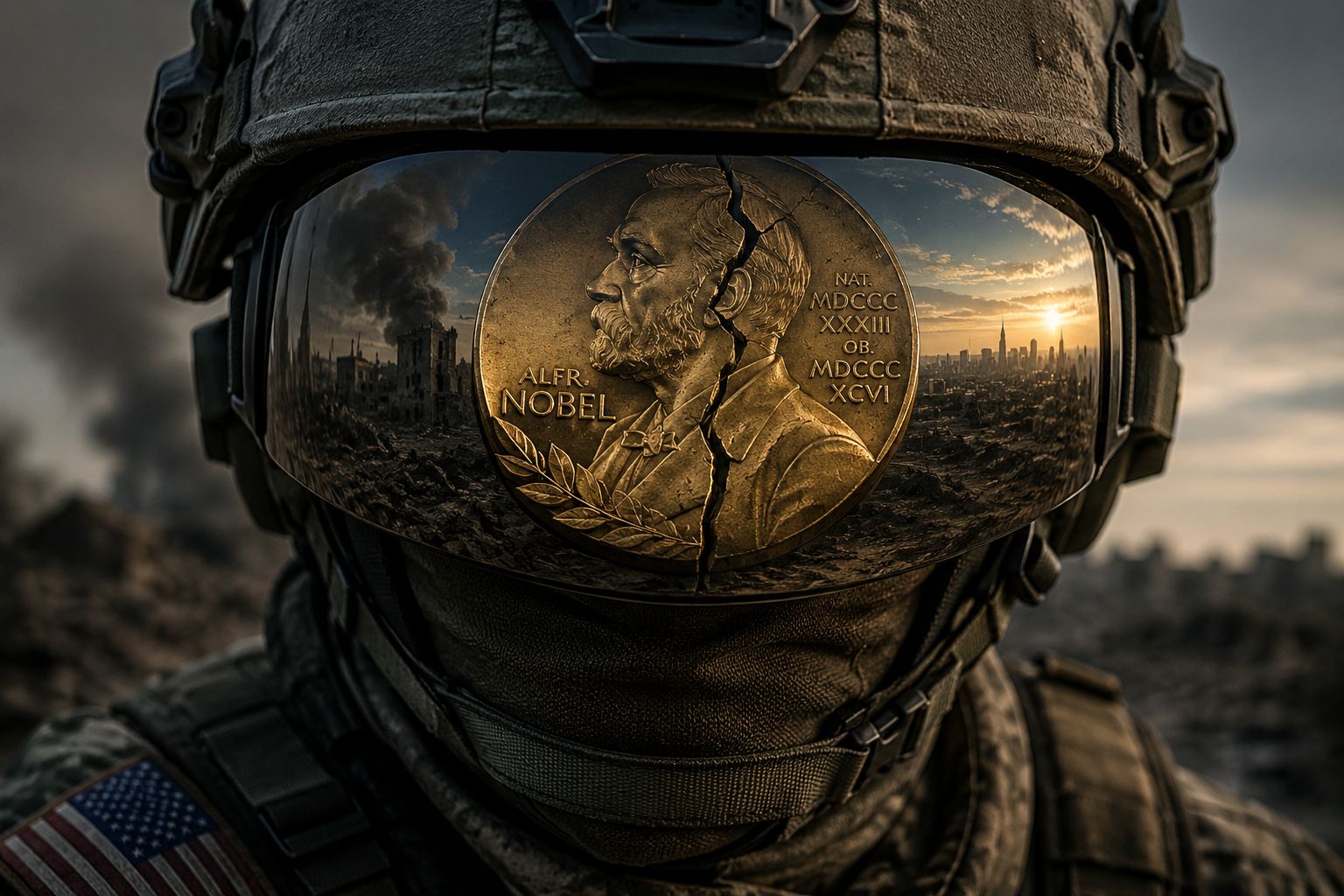
The Nobel Peace Prize has produced its share of controversial winners. Politicians still wage wars after receiving it. International organizations have been criticized for political bias. Even former U.S. President Barack Obama received the prize before many of his most important foreign policy decisions had unfolded.
Yet one proposal sounds so absurd that most people would probably laugh before hearing a single argument.
A former consultant to unnamed Czech Prime Minister once argued that the Nobel Peace Prize should go to the United States Army. The same consultant also described another former Czech prime minister as a “weeping Kremlophile weakling.” Unsurprisingly, the suggestion about the Nobel Prize attracted ridicule. After all, how could one of the world’s most powerful military organizations deserve an award dedicated to peace?
At first glance, the idea appears ridiculous.
War crimes
The United States military has fought numerous wars since the Second World War. It participated in Vietnam, Afghanistan, Iraq, Libya, and many smaller military operations across the globe. American special forces have operated in dozens of countries, often without attracting much public attention. The United States has carried out drone strikes that killed terrorist leaders but also civilians. It has supported controversial governments and armed groups. Moreover, after the terrorist attacks of September 11, 2001, the CIA operated secret detention facilities where prisoners were subjected to interrogation techniques widely regarded as torture. These practices have been documented by investigations conducted in the United States itself.
Many critics go even further.
They argue that the 2003 invasion of Iraq violated international law because it lacked explicit authorization from the United Nations Security Council and was justified by claims about weapons of mass destruction that ultimately proved false. Numerous international lawyers, former diplomats, and political leaders have therefore described the invasion as illegal. Others disagree and argue that international law surrounding military intervention is more complex. Nevertheless, few would dispute that Iraq became one of the most controversial wars of the modern era.
Civilian casualties further complicate America’s record.
Casualties
Precise numbers remain disputed because different organizations use different methodologies. However, there is no doubt that hundreds of thousands of civilians have died in conflicts involving American military interventions over the past several decades. Millions more became refugees or were displaced from their homes. Entire regions experienced years of instability after major military campaigns.
None of this resembles the image normally associated with the Nobel Peace Prize.
Peace prizes are supposed to recognize diplomacy, reconciliation, humanitarian work, or efforts to reduce armed conflict. Soldiers are generally associated with violence rather than peace. Tanks, aircraft carriers, missiles, and special operations units seem like the complete opposite of Nobel’s vision.
If this were the entire story, the consultant’s proposal would indeed deserve nothing more than ridicule.
However, history rarely presents us with such simple moral choices.
Military power has always been a paradox. The same army that wages war may also prevent wars. The same weapons capable of destroying cities may discourage dictators from launching invasions. A military alliance built upon overwhelming force may ultimately save more lives than it costs. Throughout history, peace has often depended not only on diplomacy but also on deterrence.
This raises an uncomfortable question.
What if the United States military, despite its undeniable mistakes and sometimes horrific actions, has prevented even greater catastrophes?
I may be wrong, but I believe this possibility deserves serious consideration. Too many discussions focus exclusively on what the United States has done wrong. Those criticisms are often justified. Yet far fewer people ask what the world might look like if the United States had never possessed such overwhelming military power in the first place.
That question cannot be answered with certainty.
WW2
History never provides controlled experiments. We cannot compare our world with an alternative timeline in which America abandoned its global military role after 1945. Nevertheless, geopolitical analysis frequently relies on counterfactual thinking. Historians ask what might have happened if Nazi Germany had won the Second World War, if the Soviet Union had never collapsed, or if nuclear weapons had never been invented. While these questions cannot produce definitive answers, they often help us understand why history unfolded as it did.
The same reasoning applies here.
The real question is not whether the United States military has blood on its hands. It unquestionably does. The more difficult question is whether the world would ultimately have become even more violent without it.
That possibility transforms an apparently absurd proposal into a serious philosophical and geopolitical dilemma.
The argument that almost nobody wants to hear
Many people believe the modern world has become increasingly unstable because of the United States. They point to wars, coups, sanctions, covert operations, and military interventions. According to this view, American power itself creates chaos. Remove the United States from the equation, and the world would supposedly become more peaceful.
I have serious doubts.
I may be wrong, but I suspect the opposite is closer to reality.
The international order that emerged after the Second World War did not arise naturally. It required overwhelming military, economic, and political power. The United States possessed all three. It built military alliances, stationed troops across several continents, guaranteed maritime trade routes, and became the principal military force behind what is commonly called the liberal international order.
Critics rightly point out that this order has never been truly liberal for everyone.
Washington has supported dictatorships when doing so served its strategic interests. It has overthrown elected governments, armed questionable allies, and ignored international law when it considered its own security more important. These criticisms are well documented and should not be dismissed.
Nevertheless, another question deserves equal attention.
What prevented even more aggressive powers from filling the vacuum?
Cold War
During the Cold War, the Soviet Union sought to expand its influence far beyond its borders. Eastern Europe remained under communist dictatorships for decades. Political repression became routine. Freedom of speech barely existed. Secret police monitored citizens. Thousands of political prisoners were imprisoned, tortured, or executed throughout the communist bloc.
Many Western Europeans understandably feared that Soviet influence would continue expanding.
NATO, supported overwhelmingly by American military power, became one of the principal reasons why this expansion eventually stopped. Nuclear deterrence prevented direct war between the two superpowers. The balance remained fragile, but Europe avoided another continent-wide conflict.
History then changed once again.
The Soviet Union collapsed. Many believed liberal democracy had won permanently. Some even predicted the “end of history,” arguing that democracy and market economies would gradually spread throughout the world.
Instead, new authoritarian powers emerged.
Russia
Russia gradually abandoned democratic reforms and became increasingly authoritarian under Vladimir Putin. China transformed itself into an economic superpower without abandoning one-party rule. Unlike the Soviet Union, modern China combines authoritarian politics with advanced capitalism, technological development, and enormous industrial capacity.
Neither country hides its dissatisfaction with the international order created after 1945.
Russia has repeatedly used military force against neighboring countries. Georgia experienced war in 2008. Crimea was annexed in 2014 in violation of international law. In 2022, Russia launched its full-scale invasion of Ukraine, producing Europe’s largest war since the Second World War.
China has generally pursued a different strategy.
Unlike Russia, Beijing has not fought major wars for decades. Chinese leaders frequently emphasize this fact as evidence of their peaceful intentions. However, they have also dramatically expanded military spending, strengthened their armed forces, militarized islands in the South China Sea, intensified pressure on Taiwan, and adopted an increasingly assertive foreign policy.
Does this mean China would immediately become militarily expansionist if American power disappeared?
No one knows.
However, I find such optimism difficult to share.
History rarely rewards great powers that suddenly find themselves without meaningful opposition. Throughout history, dominant states have often expanded their influence whenever opportunities emerged. Britain did it. France did it. Russia did it. The United States did it. There is little reason to assume that China would permanently behave differently simply because it currently emphasizes peaceful development.
Nevertheless, I suspect that a significant reduction in American military power would encourage rather than discourage geopolitical competition.
Regional powers would begin testing new limits. Existing security guarantees would become less credible. Smaller democracies might discover that no powerful ally remained willing to defend them against larger authoritarian neighbors.
Next arms race?
Some countries would probably respond by dramatically increasing their own military spending.
Others might pursue nuclear weapons.
Still others might simply accept the influence of stronger authoritarian powers because no realistic alternative remained.
None of these outcomes would necessarily occur immediately.
However, history suggests that power vacuums rarely remain empty for long.
Here’s the third part in your usual style.
The invisible peacekeeper
When people think about the United States military, they usually imagine bombs, aircraft carriers, fighter jets, drones, and soldiers. Few people associate these images with peace.
Ironically, however, one of the military’s greatest achievements may consist of wars that never happened.
Deterrence rarely makes headlines.
Nobody celebrates the invasion that never occurred. Newspapers do not report on dictators who abandoned military plans because the risks proved too great. Historians can document wars, but they struggle to measure conflicts successfully prevented by military strength.
This makes deterrence one of the most underestimated concepts in international relations.
The basic idea is remarkably simple.
American imperialism?
A country refrains from attacking because the expected costs outweigh the expected benefits. Military strength therefore serves not only as a tool for fighting wars but also as a means of preventing them. The stronger and more credible the deterrent, the less likely an ambitious rival is to test it.
The United States has played precisely this role for decades.
American military bases stretch across Europe, Asia, and the Middle East. Its navy patrols the world’s most important sea lanes. Its alliances cover dozens of countries. Its nuclear arsenal remains one of the largest ever created.
Critics often view this global presence as imperialism. Supporters see something entirely different.
They argue that American military dominance has discouraged countless governments from pursuing territorial expansion. Countries protected by NATO or bilateral defense treaties have generally not needed to build enormous armies of their own because they rely on American security guarantees.
Europe illustrates this remarkably well.
After centuries of devastating wars, Western Europe experienced an unprecedented period of peace following the Second World War. European integration certainly deserves enormous credit. Economic cooperation made war increasingly irrational. Democracy spread throughout much of the continent.
However, these developments occurred under the protection of American military power.
Had NATO never existed, would Western Europe have reduced military spending so dramatically?
Would Germany have become comfortable maintaining relatively small armed forces?
Would Poland, the Baltic states, or Scandinavia feel secure today without American guarantees?
Again, nobody knows.
Nevertheless, I suspect the answers would often be negative.
The same argument extends beyond Europe.
Just interests
International trade depends heavily upon secure shipping routes. Around 80 to 90 percent of global merchandise trade by volume travels by sea. Piracy, blockades, or regional wars could disrupt the global economy far more severely than most people realize.
The United States Navy has spent decades protecting freedom of navigation across many of the world’s oceans. Critics describe this as serving American interests, and they are certainly correct.
Yet American interests and global interests frequently overlap.
The world’s largest trading economy also benefits when international commerce remains open, predictable, and relatively secure.
Without that naval dominance, another power would eventually assume the same role. Would Russia perform it? Almost certainly not. Would China? Possibly.
However, would a Chinese-led international order protect political freedoms, independent media, democratic institutions, and smaller nations to the same extent?
I have serious doubts.
China frequently emphasizes the principle of non-interference in other countries’ internal affairs. At first glance, this sounds admirable.
However, the same principle also means remaining largely indifferent to how governments treat their own populations. Liberal democracies generally place greater emphasis on human rights, even if they often fail to uphold those ideals consistently. Beijing, by contrast, usually prioritizes state sovereignty over individual freedoms.
I may be wrong, but I suspect this distinction matters enormously.
If authoritarian powers gradually replaced democratic ones as the principal guarantors of international security, I believe the world would slowly become less free. Democracies would not disappear overnight. Instead, authoritarian models would probably become increasingly influential. Governments might feel less pressure to respect civil liberties. Institutional torture could become more common again in some regions. The death penalty might spread rather than continue its long-term global decline. Political repression could become easier to justify if the world’s dominant powers no longer regarded liberal democracy as the preferred model.
None of these developments would occur automatically. Nor can anyone prove they would happen.
Nevertheless, geopolitical history repeatedly shows that international norms are shaped by the world’s strongest powers. When authoritarian states become more influential, authoritarian practices often gain legitimacy beyond their own borders.
That possibility makes the consultant’s proposal considerably less absurd than it initially appears.
Perhaps the United States military has not preserved peace because it is peaceful.
Perhaps it has preserved peace because it has remained powerful enough to discourage something even worse.
Here’s the fourth part in your usual style.
The strongest argument against my hypothesis
Every argument deserves serious criticism, especially when it challenges conventional thinking.
The greatest weakness in my reasoning is obvious.
No one can prove what would have happened if the United States had never become the world’s dominant military power. History does not allow controlled experiments. Every alternative timeline remains speculative. Consequently, my argument cannot be demonstrated with certainty.
Perhaps the world really would have become more peaceful.
Perhaps China would have remained primarily an economic power rather than expanding its military influence. Perhaps Russia would never have invaded Ukraine. Perhaps Europe would have built its own powerful defense alliance decades ago. Perhaps regional organizations would have prevented conflicts without relying on Washington.
These possibilities cannot simply be dismissed.
However, I find them less convincing than the alternative.
History offers remarkably few examples of great powers voluntarily limiting their geopolitical ambitions once they possess overwhelming economic and military strength. The British Empire expanded across much of the world. France repeatedly sought dominance over Europe. Imperial Japan attempted to establish control throughout East Asia. Nazi Germany pursued continental domination. The Soviet Union built an enormous sphere of influence after the Second World War. The United States itself became a global superpower with military bases on several continents.
Why should China become the first historical exception?
Supporters of Beijing frequently point out that China has not started a major war for decades.
That observation is factually correct.
China at large
Nevertheless, today’s geopolitical environment differs dramatically from one in which American military power largely disappears. China has developed under an international system where another superpower possessed overwhelming naval superiority and maintained extensive military alliances throughout Asia.
Would Chinese leaders pursue exactly the same policies if those constraints vanished?
Again, nobody knows. I suspect they would not. The same reasoning applies to Russia.
Some commentators argue that NATO expansion provoked Moscow into becoming increasingly aggressive. Others argue precisely the opposite. They believe NATO expansion became necessary because Russia repeatedly demonstrated imperial ambitions toward its neighbors.
The debate remains unresolved.
However, one observation appears difficult to dispute.
Countries closest to Russia have consistently sought stronger American security guarantees rather than weaker ones.
Poland, Finland, the Baltic states, and many Central and Eastern European countries generally view the United States military very differently from much of Western Europe. Their historical experiences with Russian domination shape their perspective. They do not primarily see American troops as occupiers. They see them as deterrents.
History influences perception.
Cooperation with the US
Someone living in Prague, Warsaw, Tallinn, or Vilnius often interprets geopolitical risks differently from someone living thousands of kilometers away.
The same applies in Asia.
Japan, South Korea, Taiwan, and the Philippines have repeatedly strengthened military cooperation with the United States. These governments certainly pursue their own interests, yet their decisions also reveal something important.
Many countries located closest to authoritarian great powers actively seek American military protection.
That fact deserves serious attention.
If American military power were primarily a source of instability, we might expect its allies to distance themselves from Washington.
Instead, many request an even stronger American presence.
Too much spending?
Of course, critics offer another explanation.
They argue that the United States deliberately exaggerates external threats to justify its global military network and enormous defense budget. According to this view, Washington benefits politically and economically from maintaining a permanent sense of insecurity.
There is some truth to this criticism.
The American military-industrial complex possesses enormous political influence. Defense companies earn vast sums of money. Politicians sometimes use national security to justify policies that deserve far greater scrutiny. President Dwight D. Eisenhower himself warned about the growing influence of the military-industrial complex during his farewell address in 1961.
Ignoring these incentives would therefore be a mistake.
Nevertheless, acknowledging economic interests does not automatically invalidate every security concern.
Defense companies profit from wars. That does not mean every war is unnecessary.
Likewise, the existence of political propaganda does not automatically mean every warning about authoritarian expansion is false.
Reality is often more complicated. The United States has undoubtedly committed grave mistakes.
It has overthrown governments, supported dictatorships, violated international law, and tolerated torture. These actions deserve criticism regardless of whether they ultimately advanced American strategic interests.
Yet another possibility also deserves consideration.
Perhaps the same military establishment that sometimes destabilized individual regions simultaneously preserved the broader international order upon which hundreds of millions of people continue to depend.
If that hypothesis proves even partly correct, then judging the United States military becomes one of the most difficult moral questions in international politics.
My opinion
I may be wrong. In fact, I hope I am.
The world would be a far better place if international peace no longer depended upon overwhelming military power. It would be wonderful if diplomacy alone could prevent aggression, if international law were respected by every government, and if authoritarian states voluntarily abandoned territorial ambitions.
History, however, gives me little reason for such optimism.
For thousands of years, civilizations have competed for land, wealth, influence, and resources. Great powers have repeatedly attempted to dominate weaker neighbors whenever opportunities presented themselves. Human nature has not fundamentally changed simply because our weapons have become more sophisticated.
For that reason, I struggle to imagine a stable international order without a dominant military power capable of deterring potential aggressors.
Today, that power remains the United States.
Is the US morally superior?
This does not make America morally superior.
The United States has committed grave mistakes. It has participated in controversial wars. It has supported dictators. It has tolerated torture. It has conducted covert operations that undermined democratic governments. It has often placed strategic interests above human rights. These actions deserve criticism, and in some cases outright condemnation.
Nevertheless, another uncomfortable truth may exist alongside them.
The same military that committed these abuses may also have prevented even greater catastrophes.
Without the American security umbrella, I suspect Russia would have expanded far more aggressively long before 2022. China might already dominate much of East Asia politically and militarily. Smaller democracies could find themselves under constant pressure to accommodate authoritarian powers rather than resist them. International trade might become increasingly fragmented. Regional arms races could accelerate. Nuclear proliferation could become far more widespread as countries sought to guarantee their own survival.
If American power declines
Perhaps I am wrong.
Yet I find this scenario considerably more plausible than the belief that the disappearance of American military power would automatically produce a more peaceful world.
Many critics correctly describe the United States as an empire.
Perhaps they are right.
However, history suggests that empires eventually disappear. The more important question therefore becomes what replaces them.
Every international order has a dominant power. The Roman Empire eventually declined. The British Empire lost its global position. If American influence continues to weaken during the twenty-first century, another state or coalition will almost certainly assume greater responsibility for shaping international politics.
I am not convinced the alternatives would be preferable.
Russia offers political repression, aggressive nationalism, and repeated violations of international law. China presents a highly sophisticated authoritarian model built upon extensive state surveillance, censorship, and one-party rule. Neither vision strikes me as a more attractive foundation for the future international order.
Some readers may object that Europe should simply defend itself. I agree.
European countries should invest far more heavily in their own defense. A stronger Europe would benefit both Europeans and the broader democratic world. Yet this objective requires decades rather than years. Until then, American military power remains one of the principal pillars supporting European security.
This brings us back to the Nobel Peace Prize. Do I genuinely believe the United States Army should receive it?
The Nobel Peace Prize? No
No.
The suffering caused by American military interventions, civilian casualties, torture, and controversial wars makes such an award extraordinarily difficult to justify.
At the same time, I no longer find the proposal ridiculous. It forces us to confront a paradox that many people would rather ignore. Can an institution responsible for violence also preserve peace?
Can the existence of overwhelming military power prevent even bloodier conflicts?Can the army of one imperfect democracy ultimately protect more freedom than it destroys? I believe these questions deserve serious discussion.
Peace is not always created by peaceful people.
Sometimes it is preserved because those willing to use force convince others that war would become even more costly.
That is an uncomfortable conclusion.
Unfortunately, history is full of uncomfortable conclusions. Perhaps the consultant’s proposal should never win widespread support. Perhaps the United States Army should never receive the Nobel Peace Prize. However, the very fact that the idea can be defended through rational arguments demonstrates something important.
Reality is far more complicated than simple slogans about peace, war, good, and evil.
Leave a Reply