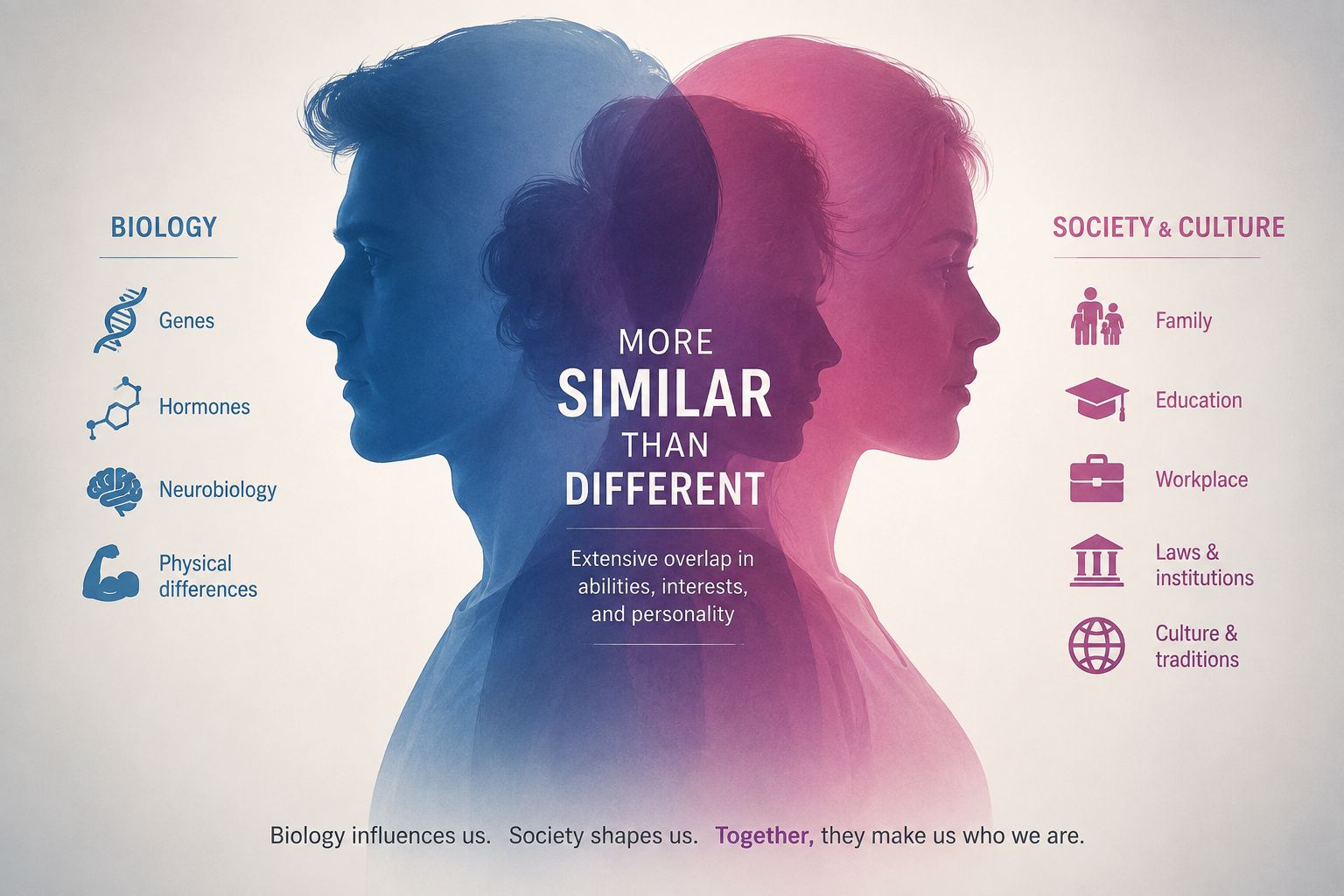
Few debates have generated more political heat than the origins of gender inequality. One side argues that men and women are born fundamentally different and that unequal outcomes naturally emerge from biology. The other claims that nearly every difference between the sexes is socially constructed and can therefore be eliminated through education and policy. Both positions contain elements of truth, yet both become misleading when taken to their extremes.
The central mistake is treating two different questions as if they were the same. One concerns biological differences between men and women. The other concerns unequal rights, opportunities, power, and social status. Science strongly suggests that biology influences average behavior and preferences, while sociology, economics, and history demonstrate that inequality itself is largely a product of culture, institutions, and historical development.
Two different questions
Before discussing inequality, we must distinguish between differences and discrimination. Men and women are not biologically identical. Evolution has shaped each sex differently because they faced different reproductive pressures throughout human history.
These differences, however, do not automatically create unequal societies. A biological tendency may influence career preferences or personality traits without determining who should hold political power, receive equal pay for equal work, or enjoy the same legal rights. Confusing these issues has fueled decades of unnecessary ideological conflict.
Biology matters
Evolutionary biology, endocrinology, and neuroscience all demonstrate that biological sex influences human development. Hormones shape the body and the brain long before birth and continue to influence behavior throughout life.
Men typically develop greater muscle mass, larger hearts, stronger bones, and higher upper-body strength because of testosterone-driven puberty. Women experience pregnancy, childbirth, lactation, and menopause. These biological realities have profound consequences for health, employment, and family life.
Average psychological differences also appear consistently across many studies. Men generally score higher on measures of physical risk-taking, sensation seeking, and aggressive competition. Women, on average, perform slightly better on verbal fluency and tend to display greater empathy and social sensitivity. None of these differences apply to every individual, but they appear repeatedly across cultures.
Perhaps the most robust finding concerns occupational interests. Researchers such as David Geary have shown that women, on average, display stronger preferences for people-oriented occupations, whereas men more often prefer working with objects, systems, or machines. Similar patterns have even been observed in non-human primates, suggesting that at least part of these preferences predates human civilization.
Average does not mean destiny
These findings are often misunderstood.
Average differences do not imply that every man is stronger than every woman or that every woman prefers caring professions. Human distributions overlap enormously. Many women outperform most men in mathematics or engineering, while many men excel in nursing, education, or psychology.
Variation within each sex is greater than the average difference between them for many psychological traits. Biology creates probabilities rather than certainties.
This distinction matters because public debates frequently replace statistical averages with stereotypes. Scientific research describes populations, not individuals.
Biology cannot explain inequality alone
Although biology explains many behavioral tendencies, it cannot explain why societies differ so dramatically in their treatment of women.
If gender inequality were purely innate, we would expect similar social arrangements throughout history and across cultures. Instead, anthropologists have documented remarkable diversity.
Many hunter-gatherer societies were relatively egalitarian. Some communities divided responsibilities according to biological constraints while maintaining shared decision-making. In contrast, numerous agricultural civilizations developed rigid patriarchal systems.
Matrilineal societies provide another challenge to purely biological explanations. Among the Minangkabau of Indonesia, for example, property and family lineage traditionally pass through women. Similar systems have existed elsewhere in the world. Such variation would be difficult to explain if biology alone dictated social hierarchy.
The history of gender inequality
Understanding the origins of gender inequality requires looking far beyond modern politics. Human societies have not always treated men and women in the same way, nor have gender roles remained constant throughout history. The relationship between biology, technology, economics, and culture has evolved over thousands of years.
Hunter-gatherer societies
For more than 95% of human history, people lived as hunter-gatherers. Many anthropologists believe these societies were relatively egalitarian compared with later civilizations. Men generally hunted large game, while women gathered plants, cared for children, and processed food. Although responsibilities differed, both activities were essential for survival. In many groups, important decisions were made collectively, and women often possessed considerable influence within their communities.
Biological differences certainly affected the division of labor. Pregnancy, breastfeeding, and childcare naturally limited long-distance hunting, while men’s greater physical strength made them better suited to pursuing large animals. However, these differences did not necessarily create rigid political hierarchies.
The agricultural revolution
The Agricultural Revolution, beginning around 10,000 years ago, fundamentally transformed gender relations. Permanent settlements created private property, inherited wealth, and social classes. Physical strength became more valuable because farming required heavy manual labor, clearing forests, constructing irrigation systems, and protecting crops from rivals.
Inheritance also became increasingly important. Families sought certainty regarding biological parenthood because land and wealth could now be passed to future generations. Many historians argue that this encouraged stricter control over female sexuality, marriage, and reproduction. At the same time, organized warfare expanded, strengthening male dominance in political and military leadership.
These developments were not inevitable consequences of biology alone. Rather, they reflected how biological differences interacted with changing economic conditions.
Ancient and medieval societies
Most ancient civilizations developed patriarchal legal systems. In Ancient Greece and Rome, women often possessed fewer political rights than men, although the extent of these restrictions varied considerably between regions and historical periods. Similar patterns emerged across much of Asia, the Middle East, and Europe.
Religious traditions reinforced many of these social structures. Marriage, inheritance, family authority, and gender roles became embedded within legal and religious institutions. Women were frequently expected to focus on domestic responsibilities, while men dominated politics, commerce, and warfare.
Nevertheless, history was never uniform. Some societies granted women significant property rights or political influence, while others remained highly restrictive. These differences demonstrate that culture played a decisive role alongside biology.
Industrialization and women’s rights
The Industrial Revolution began to weaken many traditional gender roles. Mechanization reduced the importance of physical strength in numerous occupations, while urbanization created new forms of employment outside agriculture. Expanding literacy and compulsory education allowed increasing numbers of women to acquire professional skills.
During the nineteenth and twentieth centuries, women’s rights movements successfully campaigned for access to universities, voting rights, property ownership, and legal equality. These reforms transformed societies within only a few generations. Human biology remained unchanged, but institutions evolved rapidly.
The modern era
Today, gender inequality continues to decline in many parts of the world, although progress remains uneven. Women now outnumber men in higher education across numerous developed countries and occupy positions once considered exclusively male, including heads of government, military officers, scientists, and corporate executives.
At the same time, major differences persist. Women remain underrepresented in some leadership positions, while men dominate many dangerous occupations and account for the overwhelming majority of workplace fatalities. Parenthood continues to affect women’s careers more strongly than men’s, and cultural expectations differ substantially between countries.
The historical record demonstrates that gender inequality has never been static. Biological differences have remained relatively constant throughout human history, yet the social status of women has changed dramatically. This suggests that biology influences the starting conditions, while technology, economics, institutions, and culture largely determine how those differences are translated into social outcomes.
Culture shapes inequality through everyday interactions as well. Parents, teachers, peers, employers, and the media constantly communicate expectations about masculinity and femininity. Children learn which careers appear suitable, how emotions should be expressed, and what society expects from each sex. These messages influence confidence, ambition, negotiation behavior, and occupational choices long before adulthood. Small differences introduced early in life can gradually accumulate into substantial inequalities.
Economic development has accelerated these changes. Reliable contraception, improved maternal healthcare, mechanization, and labor-saving household technologies reduced many of the biological constraints that historically limited women’s participation in paid work. Access to universities and professional careers expanded accordingly. Today, women outnumber men in higher education across many developed countries, illustrating how rapidly educational inequality can disappear once structural barriers are removed.
Taken together, historical evidence leaves little doubt that culture profoundly shapes gender inequality. Biology influences average physical and psychological tendencies, but societies decide how those differences are interpreted, rewarded, restricted, or compensated. Laws can remove discrimination. Educational systems can expand opportunity. Cultural norms can evolve within a generation. The remarkable transformation of women’s rights over the last century is perhaps the strongest evidence that inequality itself is largely a social creation rather than an inevitable consequence of human biology.
The gender equality paradox
One of the most fascinating findings in modern psychology is the so-called Gender Equality Paradox.
In highly egalitarian countries such as Finland, Norway, and Sweden, women are less likely to choose STEM careers than women in many developing countries. At first glance, this appears contradictory.
The most widely discussed explanation is that greater economic security allows people to follow their personal preferences more freely. If women are, on average, more interested in people-oriented professions, those preferences become more visible once financial survival is less pressing.
Importantly, this finding does not imply that women are incapable of succeeding in science or engineering. Rather, it suggests that freedom sometimes increases, rather than decreases, occupational differences between the sexes.
The pipeline and the glass ceiling
Economists often distinguish between two mechanisms.
The first is the pipeline. Biological tendencies may influence career preferences, leading more men toward physically demanding or highly technical occupations and more women toward healthcare, education, or social services.
The second is the glass ceiling. This refers to barriers that prevent equally qualified women from reaching senior positions because of discrimination, unequal domestic responsibilities, harassment, or biased promotion practices.
Evidence suggests that both mechanisms exist. Their relative importance differs across occupations, countries, and historical periods.
Ignoring either one produces an incomplete explanation.
Nature and nurture work together
Modern biology has largely abandoned the old nature-versus-nurture debate.
Genes and environments constantly interact. A slight biological tendency can influence how parents, teachers, and peers respond to a child. Those responses then reinforce the original tendency, creating a feedback loop.
For example, a child with stronger verbal abilities may receive more books and conversational encouragement. A child who enjoys constructing objects may receive more spatial toys and technical hobbies. Over many years, these small differences accumulate into substantial differences in knowledge, confidence, and career choices.
Biology initiates part of the process. Society amplifies or moderates it.
Equality does not require sameness
A common mistake in political debate is assuming that equality requires identical outcomes.
A society can guarantee equal rights while accepting that men and women may, on average, make different choices. Likewise, recognizing biological differences should never become an excuse for denying equal dignity, legal protection, or opportunity.
Pregnancy illustrates this principle well. Pregnancy is an unavoidable biological reality, yet modern societies can reduce its economic consequences through childcare, parental leave, flexible employment, and healthcare. Social institutions can compensate for biological differences without pretending those differences do not exist.
Geographic differences
If gender inequality were determined primarily by biology, we would expect similar patterns across countries and cultures. Reality is far more complex. Levels of inequality differ enormously depending on geography, economic development, political institutions, religion, and cultural traditions.
The Nordic countries consistently rank among the world’s most gender-equal societies. Women participate extensively in politics, education, and the labor market, while generous parental leave and childcare systems reduce many traditional barriers. By contrast, women in parts of Afghanistan, Yemen, and several other countries face severe legal and social restrictions on education, employment, mobility, and political participation. These differences cannot be explained by genetics. Human biology has not changed between Scandinavia and the Middle East. Institutions, laws, and cultural norms have.
Regional differences also exist within countries. Urban areas generally offer greater educational opportunities, more diverse occupations, and more progressive attitudes toward gender roles than rural regions. Immigration can further increase diversity, bringing together communities with very different beliefs about family structure, women’s employment, and gender expectations.
Even countries with similar levels of wealth often display substantial differences. Japan and South Korea are among the world’s most technologically advanced nations, yet women remain underrepresented in senior corporate leadership compared with several European countries. Meanwhile, Rwanda has one of the highest proportions of women in parliament anywhere in the world, illustrating that political representation depends on historical and institutional factors rather than biological differences.
These international comparisons demonstrate that while biology may influence individual preferences, the degree of gender inequality is strongly shaped by social environments. The remarkable variation across societies is difficult to reconcile with purely biological explanations.
The economic cost of gender inequality
Gender inequality is not only a moral or political issue. It also carries substantial economic costs. When half of the population cannot fully develop its skills or participate equally in the economy, societies waste human capital that could otherwise contribute to innovation, productivity, and economic growth.
The numbers are striking. The World Bank estimates that differences in lifetime earnings between women and men translate into roughly $160 trillion in lost human capital worldwide. Other analyses by the McKinsey Global Institute suggest that advancing women’s equality could add up to $12 trillion to annual global GDP by 2025 under a realistic scenario, while complete equality in labor markets could theoretically increase global economic output by as much as $28 trillion, or roughly 26% above projected levels.
Lower female labor-force participation reduces the available workforce and limits tax revenues. Economies with significant barriers to women’s employment often experience slower growth because qualified workers remain underutilized. This is particularly important in countries with ageing populations, where labor shortages have become a major economic challenge.
Educational inequality
Educational inequality creates similar losses. Preventing girls from completing secondary or higher education reduces future productivity, lowers household incomes, and limits entrepreneurship. According to UNESCO, each additional year of schooling substantially increases future earnings, while educating girls is associated with lower child mortality, improved health, and faster long-term economic development.
Unequal domestic responsibilities also impose hidden costs. In many societies, women continue to perform a disproportionate share of unpaid childcare, household work, and elder care. The International Labour Organization estimates that women perform more than three times as much unpaid care work as men globally. Although these activities generate enormous economic value, they are rarely reflected in GDP and often reduce career progression, lifetime earnings, and retirement savings.
Discrimination during hiring or promotion can also reduce productivity. If companies fail to recruit or promote the most capable candidates because of unconscious bias or outdated stereotypes, valuable talent remains underutilized. Research from several consulting firms has found that companies with more diverse leadership often outperform less diverse competitors, although these studies generally show correlations rather than proving direct causation.
At the same time, policymakers should avoid assuming that identical occupational distributions are always economically optimal. If men and women voluntarily choose different careers because of genuine differences in interests or life priorities, those outcomes do not necessarily represent economic inefficiency. The objective is not to produce identical statistics but to ensure that every individual has the opportunity to pursue their preferred career without artificial barriers.
From an economic perspective, the ideal society is one in which talent is fully utilized regardless of sex while respecting individual freedom of choice. Reducing discrimination increases economic efficiency, but acknowledging biological diversity also prevents policymakers from interpreting every statistical difference as evidence of injustice.
How should society address gender inequality?
Recognizing that gender inequality arises from both biology and culture leads to a more practical approach than either ideological extreme. A successful society should neither deny biological differences nor accept discrimination as inevitable. Instead, it should remove artificial barriers while allowing individuals to make their own choices.
The first priority is legal equality. Men and women should enjoy identical rights before the law, including equal protection against discrimination, equal access to education, equal property rights, and equal opportunities in employment and political participation. Although these principles are established in most developed countries, they remain absent or only partially implemented in many parts of the world.
Education is equally important. Schools should encourage both boys and girls to develop their talents without restricting them through outdated stereotypes. Children should be exposed to a broad range of subjects and career paths, allowing interests and abilities to develop naturally rather than according to social expectations.
Governments cannot change biology
Governments can also reduce inequalities created by biology without attempting to eliminate biology itself. Affordable childcare, paid parental leave for both parents, flexible working arrangements, and high-quality maternal healthcare allow women to balance careers and family life more easily while encouraging fathers to share childcare responsibilities. Such policies reduce the economic disadvantages associated with pregnancy and parenthood without forcing identical life choices.
Workplaces should prioritize merit rather than quotas whenever possible. Hiring and promotion decisions should be based on competence, experience, and performance rather than sex. Transparent recruitment procedures, objective evaluation criteria, and equal pay for equal work help reduce discrimination while preserving fairness. At the same time, employers should recognize that equal opportunity does not necessarily produce identical outcomes because individuals differ in interests, priorities, and life circumstances.
Cultural attitudes also matter. Media, schools, families, and political leaders shape expectations about masculinity and femininity. Challenging harmful stereotypes benefits both sexes. Women should not be discouraged from pursuing science, engineering, or leadership positions, while men should not face stigma for choosing careers in nursing, education, or childcare. Expanding opportunities is more important than enforcing statistical equality.
Finally, policymakers should distinguish between unequal outcomes and unjust discrimination. Not every difference in representation proves discrimination, just as not every inequality reflects free choice. Effective public policy should identify genuine barriers that prevent capable individuals from succeeding while respecting personal autonomy and biological diversity.
A just society does not require men and women to become identical. It requires that every individual has the freedom to pursue their ambitions without unnecessary legal, cultural, or institutional obstacles. Equality of opportunity should be the objective, while diversity in individual choices should be accepted as a natural consequence of human variation.
Men and women are more similar than different
Public debate often focuses on the differences between men and women, creating the impression that the two sexes are fundamentally distinct. Scientific research paints a more nuanced picture. While average biological and psychological differences certainly exist, men and women are far more similar than different across most measurable traits.
Psychologists frequently describe these differences using statistical distributions rather than rigid categories. Although men and women differ on average in characteristics such as physical strength, aggression, or occupational interests, the distributions overlap extensively. Many women are physically stronger than the average man, while countless men display greater empathy or verbal ability than many women. Sex therefore predicts individual characteristics only imperfectly.
Research consistently shows that variation within each sex is often greater than the average difference between them. Intelligence provides an excellent example. Men and women have virtually identical average IQ scores, even though some studies suggest slightly greater male variability at both the highest and lowest ends of the distribution. Similarly, personality traits differ only modestly on average, with substantial overlap between the sexes.
This distinction has important practical consequences. Statistical averages help researchers understand populations, but they are poor tools for judging individuals. Employers, educators, and policymakers should evaluate people according to their abilities, qualifications, and achievements rather than assumptions based on sex. An individual woman may possess exceptional spatial reasoning, while an individual man may excel in communication or childcare. Biology influences probabilities, not destinies.
Recognizing that men and women are more alike than different helps bridge the divide between biological and social explanations of gender inequality. It acknowledges that evolution has shaped average tendencies while emphasizing that every individual should be treated as a unique person rather than as a statistical average.
Conclusion
The evidence points toward a balanced conclusion. Men and women are not psychologically or biologically identical. Evolution, hormones, and reproductive biology create measurable average differences in physical abilities, behavior, and interests. Those findings are supported by decades of research across multiple scientific disciplines.
Gender inequality itself, however, is largely a product of human society rather than human biology. Laws, cultural traditions, religion, education, and economic institutions determine who holds power, who owns property, and who enjoys equal opportunities. These structures have changed dramatically throughout history, demonstrating that inequality is neither fixed nor inevitable.
The greatest mistake is reducing this complex issue to either biology or culture alone. Biology influences tendencies. Society transforms those tendencies into outcomes. A fair society neither denies biological reality nor treats it as destiny. Instead, it seeks to ensure that natural differences never become a justification for unequal rights, diminished opportunities, or reduced human dignity.
Leave a Reply