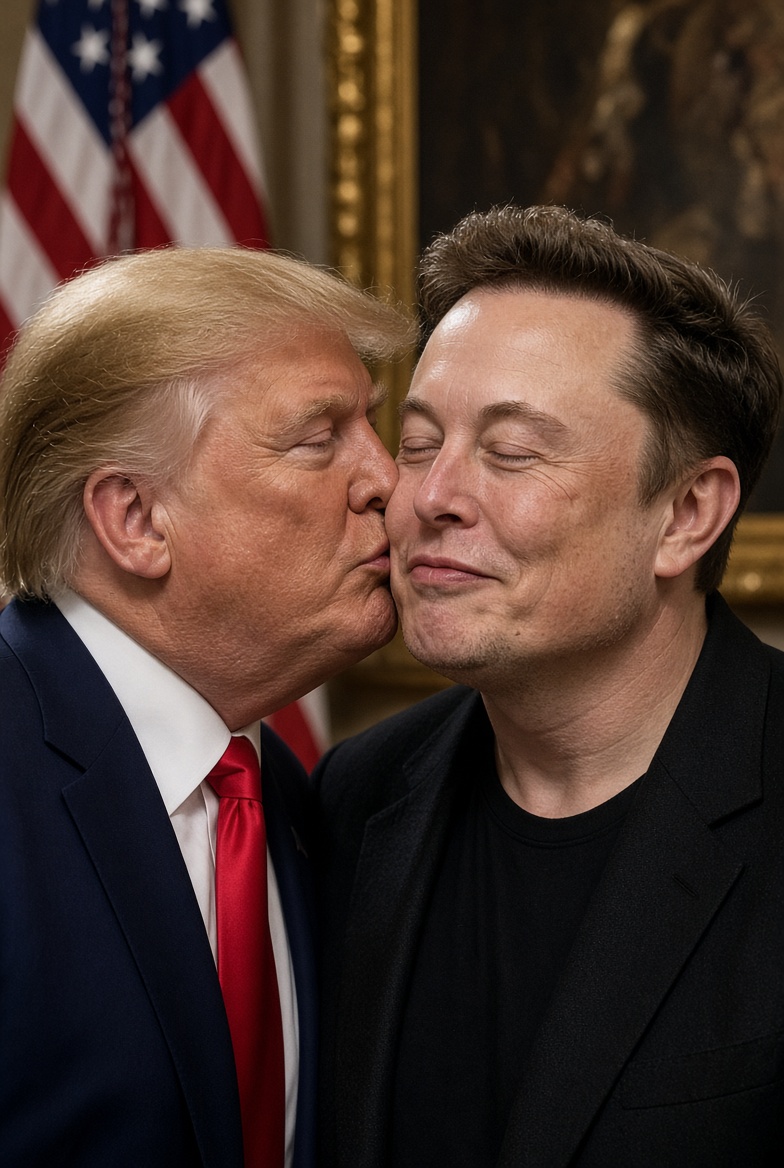
A year ago, Donald Trump and Elon Musk appeared to have transformed one of the strangest alliances in American politics into one of its most spectacular feuds. Musk attacked Trump’s spending plans, floated the creation of a new political party and even dragged the Epstein files into their increasingly personal dispute. Trump responded in characteristic fashion, threatening the federal contracts and subsidies connected to Musk’s enormous business empire.
Now the Tech Bro is back.
The reconciliation may look surprising if we treat politics as a story about friendships, betrayals and personalities. It becomes considerably less mysterious if we treat politics as a story about power. Trump needs money and political machinery before the 2026 midterm elections. Musk needs a federal government that buys rockets, regulates autonomous vehicles, shapes artificial-intelligence policy and determines the environment in which his companies operate.
Apparently, there are few disagreements that cannot be overcome when hundreds of millions of dollars and billions in government business are somewhere in the background.
The more important question, however, is not whether Trump and Musk are friends again. It is why the political preferences of Elon Musk, Peter Thiel and a relatively small circle of extraordinarily wealthy technology executives matter so much in a country of more than 340 million people.
Perhaps Americans should be asking a simpler question: who exactly is supposed to be in charge of the United States?
From political marriage to spectacular divorce
Musk’s transformation from businessman to Republican political powerbroker happened remarkably quickly. During the 2024 election, his America PAC spent more than $260 million helping Trump return to the White House. Axios later described Musk’s pro-Trump spending as making him the largest individual political donor in a single American election cycle.
His reward was not an obscure ambassadorship or ceremonial advisory position. Musk became one of the most visible figures surrounding the new administration and led the Department of Government Efficiency, or DOGE. For several months, it sometimes seemed difficult to determine where Musk the businessman ended and Musk the political actor began.
Then everything collapsed.
Musk became an outspoken opponent of Trump’s enormous spending legislation. The dispute escalated far beyond disagreements about deficits. Musk talked about creating a new political party. Trump threatened to reconsider government contracts and subsidies benefiting Musk’s businesses. Musk went considerably further and alleged that Trump’s name appeared in the Epstein files.
This was not an ordinary disagreement between political allies. It looked like a permanent rupture.
Yet American politics has an extraordinary ability to repair relationships when both parties discover that separation is expensive.
The bromance returns
By 2026, the relationship was warming again. According to recent reporting, the reconciliation involved efforts by figures around Trump, while the political incentives for cooperation became increasingly obvious.
Then came the money.
The Wall Street Journal reported this week that Musk intends to spend at least $100 million on a voter-turnout operation designed to help Republicans maintain control of Congress. During a May flight to China aboard Air Force One, Musk reportedly discussed his American investment plans with Trump and told the president’s team that he intended to help Republicans in November.
Axios had already reported in July that Musk was reviving America PAC for the midterms. The organization plans door-knocking, digital advertising and direct-mail operations intended to mobilize conservative voters.
So are Trump and Musk best friends again?
Probably not in the conventional meaning of friendship. Their renewed relationship looks more interesting than that. It is a political alliance in which both men possess something the other wants.
Trump wants Musk’s money, political infrastructure, technological prestige and enormous online reach. Musk has businesses whose fortunes are inevitably affected by Washington.
That makes reconciliation considerably easier.
Musk has something Trump desperately needs
The November midterms could determine whether Trump retains a cooperative Congress for the remainder of his presidency. Republicans therefore have an enormous incentive to mobilize voters who participated in the 2024 presidential election but might otherwise stay home during a midterm.
Musk can help solve precisely that problem.
America PAC says it knocked on more than ten million doors during the 2024 campaign. Its revived operation can concentrate on turnout while other Republican organizations spend their resources elsewhere.
This illustrates why billionaire political influence cannot be measured simply by adding campaign donations.
A billionaire does not merely purchase advertisements. He can finance political organizations, employ campaign professionals, build voter databases, fund legal battles, dominate communication platforms and sustain political projects that ordinary citizens could never afford.
A voter has one ballot.
A billionaire also has one ballot. But he may arrive at the polling station after spending $100 million persuading everyone else how to use theirs.
Formally, those two citizens possess equal political rights. In practical political power, they inhabit different universes.
Musk needs Washington too
The relationship is not one-sided.
Musk’s companies operate in industries in which government policy is enormously consequential. SpaceX is deeply involved with the American government and national-security establishment. Tesla depends on decisions involving transportation, trade, manufacturing and regulation. xAI operates in an artificial-intelligence industry whose future rules are being written today.
This does not mean that every government decision favorable to a Musk company represents corruption. SpaceX, for example, has developed capabilities that the American government genuinely needs. Governments inevitably contract with private companies, and successful businesses should not be punished because their owners possess political opinions.
The problem begins when political power, enormous campaign spending and commercial dependence on government become intertwined so closely that citizens cannot easily determine where one relationship ends and another begins.
The iDNES report on the reconciliation captures the basic logic rather well: Trump and Musk have found common ground because doing so benefits both of them.
That may be perfectly rational behavior for Trump and Musk.
Whether it is healthy behavior for American democracy is another matter.
And then there is Peter Thiel
Musk attracts attention because he enjoys attention. Peter Thiel represents a different form of Tech Bro influence.
The question “Is Peter Thiel still in charge?” should obviously not be interpreted literally. Thiel does not secretly command the whole United States government. Trump remains president, elected officials retain constitutional authority, and the administration contains competing ideological and commercial factions.
Nevertheless, Thiel’s political network makes the question worth asking.
His relationship with Vice President JD Vance is particularly important. Thiel employed Vance, supported his political rise and contributed $15 million to the super PAC backing Vance’s successful 2022 Senate campaign. Thiel also introduced Vance to Trump.
Then there is Palantir.
Thiel co-founded the data-analysis and defense technology company, which has become increasingly important to the American government. Reuters reported this year that Palantir’s growth has been boosted by numerous government contracts and noted Thiel’s longstanding relationship with Trump and his close connections with Vance.
Palantir’s success should not simply be reduced to Thiel’s politics. The company worked with the American government long before Trump’s second presidency and possesses technology federal agencies genuinely want. Yet the overlap between Silicon Valley networks, political patronage, defense technology, artificial intelligence and government procurement deserves intense public scrutiny.
Musk may be the most visible Tech Bro in Trump’s orbit. Thiel’s influence demonstrates why concentrating exclusively on Musk misses the larger transformation.
The Tech Bros did not disappear with DOGE
There was a temptation after Musk’s departure from DOGE and his feud with Trump to declare the Silicon Valley-Trump alliance dead.
That conclusion now looks premature.
The personalities may change. The underlying convergence of interests remains.
Parts of Silicon Valley want lower regulation, favorable AI policies, access to government contracts, a sympathetic approach to cryptocurrency, opportunities in defense technology and an administration that views technology entrepreneurs as national assets rather than merely corporations requiring oversight.
Trump’s political movement, meanwhile, wants wealthy donors, alternative institutions, technological expertise, media infrastructure and businessmen willing to challenge the traditionally Democratic culture of much of the technology industry.
Those interests do not require genuine friendship.
They require cooperation.
This is why Musk can attack Trump ferociously one year and spend enormous sums helping his party the next.
This is bigger than Trump
It would be convenient to describe billionaire political influence as another Trump phenomenon. That would also allow everyone else to avoid uncomfortable questions.
America’s dependence on wealthy political donors existed long before Donald Trump entered politics. Democrats have their billionaires too. Wall Street, Hollywood, Silicon Valley, unions, corporations, lobbying organizations and wealthy individuals have attempted to influence American governments under presidents of both parties.
The scale and character of today’s Tech Bro phenomenon are nevertheless unusual.
Modern technology billionaires possess something earlier industrial magnates often lacked: simultaneous influence over capital, communications, data, artificial intelligence, satellites, defense technology and political campaigning.
Musk does not merely own companies. He owns X, one of the world’s major political communication platforms. SpaceX operates infrastructure of strategic importance. His AI companies participate in a technological race governments increasingly regard as a matter of national security.
Thiel’s network reaches venture capital, defense technology, data analysis and national politics.
When people possessing such resources become political actors themselves, the traditional distinction between economic and political power becomes increasingly difficult to maintain.
Money does not have to buy politicians to distort democracy
The crudest conception of political corruption involves an envelope of cash exchanged for a political favor.
Modern influence is usually more sophisticated.
Nobody needs to tell a politician, “Here is $100 million; now pass my preferred legislation.” Politicians know who finances campaigns. Donors know which politicians share their interests. Lobbyists understand which arguments will receive attention. Political organizations know which billionaires can finance them for another election cycle.
Influence therefore frequently operates without an explicit transaction.
The danger is not simply bribery. It is agenda-setting.
Ordinary Americans might worry about rent, wages, healthcare, education or the cost of food. A billionaire might worry about AI regulation, capital gains, antitrust enforcement, government contracts or restrictions affecting his companies.
Both can express their concerns.
Only one can potentially spend $100 million ensuring that politicians hear them.
Lobbying creates the same democratic imbalance
Billionaires are only part of the problem. America’s lobbying industry institutionalizes unequal access to political decision-making.
Lobbying itself is not inherently illegitimate. Environmental organizations lobby. Human-rights groups lobby. Trade unions lobby. Businesses need some mechanism for explaining complicated industries to lawmakers.
However, access becomes problematic when wealth determines who can purchase the largest armies of lawyers, consultants, former officials and policy specialists.
The result is not necessarily a government directly controlled by corporations. It can be something subtler: a political environment in which some interests are permanently present in Washington while ordinary citizens appear mainly on Election Day.
The average voter cannot employ a former senator.
The average voter cannot donate $100 million.
The average voter cannot offer politicians access to a communications platform with hundreds of millions of users.
The average voter cannot threaten to redirect a major investment project to another state.
Yet democracy supposedly begins with the average voter.
The United States does not need benevolent oligarchs
Supporters of powerful technology entrepreneurs can make a reasonable counterargument. Musk, Thiel and other Silicon Valley figures have created or financed innovative companies. They understand technologies that many politicians barely comprehend. Government bureaucracies can be slow, wasteful and technologically backward.
All of that may be true.
It still does not follow that successful entrepreneurs deserve disproportionate political authority.
Democracy does not depend on billionaires being stupid or malicious. The problem would remain even if every billionaire were extraordinarily intelligent, personally decent and sincerely interested in improving society.
The question is institutional rather than personal.
Who gave them the mandate?
Elon Musk may have brilliant ideas about spaceflight. Peter Thiel may have brilliant ideas about technology. A hedge-fund manager may understand financial markets better than almost every member of Congress.
Expertise deserves to be heard.
It does not deserve extra votes.
Let Americans take charge
The United States does not need another political messiah from Silicon Valley. Nor does it need a Democratic collection of billionaires to counterbalance a Republican collection of billionaires.
It needs stronger democratic institutions.
Campaign-finance rules should make it considerably more difficult for individual fortunes to become political weapons. Political donations and organizations should be radically transparent. Revolving doors between government and lobbying firms deserve stricter restrictions. Government contracts involving politically active billionaires require exceptional scrutiny. Conflicts of interest should be disclosed aggressively rather than discovered months later by investigative journalists.
Most importantly, politicians must once again become more dependent on voters than on donors.
None of this requires hostility toward wealth. Becoming rich by creating something useful is not a democratic offense. Musk should be free to build rockets. Thiel should be free to invest. Entrepreneurs should be free to advocate political ideas, donate within reasonable limits and vote like everybody else.
The key words are “like everybody else.”
Economic inequality is compatible with democracy only up to the point at which enormous differences in wealth become enormous differences in political power.
One person, one vote should mean something
The reunion between Trump and Musk will probably generate plenty of entertaining headlines. Their friendship may survive. They may quarrel again next month. Musk may praise Trump today and attack him tomorrow.
That is political theatre.
The structural issue will remain after both men have disappeared from politics.
A democratic republic cannot promise absolute equality of influence. Famous people will always attract more attention. Intelligent people may persuade more voters. Business leaders will understand some subjects better than ordinary citizens. Newspapers, activists, academics, celebrities and organizations will always possess different levels of influence.
But there is a profound difference between unequal influence arising from persuasion and unequal influence purchased through extraordinary concentrations of wealth.
The American experiment was not supposed to answer the question of who should govern with “whichever billionaire writes the largest check.”
So perhaps the interesting question is not whether Donald Trump and Elon Musk are best friends again.
Nor is it whether Peter Thiel remains the more discreet power behind parts of the Trump-era technology network.
The question is why Americans should tolerate a political system in which the friendships, feuds and financial decisions of a handful of billionaires can matter so enormously.
Trump has power. Musk has money, companies and a communications empire. Thiel has capital, networks and influential political protégés.
American voters have something more important.
They have the democratic legitimacy that none of those things can buy.
It might be time for them to use it.
Leave a Reply