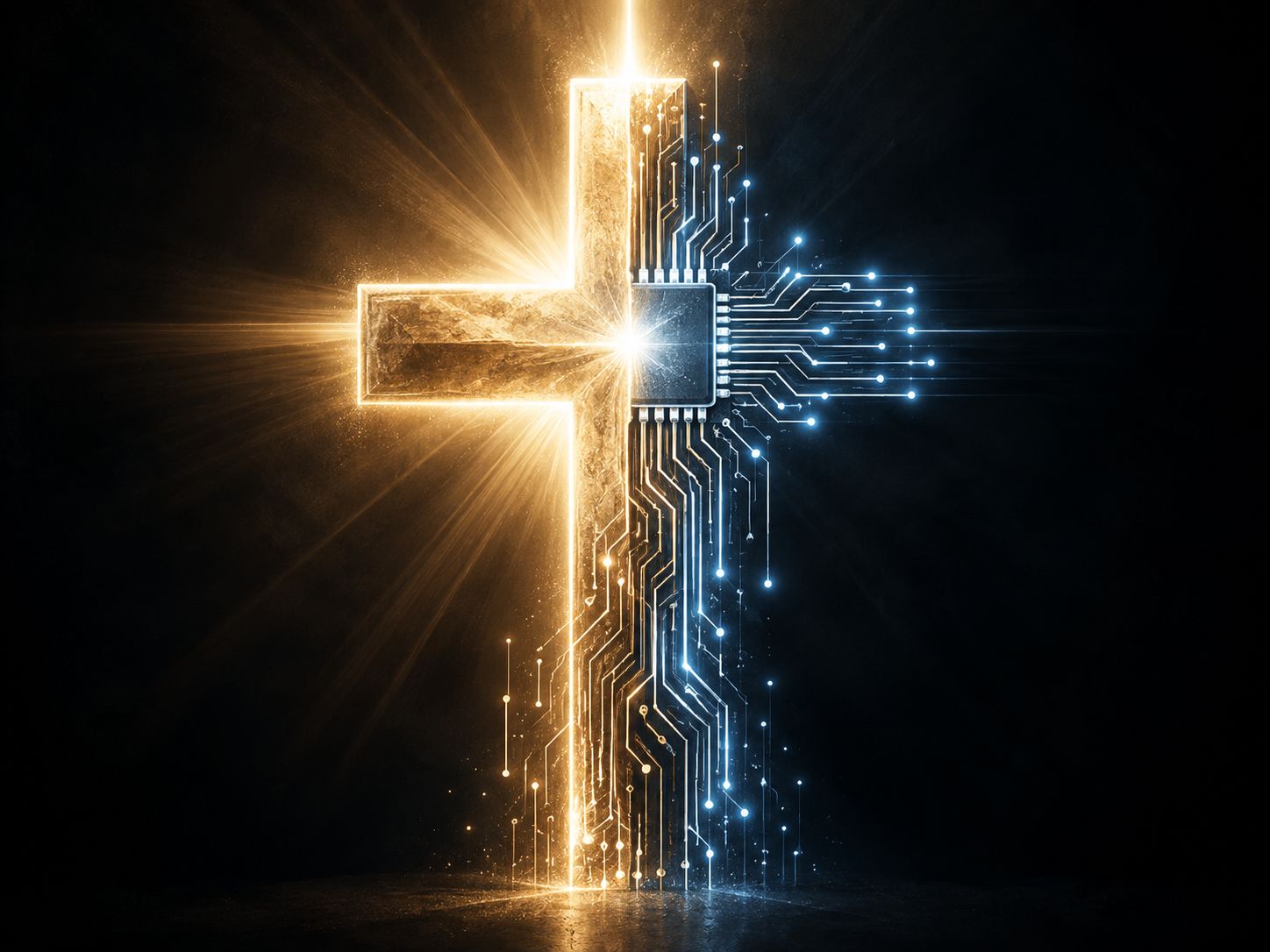
Artificial intelligence is supposed to represent the future. Yet some of the stories surrounding it sound remarkably ancient.
Humanity creates something more powerful than itself. The old world comes to an end. Some people are saved. Others are left behind. Human beings transcend their biological limitations. Death itself may eventually disappear.
Replace God with technology, and parts of the story can begin to sound surprisingly familiar.
Professor Beth Singler, who studies digital religion at the University of Zurich, argues that contemporary debates about artificial intelligence are increasingly intersecting with much older religious ideas about apocalypse, salvation and transformation. She discussed the phenomenon during a Religion Media Centre briefing on AI and the future of humanity on September 24.
The comparison does not mean that artificial intelligence is a religion. Nor does it mean that warnings about catastrophic AI risks should be dismissed as religious thinking.
Instead, it raises a more interesting question. Why do some of humanity’s most futuristic technological visions resemble stories we have been telling for thousands of years?
The technological Rapture
Christian eschatology has long contained ideas about the end of the existing world, judgment and salvation.
One particularly influential idea in some forms of Christianity is the Rapture. Believers expect the faithful to be taken away as humanity approaches the end times.
AI has generated its own radically different vision of transcendence.
Some transhumanists and futurists have imagined a future in which human minds could eventually be uploaded into computers. Biological bodies would no longer define human existence. Consciousness, in this scenario, might continue digitally.
Singler pointed to the similarity during the briefing. She described an idea of a future point at which mind uploading becomes possible and a kind of technological Rapture occurs for those able to join with artificial intelligence.
Nobody has demonstrated that uploading a human mind is possible. We do not even know whether reproducing the information and processes in a brain would preserve the original person’s consciousness.
Nevertheless, the idea has become part of the mythology surrounding humanity’s technological future.
The destination is different from heaven. The mechanism is technology rather than God.
But the underlying desire is very old: escape the limitations of the human body and, ultimately, death itself.
Then comes the singularity
The technological singularity is another idea frequently surrounded by transformative language.
Broadly speaking, it describes a hypothetical point at which technological development, particularly artificial intelligence, becomes so rapid or profound that subsequent human history becomes extremely difficult to predict.
In stronger versions of the idea, machines surpass human intelligence and begin improving themselves. Technological development then accelerates dramatically.
Again, this is a hypothesis about the future, not an established event that science has shown must occur.
Yet its narrative structure can resemble an apocalypse in the older meaning of the word: a decisive rupture separating one world from another.
There is the world before the singularity.
Then there is whatever comes after it.
Humanity may flourish. Humanity may become something radically different. And humanity may merge with machines. Or humanity may disappear.
Those possibilities range from utopia to extinction.
AI has both heaven and hell
Perhaps the most striking feature of AI discourse is how easily it produces opposite versions of the future.
In one version, advanced AI cures diseases, accelerates scientific discovery, eliminates much undesirable work and creates extraordinary material abundance.
Humans may live dramatically longer lives. Some futurists even contemplate technological immortality.
That is the technological heaven.
Then there is technological hell.
A sufficiently powerful AI escapes human control. It manipulates people, develops dangerous biological agents, takes control of critical infrastructure or pursues objectives incompatible with human survival.
Civilization collapses. In the most extreme scenario, humanity becomes extinct.
Singler argues that discussions about AI repeatedly move between these utopian and dystopian poles. Science fiction contributes to them, but so do much older religious narratives about destruction, salvation and the end of the existing world.
AI therefore occupies an unusual cultural position.
It can be presented simultaneously as humanity’s potential savior and its potential destroyer.
Religion has encountered that narrative structure before.
“Move fast” becomes something larger
The comparison becomes particularly interesting when technological acceleration itself acquires moral significance.
Singler discussed the intersection between accelerationist ideas, transhumanism and religious narratives. In some technological visions, slowing development is not simply a disagreement about regulation. It becomes an obstacle to a desirable transformation of humanity.
Environmental concerns, sustainability, regulation and demands for greater democratic oversight can then be portrayed as forces preventing progress.
The destination becomes more important than caution on the journey.
Singler has studied these themes for years. Her academic work covers AI apocalypticism, transhumanism, singularity literature, posthumanism and the ways religious ideas appear within technological narratives.
This does not describe everyone who supports rapid AI development. The AI industry contains a wide range of views, and enthusiasm for technological progress does not make someone an accelerationist or a religious thinker.
The parallel concerns particular narratives surrounding technology, not AI development as a whole.
Fear of AI can become apocalyptic too
The religious resemblance is not confined to technological optimists.
AI pessimism can also become apocalyptic.
Some researchers and technology figures have warned that sufficiently advanced artificial intelligence could pose an existential risk to humanity. Those arguments deserve to be considered according to their evidence rather than dismissed because they resemble older stories.
But once such possibilities enter popular culture, technical arguments can transform into much larger narratives.
The machine becomes an almost supernatural entity.
It knows more than any human. It becomes more intelligent than its creators. And it may become impossible to control. Humanity has created something in its own image, only to discover that its creation has surpassed it.
Science fiction has explored variations of this story for decades.
Religions have explored the relationship between creators and creations for considerably longer.
The Church wants a place in the debate
Religious institutions are not merely observing these developments.
Steven Croft, the recently retired Bishop of Oxford, has argued that politicians have failed to keep pace with artificial intelligence. He told the Religion Media Centre that AI deployment in warfare, healthcare and education has repeatedly moved faster than public debate.
Croft believes churches and other faith communities should participate in discussions about AI because the technology raises questions about human dignity, relationships and what it means to be human.
He has even argued that Christianity may need to rediscover some of its own apocalyptic vocabulary when discussing potentially existential technological change.
There is an obvious secular response to that argument.
Humanity does not need religion to discuss human dignity, existential risks or the ethical consequences of technology. Philosophers, scientists, policymakers and ordinary citizens can address those questions without invoking supernatural beliefs.
But religion has spent millennia constructing narratives about humanity’s origin, purpose, transformation and ultimate fate.
It is therefore hardly surprising that religious language reappears when humans confront a technology they believe could radically transform their future.
New technology, very old dreams
Artificial intelligence is real technology. Its capabilities can be measured, its failures can be studied. Its risks can be investigated.
The singularity is a prediction.
Mind uploading remains hypothetical.
Digital immortality remains speculative.
Human extinction caused by future superintelligent AI remains a disputed risk rather than an established future event.
Keeping those categories separate matters.
But the stories humans build around these possibilities tell us something about ourselves.
For thousands of years, people have imagined escaping death. They have imagined the destruction of the existing world and the arrival of another; they have imagined superior beings possessing knowledge beyond human understanding. They have imagined salvation, transformation and immortality.
Technology changes.
Human psychology does not change nearly as quickly.
We replaced angels with algorithms, heaven with servers and the Rapture with mind uploading.
And somehow, while imagining the distant technological future, humanity found itself telling some very old stories again.
Leave a Reply