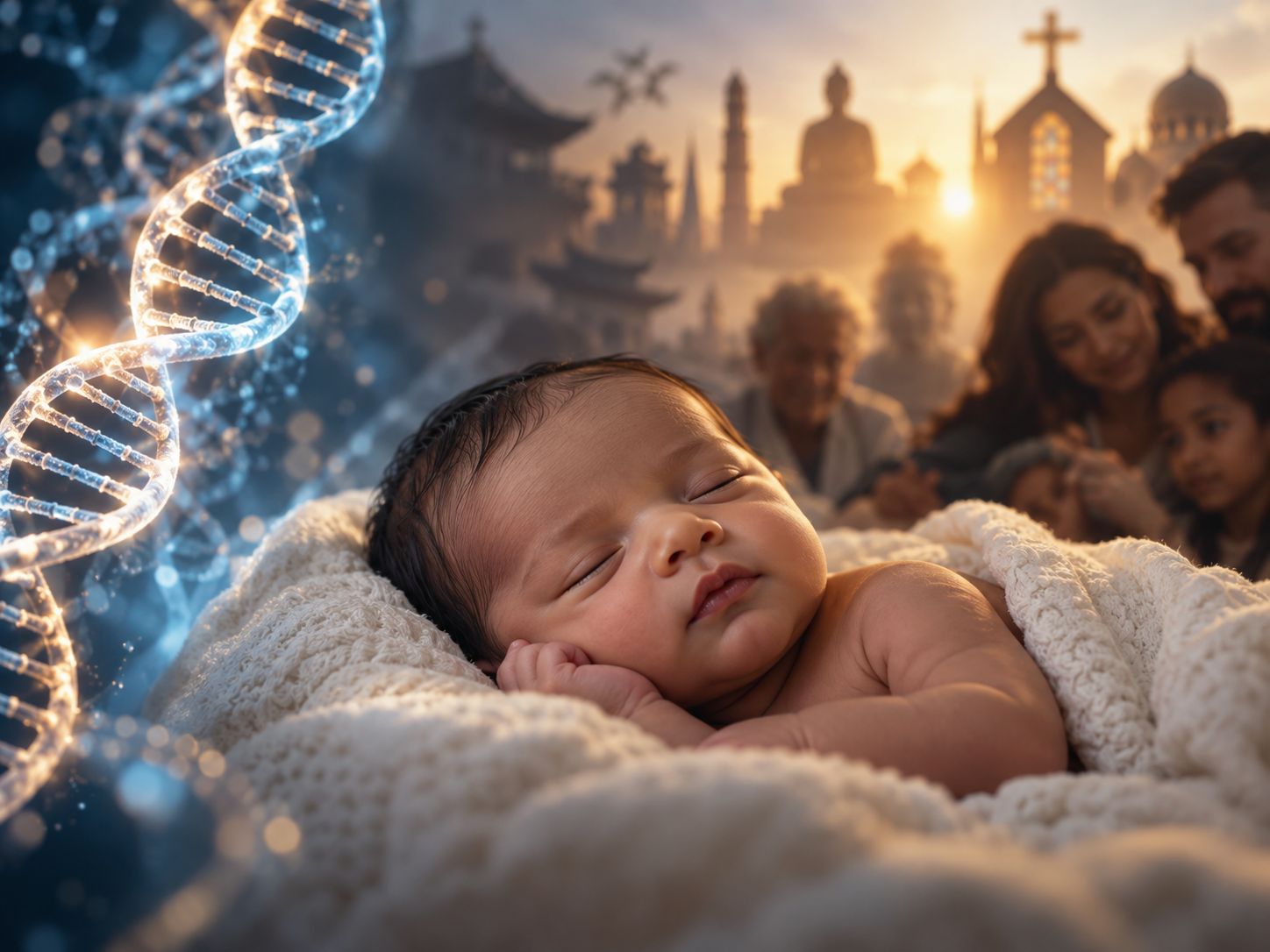
Why do some people become deeply religious while others remain indifferent or reject religion altogether? The obvious answer is upbringing. A child born into a Catholic family in Poland is much more likely to become Catholic than a child born into a Muslim family in Saudi Arabia or a Hindu family in India. Yet research on twins suggests that upbringing is not the whole story.
Religiosity appears to have a partly heritable component. However, genes do not determine whether someone believes in Christianity, Islam, Hinduism, or any other specific religion. Instead, inherited psychological differences may make some people more receptive to religion than others.
Religiosity is moderately heritable
Twin studies provide one of the main ways researchers estimate the genetic contribution to human traits. Identical twins share essentially all of their genetic variation, while fraternal twins share roughly half on average. Researchers can therefore compare how similar the two kinds of twins are in religious attitudes and behavior.
The results vary considerably depending on the population, age of participants, and definition of religiosity. Nevertheless, studies of adults frequently estimate the heritability of religious attitudes and behavior somewhere around 30 to 50 percent. Some estimates are lower, while others are higher.
This does not mean that 40 percent of an individual’s religion comes from their DNA. Heritability describes differences within a population. If religiosity has a heritability of 40 percent in a particular population, it means that genetic differences statistically explain about 40 percent of the variation between people in that population under those environmental conditions.
The number can also change when society changes. A highly restrictive religious society may suppress individual differences because nearly everyone is expected to behave religiously. In a more secular and permissive society, inherited personality differences may have more opportunity to influence whether someone chooses religion.
Children largely inherit religion from their environment
The influence of family environment is particularly obvious during childhood. Young children normally encounter the religion selected for them by their parents and surrounding culture.
A child does not independently examine the theological arguments for hundreds of religions and then choose one. Religious identity is usually transmitted through parents, schools, communities, rituals, language, and social expectations.
This explains one of the clearest patterns in religion: geography predicts religious identity extremely well. Christianity dominates some regions, Islam others, Hinduism others, while highly secular populations are concentrated elsewhere.
Genes cannot plausibly explain why neighboring populations can have dramatically different religions. Cultural transmission can.
Therefore, while a general psychological inclination toward religiosity may be partly inherited, the particular religion someone adopts is overwhelmingly environmental.
Genetic influence may become stronger with age
Interestingly, some twin research suggests that genetic influences on religiosity become more important as people get older.
At first this may sound strange. Genes do not become more religious with age. What changes is personal freedom.
Children usually live in an environment chosen by their parents. They attend the church, mosque, synagogue, temple, or secular household selected for them. Consequently, siblings can appear relatively similar because they share the same environment.
Adults gain far greater control over their lives. They can stop attending religious services, join another religion, become atheists, seek spiritual communities, or surround themselves with people who share their worldview.
As this freedom increases, people can construct environments that fit their psychological dispositions. Behavioral geneticists call this gene-environment correlation. Someone naturally attracted to ritual, community, tradition, or supernatural explanations may increasingly seek environments that reinforce those tendencies. Someone with a different psychological profile may move in the opposite direction.
Genes therefore do not need to directly produce religion. They can influence the characteristics that affect which environments people choose.
There is probably no “religion gene”
Religiosity is far too complicated to be explained by a single gene.
Instead, many genetic differences probably influence psychological traits that can indirectly affect religious belief. These may include personality, openness to experience, social conformity, sensitivity to threats, emotional responsiveness, intuitive thinking, social attachment, and interest in supernatural explanations.
Each individual genetic effect is likely to be tiny. Moreover, the same psychological trait could have different consequences depending on the person’s environment.
For example, a strong tendency toward conformity could reinforce Christianity in a predominantly Christian community and Islam in a predominantly Muslim one. In an overwhelmingly secular society, the same tendency might encourage secularism instead.
The underlying disposition can therefore be partly inherited while its ideological expression remains culturally determined.
Human evolution may have made religion easier to develop
There is another level to the question. Even if individual differences in religiosity are only moderately heritable, human beings as a species possess cognitive tendencies that make religious ideas relatively easy to create and transmit.
Humans are extremely sensitive to agency. When something happens, we naturally look for an actor behind it. This tendency was probably useful throughout evolution because incorrectly assuming that movement in the bushes was caused by a predator was often less costly than ignoring a real predator.
Humans are also unusually interested in intentions, minds, social rules, punishment, group loyalty, and explanations for events. Religious systems can exploit many of these pre-existing cognitive mechanisms.
An invisible being that watches behavior, knows intentions, rewards cooperation, punishes wrongdoing, and explains otherwise mysterious events fits surprisingly well into cognitive machinery that originally evolved for dealing with other humans.
This does not mean evolution specifically programmed humans to believe in gods. Religion may instead emerge partly from cognitive abilities that evolved for other purposes.
Culture determines what those tendencies become
Innate psychological tendencies alone cannot explain the enormous diversity of religions.
A person might possess a strong disposition toward supernatural belief, but nothing in their DNA tells them about Jesus, Muhammad, Shiva, reincarnation, angels, karma, or the Trinity. These are cultural ideas transmitted between human minds.
Religion therefore provides a good example of interaction between biology and culture.
Biology supplies a brain capable of agency detection, social learning, conformity, ritual, emotional attachment, and supernatural imagination. Individual genetic differences influence some of these traits. Culture then supplies the particular stories, doctrines, institutions, and gods.
The result can look entirely different depending on where and when someone is born.
Environment can overwhelm genetic predispositions
Even moderately heritable traits can change dramatically when environments change.
Religiosity illustrates this particularly well. Many societies have experienced enormous declines in religious participation within only a few generations. Human genetics could not possibly have changed fast enough to explain such a transformation.
Czechia, Estonia, the Netherlands, and several other European societies became dramatically more secular during periods far too short for substantial genetic evolution. Conversely, religious revivals can also occur without any meaningful genetic change.
That tells us something important. Genetic predispositions influence differences between individuals, but cultural conditions can shift the behavior of an entire population.
The same principle applies to many human traits. Heritability does not imply immutability.
Nature and nurture are not competitors
Trying to divide religiosity neatly into “nature” and “nurture” ultimately oversimplifies the issue.
A reasonable summary of the evidence is that individual differences in adult religiosity are moderately heritable, with estimates often falling somewhere around 30 to 50 percent depending on what researchers measure. Family and broader cultural environments account for much of the remaining variation, particularly during childhood.
Specific religious identities, however, are overwhelmingly cultural. Genes do not make someone Catholic, Sunni, Buddhist, or atheist in any simple deterministic sense.
Perhaps the most accurate way to describe religion is therefore this: evolution gave humans psychological machinery capable of producing religious thought; genetic variation makes some individuals more receptive to certain aspects of it than others; and culture determines what beliefs are available for those minds to adopt.
Religion is neither simply inherited nor simply taught. It emerges from the interaction between the kind of brains humans evolved and the societies in which those brains develop.
Leave a Reply