At first glance, capitalism looks simple. It connects buyers and sellers. It rewards effort, innovation, and efficiency. It scales across societies and creates wealth at unprecedented levels. For a time, it even appears self-correcting.
However, this simplicity belongs to an earlier stage. As capitalism expanded, it did not merely grow. Instead, it accumulated layers. It absorbed finance, global trade, political lobbying, technological systems, and institutional power into one vast structure.
Consequently, what once functioned as a market system now operates as a dense, multi-layered organism. It no longer resembles a system that individuals can intuitively understand or control.
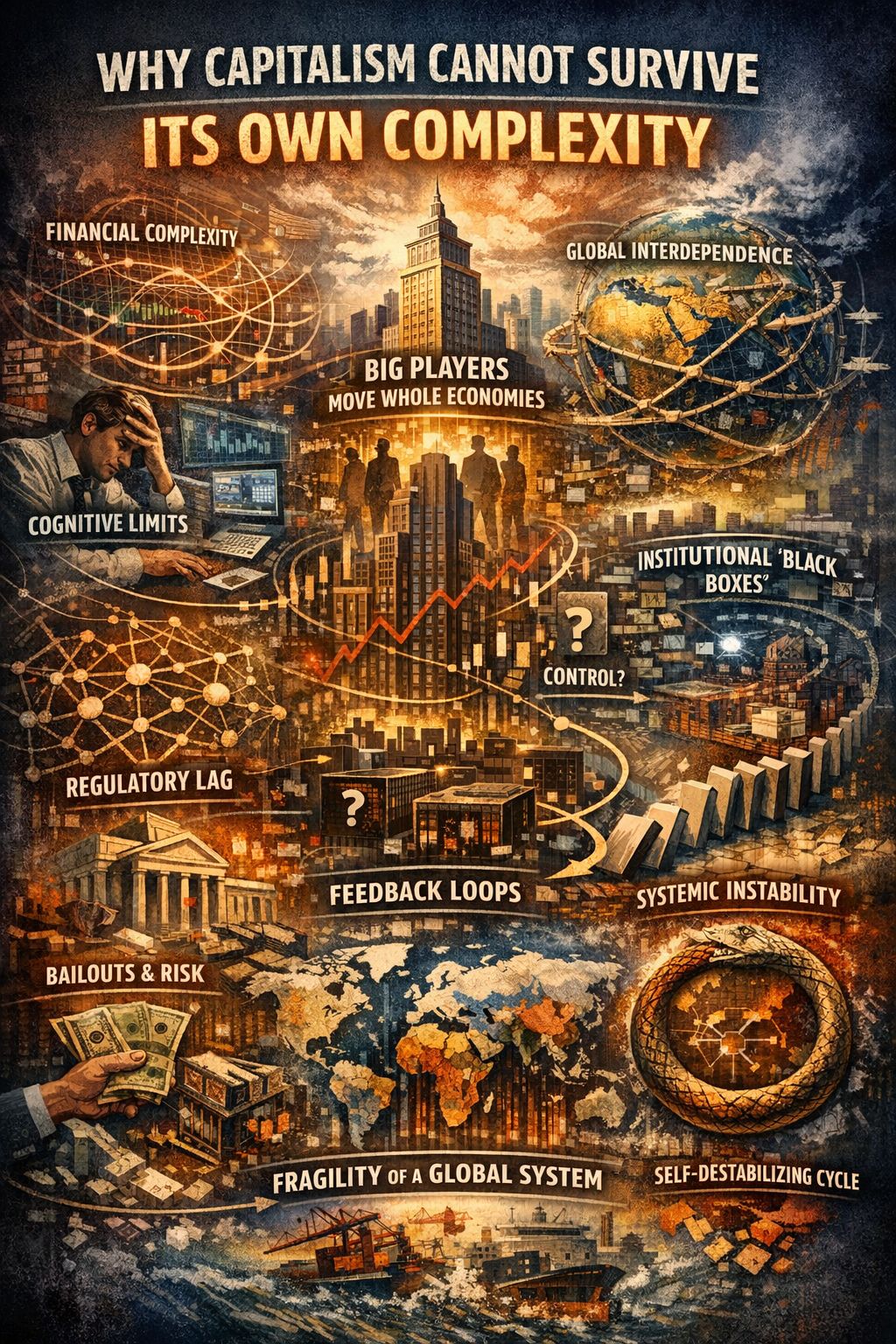
This leads to a central claim. Capitalism does not face its greatest threat from socialism, populism, or external enemies. Rather, it faces a deeper problem. It is becoming too complex to manage, too interconnected to stabilize, and too opaque to regulate.
Therefore, capitalism risks collapse not because it fails to grow, but because it grows beyond the limits of human comprehension and institutional coordination.
From markets to meta-systems
Originally, capitalism revolved around tangible exchange. Farmers sold crops. Craftsmen sold goods. Prices reflected scarcity, labor, and demand. The system remained grounded in physical reality.
Then, gradually, abstraction entered the system.
Financial markets introduced instruments that no longer represented goods themselves. Instead, they represented claims on future value. Futures contracts, options, and derivatives allowed actors to trade expectations rather than products.
As a result, capitalism shifted from a production-based system to a meta-system.
In this new structure, capital circulates independently of physical output. Financial assets reference other financial assets. Value becomes layered, indirect, and increasingly detached from underlying production.
Moreover, this transformation accelerates itself. Each new layer enables the creation of additional layers. Thus, capitalism no longer expands linearly. It expands exponentially through abstraction.
The explosion of financial complexity
With abstraction comes complexity. Modern finance no longer consists of simple loans or equity investments. Instead, it includes intricate instruments such as collateralized debt obligations, credit default swaps, synthetic derivatives, and high-frequency trading algorithms.
Each instrument serves a purpose. It manages risk, increases liquidity, or enables speculation. However, when combined, these instruments create a network so intricate that no single actor fully understands it.
The 2008 financial crisis illustrates this clearly. Banks traded mortgage-backed securities that they believed were safe. Rating agencies confirmed these beliefs. Models predicted stability.
Yet, beneath the surface, risk accumulated.
When housing prices declined, the entire structure unraveled. Interconnections amplified losses. Institutions failed not only because of bad decisions, but because the system itself had become too complex to assess accurately.
Importantly, complexity did not disappear after the crisis. On the contrary, it increased. New regulations added additional layers. Financial innovation continued.
Thus, the system became even more sophisticated and simultaneously more fragile.
Cognitive limits of decision-makers
At this point, a fundamental constraint emerges. Human cognition has limits.
Evolution shaped the human brain to operate in small groups. Our ancestors dealt with immediate threats, social hierarchies, and resource allocation within tribes of limited size.
However, modern capitalism demands something entirely different.
Decision-makers must understand global supply chains, macroeconomic trends, financial derivatives, geopolitical risks, and technological systems. They must process vast amounts of data and anticipate complex interactions.
No human can fully achieve this.
Even highly intelligent individuals rely on simplified models, assumptions, and institutional frameworks. They operate under uncertainty while believing they maintain control.
This creates a structural vulnerability.
Small errors in judgment, misunderstood risks, or flawed assumptions can propagate through the system. Because the system is interconnected, these errors do not remain isolated. They expand.
Therefore, capitalism operates beyond the cognitive capacity of the very actors who run it.
The rise of institutional black boxes
As complexity increases, transparency declines.
Large institutions such as big banks, investment funds, and multinational corporations no longer function as fully understandable entities. Their internal operations involve countless transactions, models, and decision layers.
Consequently, these institutions become black boxes.
Even regulators struggle to see inside them. Internal divisions operate semi-independently. Risk becomes distributed and obscured.
At the same time, these institutions interconnect.
Ownership structures overlap. Major investment firms hold shares in competing corporations. Board members move across organizations. Capital flows circulate within tightly connected networks.
Thus, the system evolves into a web of opaque entities linked by hidden relationships.
When instability builds, it remains invisible until it reaches a critical point. At that moment, intervention becomes reactive rather than preventive.
Feedback loops and systemic instability
Complex systems generate feedback loops. Capitalism exemplifies this dynamic.
Positive feedback loops amplify trends. Rising asset prices attract investment. Increased investment pushes prices higher. This creates bubbles.
At first, the system appears stable, even prosperous. However, the stability is deceptive. It rests on self-reinforcing expectations rather than underlying fundamentals.
Eventually, correction occurs.
Negative feedback loops then dominate. Prices fall. Investors withdraw. Liquidity disappears. Panic spreads.
Because the system is interconnected, these dynamics do not remain local. A housing bubble in one country can trigger a global financial crisis.
Thus, complexity transforms ordinary fluctuations into systemic events.
Regulatory lag and the illusion of control
In response to instability, governments intervene. They regulate markets. They impose rules. They attempt to reduce risk.
However, regulation faces a structural limitation. It always lags behind innovation.
Financial institutions continuously develop new instruments and strategies. Regulators, in contrast, react after problems emerge.
Moreover, regulators depend on the system they oversee. They rely on data, models, and expertise generated within financial institutions.
This creates a paradox.
Regulation aims to control complexity, yet it often reinforces it. New rules introduce new categories, new reporting requirements, and new compliance mechanisms.
Consequently, the system appears more controlled. In reality, it becomes more intricate and harder to manage.
Concentration of power within complexity
As complexity increases, power concentrates.
Navigating a complex system requires resources, expertise, and access. Large institutions possess these advantages. Smaller actors do not.
Therefore, complexity acts as a barrier to entry.
Big banks, investment giants, and super-rich networks dominate the system. They operate across jurisdictions. They influence regulation. They shape market conditions.
At the same time, their importance creates systemic risk.
These institutions become too big to fail. Their collapse would destabilize the entire system. As a result, governments support them during crises.
This creates a feedback loop of power concentration and risk accumulation.
Thus, complexity not only destabilizes capitalism. It also centralizes control within a small group of actors.
Big players move whole economies

At this stage, complexity does not remain neutral. Instead, it concentrates power in the hands of actors who can navigate it. Consequently, a small group of institutions and individuals gains the ability to influence not just markets, but entire economies.
First, consider scale. Large banks, investment giants, and sovereign funds control trillions in assets. When they reallocate capital, they do not merely adjust portfolios. They shift entire sectors. A decision to move funds into energy, technology, or emerging markets can redirect investment flows across continents.
Networks
Moreover, these actors do not operate in isolation. They form networks.
Ownership structures overlap. The same investment firms hold shares in competing corporations. Board members sit across multiple institutions. Advisory roles connect finance, politics, and regulation. As a result, decisions made within one part of the network ripple through the entire system.
Therefore, what appears as decentralized capitalism often functions as coordinated influence.
Liquidity
Second, liquidity itself becomes a tool of power.
When major institutions provide or withdraw liquidity, they can stabilize or destabilize markets. Central banks amplify this effect. Interest rate changes, asset purchases, or currency interventions can reshape economic conditions almost instantly.
However, large private actors anticipate and respond to these moves. In many cases, they position themselves ahead of policy changes. Thus, they do not merely react to the system. They help shape it.
Third, crises reveal the true extent of this influence.
During financial instability, governments intervene to prevent collapse. They support systemically important institutions. They inject capital. They guarantee liabilities.
Asymmetry
This creates an asymmetry.
Large actors operate with implicit protection. Smaller actors do not. As a result, risk-taking concentrates at the top while vulnerability spreads across the broader population.
Furthermore, this dynamic reinforces itself. The more important an institution becomes, the more likely it is to receive support. The more support it receives, the more dominant it grows.
Fourth, political influence emerges naturally from economic scale.
Large financial actors fund lobbying efforts. They influence regulatory frameworks. They shape public narratives through media and think tanks.
Consequently, economic power translates into political power.
Policies often reflect the interests of those who can navigate and influence the system’s complexity. This does not require explicit conspiracy. It emerges structurally from the interaction between capital, information, and access.
Global capital flows
Fifth, global capital flows amplify this effect.
Investment decisions in one financial center can impact employment, currency stability, and economic growth in distant regions. A sudden withdrawal of capital can trigger currency crises. Conversely, inflows can create unsustainable booms.
Thus, entire national economies become sensitive to decisions made by a relatively small group of actors.
Finally, complexity itself protects these actors.
Because the system is difficult to understand, it becomes difficult to challenge. Public discourse simplifies reality into slogans, while actual power operates within intricate financial and institutional networks.
Therefore, accountability weakens.
In simpler systems, influence is visible. In complex capitalism, influence becomes diffuse, indirect, and hidden within layers of transactions and structures.
As a result, big players do not merely participate in capitalism. They shape its direction, stabilize it when it benefits them, and, at times, destabilize it when incentives align.
This chapter reinforces the broader argument.
Capitalism’s complexity does not only create instability. It also creates a hierarchy in which a small number of actors can move entire economies while the majority can barely perceive the mechanisms at work.
Global interdependence and fragility
Capitalism now operates on a global scale. Supply chains stretch across continents. Financial flows move instantly. Political decisions in one region affect markets worldwide.
This interdependence increases efficiency. It allows specialization and rapid growth.
However, it also increases fragility.
A disruption in one part of the system can propagate globally. A pandemic, a geopolitical conflict, or a financial shock can cascade through interconnected networks.
The system lacks buffers.
In simpler systems, failures remain localized. In complex global capitalism, failures spread.
Thus, globalization amplifies both productivity and vulnerability.
Information overload and market noise
Modern capitalism generates enormous quantities of information.
Markets react to economic data, political events, technological developments, and social trends. Algorithms process signals in milliseconds.
At first, more information seems beneficial. It promises better decision-making.
However, beyond a certain point, information becomes noise.
Market participants struggle to distinguish meaningful signals from irrelevant fluctuations. Short-term reactions dominate long-term analysis.
Consequently, volatility increases.
Prices move rapidly in response to incomplete or misinterpreted information. Narratives drive markets as much as fundamentals.
Thus, complexity produces confusion rather than clarity.
Moral hazard embedded in complexity
Complex systems obscure responsibility.
When outcomes result from countless interactions, it becomes difficult to assign blame. This enables moral hazard.
Institutions take risks because they do not bear full consequences. Gains remain private. Losses spread across the system.
During crises, governments intervene. They provide liquidity. They prevent collapse.
While these actions stabilize the system, they also reinforce risky behavior.
Actors learn that failure will be absorbed. Therefore, they continue to operate within increasingly complex and fragile structures.
The limits of technological solutions
Some argue that technology can solve complexity.
Artificial intelligence, big data, and advanced modeling promise better prediction and control. They analyze patterns beyond human capability.
However, technology introduces new challenges.
Algorithms interact with each other. Automated systems create feedback loops at speeds humans cannot monitor. Flash crashes illustrate this risk.
Moreover, reliance on models creates overconfidence. Models simplify reality. They cannot capture all variables.
Thus, technology does not eliminate complexity. It transforms it and often amplifies it.
Capitalism as a self-destabilizing system
At this stage, a pattern becomes clear.
Capitalism generates complexity through innovation. This complexity creates new risks. Managing these risks requires additional mechanisms, which increase complexity further.
The system enters a self-reinforcing cycle.
Each solution becomes part of the problem.
Over time, the system grows more intricate, more opaque, and more fragile. Stability becomes increasingly difficult to maintain.
Therefore, capitalism begins to destabilize itself from within.
Historical parallels of overcomplex systems
History provides relevant parallels.
Large empires often collapse not because of a single external force, but because internal complexity overwhelms their capacity to govern.
Administrative systems expand. Coordination becomes difficult. Resources become misallocated.
Similarly, centrally planned economies failed because they could not process the information required to manage complex production systems.
Although capitalism differs in structure, it faces a comparable constraint.
When complexity exceeds the ability to process information and coordinate action, systems fail.
Possible trajectories: Adaptation or breakdown
Looking forward, two paths emerge.
First, adaptation.
The system could simplify. Financial structures could become more transparent. Regulation could focus on reducing complexity rather than managing it. Power could decentralize.
However, this requires coordinated action across global institutions, which itself is difficult within a complex system.
Second, breakdown.
Complexity could continue to increase until a major crisis forces abrupt restructuring. This restructuring may occur through financial collapse, political upheaval, or systemic reform imposed under pressure.
Both paths involve disruption.
The key question is timing. Can adaptation occur before breakdown?
Conclusion: The paradox at the core of capitalism
Capitalism thrives on expansion, innovation, and abstraction. These forces drive growth and create wealth.
However, they also generate complexity.
In the short term, complexity increases efficiency and profit. In the long term, it reduces transparency, amplifies risk, and exceeds human and institutional limits.
Thus, capitalism contains a fundamental paradox.
The mechanisms that make it successful also make it unstable.
If this trajectory continues, capitalism will not fail because it stops working. It will fail because it becomes too complex to function.
And when a system becomes too complex to understand, it becomes impossible to control.
Leave a Reply