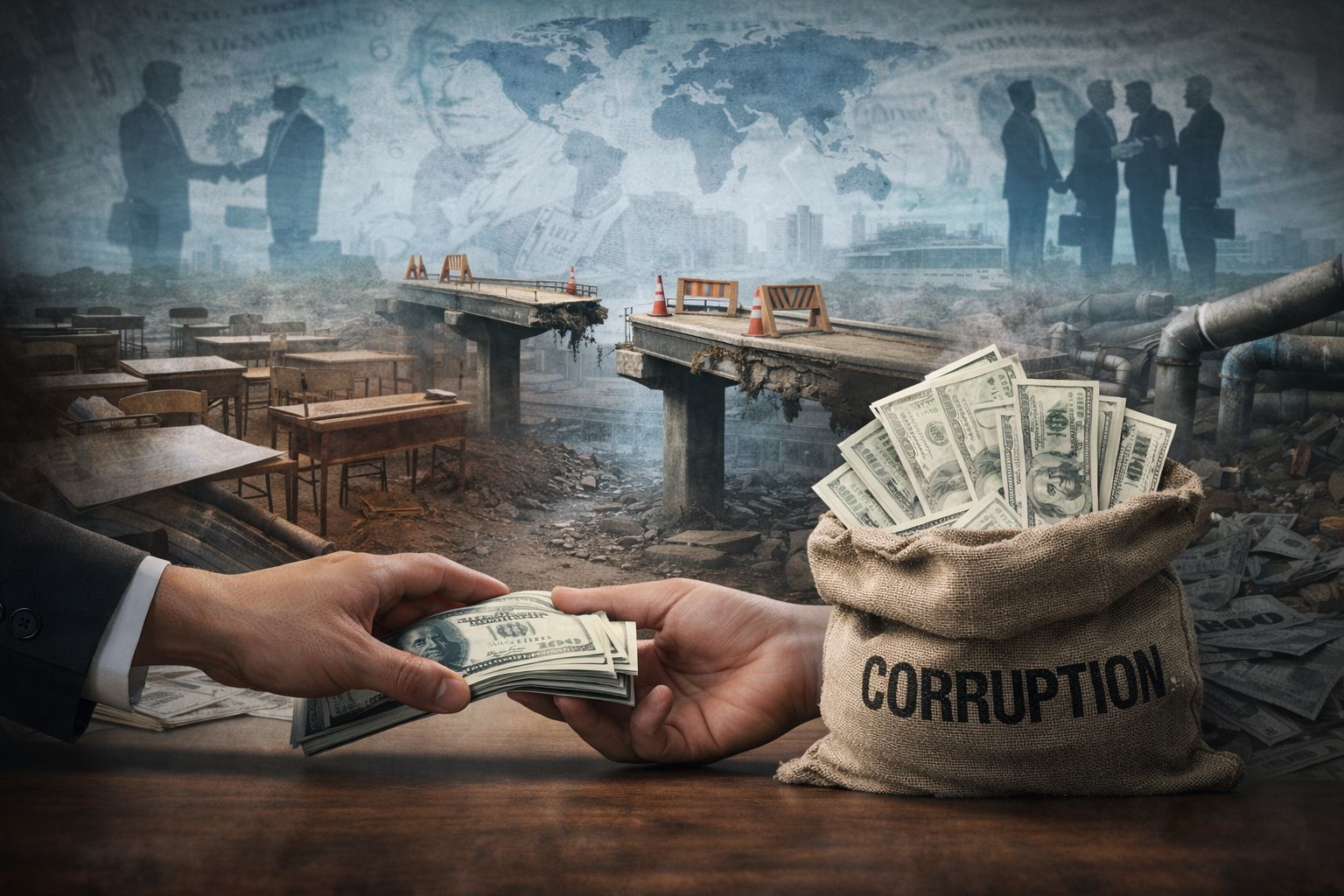
Corruption does not begin in institutions. It begins in human nature. People often treat it as a failure of laws, culture, or governance. However, these explanations remain incomplete. Corruption emerges from behavioral tendencies that once improved survival and reproduction. Therefore, to understand corruption, one must start with biology. Only then can one understand why it persists even in advanced systems.
Corruption as an evolutionary strategy
Early humans lived in small groups with limited resources. Survival depended on access to food, protection, and alliances. Therefore, individuals who secured advantages for themselves and their kin increased their chances of survival. Favoritism, deception, and resource hoarding did not appear immoral. They appeared useful.
Moreover, cooperation did not exclude manipulation. Individuals cooperated when it benefited them. They defected when the cost remained low. This flexibility increased survival. In modern societies, this same flexibility appears as corruption. What once ensured survival now undermines fairness.
Kin selection and nepotism
Humans evolved to favor relatives. This tendency follows a simple logic. Helping genetic kin increases the likelihood that shared genes survive. Therefore, loyalty to family became deeply embedded in human psychology.
However, modern institutions require impartiality. They demand that individuals treat strangers equally. This demand conflicts with instinct. As a result, nepotism emerges. Hiring relatives, protecting family members, and directing resources toward kin reflect ancient preferences operating in modern structures.
Reciprocal altruism and bribery
Humans also evolved systems of exchange. “I help you, you help me” created stable cooperation. In small groups, this system functioned effectively. Reputation mattered. Betrayal carried consequences.
In large societies, anonymity increases. Therefore, the same mechanism transforms. Favors become transactions. Reciprocity becomes bribery. Instead of mutual survival, individuals exchange benefits for advantage. Consequently, cooperation shifts from fairness to opportunism.
Status, dominance, and resource control
Status plays a central role in human behavior. High-status individuals gain better access to resources, influence, and reproductive opportunities. Therefore, the drive to increase status remains powerful.
Corruption provides shortcuts. Instead of competing within rules, individuals manipulate systems. They secure positions, wealth, and influence through indirect means. As a result, power accumulates. Those who gain advantage reinforce their position. This creates self-sustaining hierarchies.
Coalition building and network corruption
Humans rarely act alone. They form alliances to increase strength. In evolutionary environments, coalitions improved survival in conflicts with other groups. Loyalty within the group ensured mutual protection.
In modern societies, this tendency produces networks of corruption. Groups protect each other. They share resources and conceal wrongdoing. Loyalty overrides legality. Therefore, corruption rarely appears as isolated behavior. It emerges as a coordinated system.
Moral flexibility and self-justification
Humans do not perceive themselves as corrupt. Instead, they justify their actions. Evolution favored flexible morality because rigid rules could reduce survival chances. Therefore, individuals reinterpret behavior to align with self-image.
A bribe becomes a necessity. Favoritism becomes loyalty. Exploitation becomes success. This cognitive process reduces internal conflict. Consequently, corruption persists without psychological discomfort. People do not feel immoral. They feel rational.
The mismatch between evolution and modern institutions
Modern societies rely on abstract systems. Laws, bureaucracies, and large-scale cooperation require impartial behavior. However, human psychology evolved in small groups. It responds to faces, relationships, and immediate benefits.
This creates a mismatch. Individuals apply tribal instincts in impersonal systems. They prioritize personal connections over abstract rules. Therefore, institutions struggle to enforce fairness. Corruption exploits this gap between design and behavior.
Scarcity mindset in an age of abundance
Human psychology expects scarcity. Evolution shaped the brain to secure resources whenever possible. Even in wealthy environments, this perception persists.
As a result, accumulation continues beyond necessity. Wealth, influence, and control become goals in themselves. Corruption becomes a tool to secure excess. Fear of loss drives behavior more than actual need. Therefore, abundance does not eliminate corruption. It often amplifies it.
Risk, reward, and rational calculation
Corruption often follows a simple calculation. Individuals assess potential gains against potential risks. If rewards exceed perceived consequences, they act.
Weak enforcement reduces risk. Inconsistent punishment lowers deterrence. Therefore, corruption increases where accountability remains uncertain. This dynamic does not require immorality. It requires opportunity.
Cultural amplification of evolutionary tendencies
Culture shapes behavior. It can restrain or amplify instincts. In some environments, corruption becomes normalized. Individuals observe others engaging in it without consequence.
As a result, resistance weakens. What begins as an exception becomes routine. Social acceptance reduces internal barriers. Therefore, culture does not create corruption from nothing. It magnifies existing tendencies.
Corruption in developing world and developed world
Corruption exists in all societies. However, its form differs. In developing countries, corruption appears direct and visible. Officials demand bribes for basic services. Citizens pay to access healthcare, education, or legal processes. Therefore, corruption becomes part of daily survival. Weak institutions and low wages reinforce this system.
In developed countries, corruption appears more sophisticated. It hides within legal frameworks. Lobbying, regulatory capture, and financial influence replace direct bribery. Therefore, power operates through formal channels. It appears legitimate, yet it distorts fairness.
Thus, the difference lies in expression. In poorer systems, corruption remains crude and immediate. In richer systems, it becomes complex and institutionalized. Both forms reflect the same underlying psychology. They adapt to different environments.
Institutional design and the containment of corruption
Institutions can limit corruption. Transparency increases visibility. Accountability raises risk. Enforcement creates consequences. However, these measures must align with human behavior.
Systems that ignore psychology fail. Individuals find ways around rules. Therefore, effective institutions anticipate manipulation. They reduce opportunities and increase costs. Design matters as much as enforcement.
Inequality and the incentive to corrupt
Inequality intensifies competition. Those at the top seek to maintain advantage. Those at the bottom seek mobility. Therefore, incentives for corruption increase across the spectrum.
Elites manipulate systems to preserve power. Ordinary individuals engage in smaller acts to improve conditions. Although the scale differs, the motivation remains similar. Inequality accelerates corruption. It does not create it, but it amplifies it.
Corruption among elites vs ordinary individuals
Elites operate at a systemic level. Their actions influence entire economies and political structures. Ordinary individuals operate at a local level. They engage in minor acts, often for convenience or necessity.
However, both follow similar psychological patterns. The difference lies in scale, not nature. Small acts accumulate. Large acts reshape systems. Together, they form a continuum of corruption.
Long-term consequences: from adaptation to systemic collapse
Corruption once improved survival in small groups. In modern societies, it produces the opposite effect. It erodes trust and weakens institutions. It reduces efficiency.
Over time, systems degrade. Economic performance declines. Social cohesion weakens. Therefore, an adaptive trait becomes a destructive force. What once ensured survival now threatens stability.
The cost of corruption in the world
Corruption does not only distort morality. It extracts enormous economic value. It drains resources from states, weakens growth, and reduces overall prosperity. Therefore, its cost is not abstract. It is measurable, structural, and global.
Estimates suggest that corruption costs the global economy trillions of dollars each year. Direct bribery alone accounts for over one trillion dollars annually. However, this figure captures only a fraction of the damage. The real cost lies in inefficiency, lost investment, and misallocation of resources.
Public funds often disappear before reaching their intended purpose. Infrastructure projects become overpriced and underdelivered. Roads remain unfinished. Hospitals lack equipment. Schools operate without resources. Therefore, corruption does not only waste money. It reduces the quality of essential services.
Business and investment
Moreover, corruption discourages investment. Businesses avoid environments where rules can be bypassed or manipulated. Uncertainty increases risk. As a result, economic growth slows. Countries with high corruption levels often struggle to attract stable, long-term capital.
In addition, tax systems suffer. Individuals and corporations exploit loopholes or bribe officials to reduce obligations. Governments collect less revenue. Consequently, they cannot fund public services effectively. This creates a cycle. Weak institutions enable corruption, and corruption further weakens institutions.
The social cost extends beyond economics. Corruption increases inequality. Resources concentrate among those with access to power. Meanwhile, ordinary citizens pay higher costs for basic services. Therefore, corruption widens the gap between elites and the rest of society.
Healthcare and education also suffer. Funds intended for public welfare often get diverted. Hospitals lack supplies. Teachers remain underpaid. As a result, long-term human capital declines. This effect compounds over generations.
Finally, corruption erodes trust. Citizens lose confidence in institutions. They begin to expect unfairness as normal. Therefore, compliance with rules declines. This creates a self-reinforcing system where corruption becomes embedded in everyday behavior.
In total, corruption imposes both visible and hidden costs. It removes trillions from the global economy. It reduces growth, increases inequality, and weakens social cohesion. Therefore, its impact reaches far beyond individual transactions. It shapes the entire structure of societies.
Conclusion: Understanding before solving
Corruption cannot be eliminated through moral condemnation alone. It requires understanding its origins. Evolutionary psychology explains why corruption persists despite laws and norms.
Therefore, solutions must adapt to human nature. Systems must limit opportunities, increase accountability, and align incentives with fairness. Human nature will not change. However, structures can shape behavior.
In the end, corruption reflects who humans are. The challenge lies in designing systems that prevent those instincts from destroying the societies they built.
Leave a Reply