
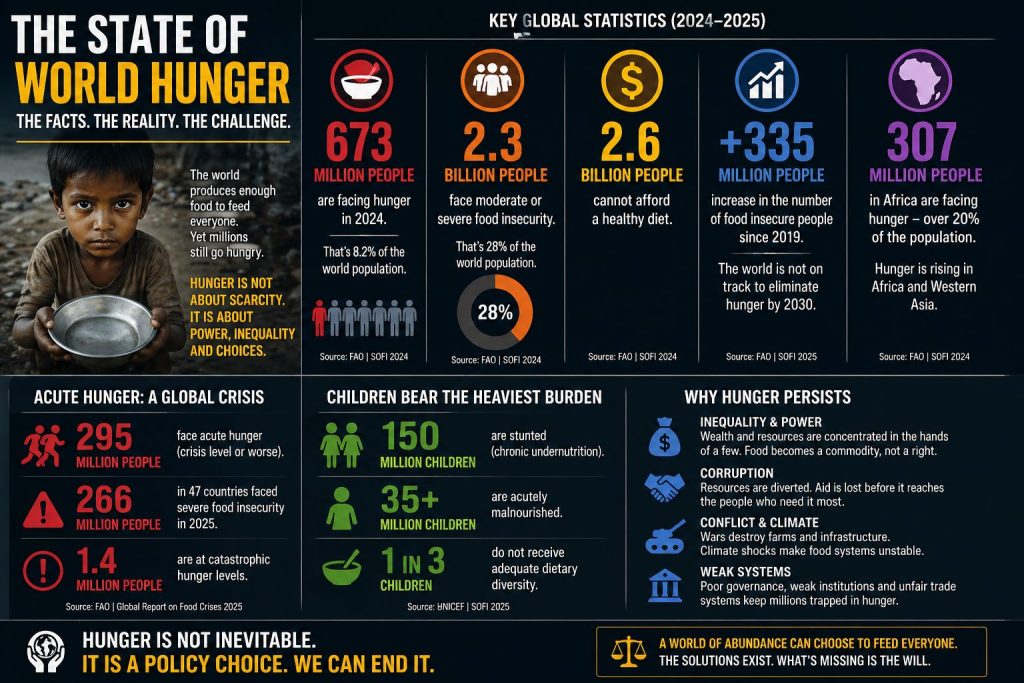
The world produces enough food. Yet millions starve. Therefore, the problem does not lie in production. It lies in distribution, incentives, and power. In other words, hunger reflects a systemic failure, not a natural limit.
At the same time, wealth has reached unprecedented levels. Capital concentrates in the hands of wealthy families, multinational corporations, and investment giants such as BlackRock and Vanguard Group. Consequently, the contrast becomes stark. Hundreds of trillions of dollars in assets exist globally, yet hunger persists. Extreme wealth coexists with extreme deprivation. Therefore, one must ask a direct question. Why does a system capable of generating immense wealth fail to eliminate starvation?
The scale of hunger in a wealthy world
Hundreds of millions face chronic hunger. Billions live with food insecurity. Institutions like the World Food Programme and the Food and Agriculture Organization track these realities in detail.
However, global agriculture produces sufficient calories. Therefore, hunger does not stem from scarcity. It stems from access failure. Food exists, yet it does not reach those who need it. Consequently, hunger becomes a distribution problem shaped by economic and political structures.
Wealth concentration and distorted incentives
Wealth does not remain static. It flows. However, it flows toward profit, not toward human survival. Investment companies, multinational corporations, and elite financial networks allocate capital based on returns. Therefore, regions that cannot generate high returns receive less investment.
Moreover, wealth includes more than money. It includes land, logistics, patents, and political influence. These assets determine who controls food production and distribution. As a result, food becomes a commodity first and a human necessity second.
Structural causes: corruption, conflict, and weak systems
Hunger persists because systems fail.
Corruption diverts resources. Aid disappears before reaching the needy.
Conflict destroys agriculture and infrastructure.
Weak institutions fail to organize distribution.
Global trade systems disadvantage poorer regions.
Climate disruptions destabilize production.
Institutions such as the International Monetary Fund and the World Bank shape economic conditions. However, they often prioritize macroeconomic stability over immediate human welfare. Therefore, inequality persists.
Why current aid models fail
Traditional aid operates in fragments. Governments, NGOs, and agencies act separately. Coordination remains weak. Therefore, inefficiencies multiply.
Local elites capture resources. Aid enters a country but does not reach the population. Instead, it reinforces existing power structures. Consequently, aid can stabilize corruption rather than eliminate hunger.
Short-term relief dominates. Food arrives during crises. However, long-term systems remain unchanged. Therefore, dependency replaces resilience.
Humanism as a systemic approach
Humanism places human well-being at the center. Not as a side effect. As a primary goal.
This requires a shift.
From charity to system design.
From national interest to global coordination.
From reactive aid to preventive infrastructure.
Therefore, hunger must be treated as a global systems failure that requires structural correction.
The case for global governance
A fragmented world cannot solve a global problem. Each state acts in its own interest. Therefore, coordination fails. Consequently, stronger global governance becomes necessary.
Institutions like the United Nations exist. However, they lack enforcement power. They coordinate, yet they cannot compel.
A functional global system would include coordinated food distribution, global taxation mechanisms, binding anti-corruption enforcement, and integrated agricultural planning.
However, risks remain. Power concentration can lead to abuse. Therefore, transparency and accountability must accompany any expansion of global authority.
Direct confrontation with corruption
Corruption blocks delivery. In many regions, aid does not reach the needy. It gets intercepted. Therefore, solutions must bypass or transform these systems.
Direct digital transfers can reach individuals.
International oversight can track distribution.
Sanctions can target corrupt officials.
In extreme cases, structured intervention can enforce delivery.
Thus, the goal shifts from sending aid to ensuring arrival.
The role of developed countries
Developed countries hold capital, technology, and logistics. Therefore, they cannot remain passive.
They can contribute financially based on capacity.
They can transfer agricultural technology.
They can build infrastructure for storage and transport.
They can pressure corrupt regimes.
However, intervention raises concerns. It can resemble neocolonialism. Therefore, it must include transparency, accountability, and measurable outcomes.
Corporate responsibility beyond ESG
Corporations operate globally, yet regulation remains national. This creates a structural gap. Frameworks like ESG attempt to address this, but they often remain superficial.
Therefore, stronger mechanisms are needed.
Global taxation on large corporations can fund food systems.
Mandatory contributions tied to profits can support vulnerable regions.
Penalties can target exploitative practices.
Thus, responsibility becomes enforced, not voluntary.
Technology as a multiplier
Technology provides tools. However, it does not solve structural problems alone.
Precision agriculture increases yields.
Resilient crops reduce climate risk.
AI optimizes supply chains.
Satellite systems monitor shortages.
When combined with governance, these tools improve efficiency. Without governance, their impact remains limited.
Capital flows and redistribution
Capital moves instantly. Food does not. Therefore, aligning financial flows with human needs becomes essential.
Global food security funds can stabilize vulnerable regions.
Automatic financial mechanisms can respond to crises.
Subsidies can shift toward food systems.
Thus, finance becomes an instrument of survival, not only profit.
Ethical dimension: A test of civilization
A civilization capable of producing immense wealth cannot justify starvation. Therefore, hunger reflects a failure of priorities.
It shows that incentives do not align with human survival. Consequently, solving hunger becomes a test of whether systems serve people or power.
Counterarguments and risks
Critics raise concerns.
Global governance may become authoritarian.
Intervention may destabilize regions.
Redistribution may reduce incentives.
However, the current system already produces instability and inequality. Therefore, inaction also carries risk.
Conclusion: Redesign, not relief
Hunger persists not because solutions do not exist. It persists because systems do not prioritize them.
Therefore, the answer lies in redesign. Not more charity. Not temporary fixes. A structural shift in how power, capital, and coordination operate globally.
Only then can a world of abundance eliminate hunger.
Leave a Reply