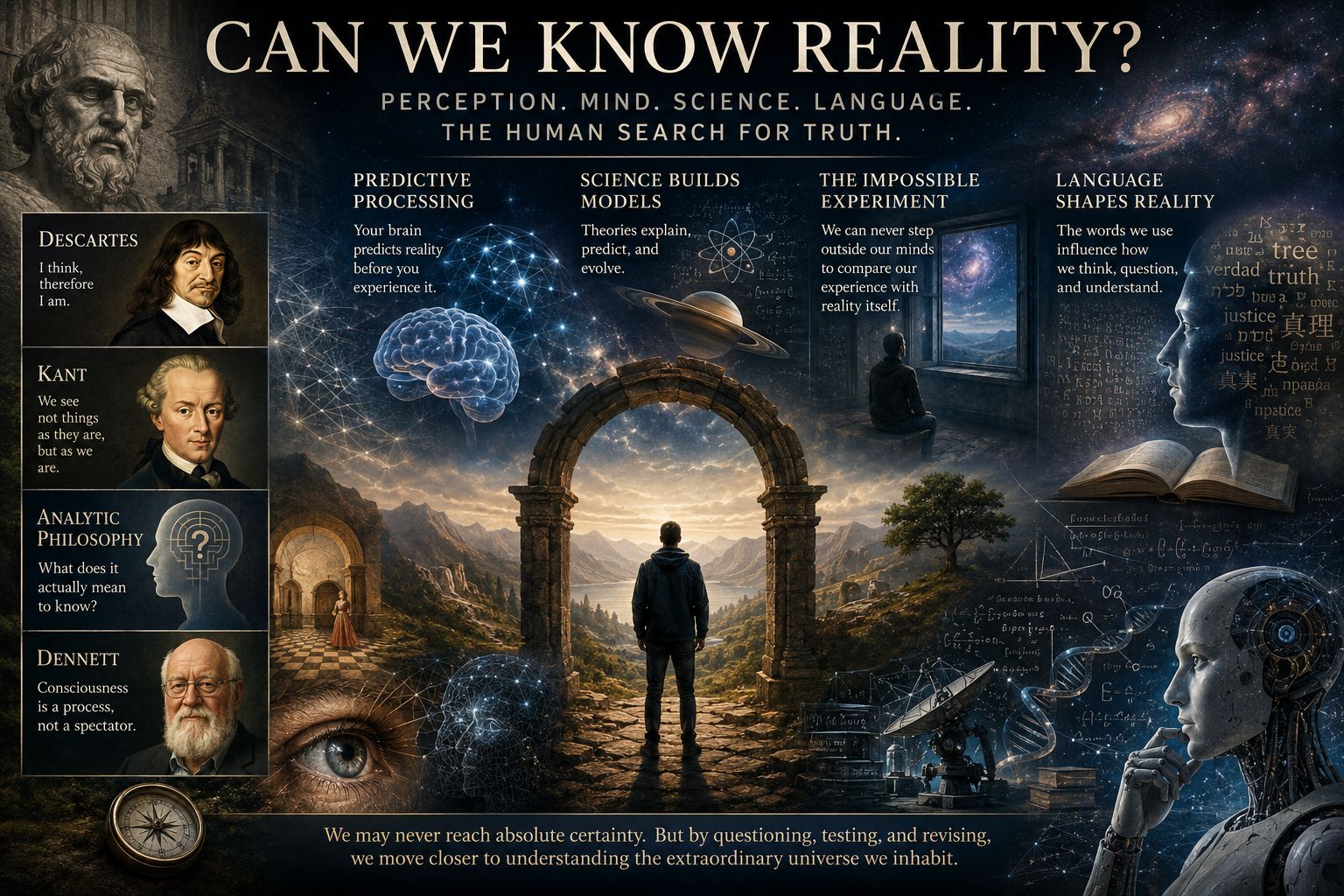
Look around you for a moment. You probably see walls, furniture, trees outside the window, or perhaps a computer screen displaying these words. Everything appears solid and obvious. Consequently, you instinctively trust what your eyes tell you.
Nevertheless, philosophy asks a deeply uncomfortable question. What if you have never experienced the world itself? What if you have only experienced your brain’s interpretation of it?
At first, the idea sounds absurd. After all, you can touch a table. You can hear music. You can smell coffee. Surely those experiences prove that the external world exists exactly as you perceive it.
Unfortunately, they do not.
Every sensation must first travel through your nervous system before it reaches your conscious mind. Light strikes your eyes. Sound vibrates your eardrums. Chemicals stimulate your nose and tongue. Pressure activates receptors in your skin. Your brain then processes enormous amounts of electrical information and constructs the experience you call reality.
In other words, you never observe reality directly. Instead, you observe a model your brain continuously builds.
This simple observation has fascinated philosophers for centuries. It also attracts neuroscientists, psychologists, physicists, and computer scientists today. Moreover, it raises one of the oldest questions in human history. Can we ever know the world as it truly exists?
Analytic philosophy approaches this question with remarkable caution. Rather than making grand metaphysical claims, analytic philosophers carefully examine concepts, language, logic, and evidence. They ask what it actually means to “know” something. Furthermore, they investigate whether certainty about the external world is even possible.
The answer remains controversial.
Some philosophers argue that science steadily uncovers objective reality. Others maintain that every observation depends on the observer. Meanwhile, many reject both extremes. They believe humans genuinely acquire knowledge while accepting that every piece of knowledge comes through imperfect cognitive systems.
The debate continues because enormous stakes depend on the answer.
If we understand reality directly, then our senses provide a reliable window into the universe. Conversely, if our minds construct reality, then every observation already contains interpretation. Science, politics, religion, and even everyday life suddenly look very different.
Artificial intelligence has made the question even more relevant. Modern AI systems also construct internal models from incoming data. They never perceive reality itself. Instead, they identify patterns and make predictions. Surprisingly, the human brain appears to work in a broadly similar way.
Perhaps humans have always behaved more like intelligent prediction machines than living cameras.
Such a possibility changes how we think about consciousness, truth, and knowledge itself.
Before reaching any conclusions, however, we must examine something most people rarely question.
Can we really trust our senses?
We trust our senses. Should we?
Human civilization rests on an obvious assumption. We believe our senses generally tell us the truth.
Every morning we wake up, recognize familiar faces, drive cars, cross busy streets, and make countless decisions without questioning whether the surrounding world actually resembles our experience. Such confidence seems perfectly reasonable. Otherwise, everyday life would become impossible.
Even so, history repeatedly demonstrates that common sense often misleads us.
People once believed the Sun revolved around the Earth because that conclusion seemed self-evident. Sailors feared they might eventually reach the edge of the world. Physicians performed medical procedures that later generations considered dangerous nonsense. Scientists even accepted ideas that later collapsed under better evidence.
Experience alone rarely guarantees truth.
Our senses evolved over millions of years. However, evolution did not reward organisms for discovering objective reality. Instead, natural selection rewarded those that survived long enough to reproduce.
That distinction matters enormously.
Imagine two prehistoric humans walking through tall grass. One immediately assumes a moving shadow hides a dangerous predator. The other carefully investigates every possibility before reacting.
The first individual sometimes makes unnecessary mistakes. Nevertheless, he survives when the threat proves real.
The second individual occasionally reaches more accurate conclusions. Unfortunately, accuracy means little if a lion attacks before careful analysis finishes.
Evolution therefore favors useful perception rather than perfect perception.
Your brain constantly simplifies overwhelming amounts of information. Every second, your eyes receive millions of bits of visual data. Your ears detect countless sound frequencies. Your skin monitors pressure, temperature, vibration, and pain. Meanwhile, your internal organs continuously report changes throughout your body.
Consciousness cannot process everything simultaneously.
Consequently, your brain filters, compresses, and organizes information before you become aware of it. Most of that work happens automatically. You never notice the enormous amount of editing taking place behind the scenes.
Consider color.
Many people assume redness exists as an inherent property of an apple. Physics tells a different story. Objects merely reflect certain wavelengths of electromagnetic radiation while absorbing others. Your brain transforms part of that reflected radiation into the subjective experience you call red.
The same principle applies to sound.
Air molecules vibrate. Your ears convert those vibrations into electrical signals. Afterwards, your brain creates the experience of music, speech, or thunder. Outside conscious perception, no orchestra performs inside the air itself.
Smell follows exactly the same pattern.
Chemical molecules enter your nose. Specialized receptors respond to them. Neural circuits interpret those signals. Finally, you experience the aroma of fresh bread or strong coffee.
Taste works no differently.
Even touch depends entirely on specialized nerve endings sending electrical messages to the brain.
Every sensation follows the same general rule. External events trigger physical processes. Your nervous system converts those processes into electrical activity.
Finally, your brain constructs conscious experience.
This observation does not prove the external world fails to exist. On the contrary, something clearly interacts with our senses. Nevertheless, it reminds us that consciousness never receives reality unfiltered.
Instead, consciousness receives an interpretation. That distinction may seem subtle. Yet it has transformed philosophy for more than two thousand years.
The next question therefore becomes unavoidable.
If our senses always present an interpretation rather than reality itself, how can we determine whether that interpretation accurately reflects the world beyond our minds?
Your senses deceive you more often than you think
Most people trust their senses without hesitation. They believe they see the world exactly as it exists. Occasionally, they admit that hallucinations or optical illusions can fool the mind. Nevertheless, they usually dismiss such cases as rare exceptions that have little relevance to everyday life.
Science paints a far more complicated picture. Your brain constantly interprets incoming information before you become aware of it. Every second, it fills gaps, ignores details, predicts what comes next, and corrects what it considers errors. Most of the time, this process works remarkably well. However, it also demonstrates that perception involves far more than simply recording reality.
Optical illusions provide perhaps the clearest evidence. Consider the famous Müller-Lyer illusion. One horizontal line ends with arrows pointing outward, while another ends with arrows pointing inward. Although both lines have exactly the same length, one appears noticeably longer than the other. Even after measuring the lines yourself, your perception refuses to change. You know the truth, yet your brain continues to present the illusion.
The checker shadow illusion reveals the same principle from another angle. Two squares display exactly the same shade of gray. Nevertheless, one appears much darker because the surrounding pattern tricks your visual system into compensating for the imagined lighting. Once again, your knowledge fails to override your perception. The illusion survives because your brain interprets the scene rather than simply copying it.
Even healthy eyesight contains surprising limitations. Every human eye possesses a blind spot where the optic nerve leaves the retina. That small area contains no light-sensitive cells whatsoever. Consequently, part of your visual field constantly lacks visual information. You never notice the missing section because your brain automatically fills it with surrounding colors and shapes. Every moment of your life, your mind quietly invents pieces of the world without your awareness.
Psychologists have uncovered even stranger phenomena. In one famous experiment, volunteers watched several people passing basketballs and counted the number of passes. During the exercise, a person wearing a gorilla costume calmly walked across the middle of the scene, stopped, beat their chest, and walked away. Surprisingly, many participants never noticed the gorilla at all. Their eyes looked directly at it, yet their attention focused elsewhere. Scientists call this phenomenon inattentional blindness. The experiment demonstrates that seeing something and consciously perceiving it are not always the same process.
Memory creates another challenge. Most people imagine memory as a recording stored somewhere inside the brain. Whenever they remember an event, they assume they simply replay it. Modern psychology reaches a different conclusion. Every act of remembering reconstructs the past. Your brain fills missing details, reorganizes fragments, and occasionally introduces information that never existed. Researchers have repeatedly shown that people can confidently remember words they never heard, conversations they never had, or even childhood events that never occurred. Confidence, therefore, tells us surprisingly little about accuracy.
Dreams push the problem even further. While dreaming, you usually accept everything as real. You meet people, visit familiar places, and experience powerful emotions without questioning any of it. Only after waking up do you recognize that your brain created an entire world from within. The experience raises an uncomfortable question. If your mind can produce a convincing reality every night, how can you prove that your waking experience always corresponds perfectly to the external world?
Hallucinations reveal the same principle in a different way. People suffering from neurological disorders sometimes hear voices that nobody else hears. Others see objects or people that simply do not exist. Certain medications, sleep deprivation, or high fever can produce similar experiences. Those individuals do not choose to perceive an altered reality. Their brains create it. Consequently, conscious experience depends not only on the external world but also on the condition of the nervous system itself.
None of these examples prove that the external world does not exist. Such a conclusion would go far beyond the available evidence. They do, however, demonstrate something equally important. Human beings never experience reality directly. Instead, they experience a carefully constructed interpretation generated by one of the most complex organs in the known universe.
This realization has troubled philosophers for centuries. If our senses can deceive us, our memories can change, and our brains constantly interpret incoming information, then another question naturally follows. How can we ever know whether our experience truly matches reality itself?
No philosopher pursued that question more relentlessly than René Descartes.
Descartes doubted everything. What remained?
By the beginning of the seventeenth century, philosophers had debated knowledge for more than two thousand years. Some trusted reason. Others relied on observation. Many attempted to combine both approaches. Nevertheless, one French philosopher decided to start from the opposite direction. Instead of asking what we could know, he asked what we could not possibly doubt.
That philosopher was René Descartes.
Descartes believed that people often accepted beliefs without examining them carefully. Education, tradition, religion, and everyday experience shaped countless opinions. However, if even one of those foundations proved unreliable, the entire structure of knowledge could collapse. Consequently, he proposed a radical method. He would temporarily reject every belief that contained even the slightest possibility of error. Only absolute certainty could survive such a test.
His first target was the senses.
After all, our senses occasionally deceive us. A straight stick appears bent in water. Distant mountains seem blue. Objects look smaller as they move farther away. Optical illusions fool almost everyone. Since perception sometimes fails, Descartes argued that we should hesitate before treating it as the ultimate source of certainty.
Then he pushed the argument even further.
Every night, people experience dreams that often feel completely real. They speak with friends, travel through familiar places, and experience fear or happiness without realizing they are asleep. Only after waking up do they recognize that none of those events actually happened. Descartes therefore asked a disturbing question. If dreams can perfectly imitate reality while they last, how can you prove that you are not dreaming right now?
The question continues to fascinate philosophers today. It also appears regularly in popular culture. Films such as The Matrix build entire stories around the possibility that human beings cannot distinguish genuine reality from an elaborate illusion. Although the movie relies on science fiction, the underlying philosophical problem dates back more than four centuries.
Descartes did not stop there. He imagined an even more extreme possibility. Suppose an immensely powerful intelligence deliberately deceived every human being. Such an “evil demon” could manipulate every sensation, every memory, and every thought. Under those circumstances, even mathematics might become unreliable. The entire external world could turn out to be one enormous deception.
The scenario sounds bizarre. Nevertheless, its purpose was not to convince readers that such a demon actually existed. Instead, Descartes wanted to discover whether any belief could survive even the most radical skepticism imaginable.
Surprisingly, one certainty remained.
Even if every sensation proved false, every memory turned out to be fabricated, and every belief collapsed, one fact still resisted doubt. Someone had to perform the doubting. The very act of questioning demonstrated the existence of a thinking mind. Descartes therefore reached one of the most famous conclusions in the history of philosophy: Cogito, ergo sum—”I think, therefore I am.”
The statement did not prove that the external world existed. It proved only that a thinking subject existed at the moment of thinking. Everything else still required justification. Consequently, Descartes attempted to rebuild knowledge from that single foundation, using reason to recover confidence in mathematics, science, and eventually the existence of the external world.
Many philosophers admired the elegance of his argument. Others challenged almost every step of it. Even so, Descartes permanently changed the debate about knowledge. Rather than accepting perception at face value, philosophers now had to explain why human beings should trust their senses at all.
His questions remain remarkably relevant. Virtual reality grows more convincing every year. Artificial intelligence now creates realistic voices, photographs, and videos that never existed. Deepfakes increasingly blur the distinction between authentic and fabricated evidence. As technology advances, Descartes’ skepticism appears less like a historical curiosity and more like a warning.
Nevertheless, another philosopher transformed the debate even more profoundly. Unlike Descartes, he did not claim that we should doubt the world because someone might deceive us. Instead, he argued that the human mind itself prevents us from experiencing reality exactly as it is.
His name was Immanuel Kant.
Immanuel Kant: We know appearances, not reality itself
When Immanuel Kant published his ideas in the eighteenth century, he fundamentally changed philosophy. Earlier thinkers had argued about whether knowledge came primarily from reason or experience. Kant believed both sides had overlooked something far more important. Before asking what we know about the world, he argued, we must first understand how the human mind makes knowledge possible.
His answer shocked generations of philosophers.
According to Kant, the human mind does not simply observe reality. Instead, it actively organizes every experience. The world reaches us through our senses, but our brains immediately structure that information into a coherent picture. Consequently, we never encounter reality in its raw form. We always experience a version that has already passed through the machinery of human cognition.
Kant introduced a distinction that remains famous today. He called the world as we experience it the world of phenomena. Those are the objects, events, sounds, colors, and people that fill our everyday lives. We interact with them, study them, and build science upon them. However, Kant argued that phenomena do not necessarily reveal reality exactly as it exists independently of us.
Beyond phenomena lies what he called the noumenon, or the “thing-in-itself.” This represents reality before the human mind interprets it. According to Kant, we can think about such a reality, but we can never experience it directly. Every observation already passes through our senses and our cognitive processes. Therefore, the thing-in-itself always remains beyond our reach.
To understand his argument, imagine wearing a pair of glasses from the moment you were born. You never remove them. You never compare your vision with what lies beyond the lenses. Eventually, you would stop noticing the glasses altogether. Everything would simply appear normal.
Kant believed the human mind works in much the same way.
We do not consciously notice the structures through which we perceive the world because we have never experienced anything else. Space, time, causality, and many other aspects of experience seem obvious precisely because our minds constantly organize reality according to those principles.
Take time as an example. Most people assume time exists exactly as they experience it. Kant offered a different perspective. He argued that time forms part of the framework through which the human mind organizes events. The same applies to space. We naturally experience objects as occupying locations, distances, and directions because our minds structure experience that way.
Whether reality itself possesses those characteristics remains another question entirely.
This conclusion does not mean the external world is imaginary. Nor does it imply that science becomes useless. Quite the opposite. Kant believed science could produce genuine knowledge about the world as human beings experience it. Physics, chemistry, biology, and mathematics all remain extraordinarily successful because they investigate the phenomenal world—the only world directly available to us.
However, science cannot step outside the human mind to compare its descriptions with reality as it exists independently of all observers. Such a comparison would require precisely what human beings lack: direct access to the thing-in-itself.
For many readers, this idea feels deeply unsettling. We instinctively assume that seeing a tree means experiencing the tree itself. Kant invites us to consider another possibility. Perhaps we experience a tree exactly as the human mind necessarily presents it. Those two statements may seem almost identical, yet they differ profoundly.
Modern neuroscience has made Kant’s insight even more intriguing. Researchers now know that the brain constantly filters, organizes, predicts, and interprets sensory information before conscious awareness begins. In other words, perception involves active construction rather than passive observation. Although neuroscience and Kant emerged in completely different intellectual traditions, they point toward a remarkably similar conclusion: human experience reflects the interaction between the external world and the human mind.
Not everyone accepted Kant’s philosophy. Many later thinkers argued that he drew an unnecessary distinction between appearances and things-in-themselves. Others questioned whether it even makes sense to speak about a reality that, by definition, nobody can ever experience. Nevertheless, Kant permanently changed the discussion. Philosophers could no longer treat perception as a simple window onto reality. They now had to explain how human cognition shapes every observation.
The twentieth century brought another major shift. Instead of focusing primarily on metaphysics, many philosophers began analyzing language, logic, science, and the concept of knowledge itself. Their goal was not merely to ask whether reality exists. They wanted to understand what it actually means to claim that we know anything at all.
That movement became known as analytic philosophy.
Analytic philosophy: What does it actually mean to know?
During the twentieth century, philosophy changed direction. Earlier thinkers often built vast systems explaining reality, God, morality, and the human mind. Many analytic philosophers considered that approach too speculative. Instead, they preferred to examine arguments with the same precision that scientists and mathematicians applied to their own work. Every concept deserved careful analysis. Every conclusion required clear justification. Every assumption demanded scrutiny.
Their central question therefore became surprisingly simple. What does it actually mean to know something?
At first glance, the answer seems obvious. You know that Paris lies in France. You know that water freezes at zero degrees Celsius under standard atmospheric pressure. You know that you are reading this article. Everyday language treats knowledge as something straightforward.
Philosophers quickly discovered that the issue was far more complicated.
Suppose you correctly guess tomorrow’s lottery numbers. You certainly possess a true belief. Nevertheless, almost nobody would call that knowledge. Luck alone produced the correct answer. Now imagine another situation. You confidently believe your watch shows the correct time because it normally works perfectly. Unknown to you, however, the watch stopped exactly twenty-four hours earlier. Pure coincidence makes it display the correct time when you happen to look at it. Once again, you hold a true belief, yet something important seems missing.
Those examples reveal a crucial distinction. A belief may happen to be true without qualifying as knowledge. Philosophers therefore searched for additional conditions that separate genuine knowledge from fortunate coincidence.
For centuries, many accepted a famous definition. Knowledge consists of justified true belief. In other words, a statement must satisfy three conditions. First, it must be true. Second, you must actually believe it. Third, you must possess good reasons for believing it.
The definition appeared elegant.
Unfortunately, it did not survive.
In 1963, the American philosopher Edmund Gettier published a paper containing only a few pages. Despite its extraordinary brevity, the article transformed epistemology almost overnight. Gettier described situations in which people possessed justified true beliefs, yet most readers still refused to call those beliefs knowledge.
One famous example illustrates the problem. Imagine that you look into a field and see what appears to be a sheep. You therefore conclude that a sheep stands in the field. Unknown to you, the object you noticed is actually a dog disguised as a sheep. However, a real sheep happens to stand behind a hill where you cannot see it. Your belief turns out to be true. You also possess reasonable evidence. Nevertheless, you reached the correct conclusion for the wrong reason.
Something still feels unsatisfactory.
Since Gettier’s paper appeared, philosophers have proposed countless new definitions of knowledge. Some emphasize reliability. Others focus on intellectual virtues. Still others argue that knowledge depends on the absence of luck. No proposal has achieved universal acceptance. Consequently, epistemology remains one of the liveliest fields in contemporary philosophy.
This debate carries important consequences for our original question.
If philosophers struggle even to define knowledge, then claiming that we possess absolute knowledge about reality becomes far more difficult. Before proving that we know the external world, we must first explain what knowledge itself actually means.
Several leading analytic philosophers nevertheless rejected radical skepticism. W. V. O. Quine argued that our beliefs form an interconnected web rather than a collection of isolated facts. New evidence may force us to revise parts of that web, yet we rarely abandon the entire structure. Human knowledge therefore evolves continuously instead of resting upon absolutely certain foundations.
Donald Davidson challenged skepticism from another direction. He argued that complete and systematic error makes little sense. If almost every belief about the world proved false, communication itself would collapse. We could not meaningfully interpret one another’s words or actions because successful interpretation already assumes substantial agreement about reality.
Hilary Putnam also criticized extreme skepticism. According to Putnam, knowledge does not require access to a mysterious reality completely independent of human thought. Instead, truth emerges within the conceptual frameworks through which human beings investigate the world. Although philosophers continue to debate his position, Putnam reminded readers that demanding an impossible “God’s-eye view” may set an unreasonable standard for knowledge.
Analytic philosophy therefore reached a more nuanced conclusion than many people expect. Most analytic philosophers do not claim that the external world is an illusion. Nor do they argue that knowledge is impossible. Instead, they ask whether our beliefs possess sufficient justification, whether our methods reliably produce truth, and whether certainty represents the right goal in the first place.
The discussion did not end there.
Meanwhile, advances in biology, psychology, and neuroscience inspired philosophers to examine the human mind itself. Among those thinkers, one became especially influential. He argued that consciousness does not provide a transparent window onto reality. Instead, it reflects a complex process shaped by evolution, prediction, and interpretation.
That philosopher was Daniel Dennett.
Daniel Dennett: Your brain tells you a story
Few philosophers influenced the modern study of consciousness as profoundly as Daniel Dennett. Throughout his career, he challenged ideas that many people accepted almost instinctively. Most importantly, he rejected the notion that consciousness provides direct access to reality. Instead, he argued that the brain continuously constructs an interpretation of the world.
Dennett’s philosophy rested on a simple observation. The human brain receives enormous amounts of information every second. Billions of neurons exchange electrical signals at astonishing speed. Nevertheless, consciousness remains remarkably coherent. You do not experience millions of disconnected sensations. You experience a stable world filled with familiar objects, recognizable faces, and meaningful events.
Something must organize that experience.
Many earlier philosophers imagined that the brain contained a kind of inner theater. According to this picture, sensory information eventually reached a central location where a conscious observer watched the final performance. Dennett called this idea the “Cartesian Theater,” referring to René Descartes. Although the metaphor feels intuitive, Dennett believed it creates more problems than it solves.
The obvious question quickly appears. If someone watches the theater inside your brain, who watches the observer? Does another theater exist inside that observer? Then who observes the next one?
The explanation immediately collapses into an infinite regress.
Dennett therefore rejected the entire picture. He argued that consciousness does not occur in one special location where everything suddenly comes together. Instead, countless processes operate simultaneously throughout the brain. Different regions analyze color, movement, language, sound, memory, and attention. Those processes constantly influence one another. Eventually, some information becomes important enough to shape thoughts, decisions, or behavior.
No hidden observer sits inside your head.
Only the brain itself performs the work.
Dennett developed what became known as the “Multiple Drafts Model.” According to this view, the brain continuously produces competing interpretations of incoming information. Some disappear almost immediately. Others influence memory, speech, or action. Consciousness therefore resembles an ongoing editing process rather than a finished movie playing before an inner audience.
Consider an ordinary conversation.
Someone asks you a question. You immediately understand the words, recognize the speaker’s voice, remember earlier parts of the discussion, formulate an answer, and perhaps notice background music at the same time. Those activities occur almost simultaneously. Your brain does not wait until every detail reaches one central screen. Instead, numerous processes cooperate and compete until an appropriate response emerges.
The experience feels seamless.
The underlying mechanisms almost certainly are not.
Evolution helps explain why the brain works this way. Natural selection never aimed to produce perfect representations of reality. Instead, it favored organisms that survived and reproduced successfully. Consequently, the brain evolved to make useful decisions under severe time constraints. Accuracy certainly matters. Nevertheless, usefulness often matters even more.
Imagine hearing a sudden rustle in the bushes while walking through a forest. Your brain must decide almost instantly whether another person, a harmless animal, or a dangerous predator caused the sound. Waiting several minutes for complete certainty could prove fatal. A quick approximation often offers a greater evolutionary advantage than a perfectly accurate conclusion reached too late.
Dennett repeatedly emphasized this point. Human cognition evolved because it helped our ancestors navigate their environments, avoid danger, cooperate with others, and raise children. Evolution did not promise access to ultimate reality. It produced biological systems capable of solving practical problems.
That conclusion carries profound philosophical consequences.
If evolution shaped the brain for survival rather than absolute truth, then we should not automatically assume that our conscious experience mirrors reality perfectly. Instead, consciousness may resemble an extraordinarily sophisticated user interface. A computer desktop provides a useful comparison. When you click a folder icon, you do not manipulate the billions of electrical states inside the storage device. The icon simply offers an efficient way to interact with overwhelming complexity.
Perhaps consciousness performs a similar function.
Your experience presents a simplified version of reality that allows rapid decisions without exposing every underlying process.
Modern neuroscience increasingly supports parts of this picture. Researchers have discovered that the brain constantly predicts incoming information instead of merely reacting to it. Expectations influence perception. Prior experience shapes interpretation. Attention determines which details enter conscious awareness. Consequently, perception involves continuous construction rather than passive observation.
Dennett welcomed these discoveries because they reinforced one of his central ideas. Consciousness should not resemble a camera faithfully recording reality. Instead, it should resemble an active system that continuously interprets, edits, and updates information as new evidence arrives.
Some philosophers disagreed with Dennett’s conclusions. Critics argued that his theory explained information processing but failed to capture the subjective feeling of conscious experience. Others insisted that consciousness contains qualities that no purely physical explanation can fully describe. Those debates continue today, and no consensus has yet emerged.
Nevertheless, Dennett permanently changed the discussion. He encouraged philosophers to abandon the search for a mysterious inner observer and examine the actual mechanisms through which the brain constructs experience. In doing so, he brought philosophy much closer to neuroscience, psychology, artificial intelligence, and evolutionary biology.
His work also leads naturally to another fascinating question.
If the brain constantly predicts and interprets reality before we become aware of it, perhaps perception itself functions less like observation and more like an educated guess.
Many neuroscientists now believe exactly that.
Your brain predicts reality before you experience it
For centuries, most people imagined perception as a straightforward process. Light entered the eyes. Sound reached the ears. The brain collected the information and produced a faithful picture of reality. In this view, the mind functioned much like a camera. It simply recorded whatever happened in the outside world.
Modern neuroscience paints a very different picture.
Many researchers now argue that the brain rarely waits for complete sensory information. Instead, it constantly predicts what it expects to see, hear, and feel. Incoming signals then either confirm those predictions or force the brain to revise them. Consequently, perception begins with expectation rather than observation.
This idea has become known as the predictive processing theory, or simply the predictive brain. Although scientists continue to debate its details, the general principle has gained considerable support over the past two decades. According to this framework, the brain behaves less like a camera and more like a scientist. It continuously develops hypotheses about the surrounding world and updates them whenever new evidence appears.
Imagine walking into your kitchen every morning.
You expect the refrigerator to stand in its usual place. You expect the walls to retain the same color. You expect the floor to remain beneath your feet. Your brain therefore predicts those features long before you consciously notice them. Only unexpected information attracts serious attention. If someone suddenly painted the walls bright purple overnight, you would notice immediately because reality would violate your prediction.
The same principle governs ordinary conversation.
While reading this sentence, your brain does not process each letter in complete isolation. Instead, it constantly anticipates the next word. Sometimes you can even understand a sentence despite missing letters or typographical errors because your brain successfully predicts the intended meaning. Likewise, you often recognize familiar faces from only a brief glance because previous experience fills in the missing details.
Such predictions usually improve perception.
Without them, everyday life would become painfully slow. Every object, sound, and movement would require complete analysis from the beginning. Human beings would struggle to cross a busy street, understand speech, or recognize close friends. Prediction allows the brain to process enormous amounts of information with remarkable efficiency.
Efficiency, however, comes at a price.
Every prediction creates an opportunity for error. The brain sometimes expects something that simply is not there. Consequently, people occasionally mishear words in noisy environments, mistake strangers for acquaintances, or believe they saw movement where none actually occurred. The mistake does not result from faulty eyesight alone. Instead, the prediction itself shapes conscious experience.
Optical illusions illustrate exactly this principle.
Your visual system does not merely receive information. It interprets shadows, estimates distances, identifies objects, and reconstructs three-dimensional scenes from incomplete data. Most of the time, those interpretations prove astonishingly accurate. Nevertheless, carefully designed illusions exploit the assumptions built into the system. They reveal that perception depends as much on expectation as on sensory input.
Hallucinations may represent a more dramatic version of the same process. Under certain neurological conditions, the brain gives excessive weight to its own predictions while paying insufficient attention to incoming sensory information. As a result, internally generated expectations may become indistinguishable from genuine perception. Scientists continue to investigate these mechanisms, yet many researchers believe predictive processing offers an important part of the explanation.
This theory also changes how we think about certainty.
If perception always combines sensory information with prediction, then conscious experience never consists of raw data alone. Every observation already includes interpretation. The brain constantly decides which signals matter, which patterns deserve attention, and which details it can safely ignore. In other words, reality reaches consciousness only after extensive processing has already taken place.
Some philosophers have described perception as a “controlled hallucination.” The phrase sounds provocative, yet it captures an important insight. Hallucinations arise primarily from the brain itself. Ordinary perception also depends heavily on the brain. The crucial difference lies in sensory input. During normal perception, external information continuously constrains the brain’s predictions and corrects its mistakes. Without those constraints, internal models may gradually drift away from reality.
This perspective does not imply that the external world becomes unknowable. Quite the opposite. Predictions succeed precisely because something outside the brain constantly tests them. Every time your expectations match reality, your internal model becomes slightly more reliable. Every mistake provides another opportunity for correction.
Science itself follows a remarkably similar process.
Scientists propose hypotheses, perform experiments, compare predictions with observations, and revise their theories whenever evidence contradicts them. The brain appears to operate in much the same way. Both systems improve through continuous error correction rather than immediate certainty.
Perhaps that explains why human knowledge has advanced so dramatically over the past few centuries. We do not begin with perfect understanding. Instead, we construct models, test them against reality, and replace them whenever better explanations emerge.
That realization brings us to another important question.
If both the human brain and modern science rely on models rather than direct access to reality, should we think of scientific theories as literal descriptions of the universe—or simply as increasingly accurate maps that help us navigate a world we may never experience exactly as it is?
Science builds models. Does it also discover reality?
Science has transformed human civilization. It eradicated diseases that once killed millions. It allowed people to fly across continents in a matter of hours. It placed spacecraft on distant planets. Today, artificial intelligence can write essays, diagnose medical conditions, and even defeat world champions in games once considered uniquely human.
Those achievements naturally inspire confidence. If science works so well, many people conclude that it must describe reality exactly as it is.
The issue, however, is not quite that simple.
Scientists rarely observe reality directly. Instead, they collect evidence, formulate hypotheses, perform experiments, and construct theories that explain the results. Those theories then make predictions. If the predictions repeatedly prove correct, confidence in the theory grows. Nevertheless, success does not automatically guarantee that the theory represents the universe in its ultimate form.
History repeatedly illustrates this point.
For more than two centuries, Isaac Newton explained gravity with extraordinary precision. Engineers still use Newton’s equations when designing bridges, calculating planetary orbits, or launching many spacecraft. His theory worked so well that many people assumed it had uncovered the final laws of nature.
Then the twentieth century arrived.
Albert Einstein demonstrated that Newton’s description was incomplete. Gravity did not behave exactly as Newton had imagined. Instead of acting as an invisible force pulling objects together, gravity emerged from the curvature of space-time. Einstein’s theory explained observations that Newton’s equations could not.
Did that mean Newton had been wrong?
Not entirely.
His theory still produces remarkably accurate predictions under ordinary conditions. It simply fails in situations involving enormous masses, extreme speeds, or intense gravitational fields. Newton therefore discovered something important about reality, even though later science revealed a deeper explanation.
The same pattern appears elsewhere.
Classical physics successfully explained countless natural phenomena. Then quantum mechanics revealed a microscopic world that behaves in astonishing and often counterintuitive ways. Electrons do not resemble tiny planets orbiting a nucleus. Particles display wave-like properties. Probability replaces certainty in many situations. Once again, scientific knowledge expanded rather than reached a final destination.
Such examples raise an important philosophical question.
Does science gradually approach objective reality, or does it merely replace one useful model with another?
Many philosophers support the first view. They describe themselves as scientific realists. According to scientific realism, successful scientific theories reveal genuine features of the external world. Although every theory remains incomplete, science steadily moves closer to the truth. New discoveries refine earlier knowledge instead of destroying it.
Others remain more cautious.
Instrumentalists argue that scientific theories should primarily function as tools. Their value lies in accurate prediction rather than literal truth. From this perspective, asking whether electrons “really” exist may prove less important than asking whether the theory successfully explains observations and predicts future experiments.
Neither position lacks strong arguments.
Scientific realism explains why science has achieved extraordinary predictive success. Instrumentalism reminds us that history contains many once-successful theories that later generations abandoned or substantially revised. Consequently, philosophers continue to debate whether scientific progress uncovers reality itself or merely produces increasingly powerful descriptions of it.
Perhaps the most reasonable conclusion lies somewhere between those extremes.
Science clearly does more than invent convenient stories. Airplanes fly because aerodynamic principles correspond to important features of the physical world. Vaccines work because they accurately describe essential aspects of biology. Modern electronics function because quantum mechanics captures genuine regularities in nature. At the same time, history teaches humility. Every successful theory remains open to revision if stronger evidence appears.
That willingness to revise earlier conclusions represents one of science’s greatest strengths.
Unlike dogmatic systems, science does not claim infallibility. Instead, it constantly tests its own assumptions. Every experiment creates an opportunity to confirm, refine, or reject existing ideas. Knowledge therefore advances through continuous correction rather than absolute certainty.
This observation brings us back to the question that opened this article.
Perhaps humanity will never observe reality exactly as it exists independently of every observer. Nevertheless, we continue building models that explain more, predict more, and reveal patterns that earlier generations could not even imagine. Whether those models represent ultimate reality remains an open philosophical question. Their extraordinary success, however, leaves little doubt that they capture something profoundly important about the universe.
So, can we ever know reality?
After more than two thousand years of philosophy, one remarkable fact remains. Nobody has produced a definitive answer. The greatest thinkers in history have approached the problem from different directions, yet the central question refuses to disappear. Can human beings know reality exactly as it exists, or only the version that their minds construct?
No consensus exists.
Some philosophers remain optimistic. They argue that science gradually uncovers the structure of the universe. Every new discovery brings us closer to objective reality. Our theories may remain imperfect, yet they improve over time. According to this view, knowledge resembles an unfinished map. Early explorers draw rough outlines. Later generations add rivers, mountains, roads, and cities. The map never becomes perfect, but it increasingly resembles the territory.
Others remain unconvinced.
They point out that every observation depends on human perception. Every experiment relies on human-designed instruments. Every scientific theory uses concepts created by human minds. Consequently, we never step outside our own cognitive framework. We always interpret reality through biological senses, language, mathematics, and reasoning. Perhaps those tools describe the universe accurately. Perhaps they describe only the aspects that human beings can perceive and understand.
Neither position can completely eliminate the other.
Suppose someone claims that science has finally discovered reality exactly as it is. Another philosopher can immediately ask how that conclusion could ever be verified. After all, comparing our description with reality itself would require direct access to reality independent of human cognition. That is precisely what remains unavailable.
Now consider the opposite claim.
Suppose someone argues that we can never know anything about the external world. That position encounters equally serious difficulties. Airplanes fly. Antibiotics cure bacterial infections. Smartphones communicate across continents. Spacecraft land on distant planets with astonishing precision. Those achievements would seem almost miraculous if our understanding of nature had no connection to reality whatsoever.
Perhaps the disagreement begins with the word “know.”
If knowledge requires absolute certainty, the outlook appears bleak. Human beings make mistakes. Instruments contain limitations. Scientific theories evolve. New evidence sometimes overturns conclusions that once appeared unquestionable. Complete certainty therefore remains extraordinarily difficult, if not impossible, to achieve.
If knowledge instead means possessing reliable, well-justified, and continuously tested explanations, the picture changes dramatically. Science has produced exactly that kind of knowledge. It does not promise perfection. Instead, it offers the best explanations currently supported by evidence while remaining willing to revise them whenever stronger evidence emerges.
That intellectual humility distinguishes science from dogma.
Religions often begin with certainty and defend it against criticism. Science begins with uncertainty and attempts to reduce it. Every experiment invites the possibility of error. Every hypothesis risks rejection. Every generation expects future researchers to improve today’s understanding.
Perhaps that attitude explains why science has achieved so much.
Ironically, admitting uncertainty has generated more reliable knowledge than claiming absolute certainty ever could. Scientists accept that they may be wrong. Consequently, they design methods specifically intended to reveal their mistakes. Over time, those corrections gradually produce increasingly accurate models of the world.
Daniel Dennett expressed a similar spirit throughout his career. He did not argue that reality was an illusion or that knowledge was impossible. Instead, he reminded us that consciousness evolved to solve practical problems rather than reveal ultimate metaphysical truth. The brain constructs useful representations of the world because useful representations help organisms survive. Whether those representations perfectly mirror reality remains another question.
Perhaps we have expected too much.
Maybe the goal of human knowledge should never have been absolute certainty. Perhaps the real achievement lies elsewhere. A species living on a small planet around an ordinary star has learned to decode DNA, discover black holes, build artificial intelligence, and estimate the age of the universe. Those accomplishments hardly suggest complete ignorance.
At the same time, they hardly justify intellectual arrogance.
The universe has repeatedly humbled humanity. We once believed Earth occupied the center of creation. We later discovered that our planet circles an ordinary star among hundreds of billions in the Milky Way. Then astronomers revealed that the observable universe contains hundreds of billions of galaxies. Every major scientific revolution has expanded our knowledge while simultaneously exposing the limits of our previous understanding.
That lesson may prove the most important of all.
The greatest obstacle to knowledge is not ignorance. It is the illusion that we already possess the final answers.
Consequently, the question “Can we know reality?” may never receive a definitive solution. Nevertheless, asking it continues to drive philosophy, science, and human curiosity forward. Every generation refines the answers inherited from the previous one. Every discovery opens new questions. Every explanation reveals new mysteries.
Perhaps that is exactly how knowledge should work.
We may never experience reality exactly as it exists beyond every observer. Even so, we can continue building better explanations, correcting our mistakes, and expanding our understanding of the universe. Absolute certainty may remain beyond our reach. Progress, fortunately, does not.
The impossible experiment
Science relies on experiments. Whenever scientists propose a new theory, they compare its predictions with observations. If the evidence contradicts the theory, they modify or abandon it. This method has produced extraordinary progress over the past four centuries.
One experiment, however, remains impossible.
Imagine that you wanted to compare your perception of reality with reality itself. At first, the task sounds perfectly reasonable. You simply observe the world and determine whether your experience matches it.
The problem quickly becomes obvious.
Every observation already passes through your own mind.
You cannot step outside your brain and examine reality from an independent perspective. Every instrument you build eventually produces information that your brain must interpret. Every scientific measurement ultimately becomes a conscious experience. Every conclusion depends on human reasoning.
Consequently, the comparison you hoped to perform can never begin.
This difficulty has fascinated philosophers for centuries. It does not prove that the external world fails to exist. Nor does it demonstrate that science merely invents useful stories. Instead, it highlights a fundamental limitation. Human beings possess only one route to reality, and that route always passes through human cognition.
Some philosophers compare the situation to looking through a window that you can never open. You may see the landscape beyond the glass. You may even study it with extraordinary precision. Nevertheless, you can never remove the window itself to discover whether it subtly changes the view.
Others prefer a different analogy.
Imagine trying to measure a ruler with the same ruler. No matter how carefully you perform the measurement, the instrument always remains part of the process. Likewise, the human mind investigates reality while simultaneously serving as the very tool of investigation.
Artificial intelligence faces a surprisingly similar challenge. Large language models, image-recognition systems, and autonomous robots never encounter reality directly. They analyze data, identify patterns, and construct internal models that help them make predictions. In many respects, human cognition appears to operate according to the same general principle. Both biological and artificial intelligence rely on representations rather than direct access to the world itself.
Some readers may find this conclusion discouraging.
It should not be.
Human knowledge has always advanced despite this limitation. We cannot leave our minds behind, yet we can compare observations, repeat experiments, correct errors, and improve our theories. Different scientists can independently verify the same results. Different instruments can confirm the same measurements. Different generations can test the same hypotheses. Although none of those methods escapes human cognition, together they greatly reduce the influence of individual mistakes.
Perhaps that explains why science continues to progress.
We may never compare our experience with reality in its purest form. Nevertheless, we can compare one explanation with another. We can identify which theories predict more accurately, explain more phenomena, and survive more demanding tests. Over time, our models become increasingly reliable, even if the ultimate nature of reality remains forever beyond direct observation.
That realization may seem modest.
In fact, it represents one of humanity’s greatest intellectual achievements. Instead of pretending to possess absolute certainty, we have developed methods that allow imperfect minds to produce remarkably reliable knowledge about an astonishingly complex universe.
Language shapes reality more than we realize
Imagine trying to describe a color to someone who has never seen it. The task quickly becomes frustrating. You search for words, comparisons, and examples. Nevertheless, every explanation eventually reaches the same obstacle. Language cannot perfectly capture experience.
The problem extends far beyond colors.
Every time we describe reality, we rely on concepts. We speak about trees, mountains, rivers, atoms, gravity, justice, intelligence, and consciousness as though those categories naturally exist in the world. In practice, however, human beings created those concepts to organize experience. Nature does not place labels on objects. We do.
That observation became increasingly important during the twentieth century. Many analytic philosophers shifted their attention away from grand metaphysical systems and began examining language itself. They suspected that philosophical confusion often arose because people misunderstood the words they used rather than the world they attempted to describe.
Ludwig Wittgenstein became one of the most influential figures in this movement. He argued that the meaning of a word depends on how people actually use it. Consequently, many philosophical disagreements result from stretching ordinary language beyond its proper limits. Before asking whether a problem has a solution, Wittgenstein believed we should first ask whether the question itself makes sense.
Other philosophers reached similar conclusions from different directions.
Quine argued that individual words rarely possess completely fixed meanings. Instead, they form part of an interconnected network of beliefs. When new evidence appears, we do not simply replace one isolated concept. We often adjust the entire web of ideas surrounding it. As a result, knowledge evolves gradually rather than through isolated discoveries.
Language also influences scientific progress.
Consider the word “planet.” For centuries, astronomers used the term without much controversy. Then better observations revealed that some objects fit the traditional definition while others did not. Eventually, astronomers reclassified Pluto as a dwarf planet. The object itself never changed. Human understanding did.
The same pattern appears throughout science.
Physicists abandoned the concept of the luminiferous ether. Biologists redefined species as evolutionary theory advanced. Psychologists continuously revise definitions of intelligence, memory, and consciousness. Each new framework changes how researchers interpret evidence and formulate new questions.
This does not mean reality depends on language.
Mountains existed long before human beings invented the word “mountain.” Stars shone billions of years before anyone described them. Nevertheless, our understanding of those objects always depends on the conceptual framework through which we examine them. Different concepts often reveal different aspects of the same reality.
Artificial intelligence offers another fascinating example.
Modern AI systems process enormous amounts of language and learn relationships between words, concepts, and ideas. They do not merely memorize definitions. Instead, they build statistical models that capture patterns across millions of texts. Human beings accomplish something broadly similar. Throughout childhood, we learn concepts from other people before using those concepts to understand the surrounding world.
Consequently, our knowledge depends not only on perception but also on language itself.
Perhaps that explains why philosophers continue debating questions that initially seem straightforward. Before asking whether we know reality, we must first clarify what we mean by “know,” “reality,” “truth,” and even “existence.” Those words appear familiar. Yet each carries centuries of philosophical disagreement.
Language therefore serves two roles at once. It allows us to investigate the world with extraordinary precision. At the same time, it limits our thinking because every description relies on concepts created by human minds. We cannot discuss reality without using language, yet language itself forms part of the very cognitive framework whose limits we seek to understand.
That realization returns us to the central question of this article. If perception interprets reality, the brain predicts reality, science models reality, and language organizes reality, then perhaps the greatest challenge is not discovering the universe itself. Perhaps it is recognizing the limits of the tools through which we attempt to understand it.
Leave a Reply