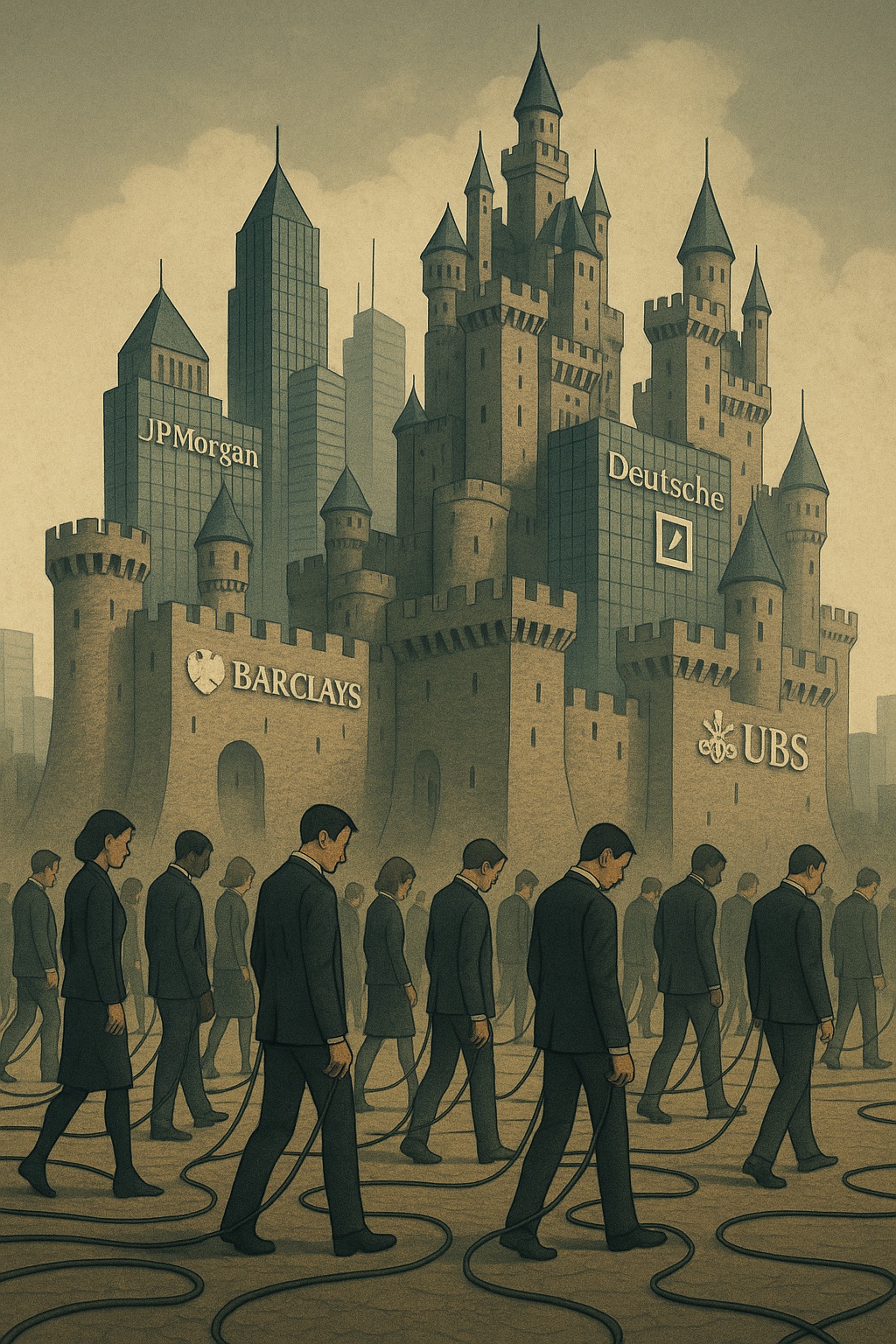
Modern slavery does not need chains. It needs numbers, contracts, and consent. The world’s richest families now control more than $100 trillion in hidden wealth. It sits behind banks, hedge funds, and corporate fronts. They could end poverty tomorrow, yet they will not. Because their purpose is not to improve the world, but to dominate it. Humanity’s freedom has been replaced by debt, illusion, and control.
To understand the world today, one must follow the money — and the money leads to a handful of families. These dynasties stretch back centuries. The names have changed, but the power structure has not. Rockefeller, Rothschild, Morgan, Walton, Koch — these are not individuals but systems of inheritance. They control banks, corporations, and think tanks, and they pass power seamlessly across generations.
Moreover, their wealth is hidden in foundations, trusts, and offshore networks. These mechanisms conceal both money and accountability. Laws do not restrain them because they design the laws. Economies do not regulate them because they own the regulators. Thus, the entire world functions as their private estate.
Whenever economies collapse, the rich rise higher. Every crisis — from wars to recessions — is an opportunity. Central banks print money, governments issue bailouts, and ordinary people lose their savings. Yet the dynasties buy assets cheaper and consolidate power.
How crises feed their wealth
In other words, recessions are not failures. They are tools. Through manipulation of interest rates, currencies, and markets, the elite transform chaos into capital. The system is designed so that every collapse strengthens those who already rule.
Banks: The first layer of control
Banks do not create value. They create dependency. They lend what they do not have and demand real work in return. Every credit, mortgage, and government bond is a digital shackle. Through debt, banks enslave not just individuals but entire nations.
Western banks are interconnected through a dense web of cross-ownership, interbank lending, and shared investment vehicles that make them function almost like one organism. The largest financial institutions — JPMorgan Chase, Goldman Sachs, Barclays, Deutsche Bank, and UBS — not only lend to one another but also co-own vast portfolios through asset managers like BlackRock and Vanguard, which hold stakes in nearly every major bank simultaneously. They share the same clearing systems, swap derivatives, and liquidity channels, allowing a crisis in one to instantly threaten the rest.
Central banks, meanwhile, act as mutual guarantors, coordinating bailouts and interest-rate policies that protect the network as a whole. On top of that, many of their directors sit on multiple boards at once, linking institutions through overlapping personal networks and revolving-door careers that blur the line between public service and private profit. Behind the surface of legality lie shady contracts, secret lending arrangements, and off-balance-sheet operations hidden in offshore entities. These connections make Western banking not a competitive market but a unified, self-protecting cartel of money, influence, and power, where even failure serves the collective survival of the same elite circle.
The families behind the banks
Furthermore, the largest investment firms — BlackRock, Vanguard, and State Street — own significant shares in almost every major global corporation. They are silent shareholders of humanity. They decide which companies grow, which nations thrive, and which collapse. Behind them stand the same dynasties, invisible yet ever-present.
Behind every major bank lies an even older power. These families are not on magazine covers because they do not need to be. They control their wealth through private funds, interlocking boards, and philanthropy that masks domination as generosity.
They fund political campaigns, influence legislation, and shape public opinion. Importantly, they operate beyond ideology. They can buy left, right, or center. What matters is continuity. Their objective is to preserve the structure that keeps them on top.
Media as a weapon of obedience
Their media teaches submission. It glorifies billionaires as geniuses and normalizes inequality as merit. It convinces the poor that the system is fair, and the rich that they are moral.
Even more dangerously, entertainment has become the main tool of distraction. People are not censored — they are sedated. Propaganda now arrives through talk shows, films, and social media. Every screen is a classroom teaching compliance.
As a result, rebellion no longer feels possible. The population is busy watching the very world that exploits them.
Their schools: Factories of obedience
The ruling class does not educate their children the same way they educate ours. Their schools are not places of learning but laboratories of hierarchy. From an early age, elite children are trained to command, not to question. They are taught diplomacy instead of honesty, influence instead of morality, and strategy instead of empathy.
While public schools teach compliance, elite academies teach control. Students there learn how to network, manage assets, and speak in coded language. They are exposed to tutors who are not educators but gatekeepers — often retired politicians, bankers, or lawyers who pass down the unwritten rules of power.
Moreover, these schools are not isolated institutions. They are recruitment centers for the next generation of rulers. Harvard, Yale, Oxford, and Eton are not educational spaces but selection mechanisms. They identify heirs, connect them with investment funds, and integrate them into the dynastic structure. Their graduates enter finance, intelligence, or politics already belonging to the same invisible order.
Ordinary citizens are told education is the great equalizer. Yet in reality, it is the great divider. Public education prepares workers. Elite education prepares masters. One system teaches to follow instructions; the other to issue them.
As a result, the gap between classes is not only economic but intellectual. Their children are trained to understand systems we are trained merely to serve. Their schools ensure that power never changes hands, no matter how many revolutions, elections, or reforms occur.
The unofficial political system
Governments appear independent but function as branches of financial power. Elections offer the illusion of choice, yet both candidates are financed by the same donors. Lobbyists, consultants, and global think tanks design policies before the public even votes.
Consequently, democracy has become ceremonial. Citizens participate, but decisions are already made. Behind every parliament stands an invisible parliament — unelected, unaccountable, and immensely wealthy.
The AI-Industrial Complex
A new frontier of control has arrived: artificial intelligence. Once a symbol of progress, AI now serves as the perfect instrument for prediction, manipulation, and surveillance. Algorithms decide what news people read, what products they buy, and even what they believe.
The same corporations that own media and finance now dominate AI development. They are teaching machines not to think freely but to reinforce their values. In essence, AI has become the digital overseer of a modern plantation.
Mass surveillance and the Orwellian State
George Orwell imagined total surveillance enforced by fear. Yet the modern world achieved it through comfort. Citizens now carry their own tracking devices. Phones, cameras, and microphones record every move. Governments, in alliance with tech giants, have built a surveillance web that covers nearly every inch of the planet.
China perfected it openly. The West adopted it quietly. Every message, purchase, and movement creates a data trail — sold, analyzed, and stored forever. The goal is not protection. It is prediction. The Orwellian state does not punish; it anticipates.
Debt and jobs as the new shackles
Debt is no longer a burden — it is a design. Education loans, mortgages, and credit cards ensure that people keep working. The system trains citizens to value careers more than freedom. They spend their best years repaying money that never truly existed.
The tragedy is that workers believe they are free. They compete for promotions, measure worth by salary, and sacrifice time for numbers. In reality, they are feeding a structure that will never reward them equally.
From surplus value to total extraction
Karl Marx identified surplus value as the heart of exploitation — profit taken from workers’ labor. But modern capitalism has evolved far beyond that. The elite now extract value from existence itself.
They profit from rents, data, insurance, and speculation. Even personal emotions are monetized. Social media sells outrage. Streaming services sell escapism. Healthcare sells fear. The economy has become a vast machine for extracting energy from every human activity.
The psychology of submission
The most effective control is mental. People admire their oppressors and defend the very system that crushes them. They are taught to believe that wealth equals virtue and that rebellion equals chaos.
Schools reward obedience. Media punishes dissent. Society mocks those who ask uncomfortable questions. Over time, citizens internalize their own subjugation. They call it stability. They call it progress.
What true freedom would look like
Freedom does not mean destruction. It means awareness, it means transparency in government, fair taxation of dynastic wealth, and an end to secrecy jurisdictions. It means artificial intelligence that serves people, not corporations.
More importantly, freedom means a cultural awakening. Humanity must stop admiring billionaires and start questioning why such power exists at all. The problem is not inequality — it is control. The issue is not wealth — it is worship.
The return of feudalism
History has not moved forward; it has looped. Feudalism has returned under another name. Kings became corporations. Peasants became employees. Castles turned into offshore accounts.
The super-rich own the land, the data, and the debt. They own the politicians and the platforms. They own the narrative of progress itself. What we call capitalism is a digital monarchy disguised as democracy.
Every empire eventually falls. This one will too — but only when people stop believing that slavery is freedom, and when they finally see that $100 trillion buys not genius, but obedience.
Leave a Reply