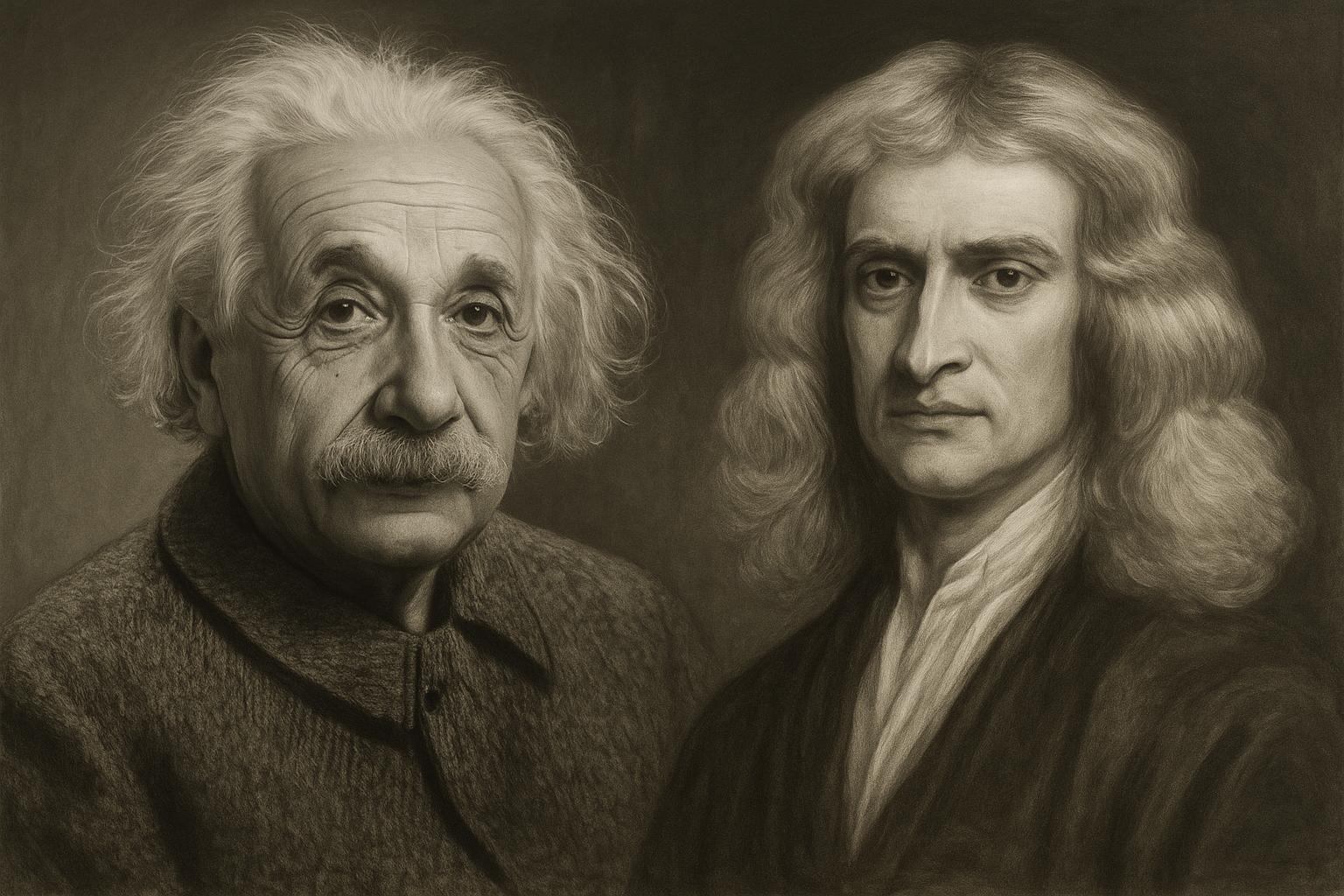
People quote Einstein, Newton, or Hawking as if their words alone decide what is true. “Einstein said it,” “Newton proved it,” “Hawking confirmed it.” But this is not reasoning. It is worship. The argument from authority is one of the most misused fallacies in human history. It gives the illusion of knowledge while replacing investigation with obedience.
Of course, listening to experts matters. Without them, no one could enjoy the fruits of mainstream science. But that trust must never become faith. The right way is to understand and then criticize by your own cognitive apparatus. The failure is obvious — most people are not smart enough to verify complex knowledge, so they imitate. Yet every single statement must be tested. Every claim must be questioned. No authority, no genius, and no Nobel laureate deserves immunity.
Why humans worship authority
Humans evolved to follow leaders. In tribal life, obedience increased survival. Following the elder hunter or the strong chieftain meant safety. This instinct still lives in modern brains. People transfer the same obedience to intellectual hierarchies — professors, experts, and famous scientists. They confuse confidence with truth. They assume prestige equals accuracy.
Our brains evolved for social harmony, not for truth. We are wired to trust power, not logic. This ancient instinct makes people worship names instead of arguments. Authority gives comfort. Doubt brings anxiety. And comfort always wins unless reason intervenes.
The fallibility of great minds
Even the brightest minds failed spectacularly. Newton combined mathematics with mysticism. He spent years on alchemy and biblical chronology. He described the universe as divine machinery designed by God. Einstein refused to accept quantum randomness because it offended his sense of order. “God does not play dice,” he said, revealing how emotion guided intellect.
Thomas Aquinas, centuries earlier, knew nothing about biology, cosmology, or cognition. He built entire arguments on theological assumptions now proven false. He filled ignorance with confidence, confusing speculation for truth. Aquinas, Newton, Einstein — all brilliant, all wrong about something. They are not gods. They were humans working with incomplete data.
Newton’s God and the birth of agent detection
Newton ascribed complexity to divine creation. Modern science explains why. The human brain evolved agent detection — the tendency to see intention behind patterns. If grass moved, a predator was near. If thunder roared, a god was angry. This instinct kept us alive, but it also made us invent invisible agents.
Today, mathematics, statistics, and evolutionary psychology prove how easily humans mistake randomness for design. Newton lacked that knowledge, so he invoked God. Einstein did the same in a subtler way. He refused chaos. He wanted a universe that made sense. That desire was not physics — it was psychology.
Einstein’s elegance and the illusion of truth
Einstein’s pursuit of elegant equations shows how the mind equates beauty with truth. Simplicity feels correct because the brain prefers efficiency. But nature is not obligated to be elegant. It can be messy, redundant, and chaotic. Einstein’s discomfort with quantum unpredictability shows the same bias — a human need for order projected onto the cosmos.
Even geniuses cannot escape human cognition. They simplify because the mind cannot bear infinite complexity. They find order because the brain evolved to find it, not because it is truly there.
The modern cult of experts
Modern society replaced priests with scientists. The robe became a lab coat. The sermon became a research paper. People treat Nobel laureates like saints. They quote them without understanding their equations. They assume that a prize means truth. But fame is not proof.
Many Nobel winners later contradicted themselves. Some defended flawed ideas until death. Their brilliance does not make them infallible. Being famous, decorated, or cited does not guarantee correctness. It only means recognition — often political, sometimes accidental. Because someone is famous or holds a Nobel Prize does not mean he is right.
Mainstream science: Trust, but question
Mainstream science is humanity’s best method for discovering truth. It deserves deep respect. But respect is not worship. Science must remain open to correction. We must believe mainstream scientists, but with caution. Otherwise, science becomes faith.
Every discovery, no matter how well accepted, must face re-evaluation. Every theory must remain provisional. The right attitude is clear: trust the data, not the name. Authority should guide inquiry, not dictate it. True science destroys idols — even its own.
The cognitive divide: Understanding vs. reciting
Most people do not understand science. They memorize it, they repeat conclusions without comprehension. They know who said what but not why it is true. Education systems encourage this behavior. They reward obedience, not curiosity.
To understand is to re-derive, to question, to think. To memorize is to conform. Society prefers memorization because it preserves order. Real progress, however, begins with disobedience. Every major scientific revolution started when someone stopped quoting and started doubting.
Institutional authority and intellectual conformity
Modern science is hierarchical. Prestige universities, elite journals, and funding agencies decide what counts as truth. Young scientists learn quickly that career survival depends on obedience. They publish what is acceptable, not what is true.
Thus, argument from authority becomes institutional. People worship not only individuals but systems — Harvard, Nature, or the Nobel Committee. But the history of science is a history of rebellion. Galileo, Darwin, Planck — all defied consensus. Science progresses by dethroning its own heroes.
The limits of the human mind
No one can verify all knowledge personally. Brains have limits. Therefore, trust is necessary — but it must remain conditional. The intelligent mind adjusts trust dynamically. It knows when to defer and when to doubt. It respects expertise but never surrenders to it.
Blind rejection of authority is ignorance. Blind obedience is servitude. Real intelligence walks between them — humble enough to listen, brave enough to question.
The ethical duty to think
Independent reasoning is not arrogance; it is obligation. The purpose of intellect is not comfort but discovery. Authority should be a starting point, not a destination. Every claim deserves examination, even if made by the greatest minds alive.
The highest form of respect is to challenge. Newton, Einstein, or Aquinas would have wanted no less. The essence of science is not agreement but correction. When authority becomes sacred, knowledge stops evolving.
Conclusion: Truth without masters
Authority dies. Truth remains. Every era produces geniuses, and every next era proves them wrong. Newton’s universe collapsed into Einstein’s, Einstein’s into quantum theory, and quantum theory will one day be revised again.
The real beauty of science is not that it glorifies geniuses — it replaces them. To think scientifically is to dethrone idols endlessly. Evidence, not fame, decides what survives. Because truth needs no master, no priest, and no prize.
And certainly, no name.
Leave a Reply