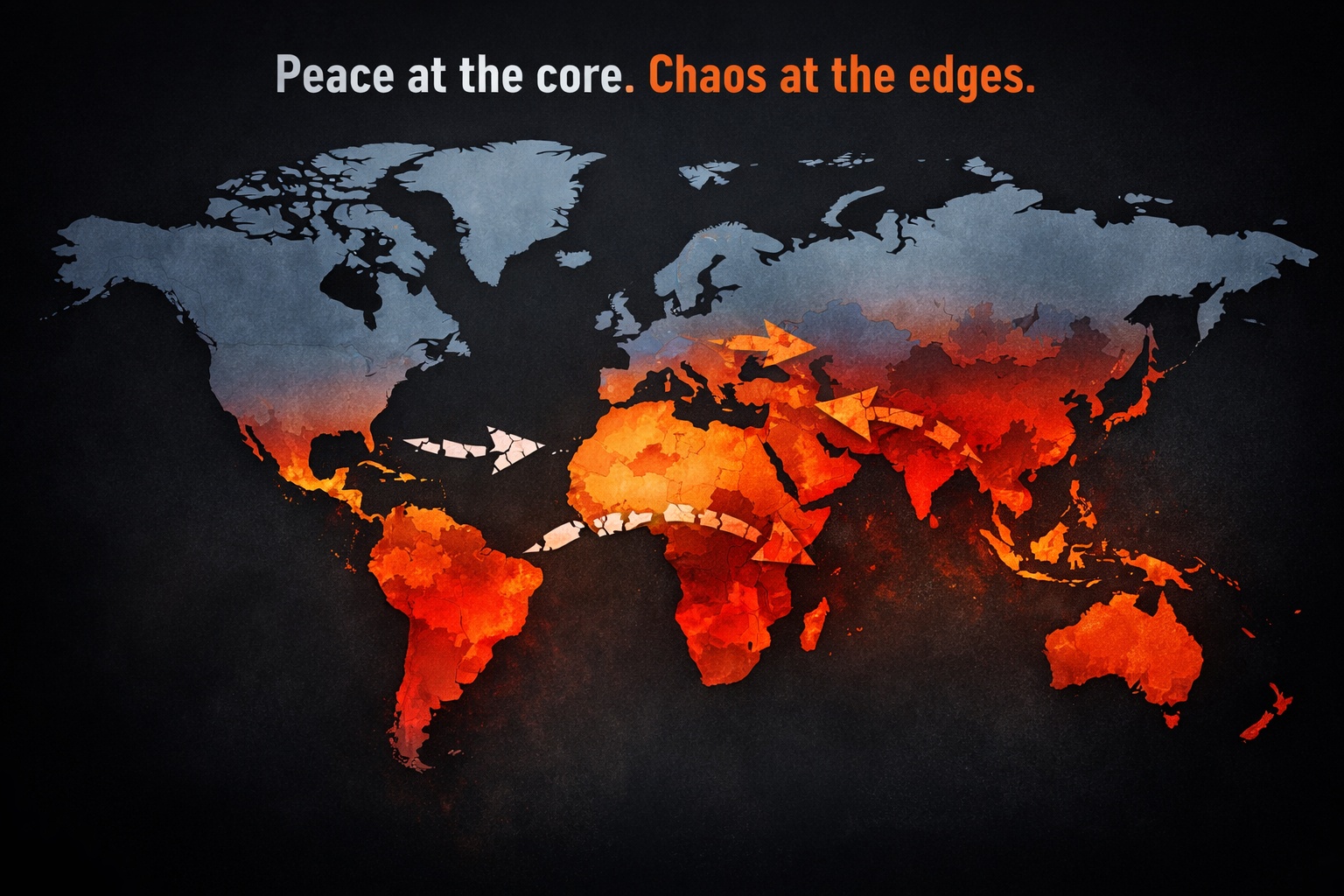
The international system is entering a phase of open instability. Power no longer concentrates in one center, nor does it move predictably through established institutions. Instead, it fragments across regions, alliances, and competing economic blocs. The West still possesses enormous military, financial, and technological advantages, yet its ability to shape outcomes has clearly diminished. At the same time, the Global South is not unified, but it is increasingly assertive, frustrated, and unwilling to accept Western dominance as natural or permanent.
As a consequence, the global order feels chaotic rather than merely competitive. Rules still exist, but enforcement has weakened. Norms still matter, but only selectively. In this environment, strategic retreat reemerges as a tempting solution. The idea of narrowing responsibility, reducing global commitments, and focusing on core interests gains appeal, particularly in the United States.
This renewed logic resembles a modernized version of the Monroe Doctrine. The crucial question, however, remains unresolved. Does withdrawal reduce the likelihood of war, or does it simply change where and how violence unfolds?
The original Monroe Doctrine was never designed to create peace
Historically, the original Monroe Doctrine did not aim to establish global stability. Instead, it sought to exclude rival powers from a defined geographic sphere. By declaring the Western Hemisphere off-limits to European intervention, the United States secured its strategic backyard while avoiding entanglement in European conflicts. This move successfully protected the American core from great-power war, but it did not eliminate violence.
On the contrary, instability intensified throughout Latin America. Coups, interventions, and regime changes became routine. Local elites aligned with external interests, while populations paid the price through repression and economic dependency. In other words, peace existed only for the center. Violence was displaced, not resolved.
This historical pattern matters because it reveals the real function of strategic doctrines. They do not eliminate conflict, they redistribute it. They determine who absorbs the cost and who enjoys stability.
Western dominance is eroding without collapsing
Despite frequent declarations of decline, Western power has not vanished. Military superiority remains overwhelming. Financial institutions still shape global flows. Technological leadership persists in key sectors. However, legitimacy has suffered profound damage. Wars in Iraq and Afghanistan undermined trust. The intervention in Libya reinforced perceptions of irresponsibility. Repeated moral rhetoric followed by selective enforcement eroded credibility.
Simultaneously, economic dominance weakens incrementally rather than dramatically. Dollar supremacy continues, yet alternatives slowly expand. Regional trade agreements bypass traditional Western hubs. Emerging powers gain confidence in operating outside Western approval structures.
As a result, the West still governs many systems, but it no longer commands unquestioned obedience. This distinction defines the current moment. Authority exists, but belief does not.
Multipolarity generates instability before equilibrium
Multipolar systems rarely begin with balance. Instead, they begin with testing. Multiple centers of power probe boundaries simultaneously. Red lines blur. Signals become ambiguous. Each actor assumes restraint will prevail, yet each prepares for escalation.
Consequently, local conflicts proliferate. Proxy wars replace direct confrontation. Regional actors exploit uncertainty to expand influence. Meanwhile, great powers hesitate, calculating risks rather than imposing order.
Although multipolarity may eventually stabilize, the transition phase is inherently dangerous. Miscalculations become more likely. Conflicts overlap. Crisis management becomes reactive rather than preventive.
Global North versus Global South is a structural conflict, not an ideological one
The emerging fault line between the Global North and the Global South is often mischaracterized as ideological. In reality, it is structural. Access to energy, technology, capital, and stable institutions divides the world far more than belief systems. Demographic pressures intensify this divide, while climate stress accelerates migration and resource competition.
As these pressures grow, resentment accumulates. The Global South perceives exclusion and hypocrisy. The Global North responds with defensiveness and securitization. Both reactions follow rational incentives, yet together they produce friction.
In this context, violence does not arise from irrational hatred. It emerges from systemic collision. The international system lacks mechanisms to absorb these shocks peacefully.
The logic behind a modern American retreat
Donald Trump did not invent American withdrawal. He articulated it bluntly. His approach rejected the illusion of moral empire and emphasized cost-benefit calculation. Alliances became transactional. Interventions required visible returns. Ideological language faded in favor of national interest.
This shift reflected deeper domestic fatigue. American society increasingly questions the value of global policing. Economic inequality, political polarization, and infrastructure decay reduce tolerance for foreign entanglements.
Therefore, the appeal of a modern Monroe-style doctrine lies in its promise of containment. America narrows its focus. It secures its core. It accepts a less orderly world beyond its borders.
Does withdrawal reduce the risk of global war
In the short term, strategic withdrawal likely reduces the probability of direct great-power confrontation. Fewer military interventions lower immediate escalation risks. Diplomatic ambiguity replaces rigid commitments. Conflict management becomes more cautious.
However, this reduction comes at a cost. Power vacuums emerge rapidly. Regional powers expand aggressively. Local conflicts intensify without external restraint. Over time, these conflicts spill across borders through energy markets, supply chains, migration flows, and financial shocks.
Thus, global war becomes less probable, but global instability becomes chronic. Violence does not disappear. It fragments.
Peace for the core, instability for the periphery
A modern Monroe Doctrine would protect the center while exposing the margins. The United States and its closest allies would reduce casualties and political risk. Meanwhile, weaker regions would absorb escalating conflict. Civil wars would deepen. Authoritarian regimes would consolidate power under the banner of sovereignty.
As a result, peace becomes selective. Security becomes unequal. Moral language persists, but enforcement remains absent. The system stabilizes those who already possess power while abandoning those who do not.
The illusion of isolation in an interconnected world
True isolation no longer exists. Global supply chains bind economies. Climate effects ignore borders. Pandemics spread regardless of policy. Cyber operations penetrate even the most fortified states.
Therefore, withdrawal delays consequences rather than eliminating them. A regional war raises global prices. A failed state destabilizes continents. Violence travels indirectly, but inevitably.
Non-intervention changes the route of impact, not its destination.
Likely outcomes under a new Monroe-style order
The most probable outcome is not world war, but permanent instability. Great powers avoid direct collision. Instead, they rely on proxies, economic coercion, cyberwarfare, and technological dominance. Military invasions decline. Financial and informational warfare expand.
The world feels calmer at the top of the hierarchy. It becomes harsher at the bottom. This is not peace. It is managed disorder.
Conclusion
A new Monroe Doctrine will not bring peace. It will reallocate violence. The probability of global war may decrease, but the certainty of global suffering will not. Stability will concentrate in the core, while chaos intensifies at the periphery.
Peace will become a privilege rather than a universal condition. Chaos will remain the default state of the system.
Leave a Reply