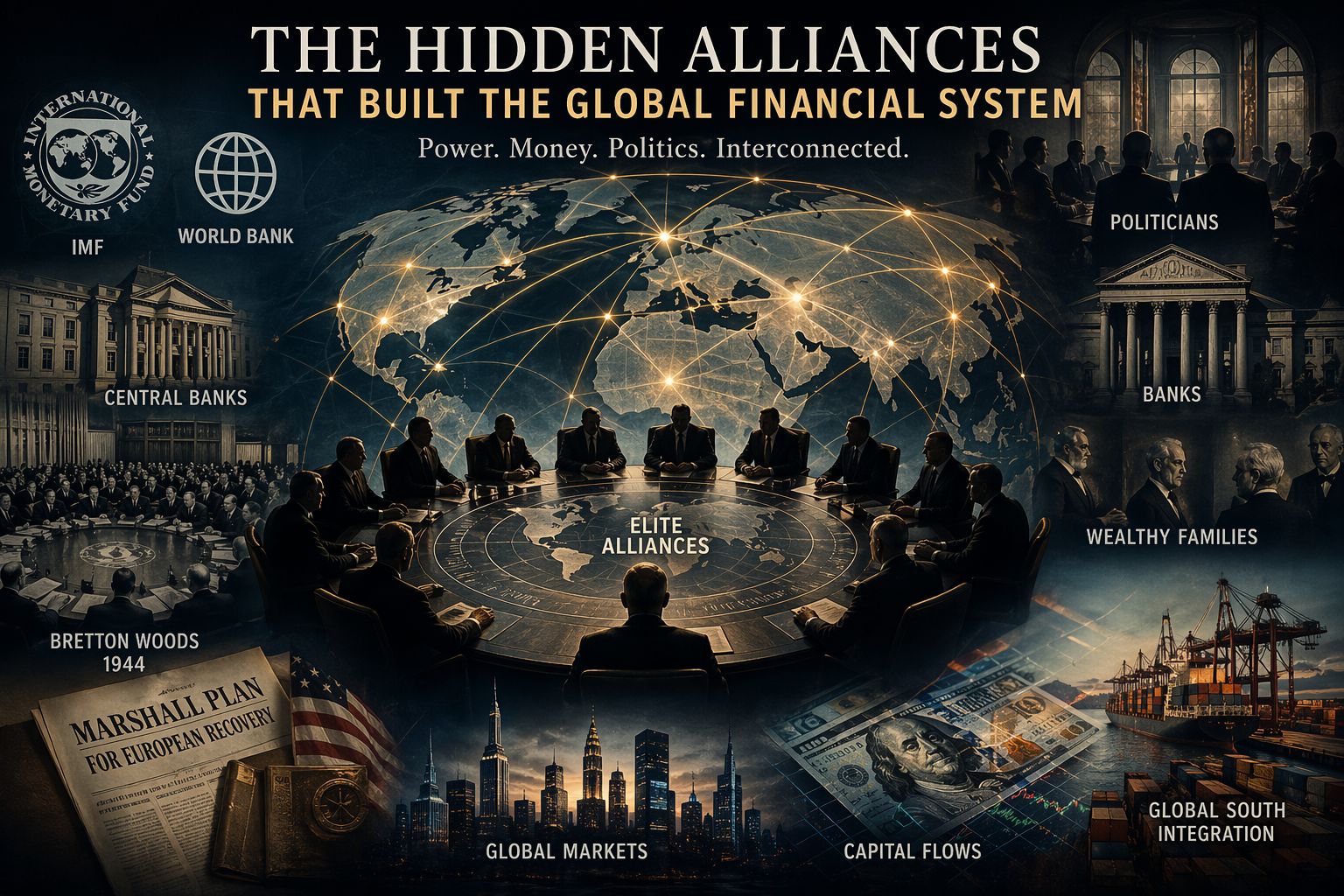
Europe did not rebuild itself in isolation after World War II. It rebuilt through links. Every factory needed foreign capital. Every currency needed external trust. Every government needed partners. At the same time, wealthy families with prewar financial influence did not disappear. They adapted. They repositioned themselves inside the emerging system. Therefore, interconnection did not emerge as a theory. It emerged as a survival mechanism shaped by both public institutions and private dynasties. Businessmen, politicians, and elite families quickly understood one thing. No single nation, and no single actor, could restore growth alone.
Bretton Woods: The architecture of controlled interdependence
The turning point came at the Bretton Woods Conference. Here, politicians and financial experts did not simply create institutions. They designed a framework of dependency. The International Monetary Fund stabilized currencies, while the World Bank financed reconstruction. However, behind these formal structures stood networks of influence.
Banking families such as the Rothschild family had already built cross-border financial expertise in the 19th century. Others, like the Rockefeller family, had accumulated immense capital through oil and industry. These actors did not design Bretton Woods directly in a formal sense. However, their institutions, connections, and capital shaped the environment in which such a system could function. Therefore, interconnection rested not only on treaties, but also on inherited financial power.
The Marshall Plan: Capital flows as strategic glue
The Marshall Plan accelerated interconnection. It did not only rebuild roads and factories. It rewired economic relationships. American capital entered Europe at scale. European industries became linked to US suppliers, technologies, and financial systems.
At the same time, alliances formed across the Atlantic. Wealthy families, corporate leaders, and political elites aligned their interests. US industrial and financial groups expanded influence into European markets. European elites accepted this integration because it offered stability and growth. Therefore, capital flows acted as glue. They bound not only economies, but also elite networks that operated across borders.
Elite networks: Where alliances were forged
Formal institutions told only part of the story. Informal networks completed it. Organizations like the Council on Foreign Relations and the Bilderberg Group provided spaces where politicians, bankers, and business leaders could meet outside public scrutiny.
Here, alliances took shape. Shared strategies emerged. Trust developed between actors from different countries. Wealthy families often participated indirectly through their representatives in banking, industry, or philanthropy. Therefore, interconnection deepened through relationships, not only regulations. The system grew cohesive because its key actors knew each other, negotiated privately, and aligned long-term goals.
Eurodollar markets: Interconnection escapes national control
By the 1950s and 1960s, a new layer emerged. The Eurodollar market allowed US dollars to circulate outside the United States. Banks in London and elsewhere handled deposits and loans beyond domestic regulation. Consequently, interconnection moved beyond formal agreements.
This development favored large banking institutions with global reach. Many of these institutions had historical ties to elite families or long-standing financial networks. As a result, financial flows became faster and less transparent. Politicians lost direct control over parts of the system. Yet they tolerated it because growth continued. Therefore, interconnection became both deeper and less visible.
European integration: Political unity as financial infrastructure
At the same time, Europe pursued integration. The European Coal and Steel Community and later the European Economic Community reduced barriers between states. Politicians promoted peace and cooperation. However, financial elites recognized a different opportunity.
A unified Europe meant larger markets and fewer restrictions. Banks expanded across borders. Corporations scaled their operations. Wealthy families diversified their holdings internationally. Therefore, political unity enabled financial consolidation. Interconnection strengthened because both political and private actors benefited from it.
While politicians debated publicly, central banks coordinated quietly. The Bank for International Settlements became a key meeting point. Here, financial authorities exchanged information and aligned strategies.
This coordination extended beyond public mandates. Central bankers interacted with private financial institutions and, indirectly, with large wealth holders. Decisions in one country affected liquidity in another. Interest rates influenced global capital flows. Therefore, central banks acted as the nervous system of the global financial network, linking public policy with private financial power.
Corporations, banks, and families: A symbiotic triangle
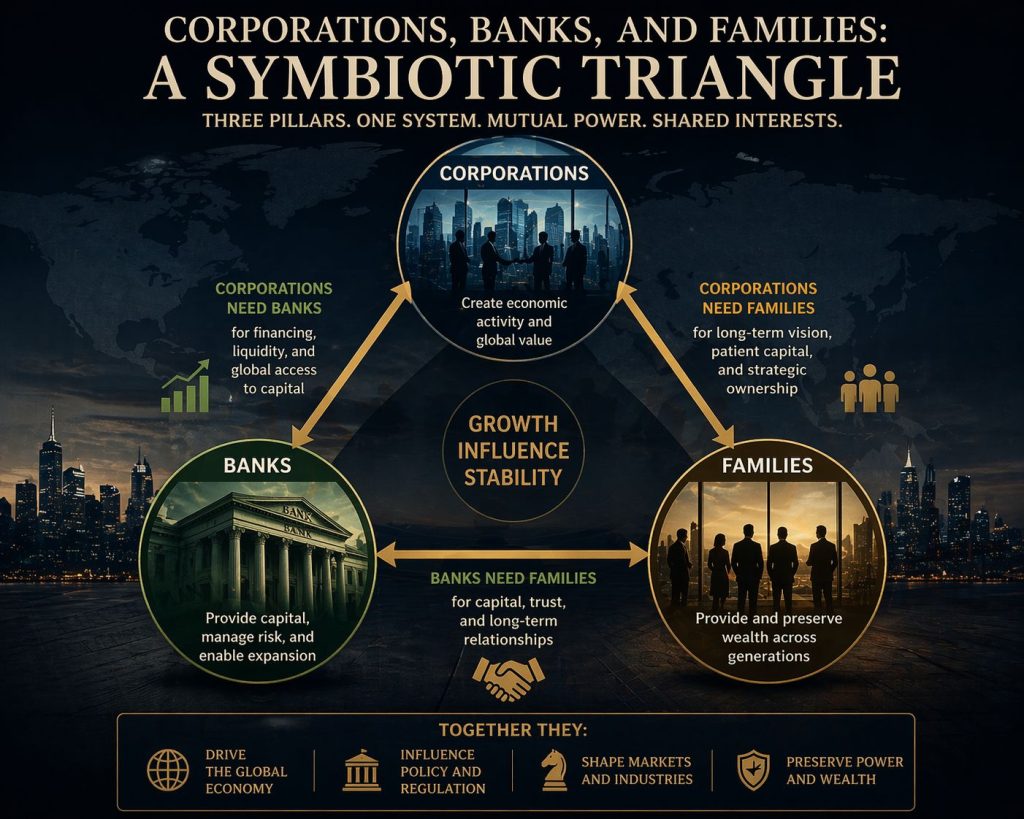
As multinational corporations expanded, banks followed. Companies needed financing for global operations. Banks provided it. In return, they gained influence over entire sectors. Wealthy families invested in both sides. They held stakes in banks and corporations alike.
Consequently, a triangle emerged. Corporations generated economic activity. Banks financed expansion. Families accumulated and redistributed capital. Politicians depended on all three for growth and stability. Therefore, alliances formed not as conspiracies, but as converging interests. Each actor reinforced the others.
Global South: Integration through dependence
Postwar interconnection did not remain a Western project. It expanded into the Global South. However, this expansion did not occur on equal terms. Instead, it followed a pattern of controlled integration. Countries in Africa, Latin America, and parts of Asia entered the system through loans, trade agreements, and development programs.
Institutions such as the International Monetary Fund and World Bank played a central role. They provided capital. However, they also imposed conditions. Governments had to adjust policies. They opened markets. They reduced state control. They aligned with global financial norms.
At the same time, Western banks and corporations expanded into these regions. Wealthy families and investment groups diversified globally. Therefore, interconnection became hierarchical. The Global South depended on capital inflows. The West controlled capital outflows. This structure reinforced alliances at the top while creating dependence at the periphery.
Peace: Interconnection as a stabilizing force
Interconnection did not only serve profit. It also reduced the likelihood of conflict among major Western powers. Economic ties increased the cost of war. Trade, investment, and shared financial systems created mutual dependence.
European integration illustrates this clearly. The European Economic Community linked economies so tightly that large-scale war became irrational. Banks operated across borders. Corporations depended on foreign markets. Governments coordinated policies.
Moreover, elite networks reinforced this stability. Politicians, bankers, and business leaders interacted regularly. They shared interests. They avoided disruptions that could damage the system. Therefore, interconnection acted as a form of soft constraint. It did not eliminate conflict globally. However, it stabilized relations within the core network.
From ban to loan: Financing wars through the system
After World War II, direct financing of large-scale wars became politically sensitive. Public opinion shifted. International norms evolved. However, this did not end financial involvement in conflict. It transformed it.
Instead of direct funding, the system moved toward indirect mechanisms. Governments issued debt. Banks purchased it. Financial markets absorbed risk. Military spending continued, but it became embedded in broader economic structures.
At the same time, international loans supported states involved in regional conflicts. Aid, credit lines, and financial support often aligned with geopolitical interests. Therefore, war financing did not disappear. It became more complex and less visible.
Interconnection played a key role here. Financial systems allowed capital to move without explicit political framing. Banks operated across borders. Investors sought returns. Governments accessed funding. Consequently, the line between economic activity and geopolitical strategy blurred.
The Cold War: Interconnection as geopolitical strategy
During the Cold War, financial interconnection became a tool. Western countries used capital flows to influence allies and counter rivals. Loans, investments, and aid programs aligned economies with political blocs.
Wealthy families and large financial institutions supported this expansion because it opened new markets. Politicians supported it because it secured alliances. Therefore, interconnection extended globally. It combined economic incentives with geopolitical strategy. Finance became an instrument of power.
Western alleged unity: Reality beneath the surface
The postwar narrative often presents the West as unified. Shared values, common goals, and coordinated policies define this image. However, reality shows a more complex structure.
Western unity rests on overlapping interests, not complete alignment. States compete economically. Banks rival each other. Corporations pursue independent strategies. Wealthy families diversify across jurisdictions. Therefore, unity emerges from interdependence, not harmony.
At the same time, alliances at the elite level maintain cohesion. Shared institutions, regular meetings, and financial integration reduce fragmentation. Even when political tensions arise, the underlying network persists.
This creates a dual system. On the surface, competition continues. Beneath it, interconnection holds the structure together. Therefore, Western unity is not absolute. It is functional. It exists because the cost of disconnection remains too high.
Deregulation: Acceleration of elite networks
The collapse of Bretton Woods in the 1970s removed key constraints. Exchange rates floated. Capital controls weakened. Financial innovation increased. Cities like New York City and London became central nodes.
Deregulation favored actors with scale and connections. Large banks expanded aggressively. Wealthy families diversified into global portfolios. Politicians encouraged this process to maintain competitiveness. Therefore, interconnection accelerated. The network became faster, denser, and more complex.
The 2008 crisis: Interconnection exposed
The 2008 financial crisis revealed the full extent of interconnection. Problems in US housing markets quickly spread to European banks. Liquidity froze. Credit collapsed. Governments intervened to prevent systemic failure.
This moment exposed a critical truth. Banks, states, and large private capital holders had become inseparable. Governments could not allow major institutions to fail because the entire network depended on them. Therefore, bailouts became inevitable. Interconnection transformed private risk into public responsibility.
The modern system: Total interdependence
Today, the interconnection between businessmen, politicians, banks, and wealthy families defines the global economy. Financial institutions operate across continents. Governments rely on markets to finance debt. Capital flows respond instantly to political decisions.
Moreover, personnel move between sectors. Bankers become policymakers. Politicians join financial institutions. Family offices and investment funds interact with both. Consequently, alliances persist across generations. They adapt, but they do not disappear.
Nowadays: Competition with Beijing, Mumbai, and the Silent Empire
The postwar financial system no longer operates without challengers. For decades, Western interconnection dominated global finance. However, new centers of power have emerged. Cities like Beijing and Mumbai now play a growing role in shaping global capital flows. At the same time, a less visible layer operates beneath formal structures. This layer can be described as a silent empire. It consists of sovereign wealth funds, state-backed corporations, and opaque financial networks that move capital strategically.
China represents the most direct challenge. Its state-driven model combines political control with financial expansion. Banks, corporations, and government agencies operate in coordination. Initiatives such as global infrastructure financing extend influence far beyond national borders. Therefore, interconnection expands under a different logic. It does not rely purely on markets. It integrates political strategy directly into financial flows.
India follows a different path. Mumbai acts as a gateway between domestic growth and global capital. Indian corporations expand internationally. Financial institutions integrate with global markets while maintaining local specificity. Therefore, India does not replicate the Western model fully. Instead, it adapts it. It blends openness with selective control.
At the same time, the silent empire operates across jurisdictions. Sovereign wealth funds from the Middle East, Asia, and other regions invest globally. They acquire stakes in infrastructure, technology, and finance. These actors do not always act visibly. However, their influence grows through ownership rather than direct control. Therefore, interconnection deepens in new ways. Power shifts from visible institutions to dispersed capital holders.
This competition reshapes the system. Western alliances remain strong. However, they no longer define the entire structure. New networks form. New alliances emerge. Financial interconnection continues, but it becomes multipolar. Therefore, the global financial system does not fragment. It evolves. It incorporates new centers of power while maintaining the underlying logic of interdependence.
Conclusion: Alliances that shape the system
Postwar interconnection began as necessity. However, it evolved into structure reinforced by alliances. Businessmen, politicians, and wealthy families did not merely cooperate. They formed overlapping networks of influence.
These alliances operate through institutions, markets, and personal relationships. They shape capital flows, policy decisions, and global outcomes. Therefore, the modern financial system reflects not only economic logic, but also the enduring connections between power, wealth, and politics.
Leave a Reply