Modern capitalism presents itself as the triumph of freedom over feudal hierarchy. According to its idealized image, anyone can rise through talent, discipline, innovation, and hard work. Markets supposedly reward merit. Competition supposedly prevents domination. Wealth supposedly reflects productivity.
However, reality increasingly points elsewhere.
The modern world contains unprecedented wealth. Trillions circulate through investment funds, multinational corporations, financial markets, luxury industries, private equity structures, offshore systems, and digital monopolies. Technological progress has reached extraordinary levels. Artificial intelligence expands rapidly. Global productivity continues growing.
Yet simultaneously, enormous numbers of people live paycheck to paycheck. Housing becomes unattainable. Debt expands continuously. Workers remain economically insecure despite full employment. Younger generations increasingly rent permanently rather than own property. Mental exhaustion rises. Fertility collapses. Social trust weakens.
Thus, one central contradiction emerges. Humanity produces historic levels of wealth, yet large parts of society increasingly resemble economically dependent peasants.
The language changed. The aesthetics changed. However, the structure increasingly mirrors feudal logic.
Feudalism never truly disappeared
Feudalism did not merely involve kings and castles. It represented a system of concentrated ownership and dependency.
Landowners controlled resources necessary for survival. Peasants depended on access to land. Protection came from above. Labor flowed upward. Wealth accumulated vertically.
Modern capitalism formally abolished feudal titles. However, it preserved many hierarchical mechanisms beneath different terminology.
Today, survival depends not on access to farmland but on access to wages, credit, housing, healthcare, and financial systems. Therefore, dependence persists even if its form evolved.
Instead of feudal lords, modern society contains multinational corporations, mega investment firms, banking networks, technology monopolies, and ultra-rich dynasties.
Unparalleled wealth concentration
Never in history has humanity produced such extraordinary wealth.
Large investment firms manage assets worth tens of trillions of dollars. Billionaires possess fortunes larger than the GDP of entire countries. Luxury industries flourish. Financial markets expand constantly. Capital flows globally within milliseconds.
At the same time, ordinary workers frequently cannot afford housing without lifelong debt.
This discrepancy becomes historically staggering.
The upper layers of society possess private jets, estates, financial portfolios, offshore structures, political influence, and access to elite educational and social networks. Meanwhile, many ordinary individuals struggle to survive despite working continuously.
Consequently, modern inequality increasingly resembles aristocratic concentration rather than competitive meritocracy.
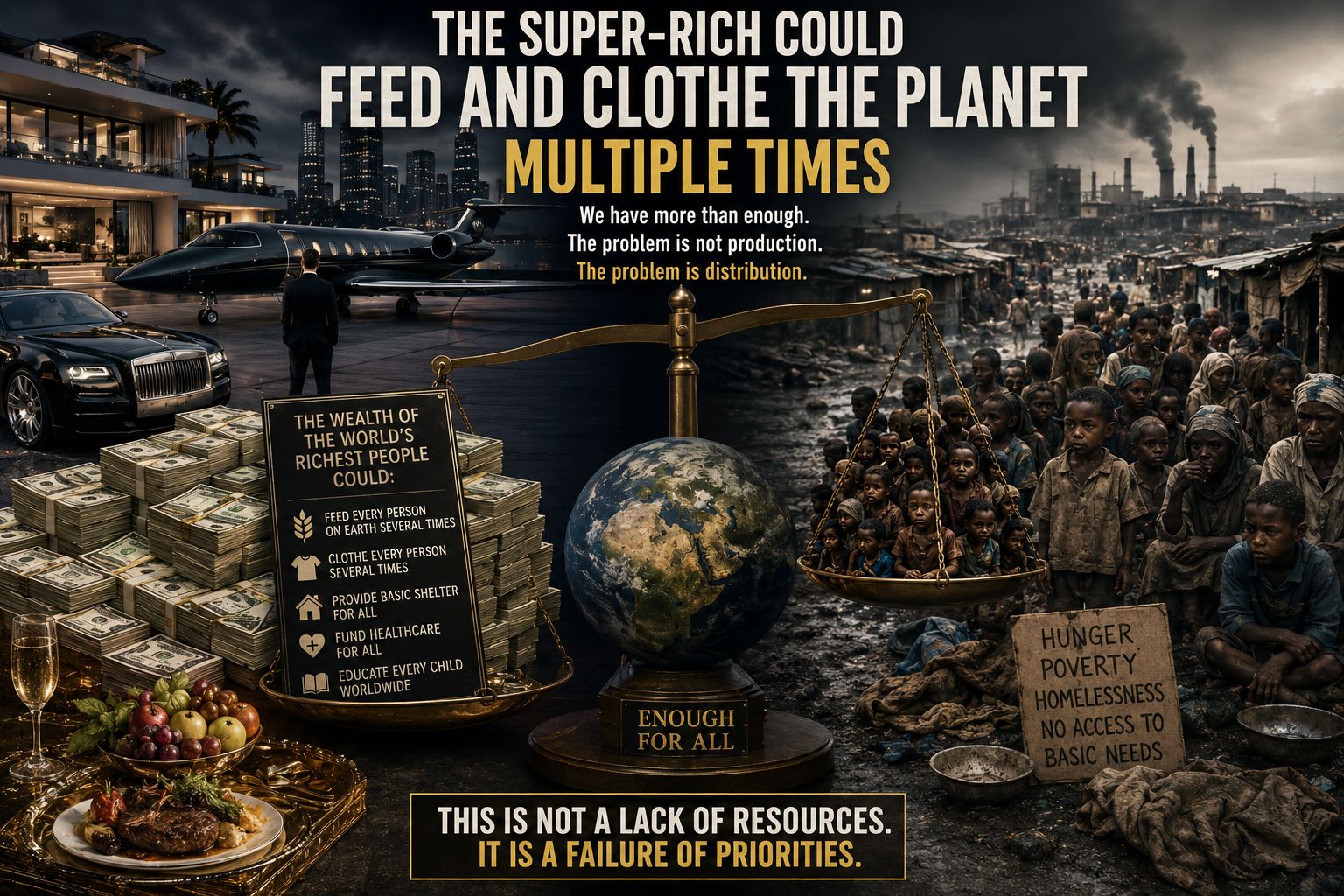
The super-rich could feed and clothe the planet multiple times
Modern humanity already possesses enough productive capacity to feed, clothe, and shelter the global population many times over.
Global agriculture produces sufficient calories for billions. The textile industry manufactures enormous surpluses of clothing. Technological automation dramatically increases productivity. Meanwhile, global wealth reaches levels unimaginable in previous centuries.
However, distribution does not follow human need. Instead, it follows purchasing power, investment logic, and profit extraction.
At the same time, the combined wealth of the ultra-rich reaches staggering proportions. A relatively small number of billionaires control fortunes worth hundreds of billions of dollars individually. Major investment firms collectively manage tens of trillions.
Consequently, one central contradiction emerges clearly. Humanity does not primarily suffer from lack of resources. It suffers from unequal allocation.
Enormous amounts of food become wasted yearly while millions remain undernourished. Luxury industries generate products for extreme wealth concentration while poorer populations struggle with basic necessities.
Moreover, financial systems continuously create additional wealth through speculation, asset inflation, ownership concentration, and capital appreciation. Therefore, money increasingly accumulates upward faster than real living conditions improve downward.
This does not mean simply confiscating wealth would magically solve every global problem. Corruption, war, logistical collapse, weak institutions, and political instability also play major roles.
Nevertheless, the scale of modern inequality remains historically extraordinary.
A civilization capable of financing superyachts worth hundreds of millions of dollars, private space programs, enormous speculative markets, and luxury consumption at massive scale clearly possesses the material capacity to eliminate much larger portions of extreme poverty than currently happens.
Therefore, the existence of widespread deprivation alongside unprecedented concentrations of wealth increasingly appears less like economic inevitability and more like structural prioritization.
Debt replaces chains
Feudal peasants could not freely leave the land because survival depended on the lord’s structure.
Modern individuals formally possess freedom. However, debt creates powerful invisible constraints.
Mortgages bind people for decades. Student loans shape life choices early. Healthcare debt destroys savings. Credit cards trap households in interest cycles. Rent consumes enormous portions of income. Inflation quietly erodes purchasing power.
Therefore, modern control increasingly functions financially rather than physically.
A deeply indebted population becomes easier to manage economically, psychologically, and politically.
People afraid of losing healthcare, housing, or loan payments become less likely to challenge institutions aggressively. Economic insecurity disciplines populations silently.
Workers without ownership
One major similarity between capitalism and feudalism lies in ownership concentration.
Under feudalism, peasants worked land they did not own.
Under capitalism, many workers spend entire lives producing value inside systems they never meaningfully control.
Employees generate profits for shareholders, executives, investment firms, and corporate structures above them. However, they often receive only a fraction of the wealth created through their labor.
This does not mean all profit is theft. Businesses require coordination, risk-taking, infrastructure, logistics, innovation, and management. Marxism often oversimplified economic complexity.
Nevertheless, modern surplus extraction may have reached extraordinary proportions.
Executive compensation explodes upward. Financial elites accumulate assets endlessly. Stock buybacks enrich shareholders. Meanwhile, wages stagnate relative to productivity in many sectors.
Thus, one may reject orthodox Marxism while still recognizing that the concentration of surplus value at the top has become immense.
The ultra-rich and exponential accumulation
Wealth today no longer grows linearly for the ultra-rich. It compounds exponentially.
A worker exchanges time for money.
A billionaire owns systems that generate money automatically through investments, equity, dividends, rents, intellectual property, financial instruments, data extraction, and ownership structures.
Therefore, the rich increasingly earn through ownership itself rather than direct labor.
This creates a self-reinforcing cycle.
Wealth purchases political access. Political access shapes regulation. Regulation protects large capital concentrations. Protected capital generates even more wealth.
Consequently, the system gradually drifts toward oligarchy.
Housing: The return of neo-feudal dependence
Housing increasingly reveals the feudal character of modern capitalism.
In many cities, property prices rise faster than wages for years or decades. Large investors purchase residential units at scale. Younger generations enter permanent rental dependence.
Therefore, housing increasingly transforms from shelter into extraction infrastructure.
Feudal peasants paid rents to landowners.
Modern tenants pay enormous portions of lifetime income to landlords, banks, and investment structures.
The result becomes psychologically similar. Economic dependence intensifies. Long-term autonomy weakens.
The financial system as the new nobility
Feudal aristocracies controlled land. Modern financial systems control liquidity, credit, and capital access.
Banks influence who can purchase homes, start businesses, access education, survive emergencies, or expand economically.
Investment companies influence enormous sections of the global economy simultaneously. Asset management giants hold shares across technology, healthcare, defense, energy, pharmaceuticals, media, and infrastructure.
Consequently, modern power increasingly concentrates through financial interconnectedness rather than direct territorial control.
Corporations as modern kingdoms
Large corporations often resemble highly organized feudal structures.
Executives occupy the upper hierarchy. Middle management transmits authority downward. Workers perform specialized labor under centralized control systems.
Internal corporate culture often demands ideological alignment, behavioral conformity, productivity optimization, and continuous performance monitoring.
Digital surveillance intensifies this further.
Algorithms track productivity. Metrics quantify behavior. Data profiles workers continuously.
Thus, modern employment increasingly combines economic dependence with technological oversight.
Technology companies and digital feudalism
Technology corporations now influence communication, information, entertainment, commerce, and even political visibility.
Data increasingly functions like modern land ownership.
Platforms harvest behavioral information continuously. Human attention becomes monetized. Psychological engagement becomes an economic resource.
People increasingly exist inside privately controlled digital ecosystems they do not govern.
This creates a form of digital feudalism.
Users generate enormous value through behavior, attention, creativity, and data. However, ownership remains concentrated upward.
The illusion of meritocracy
Capitalism strongly promotes the myth that success primarily reflects effort and talent.
Certainly, competence matters. Intelligence matters. Discipline matters. Innovation matters.
However, outcomes also heavily depend on inherited wealth, family stability, educational access, genetics, networks, geography, timing, health, social capital, and institutional support.
The child of billionaires does not begin life from the same starting line as the child of poverty.
Therefore, the rhetoric of absolute meritocracy often conceals structural inequality.
Education reproducing hierarchy
Educational systems increasingly reproduce class structures rather than eliminate them.
Elite families secure superior schools, tutoring, cultural capital, psychological stability, professional networks, and prestigious universities.
Meanwhile, poorer populations often encounter underfunded schools, instability, crime exposure, stress, and lower long-term opportunities.
Consequently, hierarchy reproduces itself across generations similarly to aristocratic inheritance systems.
Consumerism replacing noble symbolism
Feudal elites displayed castles, jewels, servants, and ceremonies.
Modern elites display yachts, private islands, luxury brands, elite schools, investment portfolios, exclusive events, and media influence.
Social media intensifies this dramatically.
Ordinary people now constantly observe elite lifestyles algorithmically amplified before them. Consequently, status anxiety expands continuously.
Consumerism then functions psychologically as modern aristocratic theater.
Why people tolerate the system
Feudal systems survived partly because hierarchy appeared natural.
Modern capitalism similarly normalizes inequality through ideology, entertainment, celebrity culture, nationalism, consumer aspiration, and hope for upward mobility.
Many individuals psychologically identify with elites even while remaining economically distant from them.
At the same time, populations often fear instability more than inequality itself.
Therefore, systems maintain legitimacy even under enormous disparities.
Capitalism still differs from feudalism
Despite similarities, important differences remain.
Capitalism created extraordinary innovation, scientific advancement, technological growth, and economic dynamism. Feudal societies rarely produced comparable mobility or productivity.
Modern capitalism still allows some upward movement. Entrepreneurs can emerge. Companies can collapse. New industries can appear rapidly.
However, over time, capital frequently reconcentrates upward.
Large firms absorb smaller competitors. Financial influence expands politically. Wealth compounds across generations.
Thus, capitalism repeatedly risks evolving toward oligarchic concentration.
The psychological consequences of economic peasantry
Economic insecurity deeply affects human psychology.
Individuals trapped in debt experience chronic stress. Long working hours reduce intellectual and emotional development. Housing insecurity delays family formation. Constant competition increases anxiety and alienation.
People increasingly feel replaceable inside giant systems they cannot influence.
This resembles feudal dependence psychologically even if modern living standards remain materially higher.
Artificial intelligence and future hierarchy
Artificial intelligence may intensify these dynamics further.
Those controlling advanced AI infrastructure, computational power, semiconductor supply chains, and massive datasets may accumulate unprecedented influence.
Meanwhile, ordinary labor may lose bargaining power further.
Therefore, future capitalism may become even more centralized technologically and financially.
Conclusion: History changing its costume
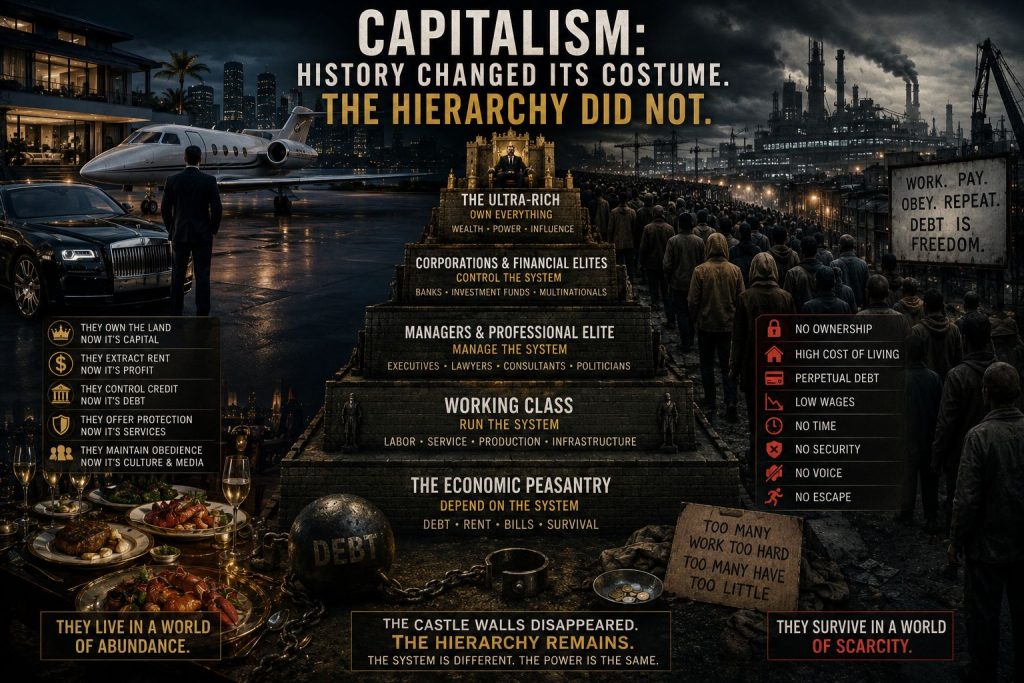
Modern capitalism did not simply abolish feudal logic. Instead, it transformed it.
Kings became financial elites. Noble houses became corporate dynasties. Land ownership became capital ownership. Peasant dependence became debt dependence.
The modern world possesses more comfort, technology, and opportunity than medieval society ever imagined. Yet simultaneously, power, ownership, and wealth increasingly concentrate upward again.
Thus, the contradiction becomes impossible to ignore.
Human civilization produces unparalleled wealth. However, large parts of the population remain economically dependent, psychologically insecure, indebted, and structurally subordinate to concentrated systems of ownership.
The castle walls disappeared.
The hierarchy did not.
Leave a Reply