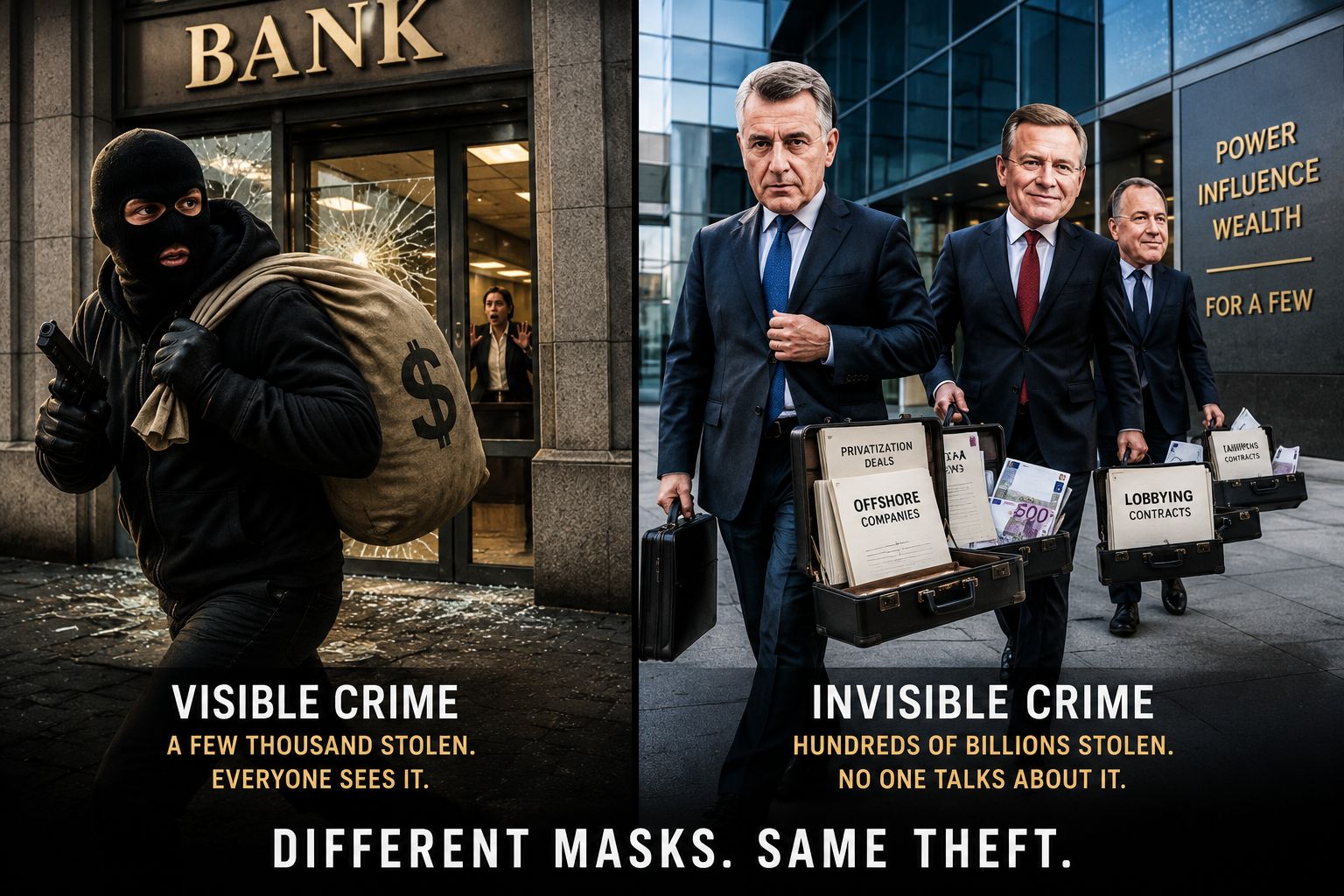
When masked robbers storm into a bank with weapons, the event dominates headlines for days. Television stations replay security footage, newspapers print dramatic photographs, and politicians promise tougher penalties. Victims often describe the experience as one of the most traumatic moments of their lives. Being threatened with violence, believing you may die, or watching someone point a gun at another human being leaves psychological scars that can last for years. There is no question that armed robbery is a cruel crime deserving severe punishment.
Recently, a group of bank robbers carried out an attack while wearing masks depicting Czech and Slovak politicians associated by critics with the post-communist privatization era. The symbolism was impossible to miss. By choosing those masks, the perpetrators appeared to draw a parallel between their own theft and what many people regard as one of the largest transfers of public wealth into private hands in Czech and Slovak history. Whatever one thinks of that comparison, it does not justify terrorizing innocent bank employees and customers. At the same time, the incident raises a broader question that society rarely asks: why do spectacular violent crimes receive far more public attention than financial crimes that often inflict far greater economic damage?
Physical danger
The answer is partly psychological. Humans evolved to react strongly to immediate physical danger. A masked robber pointing a firearm activates ancient survival mechanisms that evolved on the African savanna, where rapid responses to threats determined whether our ancestors lived or died. Financial crimes, by contrast, unfold slowly. They consist of contracts, accounting tricks, offshore companies, lobbying, tax engineering, monopolistic practices, or corruption hidden inside bureaucratic systems. There is no visible attacker, no screaming victims, and often no dramatic crime scene. As a result, our brains systematically underestimate their consequences.
This difference in perception creates a profound paradox. A single bank robbery may steal hundreds of thousands of euros while traumatizing a handful of victims. Large-scale financial crimes, by contrast, can transfer hundreds of millions or even billions from taxpayers, consumers, or shareholders to private interests. Their victims are rarely standing in the same room, which is precisely why the damage is so easy to overlook. Entire countries may lose resources that could otherwise fund healthcare, education, scientific research, infrastructure, or social security. Those responsible often wear expensive suits rather than masks, employ lawyers rather than firearms, and negotiate in conference rooms instead of threatening bank tellers.
Hundreds of billions lost
The Czech and Slovak privatization of the 1990s remains one of the most controversial examples. While privatization itself was neither inherently wrong nor unique to Central Europe, critics argue that weak regulation, political favoritism, opaque transactions, and corruption enabled enormous amounts of public wealth to be transferred into private hands at prices far below their actual value. Estimates of the losses vary widely depending on methodology, making precise figures impossible to establish, but there is broad agreement that the economic consequences amounted to many billions of Czech crowns. Regardless of the exact number, the long-term effects continue to influence public trust in political institutions.
The same principle extends far beyond post-communist countries. Around the world, white-collar crime imposes staggering costs on society. Fraud, corruption, insider trading, tax evasion, money laundering, procurement manipulation, accounting fraud, and other financial offenses collectively cost economies far more than conventional property crimes. International organizations estimate that corruption alone drains trillions of dollars from the global economy every year. These losses are rarely concentrated in one dramatic event. Instead, they accumulate gradually through thousands of seemingly ordinary decisions.
Oligopoly
Oligopolies provide another example. When only a handful of companies dominate a market, competition weakens. Prices often remain artificially high, innovation slows, and consumers ultimately pay more than they would in a genuinely competitive economy. Unlike robbery, there is no single identifiable victim. Millions of people each lose a relatively small amount, making the overall damage difficult to perceive despite its enormous cumulative scale.
Wealth concentration raises similar concerns. Every successful entrepreneur deserves to benefit from innovation, risk-taking, and hard work. However, when wealth increasingly accumulates through inherited assets, financial engineering, monopoly power, or political influence rather than productive activity, economic inequality can begin to undermine competition itself. Excessive concentration of economic power may also translate into disproportionate political influence, allowing wealthy individuals or corporations to shape legislation in ways that further reinforce their own position.
Tax avoidance
Tax havens illustrate another problem. Multinational corporations and wealthy individuals often exploit legal differences between jurisdictions to reduce their tax obligations dramatically. Much of this behaviour remains legal, which distinguishes it from tax evasion. Nevertheless, aggressive tax avoidance reduces public revenues and shifts a larger share of the tax burden onto businesses and citizens who lack access to complex international financial structures. Governments then face difficult choices: increase taxes elsewhere, reduce public spending, or accumulate debt.
The concept of surplus value, originally developed within Marxist economics, remains influential in debates about capitalism, even though economists disagree strongly about its explanatory power. Critics argue that workers often receive only a fraction of the value they create, while defenders of market economies respond that profits compensate entrepreneurs for investment, innovation, management, and risk. Regardless of where one stands in this debate, the broader question remains how economic systems should distribute the wealth they generate and how much inequality societies are willing to accept.
Corruption and clientelism
Corruption and clientelism further magnify these problems. Public contracts may be awarded to politically connected companies rather than the most efficient bidders. Hiring decisions may depend more on personal relationships than competence. Public money intended for infrastructure, education, or healthcare can instead enrich a relatively small network of insiders. Unlike armed robbery, these practices often continue for years before investigators uncover them, if they are uncovered at all.
Lobbying occupies a more complicated position because it is not inherently criminal. Businesses, trade unions, environmental organizations, charities, and professional associations all seek to influence legislation. In democratic societies, presenting arguments to elected representatives is entirely legitimate. Problems arise when lobbying lacks transparency, when financial resources allow certain interests disproportionate access to policymakers, or when political decisions primarily benefit powerful donors rather than the broader public. At that point, the line between democratic participation and undue influence becomes increasingly blurred.
None of this diminishes the suffering of bank robbery victims. Physical violence, threats, and psychological trauma deserve society’s full attention and condemnation. The point is not that white-collar crime is morally worse in every individual case. Rather, it is that society often reacts to crimes according to how dramatic they appear rather than according to the total harm they inflict.
Perhaps the most dangerous financial crimes are precisely those that never become front-page news. They occur quietly, spread across thousands of transactions, hidden behind legal documents and technical terminology. By the time their consequences become visible, billions may already have disappeared, markets may have become less competitive, institutions less trustworthy, and economic opportunities more unequally distributed.
A masked robber may steal one bank. Systemic financial crime can quietly rob an entire nation.
Leave a Reply