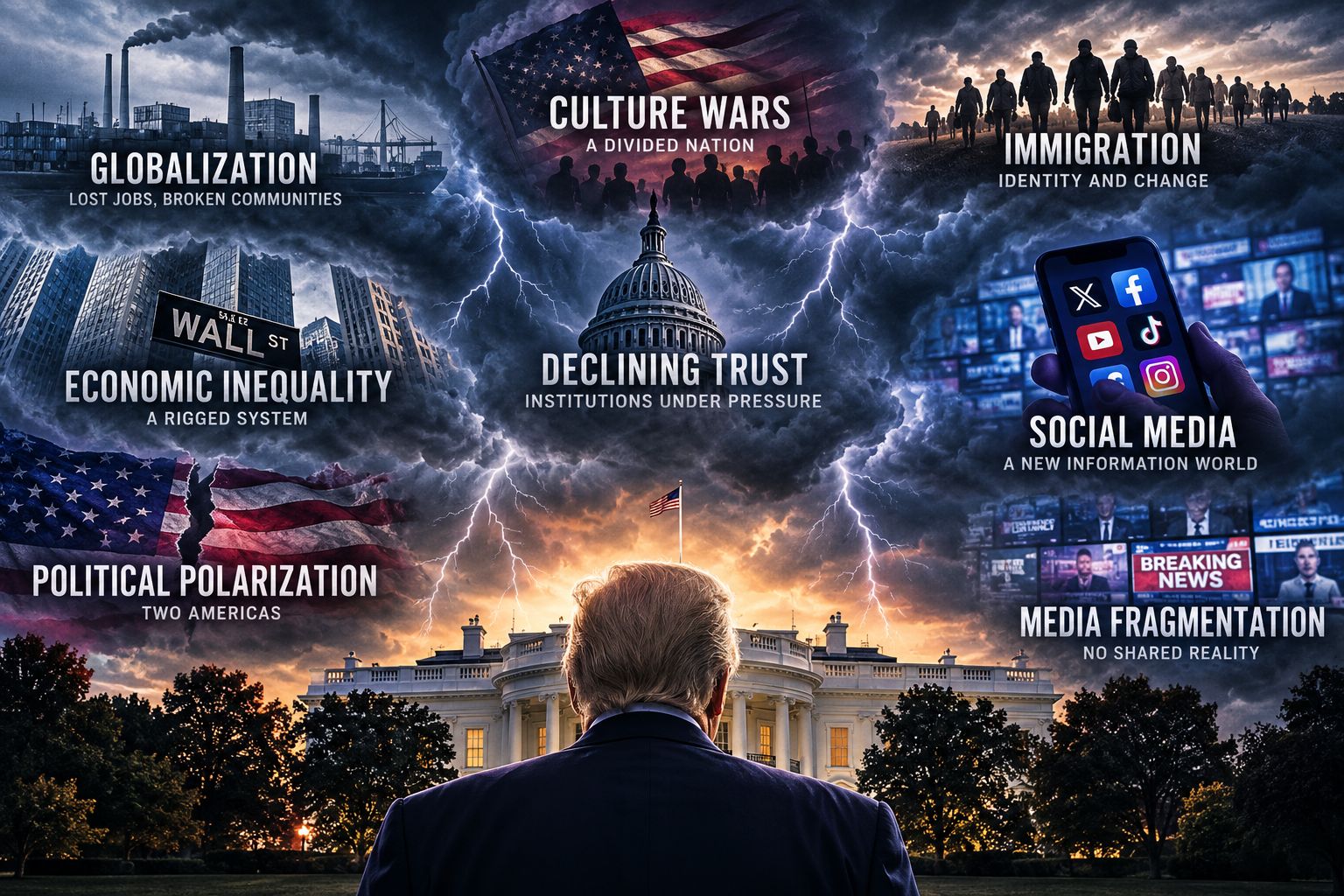
Donald Trump is one of the most polarizing political figures of the twenty-first century. To his supporters, he is the man who challenged a corrupt establishment, defended national interests, and gave a voice to ordinary Americans. To his critics, he represents populism, division, and an assault on democratic norms.
Both camps often make the same mistake.
They look for a single explanation.
Some argue that Trump is merely a puppet of billionaires. Others claim he is the product of Russian influence. Still others believe he is simply a symptom of globalization, immigration, or social media. None of these explanations is entirely wrong. Yet none is sufficient on its own.
History rarely works that way.
Major political movements almost never emerge because of one individual or one secret organization. They arise when several powerful forces converge. Economic change, cultural transformation, demographic shifts, technological innovation, and declining trust in institutions can reinforce one another until the political landscape changes dramatically. Leaders do not create these conditions from nothing. They exploit them.
Trump is no exception.
His rise cannot be understood without examining the profound changes that reshaped the United States during the last several decades. Globalization transformed the economy. Manufacturing employment declined in many regions. Immigration became increasingly politicized. Trust in Congress, the media, and other institutions fell to historically low levels. Meanwhile, social media fundamentally altered the way political messages spread.
None of these developments alone explains Trump’s success. Together, however, they created an environment in which his message resonated with millions of voters.
This also explains why similar political movements have appeared outside the United States.
Brexit in the United Kingdom, the growing strength of the Alternative for Germany (AfD), the National Rally in France, and several other European populist movements emerged under different political systems but against a remarkably similar backdrop. Although each country has its own history, many experienced the same broad trends: globalization, increasing political polarization, dissatisfaction with traditional parties, and declining confidence in established institutions.
That observation is important because it challenges one of the most common conspiracy theories surrounding Trump.
If virtually identical political movements emerge across dozens of democratic countries, the explanation is unlikely to be a single hidden group directing events from behind the scenes. Structural changes affecting many societies simultaneously provide a much stronger explanation than a universal conspiracy.
This does not mean that wealthy donors, lobbying organizations, intelligence agencies, corporations, or activist groups have no influence. They certainly do. Every modern democracy contains powerful interests attempting to shape public policy. However, influence should not be confused with complete control. Political leaders depend on public support, competing interest groups, institutional constraints, and unexpected historical events.
The more useful question, therefore, is not whether someone “created” Donald Trump.
It is why tens of millions of Americans found his message persuasive.
Understanding that distinction changes the discussion completely. Instead of searching for one mastermind, we should examine the broader historical forces that made Trump’s rise possible. Those forces began reshaping the United States long before he announced his presidential campaign in 2015, and many of them continue to influence politics today.
In the following sections, we will examine the most important of these forces, beginning with the one that many economists and political scientists regard as the foundation of the entire phenomenon: globalization.
Globalization: The force that transformed America
If one long-term trend deserves to stand at the center of Donald Trump’s political rise, it is globalization. Long before Trump descended the golden escalator in Trump Tower, the United States had begun experiencing an economic transformation unlike anything in its modern history. Millions of Americans benefited enormously from it. Millions of others concluded that the system no longer worked for them.
That divide became the foundation of modern American populism.
Globalization is often presented as a conspiracy orchestrated by multinational corporations or political elites. The reality is more complicated. It is better understood as a collection of interconnected processes: expanding international trade, cheaper transportation, technological progress, foreign investment, and the integration of national economies into a single global marketplace.
These developments produced extraordinary benefits.
Consumer goods became cheaper. International supply chains reduced production costs. Hundreds of millions of people escaped extreme poverty, particularly in East Asia. American companies gained access to enormous foreign markets. Investors enjoyed decades of strong returns. Entire industries, from electronics to pharmaceuticals, became more efficient than ever before.
From a global perspective, globalization was remarkably successful.
From a local perspective, however, the picture often looked very different.
For decades, manufacturing had provided stable, well-paid employment for millions of Americans without requiring a university education. Entire communities depended on automobile factories, steel mills, coal mines, textile plants, and heavy industry. These jobs supported families for generations and formed the backbone of many towns across the Midwest and the Rust Belt.
Then the landscape began to change.
Some factories relocated production to countries where wages were significantly lower. Others closed because they could no longer compete with imported goods. Still others remained in the United States but replaced thousands of workers with increasingly sophisticated machines.
Importantly, economists generally agree that automation eliminated more manufacturing jobs than international trade did. Industrial robots, computer-controlled machinery, and advanced logistics dramatically increased productivity while reducing the demand for labor. Nevertheless, workers rarely blamed automation.
They blamed globalization.
That reaction is understandable. Few people see the software that quietly replaces jobs inside a factory. They do, however, notice when a familiar plant closes and production moves overseas. A factory relocating to Mexico or China is far more visible than a gradual increase in automation over twenty years.
One event became particularly symbolic.
In 2001, China joined the World Trade Organization. Chinese exports expanded rapidly, and American manufacturers suddenly faced intense competition from producers with significantly lower labor costs. Economists later described this phenomenon as the “China shock.” Research suggests that regions most exposed to Chinese import competition experienced larger declines in manufacturing employment, lower wages, and greater economic disruption than other parts of the country.
Not everyone accepted these conclusions without reservation. Some economists argue that globalization’s overall benefits still outweighed its costs and that government policies failed to help workers adapt. Others emphasize that innovation and automation played a much greater role than imports. Yet almost everyone agrees that certain communities bore a disproportionate share of the disruption.
Those communities became fertile political ground.
Many residents concluded that neither major political party genuinely represented their interests. Democrats increasingly emphasized urban professionals, environmental issues, and social liberalism. Republicans continued to advocate free markets and free trade, positions that many business leaders welcomed but many industrial workers viewed with growing skepticism.
Into this political vacuum stepped Donald Trump.
Unlike many Republican leaders before him, Trump openly criticized free-trade agreements. He promised tariffs on imported goods, pledged to renegotiate international trade deals, and argued that American manufacturing had been sacrificed in the name of globalization. His slogan, “America First,” condensed these ideas into three simple words.
Whether his proposed solutions were economically sound remains highly contested among economists. Many argue that tariffs raise consumer prices, reduce competition, and ultimately hurt economic growth. Others contend that strategic protection of domestic industries has become necessary in an era of geopolitical rivalry, particularly with China.
The debate continues.
What matters politically, however, is not merely whether Trump’s diagnosis was correct. It is that millions of voters believed someone was finally acknowledging problems they felt had been ignored for decades.
Globalization, therefore, did not create Donald Trump by itself. It created something perhaps even more important: a large electorate convinced that the economic rules had been rewritten against them. Trump became the politician who promised to rewrite those rules once again.
Immigration, identity, and the culture wars
Economic change alone cannot explain Donald Trump’s rise.
If voters cared only about wages and employment, traditional economic policies would probably have been enough to restore political stability. Instead, another set of issues steadily moved to the center of American politics: immigration, national identity, and cultural values. By the mid-2010s, these debates had become just as important as taxes or trade.
Immigration was at the heart of this transformation.
The United States has always been a nation of immigrants. Throughout its history, millions of people arrived seeking economic opportunity, religious freedom, or political refuge. Immigration contributed enormously to American innovation, entrepreneurship, and population growth. Many of the country’s most successful companies were founded by immigrants or their children.
Yet immigration also generated political tensions.
Supporters generally argued that immigrants filled labor shortages, enriched American culture, and strengthened the economy over the long term. Critics acknowledged these contributions but worried about illegal immigration, pressure on public services, wage competition in certain industries, and the government’s ability to control its borders.
Donald Trump recognized that these concerns had become politically powerful.
His promise to build a wall along the Mexican border became one of the defining symbols of his 2016 campaign. Whether the wall itself would significantly reduce illegal immigration mattered less politically than what it represented. To many supporters, it symbolized national sovereignty, stronger border enforcement, and the belief that the government had lost control over immigration policy.
For many critics, however, it symbolized something very different.
They viewed Trump’s rhetoric as unnecessarily divisive and argued that it unfairly portrayed immigrants as criminals or threats. They pointed to a substantial body of research suggesting that immigrants, including undocumented immigrants, generally have lower crime rates than native-born Americans, while acknowledging that the available evidence is not unanimous and that nationwide data on undocumented immigrants remain limited. Others emphasized immigration’s positive contribution to economic growth and demographic renewal.
The debate became increasingly emotional because it was no longer solely about economics.
It became a debate about identity.
Questions that had once occupied universities or academic journals entered everyday political conversation. What does it mean to be American? Should immigration policy primarily serve economic needs or cultural continuity? How rapidly can a society absorb demographic change? Can national identity evolve without losing social cohesion?
These questions rarely produce simple answers.
At the same time, another conflict emerged that extended well beyond immigration. American politics became increasingly consumed by what are commonly called the culture wars.
Issues such as race, gender, LGBTQ+ rights, freedom of speech, historical monuments, diversity programs, school curricula, and policing became central political battlegrounds. Universities, corporations, entertainment companies, and media organizations increasingly adopted positions on these questions, making cultural disagreements visible in almost every aspect of public life.
Many progressives regarded these developments as overdue efforts to address historical discrimination and create a more inclusive society.
Many conservatives reached the opposite conclusion.
They argued that institutions were increasingly hostile to traditional values, religious beliefs, and open disagreement. Terms such as “cancel culture,” “political correctness,” and “woke ideology” entered mainstream political vocabulary. Whether these labels accurately described reality remains highly contested, but they reflected genuine perceptions among millions of voters.
Trump understood the political opportunity.
Rather than focusing exclusively on economic issues, he presented himself as a defender of ordinary Americans against what he described as cultural elites. He criticized universities, mainstream media, Hollywood, and large corporations, portraying them as institutions disconnected from everyday citizens.
This strategy expanded his coalition beyond voters directly affected by globalization.
Many supporters were financially comfortable. Some lived in prosperous suburbs or successful rural communities. Their support was driven less by economic hardship than by dissatisfaction with the country’s cultural direction. Political scientists have repeatedly found that cultural attitudes often predicted support for Trump as strongly as, or even more strongly than, personal economic circumstances.
This distinction is crucial.
If Trump’s movement were simply a revolt against poverty, it would probably have disappeared as economic conditions improved. Instead, many of its central themes—immigration, national identity, free speech, and cultural conflict—continued to dominate American politics even during periods of economic growth.
The same pattern appeared across much of Europe.
Parties such as the National Rally in France, the Alternative for Germany, Reform UK, and others increasingly emphasized immigration and national identity alongside economic concerns. Although each country’s political landscape differs, the underlying debates became remarkably similar.
Trump, therefore, was not merely responding to economic globalization.
He was also responding to cultural globalization—a period in which rapid social change convinced many citizens that the values, traditions, and institutions they had known for decades were changing faster than they could accept. Whether those fears reflected objective reality or subjective perception remains a matter of vigorous debate. Politically, however, the distinction is less important than the fact that millions of voters experienced them as real.
Economic inequality and the collapse of trust
Globalization and cultural conflict alone cannot explain Donald Trump’s rise.
Another long-term development had been quietly reshaping American politics for decades: millions of people were losing confidence in the institutions that traditionally held society together. Congress, the media, universities, corporations, financial institutions, and even parts of the scientific establishment gradually became less trusted than at almost any point in modern American history.
That loss of confidence fundamentally changed politics.
After the Second World War, Americans generally displayed relatively high levels of trust in public institutions. Citizens disagreed about policies, but many still believed that elected officials, journalists, and experts were broadly acting in the public interest. This confidence began to erode during the Vietnam War and the Watergate scandal. It continued through financial crises, political scandals, controversial wars, and increasing partisan conflict.
By the early twenty-first century, distrust had become one of the defining characteristics of American politics.
Congress consistently ranked among the least trusted public institutions. Confidence in newspapers and television networks declined sharply. Trust in large corporations suffered after repeated financial scandals and the 2008 financial crisis. Universities, once regarded primarily as centers of education and research, increasingly became political targets from both the left and the right.
Donald Trump did not create this distrust.
He inherited it.
He then transformed it into one of the central themes of his political movement.
His campaign repeatedly portrayed the “establishment” as a unified elite that no longer represented ordinary Americans. Politicians, journalists, academics, bureaucrats, and business leaders were often presented as members of the same disconnected class, protecting one another while ignoring the concerns of average citizens.
Many voters found this message convincing because it reflected their own experiences.
The 2008 financial crisis became a particularly important turning point. Millions of Americans lost jobs, homes, or savings. Yet many of the largest financial institutions survived with government assistance. To critics, this created the impression that ordinary citizens bore the costs of economic failure while powerful institutions received protection.
Whether this interpretation fully reflects the complexity of the crisis remains debated among economists. Governments argued that rescuing major banks prevented an even deeper economic collapse. Nevertheless, the political consequences were enormous. Many Americans concluded that the system operated according to different rules for ordinary people and powerful organizations.
Economic inequality reinforced these perceptions.
The United States remains one of the world’s wealthiest countries, yet wealth has become increasingly concentrated. High-income households accumulated assets at a much faster pace than much of the middle class, particularly as stock markets and real estate prices rose. Meanwhile, many families faced rising costs for housing, healthcare, childcare, and higher education.
Importantly, inequality itself was not always the primary concern.
Many people were more troubled by the perception that economic mobility had become increasingly difficult. The traditional American promise—that each generation could reasonably expect a better life than the previous one—appeared less certain than it had during much of the twentieth century.
This perception affected political attitudes regardless of actual income.
Political scientists have repeatedly found that support for populist movements cannot be explained simply by poverty. Many Trump voters belonged to the middle class or upper-middle class. What often united them was not absolute deprivation but dissatisfaction with the direction of society and declining confidence that existing institutions could solve major problems.
This distinction helps explain why conventional political promises became less persuasive.
For decades, candidates campaigned by proposing incremental reforms. They promised modest tax changes, healthcare adjustments, or education initiatives. Increasingly, however, many voters concluded that small reforms could not repair institutions they believed were fundamentally broken.
Trump offered a different message.
Rather than promising to improve existing institutions, he frequently questioned their legitimacy altogether. He criticized intelligence agencies, federal bureaucracies, major news organizations, international institutions, and even elements of the judicial system. His language was often confrontational, but it resonated with voters who had already lost confidence in those institutions long before he entered politics.
The media played an especially important role in this transformation.
For decades, a relatively small number of newspapers and television networks shaped national political debate. The rise of cable television, online news, podcasts, YouTube, and social media fragmented that environment. Americans increasingly consumed information from sources that reflected their existing beliefs, reinforcing political polarization and further weakening trust in traditional journalism.
The result was a profound change in political communication.
Expert opinion no longer carried the authority it once had. Official statements were increasingly met with skepticism. Alternative media expanded rapidly, while accusations of misinformation, bias, and censorship became common across the political spectrum.
Trump did not invent these trends.
He recognized them earlier than many of his political opponents.
Instead of relying primarily on traditional media, he communicated directly with millions of supporters through rallies, interviews, and social media. His confrontational style appealed to voters who viewed established institutions not as neutral arbiters but as participants in political conflict.
By the time Trump announced his candidacy in 2015, distrust had already become deeply embedded in American society. His success was not the beginning of that process. It was evidence of how far it had already progressed.
Here is a version that integrates Trump’s use of social media with the discussion of information overload and the comparison to Russian information tactics. It stays within what is supported by political communication research.
Donald Trump understood social media better than almost any major politician of his generation.
Before entering politics, candidates generally relied on television interviews, newspapers, carefully prepared speeches, and campaign advertisements to reach voters. Trump adopted a different strategy. Platforms such as Twitter, Facebook, and later other social media allowed him to bypass traditional gatekeepers and communicate directly with tens of millions of people within seconds.
This fundamentally changed political communication.
Instead of waiting for journalists to report his statements, Trump became his own news organization. A single tweet could dominate headlines for an entire day, forcing television networks and newspapers to react to his agenda rather than setting their own. Even his critics contributed to this cycle by repeatedly sharing and responding to his posts, further increasing their visibility.
His communication style also fit the logic of social media exceptionally well.
Platforms reward emotional, controversial, and highly engaging content. Calm policy discussions rarely spread as quickly as conflict, outrage, or surprise. Trump’s short, provocative messages generated enormous engagement, allowing him to dominate online conversations with remarkable efficiency.
Another important aspect of his communication strategy attracted considerable academic attention.
Many commentators compared elements of Trump’s messaging to information techniques long associated with Vladimir Putin’s Russia. The comparison does not imply that Trump copied Putin directly or coordinated his messaging with the Kremlin. Rather, critics argued that both frequently blurred the distinction between verified facts, opinion, exaggeration, and demonstrably false claims.
The objective was not necessarily to convince everyone that every statement was true.
Instead, critics argued, it was to create an information environment in which certainty itself became increasingly difficult. By making numerous controversial or contradictory claims, attacking established facts, and repeatedly accusing opponents of spreading “fake news,” public debate gradually shifted from determining what was true to deciding whom to trust.
Communication scholars have described a similar technique as the “firehose of falsehood.” Rather than consistently defending a limited number of arguments, political actors release a continuous stream of assertions, half-truths, exaggerations, and occasional accurate statements. Fact-checkers struggle to respond to the sheer volume of claims, while audiences become overwhelmed by conflicting information.
Trump often communicated in precisely this way.
Some of his statements proved accurate. Others were misleading, exaggerated, or false according to independent fact-checking organizations. Because truthful and inaccurate claims frequently appeared alongside one another, critics argued that many citizens eventually stopped attempting to distinguish between them. Instead, they judged information primarily according to whether it came from sources they already trusted politically.
Some analysts saw similarities with methods previously observed in Russian state media. Rather than persuading audiences to accept one official narrative, the goal can be to flood the public sphere with so many competing narratives that objective reality becomes increasingly difficult to establish. When every claim appears disputed, many people conclude that nobody truly knows what happened—or that everyone is lying.
Trump’s supporters strongly rejected this interpretation.
They argued that his attacks on mainstream media reflected genuine frustration with political bias rather than an attempt to undermine the concept of objective truth. In their view, social media allowed Trump to bypass journalists whom they believed routinely misrepresented conservative positions.
Regardless of which interpretation one accepts, there is little doubt that Trump’s use of social media transformed modern political campaigning. He demonstrated that a political leader could communicate directly with millions of supporters, dominate the daily news cycle, and shape national debate without relying primarily on traditional media. That model has since been adopted, to varying degrees, by politicians across the political spectrum and around the world.
The Republican Party’s transformation
Donald Trump did not simply change American politics.
He fundamentally changed the Republican Party.
For decades, the party had followed a relatively stable ideological direction. Beginning with Ronald Reagan in the 1980s, Republicans generally championed free markets, free trade, lower taxes, deregulation, strong national defense, and an active American role in world affairs. Although disagreements certainly existed within the party, these principles formed the backbone of Republican politics for more than thirty years.
Trump overturned many of them.
Perhaps the most dramatic change concerned trade.
Traditional Republican leaders viewed free trade as a source of economic growth. Agreements such as the North American Free Trade Agreement (NAFTA) reflected the belief that reducing trade barriers would benefit both the United States and the global economy. Trump rejected this consensus. He argued that previous administrations had negotiated poor trade agreements that encouraged companies to move production abroad while destroying American manufacturing.
Tariffs, once regarded by many Republicans as economically harmful, suddenly became central to the party’s economic agenda.
Foreign policy underwent an equally significant transformation.
Since the end of the Second World War, Republican presidents generally supported an expansive American international role. They defended NATO, maintained military alliances across the world, and often favored intervention when American strategic interests were involved.
Trump challenged this tradition.
His “America First” doctrine questioned whether the United States should continue bearing such a large share of the financial and military burden for its allies. He repeatedly argued that NATO members should spend more on their own defense and criticized countries that relied heavily on American military protection while contributing relatively little themselves.
These criticisms were controversial.
Supporters argued that Trump forced allies to take defense spending more seriously and corrected long-standing imbalances. Critics warned that his rhetoric weakened alliances that had helped maintain international stability for decades.
Immigration represented another sharp departure.
Previous Republican leaders generally attempted to balance stronger border security with support for legal immigration, particularly because many business sectors depended heavily on immigrant labor. Trump shifted the emphasis almost entirely toward border enforcement, illegal immigration, and national sovereignty. These issues became defining features of Republican political identity.
The party’s relationship with business also became more complicated.
Historically, large corporations and Republican politicians often shared common interests, particularly regarding taxation and regulation. Under Trump, however, major corporations increasingly found themselves criticized by Republican leaders, especially when companies adopted public positions on social or cultural issues.
This reflected a broader change.
The Republican Party gradually evolved from representing primarily business interests into a coalition that increasingly emphasized working-class voters without abandoning its traditional conservative base. White working-class voters, many of whom had previously supported Democrats or participated only sporadically in elections, became one of Trump’s strongest constituencies.
This political realignment surprised many observers.
For decades, political scientists had expected income to remain one of the strongest predictors of voting behavior. Instead, education, geography, and cultural attitudes increasingly became more important than economic class alone. Highly educated suburban voters shifted toward the Democratic Party, while many working-class voters moved toward Republicans.
The transformation extended beyond policy.
Trump also changed the party’s political style.
Traditional Republican politicians generally spoke in measured, carefully scripted language. Trump adopted an entirely different approach. His speeches were often spontaneous, confrontational, and highly personal. He regularly attacked opponents by name, criticized journalists directly, and ignored many of the unwritten conventions that had governed presidential politics for generations.
Supporters considered this authenticity.
Critics considered it recklessness.
Regardless of one’s opinion, there is little doubt that Trump’s communication style distinguished him sharply from previous Republican leaders.
The transformation also exposed deep divisions within the party itself.
Many prominent Republicans opposed Trump from the beginning. Some former cabinet members, military officials, governors, senators, and presidential candidates openly criticized his leadership. Others gradually embraced his political agenda after recognizing its popularity among Republican voters.
This internal struggle demonstrated an important reality.
Trump did not merely become the Republican nominee. He reshaped the party’s identity. Many positions that had once defined mainstream Republicanism—strong support for free trade, enthusiastic internationalism, and conventional political rhetoric—became significantly less influential than they had been only a decade earlier.
The consequences extend far beyond Donald Trump himself.
Even if he eventually leaves politics, many of the changes he introduced are likely to remain. Younger Republican politicians increasingly adopt elements of Trumpism while adapting them to new circumstances. The party has become more nationalist, more skeptical of globalization, more willing to challenge traditional institutions, and more focused on cultural issues than at any time since the Reagan era.
In that sense, Trump’s greatest political achievement was not merely winning the presidency.
It was permanently redefining what it means to be a Republican in twenty-first-century America.
Who really supported Donald Trump?
No politician reaches the White House alone.
Presidential campaigns require enormous financial resources, nationwide organizations, media exposure, legal expertise, volunteers, and millions of voters. Donald Trump was no exception. Yet his supporters formed an unusually diverse coalition, often bringing together groups that had previously shared little common ground.
This diversity explains why attempts to identify a single force “behind Trump” usually fail.
Some observers claim that billionaires created Trump. Others argue that evangelical Christians made him president. Still others point to conservative think tanks, wealthy donors, or influential media personalities. Each explanation contains part of the truth. None captures the entire picture.
Wealthy donors certainly played an important role.
American presidential campaigns are extraordinarily expensive. Super PACs (which are the richest interest groups in USA), political action committees, and private donors spend billions of dollars during election cycles. Trump received financial support from numerous wealthy individuals, business executives, and conservative political organizations.
This, however, is hardly unusual.
Virtually every successful presidential candidate relies just on major donors. Democratic candidates also receive substantial financial backing from wealthy individuals, labor unions, technology executives, and advocacy organizations. Money matters enormously in American politics, but it does not determine elections by itself.
Another influential pillar of Trump’s coalition was evangelical Christianity.
Many evangelical leaders viewed Trump as the candidate most likely to appoint conservative judges, oppose abortion, defend religious liberty, and protect their political influence. This alliance puzzled many observers because Trump’s personal life differed markedly from the image traditionally associated with evangelical morality.
For many evangelical voters, however, policy mattered more than personality.
They often described their choice as pragmatic rather than idealistic. They were not necessarily voting for a religious role model. They were voting for a president they believed would advance their political priorities.
Business interests also occupied an unusual position.
Some industries strongly supported Trump’s agenda. Fossil fuel companies welcomed efforts to reduce environmental regulation. Certain manufacturing firms favored tariffs designed to protect domestic production. Small business organizations often supported tax reductions and deregulation.
At the same time, many of America’s largest corporations became increasingly critical of Trump.
Technology companies, multinational corporations, Wall Street executives, and major business associations frequently disagreed with his positions on trade, immigration, or cultural issues. Contrary to popular belief, corporate America did not unite behind a single political agenda.
The same complexity appeared within the technology sector.
Many leading Silicon Valley executives openly opposed Trump. Others gradually moved closer to him, particularly as concerns about government regulation, censorship, artificial intelligence, and political polarization intensified. By the mid-2020s, parts of the technology industry had become far more politically divided than they had been a decade earlier.
Conservative media undoubtedly amplified Trump’s message.
Fox News became the most visible example, but it was only one component of a much broader ecosystem that included talk radio, podcasts, YouTube channels, independent news websites, and later social media influencers. These platforms allowed Trump’s supporters to communicate directly with millions of voters without relying on traditional newspapers or television networks.
Yet media influence flowed in both directions.
Trump benefited from conservative media, but conservative media also benefited from Trump. His ability to generate controversy attracted audiences, increased ratings, and dominated news cycles. Their relationship was mutually reinforcing rather than purely hierarchical.
Perhaps the most surprising element of Trump’s coalition was the working class.
For much of the twentieth century, industrial workers were more commonly associated with the Democratic Party. Under Trump, many shifted toward the Republicans. This realignment reflected dissatisfaction with globalization, immigration policy, and cultural change rather than a wholesale rejection of economic intervention.
This shift complicated traditional political categories.
Trump simultaneously advocated lower taxes, protectionist trade policies, stronger border controls, reduced regulation, and government efforts to revive domestic manufacturing. His coalition combined economic conservatives, religious conservatives, populists, nationalists, libertarians, and many politically independent voters.
Such an alliance inevitably contained contradictions.
Some supporters favored free markets, while others wanted greater protection for domestic industry. Some prioritized religious issues, whereas others cared primarily about immigration or trade. Still others simply opposed the political establishment and viewed Trump as the most effective vehicle for expressing their dissatisfaction.
These differences demonstrate why describing Trump’s supporters as a single ideological movement is misleading.
They were united less by complete agreement than by a shared belief that existing political institutions had failed to represent them.
This diversity also undermines one of the most persistent conspiracy theories surrounding Trump’s rise.
If Trump were merely the instrument of one hidden organization, it would be difficult to explain why his coalition included groups with fundamentally different, and sometimes conflicting, interests. Billionaires, factory workers, evangelical Christians, libertarians, protectionists, technology entrepreneurs, and independent voters rarely agree on every major issue.
The more plausible explanation is considerably less dramatic.
Donald Trump became the political focal point around which many different forms of dissatisfaction converged. His supporters did not all seek the same future. They simply agreed that they no longer trusted the direction in which the United States was heading.
The deep state: Reality, myth, and political rhetoric
Few expressions have become as controversial as “the deep state.”
For some people, it describes a hidden network that secretly governs the United States regardless of election results. For others, it is nothing more than a conspiracy theory designed to discredit public institutions. The reality lies somewhere between these two extremes.
To understand the debate, we must first define the term.
Originally, the expression “deep state” referred to countries such as Turkey, Egypt, or Pakistan, where unelected networks within the military, intelligence services, bureaucracy, or security apparatus were believed to exercise power independently of democratic governments. In those contexts, the term described organizations that sometimes influenced or even overthrew elected leaders.
The United States is different.
Its political institutions are stronger, more transparent, and subject to significantly greater public oversight. Nevertheless, every modern democracy contains permanent bureaucracies. Civil servants, intelligence agencies, regulators, military officials, prosecutors, and judges remain in office while presidents and governments come and go.
That fact alone does not constitute a deep state.
Modern governments simply could not function if every public employee changed after each election. Permanent institutions provide continuity, preserve expertise, and implement laws regardless of which political party wins power.
The controversy begins elsewhere.
Critics argue that parts of these bureaucracies sometimes pursue their own institutional interests. Intelligence agencies may resist reforms they consider dangerous. Regulatory bodies may oppose political decisions that reduce their authority. Departments can become attached to particular policies regardless of election outcomes.
Political scientists generally acknowledge that such bureaucratic resistance exists.
It is sometimes described as bureaucratic inertia rather than conspiracy. Large organizations naturally defend their budgets, influence, and established procedures. Similar behavior occurs in corporations, universities, and private companies. Employees rarely welcome reforms that threaten their positions.
This is very different from claiming that a secret organization controls the country.
Donald Trump frequently used the phrase “deep state” to describe officials whom he believed were attempting to undermine his administration. Supporters pointed to anonymous leaks, internal opposition within federal agencies, public criticism by former intelligence officials, and prolonged legal conflicts as evidence that powerful institutions resisted his agenda.
Critics offered another interpretation.
They argued that disagreements within government reflected normal democratic checks and balances rather than organized sabotage. Civil servants sometimes oppose political leaders because they believe proposed policies violate laws, threaten national security, or exceed constitutional authority.
Both interpretations contain elements of truth.
Government bureaucracies are neither perfectly neutral nor omnipotent. Individual officials possess political opinions, institutional loyalties, and personal ambitions. At the same time, there is no credible public evidence that a single coordinated organization secretly directs American politics regardless of election results.
The distinction is important.
Influence does not imply control.
Intelligence agencies undoubtedly influence national security policy. Large corporations influence economic legislation through lobbying. Labor unions influence labor policy. Environmental organizations influence climate policy. Religious groups influence debates on abortion and education. Universities shape public discourse. News organizations influence public opinion.
Democracy has always involved competition among powerful interests.
The question is whether these interests operate openly within the political process or secretly override democratic decisions.
Most available evidence supports the first explanation.
Lobbying, campaign donations, media influence, legal advocacy, and bureaucratic resistance all shape political outcomes. These mechanisms are well documented and publicly observable. They do not require a hidden conspiracy to explain how power operates.
This does not mean every conspiracy theory is automatically false.
History contains genuine conspiracies.
The Watergate scandal was real. COINTELPRO involved illegal FBI surveillance of political activists. The Iran-Contra affair secretly circumvented congressional restrictions. Intelligence agencies have conducted covert operations both inside and outside the United States.
These examples remind us that governments sometimes act secretly and illegally.
They do not, however, demonstrate the existence of a permanent organization that controls every administration from behind the scenes.
The popularity of the deep-state narrative may therefore reveal something more significant than the theory itself.
It reflects declining public trust.
When citizens lose confidence in political institutions, they naturally search for explanations that account for repeated disappointments. Hidden networks become psychologically appealing because they offer a simple answer to extraordinarily complex political systems.
Reality is usually less dramatic.
Power in modern democracies is rarely concentrated in a single secret organization. Instead, it is dispersed among governments, bureaucracies, corporations, media organizations, advocacy groups, donors, courts, universities, and voters themselves. These actors constantly cooperate, compete, negotiate, and conflict with one another.
Donald Trump’s rise did not expose a single hidden ruler of America.
It exposed how many Americans had come to believe that the political system no longer represented them. Whether one calls that bureaucracy, the establishment, the administrative state, or the deep state, the underlying political phenomenon is the same: a profound crisis of trust that continues to shape American democracy today.
Trump as a symptom, not the disease
It is tempting to explain history through individuals.
Napoleon transformed Europe. Hitler started the Second World War. Gorbachev ended the Cold War. Trump changed American politics. Such statements contain an element of truth, but they often exaggerate the importance of personalities while overlooking the historical forces that made those personalities influential in the first place.
Donald Trump did not emerge from a political vacuum.
Had he entered politics during the prosperous 1990s, when confidence in institutions was relatively high and globalization still enjoyed broad bipartisan support, he might never have become president. The same individual, with the same personality and the same communication style, could easily have remained a celebrity businessman rather than a political phenomenon.
Timing mattered.
By 2015, the United States had experienced decades of globalization, widening political polarization, declining institutional trust, repeated military interventions abroad, the financial crisis, growing cultural conflict, and the rapid expansion of social media. Millions of Americans no longer believed that traditional politicians understood their concerns.
Trump arrived at precisely the moment when many voters were searching for someone who challenged the existing political order.
That is why describing him simply as the cause of America’s divisions is misleading.
In many respects, he was their product.
The same conclusion emerges when we look beyond the United States.
Britain voted to leave the European Union. France witnessed the growing popularity of the National Rally. Germany experienced the rise of the Alternative for Germany. Italy saw the success of the Brothers of Italy. Similar populist movements gained strength in the Netherlands, Sweden, Austria, and elsewhere.
These parties differ in important ways.
Some are economically liberal, while others support greater state intervention. Some focus heavily on immigration, whereas others emphasize sovereignty or opposition to the European Union. Yet despite these differences, they emerged during the same historical period and responded to many of the same underlying forces.
That coincidence deserves attention.
If similar political movements appear across numerous democracies with different histories, cultures, electoral systems, and political traditions, the explanation is unlikely to be one charismatic leader or one secret organization. Broader structural changes provide a much more convincing account.
This does not mean these movements are inevitable.
Political decisions still matter. Governments can reduce inequality, improve education, strengthen democratic institutions, reform immigration systems, and restore public confidence. Likewise, poor governance can deepen existing frustrations and further increase political polarization.
History is not predetermined.
However, ignoring the conditions that produced Trump would make future political surprises more likely rather than less.
This lesson extends beyond the United States.
Many governments continue to assume that economic growth alone will resolve political dissatisfaction. Yet the evidence suggests otherwise. People care not only about income but also about identity, fairness, trust, security, and whether they believe public institutions treat them honestly.
Economic statistics cannot measure all of these concerns.
Nor can they fully explain political behavior.
Ultimately, the question “Who stands behind Donald Trump?” may itself be misleading.
There is no single banker, corporation, intelligence agency, or ideological movement that fully explains his rise. Wealthy donors contributed to his campaigns. Conservative media amplified his message. Evangelical Christians formed an important part of his coalition. Globalization reshaped the economy. Immigration transformed political debate. Social media revolutionized communication. Declining trust weakened traditional institutions.
Each factor contributed.
None was sufficient on its own.
Trump became the point where these long-term developments converged. His presidency was less the beginning of a new era than the culmination of changes that had been unfolding for decades.
Whether those forces continue to shape American politics after Trump leaves the political stage remains one of the defining questions of the twenty-first century. If the underlying causes remain unresolved, future leaders—whether on the political right, left, or somewhere in between—are likely to emerge from the same conditions that first brought Donald Trump to power.
Can Trumpism survive without Trump?
Donald Trump dominates American conservatism to such an extent that many observers assume his political movement will disappear when he eventually leaves public life. History suggests otherwise.
Political movements rarely vanish simply because their most famous leader retires.
Reaganism survived Ronald Reagan. Thatcherism outlived Margaret Thatcher. Peronism continues decades after Juan Perón. The same may prove true for Trumpism.
The reason is straightforward.
Trump did not invent the frustrations that fueled his rise. He gave them a political language. As long as those frustrations persist, politicians will continue appealing to the same electorate, even if they adopt a different tone or propose different policies.
Indeed, this process has already begun.
A younger generation of Republican politicians increasingly embraces many of Trump’s central ideas. They remain skeptical of globalization, support stricter immigration policies, question the role of international organizations, criticize cultural progressivism, and present themselves as opponents of the political establishment.
They often differ in style rather than substance.
Some communicate more cautiously. Others avoid Trump’s personal controversies while retaining much of his political agenda. This suggests that Trumpism is evolving from a movement centered on one individual into a broader ideological current within the Republican Party.
Democrats face a similar challenge.
Many opponents believed defeating Trump electorally would end the political phenomenon he represented. Yet elections alone cannot eliminate the social conditions that produced his popularity. If economic dissatisfaction, cultural polarization, declining institutional trust, and immigration controversies remain unresolved, new populist leaders are likely to emerge.
They may not resemble Donald Trump.
Some could be younger. Others may be more disciplined, more experienced, or less confrontational. They may come from different regions, possess different personalities, and adopt different rhetorical styles. Yet they could still appeal to many of the same voters by addressing the same underlying concerns.
This possibility extends beyond the United States.
Europe continues experiencing many of the same structural pressures. Slower economic growth, demographic change, immigration, technological disruption, and declining trust in traditional political parties have transformed politics across much of the continent. Similar conditions may continue producing populist movements, even if individual leaders change.
This is why reducing Trumpism to the personality of Donald Trump is a mistake.
Political leaders matter.
Historical conditions matter even more.
If the forces discussed throughout this article continue reshaping Western societies, Trump’s presidency may eventually be remembered less as an extraordinary exception than as one chapter in a much broader political realignment whose consequences are still unfolding.
Final thoughts
Donald Trump has inspired admiration, fear, loyalty, and hostility in equal measure. Few modern politicians have divided public opinion so profoundly. Yet focusing exclusively on Trump risks overlooking the much larger story.
Individuals rarely reshape history by themselves.
History creates opportunities for individuals.
Trump became president because millions of Americans believed that the political, economic, and cultural systems governing their country no longer reflected their interests. Globalization transformed local economies. Immigration and demographic change intensified debates over national identity. Economic inequality and the financial crisis weakened confidence in the promise of upward mobility. Trust in politicians, journalists, universities, and public institutions steadily declined. Social media fragmented public debate and allowed political outsiders to bypass traditional gatekeepers.
Together, these developments fundamentally altered the American political landscape.
This perspective also helps explain why similar movements emerged across much of the Western world. Britain experienced Brexit. France saw the continued rise of the National Rally. Germany witnessed the growth of the Alternative for Germany. Italy, the Netherlands, Sweden, and several other countries experienced their own versions of populist politics.
The leaders differed.
The slogans differed.
The political systems differed.
The underlying pressures were remarkably similar.
That observation should encourage caution when evaluating conspiracy theories.
Every democracy contains influential interest groups. Wealthy donors fund campaigns. Lobbyists attempt to shape legislation. Intelligence agencies possess significant influence in national security. Large corporations, labor unions, universities, religious organizations, advocacy groups, and media companies all compete to influence public opinion and public policy.
Ignoring these realities would be naïve.
At the same time, none of them adequately explains Trump’s rise on its own. Political change rarely results from one hidden organization pulling the strings. It usually emerges from the interaction of countless economic, cultural, institutional, and technological forces that gradually reshape society over decades.
The search for a single mastermind is therefore understandable but ultimately misleading.
Complex societies rarely produce simple explanations.
Perhaps the most important lesson is that elections do not eliminate the conditions that produced them. Defeating or replacing one politician does not automatically restore public trust, reduce polarization, or resolve long-term economic and cultural tensions. Unless those underlying problems are addressed, similar political movements are likely to emerge again, whether they are led by Donald Trump or by someone entirely different.
In that sense, the question is not merely who stood behind Donald Trump.
The more important question is why tens of millions of ordinary citizens believed that someone like Donald Trump was necessary in the first place.
Only by answering that question can we begin to understand not only Trump’s presidency but the profound political transformation that continues to reshape the United States and much of the Western world.
Leave a Reply